
 Worksheets
AP Environmental Unit 4 Review
Total questions: 95
Worksheet time: 1hrs 15mins
What are some soil conservation techniques that can be used to prevent soil erosion?
Using heavy machinery on the soil
Removing all vegetation from the area
Watering the soil excessively
Contour plowing, terracing, cover cropping, and planting windbreaks
What is El Nino and how does it impact global weather patterns?
El Nino is a type of dessert made with chocolate and vanilla, causing people to gain weight and impacting their health.
El Nino is a type of dance popular in South America, causing people to feel happier and impacting cultural events.
El Nino is a climate pattern that occurs in the Pacific Ocean, causing warmer water temperatures and impacting global weather patterns.
El Nino is a type of fish found in the Atlantic Ocean, causing colder water temperatures and impacting local weather patterns.
Describe the different layers of the atmosphere and their characteristics.
Hotosphere, Stratosphere, Mesosphere, Thermosphere, Exosphere
Troposphere, Stratosphere, Megalosphere, Thermosphere, Exosphere
Troposphere, Stratosphere, Mesosphere, Thermosphere, Exosphere
Troposphere, Stratosphere, Mesosphere, Thermosphere, Hypersphere
What are the factors that contribute to the formation of soil horizons?
Latitude, longitude, and altitude
Population, economy, and technology
Color, texture, and smell
Climate, organisms, relief, parent material, and time
Discuss the effects of El Nino on marine life and ecosystems.
El Nino can lead to changes in water temperature, nutrient availability, and food sources for marine organisms.
El Nino only affects land animals and has no impact on marine life
El Nino causes an increase in water temperature, nutrient availability, and food sources for marine organisms
El Nino has no effect on marine life and ecosystems
Explain the role of troposphere in regulating Earth's climate.
It is responsible for creating the ozone layer
It traps heat from the sun and maintains the planet's temperature.
It has no impact on Earth's climate
It causes extreme weather events
How does the stratosphere protect life on Earth from the sun's harmful UV radiation?
By reflecting the sun's harmful UV radiation back into space
By releasing a protective gas that neutralizes the sun's harmful UV radiation
By creating a barrier that physically blocks the sun's harmful UV radiation
By containing a layer of ozone that absorbs and blocks the sun's harmful UV radiation.
The land mass where all of the continents were once together in one large continent is called ________________.
Laurasia.
Pangaea.
Eurasia.
Gondwana.
Tectonic plates consist of
continental crust.
mesosphere.
both continental and oceanic crust.
oceanic crust.
The fact that similar fossils are found on both sides of the ocean is evidence of
magnetic reversal.
global positioning.
continental drift.
oceanic drift.
The movement of the tectonic plates is caused by
the rotation of the Earth.
convection currents in the Asthenosphere
the gravity of the iron-nickel core.
the Moho discontinuity.
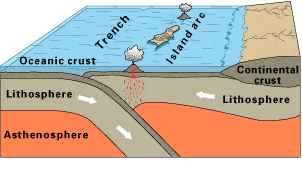
Observe this diagram of a plate boundary. One statement BEST describes what is happening. It is that
the oceanic crust is melting.
the denser ceanic crust is subducting under the less dense oceanic crust
volcanic islands are forming.
the tectonic plates are moving away from each other.

Most geologists think that the movement of Earth’s plates is caused by _______
convection.
continental drift.
subduction.
conduction.
How fast the continents move?
3-4 inches per day
3-4 inches per week
3-4 inches per month
3-4 inches per year
What is common at convergent boundaries?
Valleys
Canyons
Mountains
Rivers
The wearing away or a change in the appearance or texture of something by long exposure.
Environmental Factors
Weathering
Organic Matter
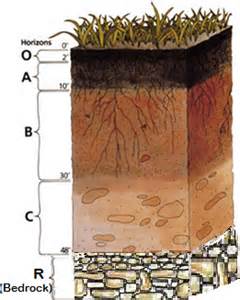
Soil Horizon
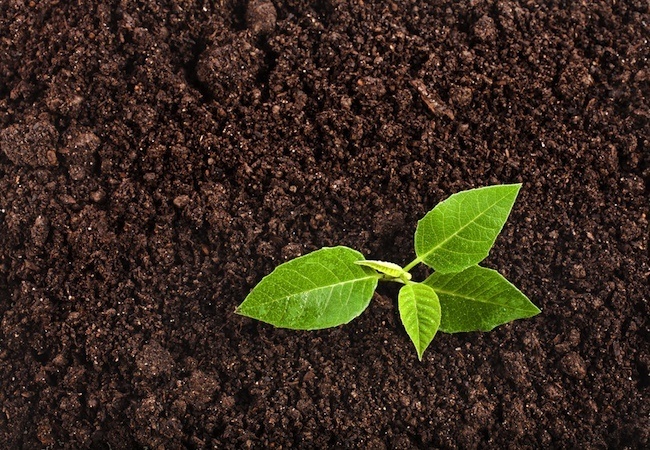


Made of small fine soil particles & other organic matter. Plant roots, fungi, & earthworms live in the horizon. It is typically 2-10ft deep.
A Horizon
C Horizon
Bedrock
O horizon
B Horizon
Made of humus, clay, & minerals (iron/aluminum). Nothing grows here, typically red/brown color, & 10-30ft deep.
A Horizon
C Horizon
Bedrock
O horizon
B Horizon
Made of broken up rocks & parent material. Nothing lives in & it is typically 30-48ft deep.
A Horizon
C Horizon
Bedrock
O horizon
B Horizon
Made of solid rock & nothing lives in the layer
A Horizon
C Horizon
Bedrock
O horizon
B Horizon
The air we breathe is made mostly of:
argon
carbon dioxide
nitrogen
oxygen
How does the ozone layer benefit living things on the Earth.
We need it to breathe.
It keeps the Earth cool.
It is a source of rain.
It protects the Earth from ultraviolet rays.
Which layer of the Earth's atmosphere does most weather occur?
mesosphere
stratosphere
thermosphere
troposphere
What is the molecular formula for ozone?
O
O2
O3
Oz
One of the major ways oceans contribute to weather systems is that the oceans -
provide a diverse habitat for many organisms
store and transport the Sun's heat energy.
experience changes in amounts of dissolved salt.
reach depths that can be as much as 12,000 meters.

Which best describes this image
Convection Current
Conduction Current
Solar Cycle
Lunar Cycle

Cold air is denser than warm air, so it sinks. What kind of pressure area does this create?
Dense pressure
High pressure
Low pressure
No pressure

What is wind?
Large scale movement of air caused by differences in air pressure and temperature
Large scale movement of CO2 caused by differences in air pressure
Large scale movement of air caused by differences in temperature
Large scale movement of temperature caused by differences in air pressure


A geographical ridge, like a hill or mountain, that separates one watershed land area from another.
divide
tributary
river
aquifer
An area of land where the surface water and groundwater drain into a particular body of water
Watershed
Drainage Divide
Erosion
Aquifer

What season is happening in the Southern Hemisphere?
Summer
Fall
Winter
Spring

What season is happening in the Northern Hemisphere?
Summer
Fall
Winter
Spring
During a(n) ____ event, trade winds are much stronger than usual.
El Nino
La Nina
Normal
Partly sunny
Both El Nino and La Nina have this in common
Influence birds that migrate over the ocean
Influence rainy / dry weather world wide
The weather at the polar regions
The directions that ships travel in the oceans
During an El Nino, trade winds are typically...
about average
stronger
weaker

The image is of a(n):
El Nino event
La Nina event
Non-El Nino (normal conditions)

The picture below is of a(n) ____ event.
Non-El Nino (Normal)
El Nino
La Nina
La Niña is characterized by ______________ of the Western Pacific Ocean.
a warming
a cooling
average temperatures
Why do the fisherman of Peru and South America not welcome a strong El Nino?
El Nino poisons the fish
El Nino causes strong winds and currents which move fish westward
El Nino bring cold water to the surface which kills the base of the food chain
El Nino shuts off upwelling and nutrients needed for the marine food chain do not rise to the surface

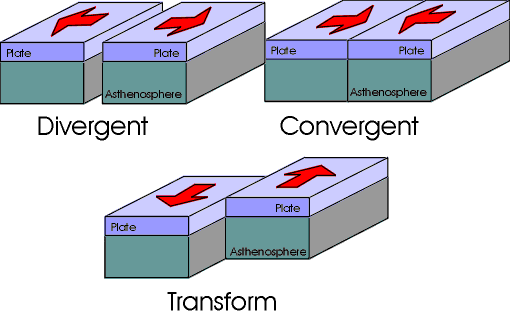
What type of plate boundary is shown here?
Convergent
Subduction
Divergent
Transform

What type of plate boundary is shown here?
Convergent
Subduction
Divergent
Transform
What type of plate boundary is most likely to cause earthquakes?
Convergent
Subduction
Divergent
Transform
What is the ozone layer?
A layer of pollution
A layer of still air with no wind
A zone that absorbs UV radiation from the sun
A zone that absorbs air pollution
Which wind system is closest to the equator?
Doldrums
Westerlies
Polar easterlies
Trade winds
As altitude increases, what happens to temperature?
Temperature increases
Temperature decreases
Temperature does not change with altitude
Which gas is there the most of in the atmosphere?
Oxygen
Nitrogen
Water vapor
Carbon dioxide
Which of the following items has the highest albedo?
Asphalt
Grass
Rooftops
Snow
Why does the Earth have seasons?
Tilt of the Earth on its axis
Earth's shape
Earth's rotation around the Sun
Earth's rotation on its own axis

Which month has the highest precipitation?
July
August
September
June
Which of the following is the largest carbon sink?
Atmosphere
Plants
Animals
Ocean
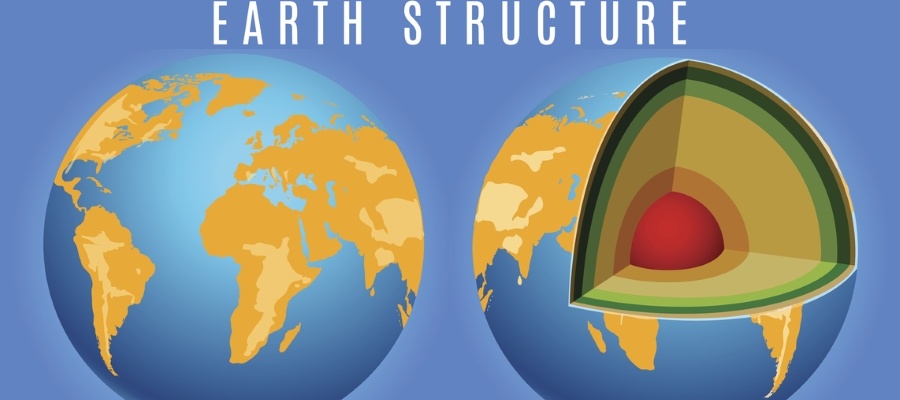
The surface of the earth, otherwise known as the ______, is broken into seven major pieces and sits atop a liquid layer called the _______
lithosphere, asthenosphere
astenosphere, mantle
crust, litosphere
asthenosphere, lithosphere

I. variation in the angle of sunlight that reaches Earth
II. variation in the amount of surface area over which the Sun's rays are distributed
III. variation in the amount of sunlight reflected from clouds


A divergent boundary occurs when plates ....
Pull apart
Come together
Slide past each other
subducting
Mountains are created when....
Two continental plates collide
Two oceanic plates pull apart
An Oceanic plate subducts under a Continental Plate
Two continental plates pull apart


The rate at which water flows through the soil is called soil percolation or ______.
Groundwater
Permeability
Soil Pores
Porosity


In which layer of the atmosphere do all the pressure, wind, and precipitation changes occur?
Outer space
stratosphere
troposphere
mesosphere
Sand
Gritty & Large
Silt
Silky & Medium
Clay
Sticky & Small
How can compatcion impact the growing enviroment of plants?
Reduce Porosity & Bulk Density
Makes water movement and plant growth easy
Makes water movement and plant growth hard
Increase Porosity & Bulk Density.
True or False: Soil traits, like water holding capacity and aeration, are affected by particle size.
True
False
True or False: Pore size and number depends on particle size.
True
False
Which type of soil would water move through more quickly?
Soil made of only large particles
Soil made of only small particles
Soil made of only medium size particles
Soil made of a mix of small and large particles

The mineral portion of a soil is composed of 30% clay, 30% silt, and 40% sand. What type of soil is this?
loam
sandy clay loam
silty clay loam
clay loam
The most biologically active region in the soil is the
B horizon
Bedrock
A horizon
C horizon
Which of the following has the soil components in order from SMALLEST to LARGEST
Sand, Silt, Clay
Clay, Sand, Silt
Silt, Clay Sand
Clay, Silt, Sand
Which option best explains organic matter's purpose in soil?
Available for plant uptake
provides nutrients via decomposition
allows gases, water, and organisms to travel through soil
Provides texture
Which of the following is NOT a reason soil is important?
Provide physical support to plants
Holds little to no water to prevent flooding
Holds water like a sponge and releases it as needed
Water is filtered

This statue was probably destroyed by _____.

True or false: chemical weathering causes rocks to change into new types of rocks.


