
 Worksheets
Unit 6 - Waves
Total questions: 109
Worksheet time: 2hrs 50mins


Which of the following has the longest wavelength?
microwaves
UV rays
Infrared
Gamma rays

Which of the following has the most energy?
Red
Blue
Green
Yellow

Which of the following has the most energy?
X-rays
The color green
Microwaves
Infrared

Which of the following has the least amount of energy?
UV rays
The color yellow
Radio waves
Gamma rays

Which of the following has the most energy?
TV
Microwaves
Radiowaves
Infrared

Which of the following has the lowest energy?
The color yellow
The color blue
The color indigo
The color orange

Which of the following has the highest frequency?
The color blue
The color orange
The color yellow
The color violet
How much of the electromagnetic spectrum is visible to the human eye?
All of it
None of it
Most of it
Only a small part

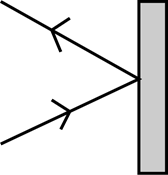
In the illustration, the light ray striking the object is-


The more energy a wave has, the greater its ____
speed
amplitude
wavelength

If waves overlap and are out of phase, how will that affect the resultant wave?
Decrease the amplitude
Increase the amplitude
Decrease the frequency
Increase the frequency
If waves overlap and are in phase, how will that affect the resultant wave?
Decrease the amplitude
Increase the amplitude
Decrease the frequency
Increase the frequency

What type of wave is pictured?
Transverse wave
Longitudinal wave
Wave, what wave?
Slinky wave

All waves carry ______________.
Sound
Light
Water
Energy

What type of waves are these?
Transverse waves
Longitudinal waves

This is an example of ______________________.
Transverse waves
Longitudinal waves

The wavelength can be measured from ( check all that apply)
crest to crest
crest to trough
trough to crest
trough to trough

The analysis of the way matter emits and absorbs radiation is called ___.
astronomy
chemistry
spectroscopy
atomic theory

Spectroscopy can also be used to study
galaxies.
the surface of Mercury.
stellar composition.
UFO's.

A spectroscope may be connected to a ___ to record an object's spectra.
telescope
CCD (charged coupled device)
spectrometer
spectrograph

Spectral lines that are observed to be narrower & blue-shifted indicates that an object is
moving away from Earth.
showing transverse motion.
moving towards Earth.
showing radial motion.

If an object like a star is moving away from Earth, the spectral lines are observed to be
smaller or thinner & red-shifted.
smaller or thinner & blue-shifted.
wider or broader & blue-shifted.
wider or broader & red-shifted.


A wave is a disturbance that transfers ___________ from one place to another.
water
air
energy
matter

What kind of waves vibrate our eardrums?
Sound Waves
Light Waves
Water Waves
Radio Waves

What type(s) of waves require a medium like air or water to travel through?
Mechanical
Electromagnetic
both Mechanical and Electromagnetic Waves
neither Mechanical or Electromagnetic Waves

What kinds of waves can travel through a vacuum?
Mechanical Waves
Electromagnetic Waves
both Mechanical and Electromagnetic Waves
neither Mechanical or Electromagnetic Waves

What types of waves transfer energy?
Mechanical Waves
Electromagnetic Waves
both Mechanical and Electromagnetic Waves
neither Mechanical or Electromagnetic Waves

In which of the following waves does the disturbance move in the same direction as the wave?
Transverse Waves
Longitudinal Waves
both Transverse and Longitudinal Waves
neither Transverse nor Longitudinal Waves

In which of these waves does the disturbance travel perpendicular to the wave?
Transverse Waves
Longitudinal Waves
both Transverse and Longitudinal Waves
neither Transverse nor Longitudinal Waves

What do we call the distance between two adjacent crests of a transverse wave?
Amplitude
Wavelength
Frequency
Period

What do we call the highest point of a transverse wave?
Amplitude
Period
Crest
Trough

Which color comes between yellow and blue in the spectrum of visible light?
red
orange
green
violet
Waves transfer _______.
particles
matter
energy
_____ waves have vibrations that run parallel to the direction the wave travels, and _____ waves have vibrations that run perpendicular to the direction the wave travels.
transverse, longitudinal
longitudinal, transverse
Examples of this type of waves include water waves, waves on a string/jump rope, and light waves.
transverse
longitudinal
_______ is the distance between waves, measured from one crest to the next crest.
Wavelength
Frequency
Amplitude
The _______ is the highest point on a transverse wave, and the ____ is the lowest point.
Trough, Crest
Crest, Trough
Compression, Rarefaction
Rarefaction, Compression
The _______ is the size or height of a wave, measured from the equilibrium to the crest or trough.
Amplitude
Wavelength
Frequency

The _______ of a wave is how many waves pass a given point every second.
Frequency
Wavelength
Amplitude
Frequency is measured in _______.
Hertz (Hz)
Meters per second
Meters
Newtons
Frequency is how many waves pass a point in 1 second. If 100 waves pass a given point in 4 seconds, what is the wave's frequency?
25 Hz
100 Hz
4 Hz
400 Hz

In a longitudinal wave, a ____ is an area where the particles are spread apart and a ____ is an area where the particles are close together.
crest, trough
compression, rarefaction
rarefaction, compression
trough, crest

Examples of ________ waves include visible light, xrays, ultraviolet, and radio waves.
transverse
longitudinal
Waves that can travel through empty space are called _____ waves. Waves that require a medium to travel, such as air or water, are called _____ waves.
mechanical, electromagnetic
electromagnetic, mechanical
crest, trough
compressional, rarefactional

In the diagram of a compressional wave, A is showing a ___ while B is showing a ___.
compression, rarefaction
trough, crest
rarefaction, compression
crest, trough

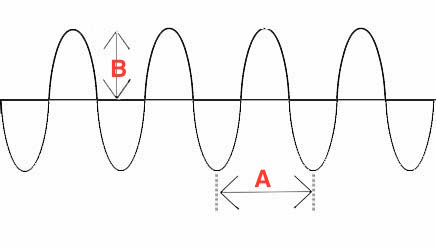
In this diagram of a transverse wave, A is showing the wave's _____ and B is showing the wave's _____.
amplitude, trough
amplitude, crest
wavelength, trough
wavelength, crest

In this diagram of a transverse wave, C is showing the wave's _____ and D is showing the wave's _____.
crest, amplitude
trough, amplitude
crest, wavelength
trough, wavelength
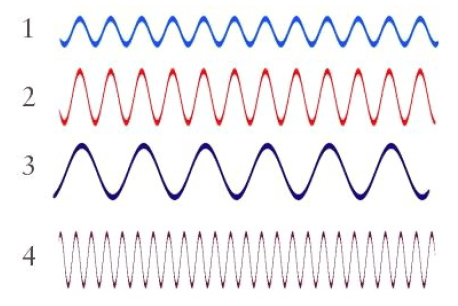
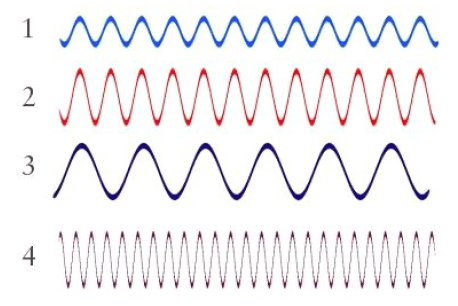

High pitched waves would have wavelengths that are...
at a rarefaction
far apart
close together
at the trough
ex. police car siren sounding lower pitch after the car passes
A repeating disturbance or movement that transfers energy through matter or space.
trough
wave
medium
refraction
The matter the waves travel through
frequency
photon
medium
trough
Matter in the medium moves back and forth at right angles to the direction that the wave travels.
compressional wave
doppler effect
transverse wave
sound waves
Matter in the medium moves back and forth along the same direction that the wave travels.
compressional wave
transverse wave
wavelength
light waves
The high point of a wave is called_________________?
intensity
amplitude
trough
crest
The low point of a wave is called ______________________?
trough
crest
frequency
amplitude
The distance between one point on a wave and the nearest point just like it.
frequency
amplitude
wavelength
rarefaction
The number of waves that pass a given point per second.
doppler effect
sonar
wavelength
frequency
The height of a wave and is related to the amount of energy carried by a wave.
amplitude
wavelength
frequency
period
This less-dense region of a compressional wave
refraction
rarefaction
wavelength
electromagnetic wave
The bending of a wave caused by a change in its speed as it moves from one medium to another.
rarefaction
acoustics
transparent
refraction
When an object causes a wave to change direction and bend around it.
diffraction
rarefaction
refraction
doppler effect
Made by vibrating electric charges and can travel through
space where matter is not present.
sound waves
electromagnetic waves
ocean waves
hair waves
The wavelength of light that can be detected by the human eye.
visible light
x-rays
gamma rays
microwaves
Electromagnetic waves that behave as a particle.
visible light
photon
cathode-ray tube
inferred light

