wayground logo

Free Printable Worksheets

Font size

S
M
L
XL
Worksheets

IPC Fall Final Exam Review

Total questions: 104

Worksheet time: 2hrs 35mins

Name
Class
Date
1.

Mist, fog and steam are ______________________?

a)

liquid phases of water

b)

gaseous phases of water

c)

solid phase of water

2.

Rain and tap water are _______________________?

a)

where most of the mass of an atom can be found

b)

liquid phases of water

c)

the amount of space an object occupies (takes up)

3.

Protons and neutrons are in the nucleus. What else is true about the nucleus?

a)

The electrons are also in the nucleus.

b)

Only carbon atoms have a nucleus.

c)

It is not very important.

d)

The nucleus is where most of the mass (weight) of an atom can be found.

4.

Density is what?

a)

The amount of space an object occupies. (how large something is)

b)

The mass of something per unit of volume (how crowded the atoms are)

c)

Where the most of the mass of an atom can be found.

5.

Volume is what?

a)

Where the most of the mass of an atom can be found?

b)

The mass of something per unit of volume (how crowded the atoms are)

c)

the amount of space an object occupies.

6.

People do not have matter and energy.

a)

True

b)

False

7.

A glass of water is an example of the liquid phase of water.

a)

True

b)

False

8.

The center of the atom is the electron orbit.

a)

True

b)

False

9.

Plasmas are one phase of matter.

a)

True

b)

False

10.

Electrons have a negative charge.

a)

True

b)

False

11.

A _______________ is made up of elements that are combined the same way every time.

a)

BEC's

b)

atoms

c)

compounds

d)

mixtures

e)

even

12.

Homogeneous mixtures have an __________ makeup.

a)

BEC's

b)

atoms

c)

compounds

d)

mixtures

e)

even

13.

_______________ are either homogeneous or heterogeneous.

a)

BEC's

b)

atoms

c)

compounds

d)

mixtures

e)

even

14.

Protons have a neutral (no) charge.

a)

True

b)

False

15.

Neutrons have a neutral (no) charge.

a)

True

b)

False

16.

Protons have a negative charge.

a)

True

b)

False

17.

There are four (4) states of matter.

a)

Gas

b)

Liquid

c)

Solid

d)

Plasma

18.
Particles in an atom that are neutral and have no charge are 
a)
negatrons 
b)
electrons 
c)
neutrons 
d)
protons 
19.
all matter is made of what 
a)
energy 
b)
atoms 
c)
electrons 
d)
compounds 
20.
If an atom has 3 electrons, how many protons does it have?
a)
1
b)
2
c)
4
d)
3
21.
If the number of protons equal the number of _____, the atom will have no charge
a)
protons
b)
neutrons
c)
electrons
d)
nucleus
22.
The subatomic particle with a negative charge is the
a)
electron
b)
proton
c)
neutron
d)
nucleus 
23.
What is the atomic number?
a)
the number of protons
b)
the number of protons and neutrons
c)
the number of neutrons
d)
the number of protons and electrons
24.
What is the mass number?
a)
the number of protons
b)
the number of protons and neutrons
c)
the number of neutrons
d)
the number of protons and electrons
25.
An atom with an unequal number of protons and electrons is said to have (a) ___.
a)
no charge
b)
balance
c)
charge
d)
unbalance
26.
Ions are: 
a)
atoms with a positive or negative charge
b)
atoms with no charge
c)
atoms with ONLY a positive charge
d)
atoms with ONLY a negative charge
27.
How many neutrons does the isotope of lithium have?
a)
8
b)
3
c)
4
d)
5
28.
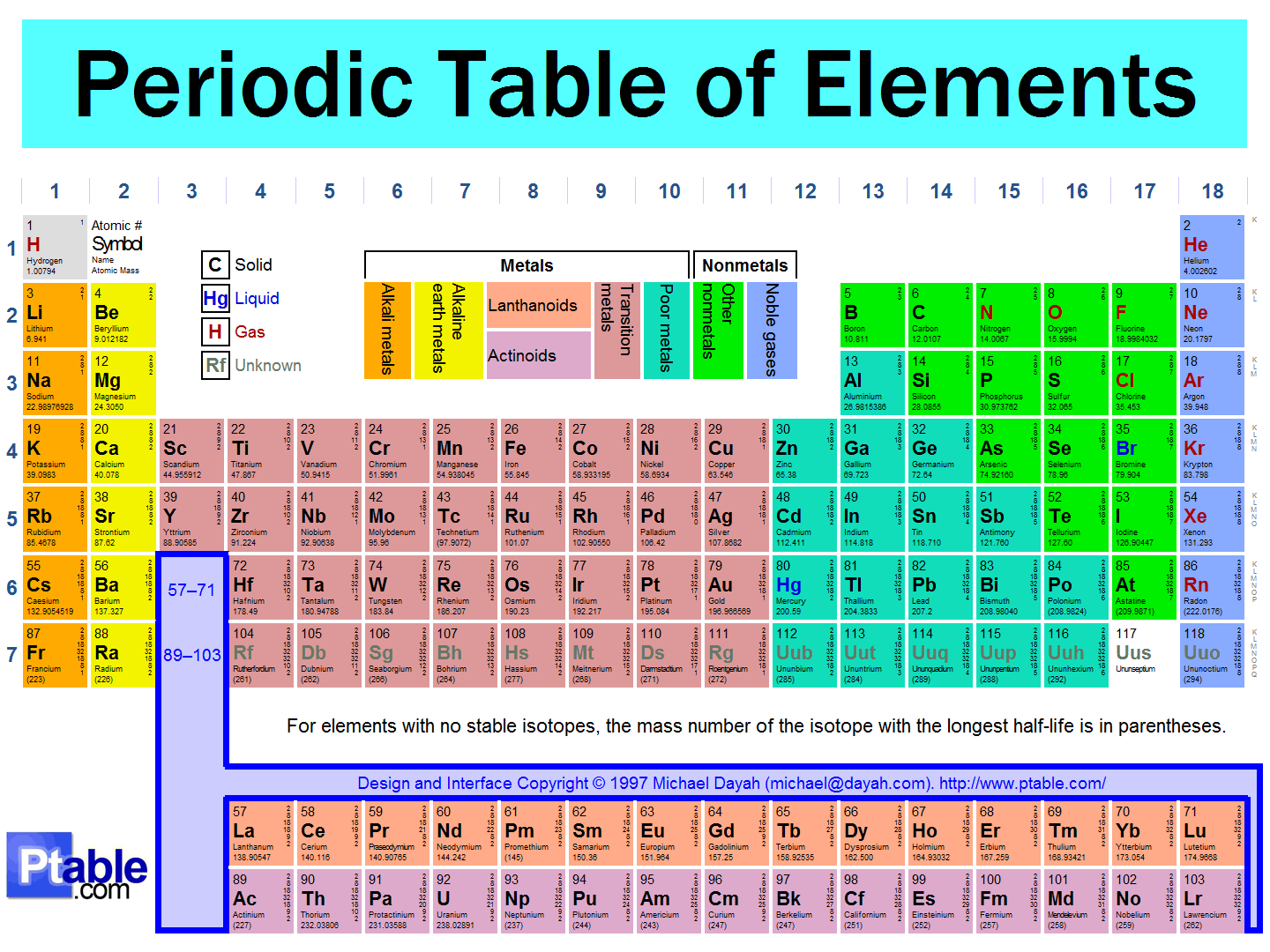
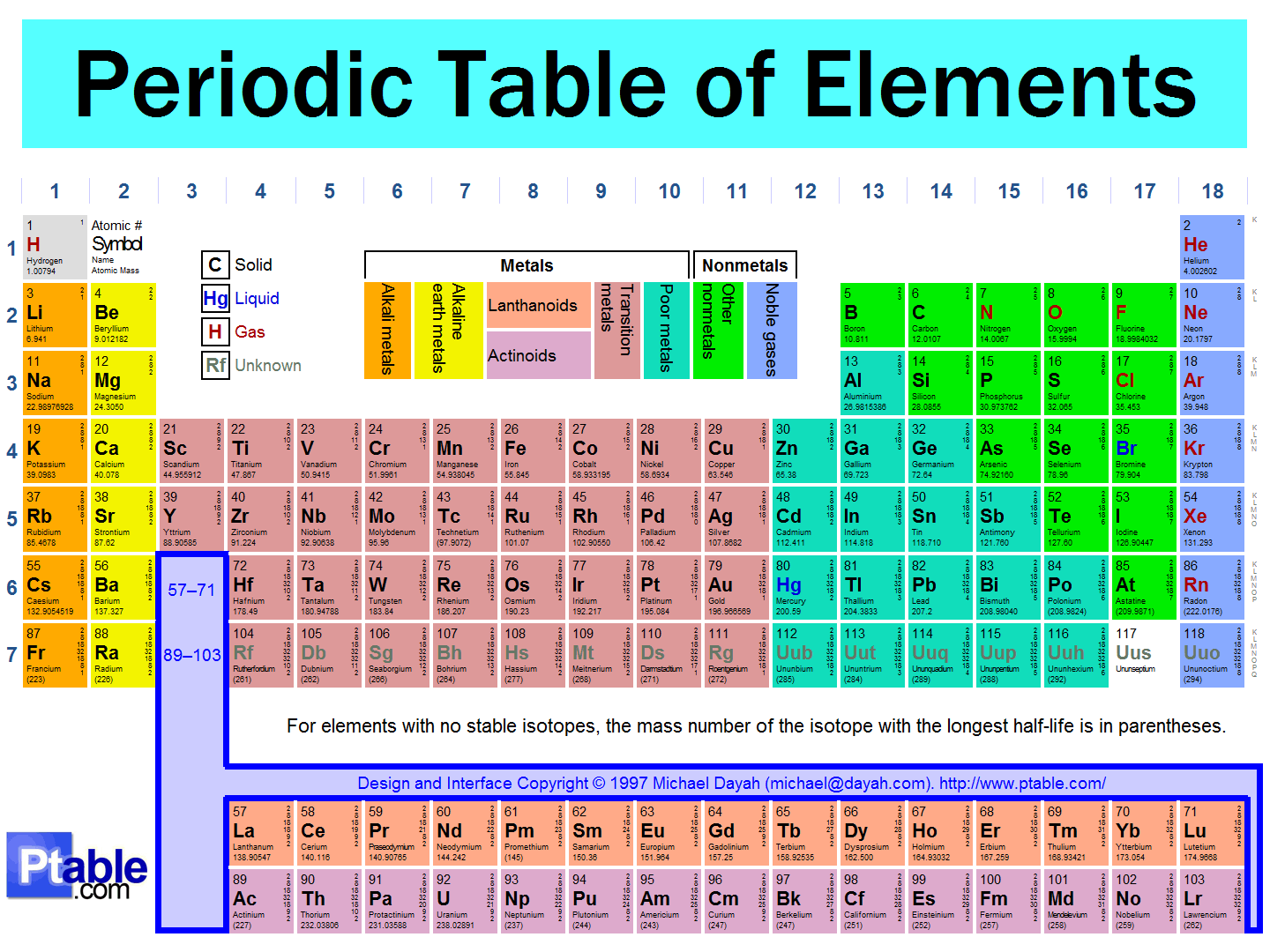
How many protons does this isotope of titanium have?
a)
48
b)
22
c)
26
d)
70
29.

____ is the use of evidence to construct testable explanations and predictions of natural phenomena, as well as, the knowledge generated through this process.

a)

Hypothesis

b)

Model

c)

Theory

d)

Science

30.

____ is the amount of matter in an object.

a)

Weight

b)

Mass

c)

Qualitative data

d)

Quantitative data

31.

Which term describes the systematic approach used in scientific study.

a)

Scientific inquiry

b)

Scientific questioning

c)

Scientific reasoning

d)

Scientific method

32.
What are the two types of mixtures? 
a)
element and sub-atomic
b)
atoms and compounds
c)
homogeneous and heterogeneous
d)
element
33.
Element is a
a)
pure substance
b)
compound
c)
mixture
d)
molecule
34.

What is the branch of science that studies matter and its changes?

a)

Biology

b)

Chemistry

c)

Integrated Chemistry and Physics

d)

Anatomy/Physiology

35.
Which is an example of a physical property?
a)
ability to react with acid
b)
 state of matter
c)
flammability
d)
ability to react with oxygen
36.
Ability to rust is this type of property:
a)
Physical property
b)
Chemical property
37.
Something that can be observed or measured without changing the substance - 
a)
Mass
b)
Volume
c)
Physical Property
d)
Shape
38.
The SI unit for temperature is __?__.
a)
degree fahrenheit  (° F)
b)
degree celsius  (° C)
c)
kelvin  (K)
d)
degree centigrade  (°C)
39.
What is something that has mass and takes up space?
a)
solids
b)
building blocks
c)
force
d)
matter
40.
What is the tiniest particle in the entire universe?
a)
cells
b)
gases
c)
atoms
d)
liquids
41.
Which part of an atom is POSITIVELY charged?
a)
protons
b)
neutrons
c)
electrons
d)
atoms
42.
What is the name of a single type of atom?
a)
cell
b)
proton
c)
element
d)
atom
43.
What is the term for combining 2 or more atoms together?
a)
atoms
b)
elements
c)
molecules
d)
compounds
44.
What is the picture displayed?
a)
Atom
b)
Element
c)
Molecule
d)
Compound
45.
What is the picture displayed?
a)
atom
b)
element
c)
molecule
d)
compound
46.
What is the picture displayed?
a)
atom
b)
element
c)
molecule
d)
compound
47.
Review:
What is the formula for density?
a)
D= M x V
b)
D= V / M
c)
D= V+M
d)
D= M / V
48.
Is this equation balanced?
a)
yes
b)
no
c)
Not enough information
49.
Is this equation balanced?
a)
yes
b)
no
c)
Not enough information
50.
Is the equation balanced?: 2H2O + O2 --> 4MgO + 3Fe
a)
Yes
b)
No
51.
Balance this equation
_Al +_HCl --> _H+_AlCl3
a)
2, 6, 3, 2
b)
it is already balanced
c)
4, 12, 3, 4
d)
2, 1, 4, 5
52.
Balance this equation-
__P+ __O--> __P2O3
a)
it is already balanced
b)
2, 1, 3
c)
1, 2, 3
d)
1, 3, 2
53.
Balance this equation.
_CH4 + _O--> _CO+ _H2O
a)
1,2,1,1
b)
2,1,2,1
c)
1,2,1,2
d)
0,2,0,2
54.
Balance this equation
_N+ _H--> _NH3
a)
1,2,3
b)
1,3,2
c)
1,1,2
d)
2,1,1
55.
Balance this equation.
_Mg + _Cl--> _MgCl2
a)
1, 2,1
b)
already balanced
c)
2,1,1
d)
1,1,2
56.
What does the Law of Conservation of Mass state?
a)
Matter cannot be gained or lost in a chemical reaction.
b)
Matter can only be lost in a chemical reaction.
c)
Matter can only be gained in a chemical reaction.
d)
Matter can be gained and lost in a chemical reaction. 
57.
What is the little number after an element in a chemical equation called.
Example: H2
a)
Coefficient 
b)
Subscript
c)
Atom
d)
Equation
58.
How many atoms of aluminum are on each side of the following equation: 4Al + 3O--> 2AlO3
a)
2
b)
6
c)
1
d)
4
59.

How many reactants are in A + B ---> C ?

a)

1

b)

2

c)

3

d)

4

60.

How many products are in A + B ---> 2C

a)

1

b)

2

c)

3

d)

4

61.

What are the products of the chemical reaction pictured?

a)

CH4 and CO2

b)

CH4 and O2

c)

CO2 and 2 H2O

d)

O2 and H2O

62.
Consider the chemical equation CH4 + 2 O2 → CO2 + 2 H2O. In this equation, CH4 is a
a)
product
b)
reactant
c)
displacement
63.
What is the left part of a chemical equation called?
H2 + O → H2O
a)
Reactants
b)
Products 
c)
Yields 
d)
Chemical Equation 
64.
What is the right part of a chemical equation called?
H2 + O H2O
a)
Reactants
b)
Products 
c)
Yields 
d)
Chemical Equation 
65.
a)
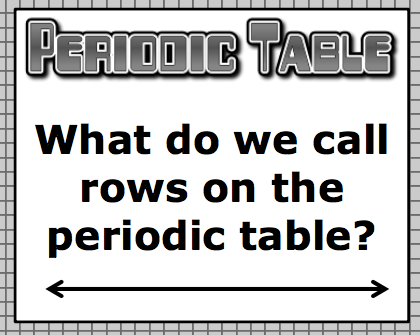
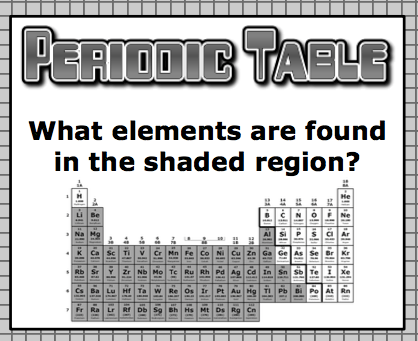
Periods
b)
Groups
66.
a)
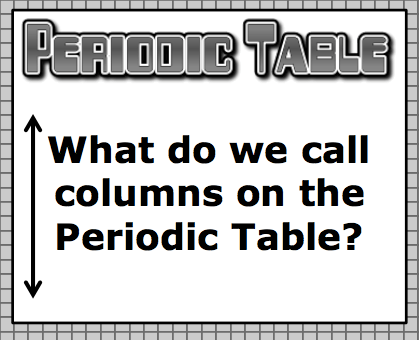
Periods
b)
Groups
67.
a)
energy levels
b)
valence electrons
c)
protons
d)
neutrons
68.
a)
Same group
b)
Same period
69.
a)
Metals
b)
Nonmetals
c)
Metalloids
70.
How did Mendeleev arrange the elements?
a)
alphabetical 
b)
density
c)
melting point
d)
atomic mass
71.
The horizontal row on the periodic table is called a
a)
group
b)
family
c)
period
d)
atomic number
72.
A vertical column is called...
a)
group
b)
tower
c)
period
d)
crew
73.
The number at the bottom of each square on the periodic table is the ...
a)
atomic number
b)
atomic mass
c)
chemical symbol
d)
element name
74.
The number at the top of each square on the periodic table is the ...
a)
atomic number
b)
atomic mass
c)
Chemical Symbol
d)
Element Name
75.
What is the chemical symbol for Lithium?
a)
H
b)
He
c)
Li
d)
N
76.
How many elements follow the periodic law?
a)
7
b)
98
c)
110
d)
All of them
77.
Most of the elements on the periodic table are classified as _____.
a)
Metals
b)
Nonmetals
c)
Metalloids
d)
Periods
78.
The atomic number tells you what?
a)
number of electrons
b)
number of protons
c)
number of neutrons
d)
both electrons and protons in an atom.
79.
Which element is not a metal?
a)
H
b)
Re
c)
Al
d)
B
80.
The atoms along the staircase are called 
a)
metals
b)
nonmetals
c)
metalloids
d)
noble gases
81.
Which is a halogen?
a)
Helium
b)
Chlorine
c)
Oxygen
d)
Neptune
82.
A horizontal row of elements in the periodic table.
a)
column
b)
group
c)
period
83.
Elements in a ..................have similar chemical properties.  
a)
period
b)
group
c)
row
84.
Jack has a rock. The rock has a mass of 14g and a volume of 2cm3. What is the density of the rock?
a)
7 mL
b)
7 g/cm3
c)
28 g/cm3
d)
1/7 g/cm3
85.
Frank has an eraser. It has a mass of 4g, and a volume of 2cm3. What is its density?
a)
8 g/cm3
b)
2 g/cm3
c)
1/2 g/cm3
d)
24 g/cm3
86.
Frank has a paper clip. It has a mass of 9g and a volume of 3cm3. What is its density?
a)
3 g/cm3
b)
1/3 g/cm3
c)
27 g/cm3
d)
39 g/cm3
87.
What is the molar mass of Zn(C2H3O2)2
a)
392.8g/mol
b)
142.9g/mol
c)
361g/mol
d)
183.5 g/mol
88.
What is the molar mass of PbSO4
a)
303.3 g/mol
b)
294.7g/mol
c)
163.8g/mol
d)
372g/mol
89.
What is the molar mass of NaBr
a)
381.9g/mol
b)
102.9 g/mol
c)
213.6g/mol
d)
93.0g/mol
90.
In the equation 6 CO2 + 6 H2O → C6H12O6 + 6 O2, the mole ratio of water to oxygen is: 
a)
6:6
b)
1:6
c)
6:1
91.
What is the molar mass of CH4
a)
16.05
b)
16.04
c)
16.03
d)
16.02
92.
How many grams are in 7.8 moles of NaCl?
a)
476grams
b)
460 grams
c)
452 grams
d)
462 grams
93.
Is hammering wood together to build a house a chemical or physical change?
a)
chemical
b)
physical
94.
The reactants are on the left side of the chemical equation.
a)
True
b)
False
95.
Which of the following is a sign that a chemical reaction has occurred?
a)
change in shape
b)
melting
c)
formation of a gas
d)
dissolving
96.
Is bleaching your hair a physical or chemical change?
a)
physical
b)
chemical
97.
Is copper tarnishing a physical or chemical change?
a)
Physical 
b)
Chemical
98.
In the equation,          2Mg + O2 ---> 2MgO, which are the reactants?
a)
Mg and O
b)
MgO
c)
Mg and MgO
d)
O and MgO
99.
What are the units for molar mass?
a)
grams
b)
moles
c)
grams/mole
d)
liters
100.

2Ca + O2 > 2CaO 

What is the 2 located behind oxygen (O) called?

a)
coefficient
b)
reactant
c)
subscript
d)
product
101.
The molar mass of an element is equal to its...
a)
Atomic mass
b)
Atomic number
c)
Oxidation number
d)
Valence electrons
102.
What is the molar mass of sodium?
a)
11
b)
23
c)
45.98
d)
3
103.
What is the molar mass of sodium?
a)
11
b)
23
c)
45.98
d)
3
104.
What is the molar mass of table salt (NaCl)?
a)
116.886 g/mol
b)
35.453 g/mol
c)
22.990 g/mol
d)
58.443 g/mol