
 Worksheets
Semester Review
Total questions: 117
Worksheet time: 3hrs 3mins
A plant is...
an autotroph
a heterotroph
a primary consumer
a carnivore
A person who eats a chicken that ate grain is a ...
primary producer
primary consumer
secondary consumer
quaternary consumer

What is a fitting description for this diagram?

The Mayfly is a food source for which 3 organisms?

The trout is a source of food for the human and the eagle. When there are more than one organism vying for the same source we call this____?

In Stage 1, the Population Pyramid looks like...


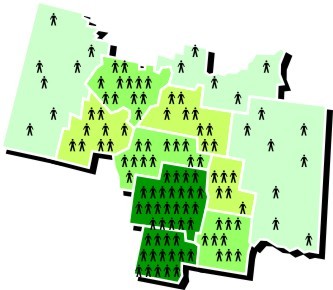
Based on Turkey's population pyramid, we can infer that...
It is industrializing.
It is in stage 5 of the DTM
It population is declining.
What does a population pyramid represent?
The total population of a country
The age and gender distribution of a population
The birth and death rates of a country
The economic development of a country
In which stage of demographic transition does a country have low birth and death rates?
Pre-industrial society
Industrial society
Post-industrial society
Developing society
Factors that are influential only when population density reaches a certain level...
density-dependent limiting factor
limiting factor
logistic growth
density-independent limiting factor
When a population's growth slows then stops, following a period of exponential growth...
immigration
logistic growth
emigration
population density
The maximum number of individuals of a particular species that an environment can support...
demography
emigration
exponential growth
carrying capacity

An organism that exhibits high parental care would be likely considered
r-selected
K-selected
Type 3 survivorship




Food webs are models that show
one sequence of producers and consumers.
complex networks of feeding relationships.
stored energy in food chains
only primary consumers in an ecosystem

Which statement best describes the relationship between species A and B?
Species A is the prey of Species B
Species A is a parasite of Species B
Species A is a consumer and B is a producer
Species A and B has a mutualistic relationship

What is a keystone species?
A species that helps to hold an ecosystem together
A species that lives in or around rocks
Keys and stones have nothing to do with ecology
A keystone isn't a living thing, it's just a stone


Which cycle are fossil fuels (oil, coal, natural gas) part of?
carbon
water
nitrogen
phosphorus
Which cycle DOESN'T have an atmosphere component (part)?
carbon
nitrogen
phosphorus
water

Which one of these does not add CO2 to the atmosphere?
cooking with gas
planting trees
burning wood
riding in a bus


Identify the cycle pictured.
The Water cycle
The Carbon cycle
The Nitrogen cycle
The Phosphorus cycle.

Identify the cycle pictured.
The Water cycle
The Carbon cycle
The Nitrogen cycle
The Phosphorus cycle.
Too much phosphorus in waterways (rivers, lakes) can lead to___________.
eutrophication
Nothing
Death
diseases

Decomposition is part of all cycles except _______
the carbon cycle
the nitrogen cycle
the water cycle
the phosphorus cycle
In order to be considered organic, a compound must contain...
Hydrogen
Carbon
Nitrogen
Phosphorus
Some soil bacteria use up nitrates and release N2 gas in a process called...
Ammonification
Nitrification
Nitrogen Fixation
Denitrification
Soil bacteria can take N2 gas and break apart its triple covalent bond. This is called...
Ammonification
Nitrification
Nitrogen fixation
Denitrification
When the carbon dioxide content of the ocean increases, the pH of the ocean....
Decreases
Increases
Remains stable
Becomes unstable
Legumes provide starches for nitrogen fixing bacteria and nitrogen fixing bacteria add nitrogen to the soil for legumes to use. This relationship is best described as...
Commensalism
Parasitism
Predation
Mutualism

What age groups does the bottom of a population pyramid represent?
The elderly
The working adults
The children
Males

What growth rate does this population pyramid represent?
Rapid Growth
Slow Growth
Negative Growth
Zero Growth

Predict the future population growth of this country.
Negative Growth (the population will shrink)
Slow/No Growth (the population will stay about the same)
Growth (the population will definitely grow)
Fast Growth (the population will explode)

Is this country Developed or Developing?
Developed
Developing

Predict the future population growth of this country.
Negative Growth (the population will shrink)
Slow/No Growth (the population will stay about the same)
Growth (the population will definitely grow)
Fast Growth (the population will explode)

By 2025 the UK will have... (tick all correct statements)
a narrower base meaning fewer young children
a wider top meaning more older people
a wider base meaning more young children
a narrower top meaning fewer older people
What are the three main parts of Biodiversity? (Check all that apply)
Endangered
Species
Genetic
High Risk
Ecosystem

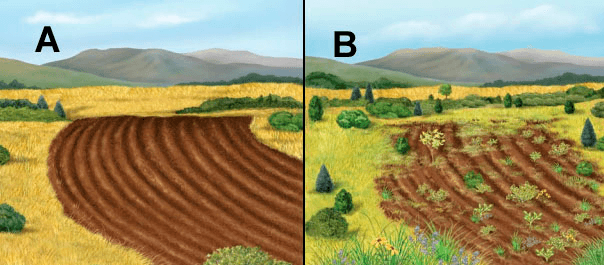
Why is "A" less biodiverse than "B"?
Image "A" is more biodiverse.
Image "A" has many corn plants and this makes it have high "rich" biodiversity.
Image "A" has a lot more plants than image "B"
Even though "A" has a lot of corn plants they are all the same species and makes this a low "poor" biodiverse area.
All of the following are causes for biodiversity loss, EXCEPT:
Habitat Loss
Invasive Species
Replanting trees
Pollution
In 2005, the government of Brazil released information showing that over 10,000 square miles of the Amazon rain forest had been destroyed. Cattle ranching is the leading cause of deforestation reported by the Brazilian government. What will most likely be the immediate result of deforestation in the Amazon rain forest?
a decrease in the use of alternative energy
an increase in biodiversity in the region
a decrease in the rate of soil erosion
an increase in atmospheric carbon dioxide
Water is polar which means that
Both ends of the molecule have a positive charge
Both ends of the molecule have a negative charge
One end of the molecule has a positive charge, while the other end has a negative charge
The molecule is neutral
Which of the following best describes water and the relation to specific heat capacity?
Water has a high specific heat capacity meaning it requires very little energy to change temperature
Water has a low specific heat capacity meaning it requires very little energy to change temperature
Water has a high specific heat capacity meaning it requires a lot of energy to change temperature
Water has a low specific heat capacity meaning it requires a lot of energy to change temperature

How does proximity to water affect climate?
Places near a large body of water experience less of a difference between high and low temperatures
Places near a large body of water experience more of a difference between high and low temperatures
Places near a large body of water experience no change in temperature

What month has the highest average temperature?
March
June
October
August

Which climograph has the most precipitation during the summer?
A
B
C
D

Check all biomes that occur in the tropics.
A
B
C
D
E
Which 2 biomes do not have a distinct wet and dry seasons?
A
C
D
E
F
Which climograph is most likely a desert?
B
C
D
E
F
Which climograph is most likely for a tropical rainforest?
B
C
D
E
F

A collection of living organisms that belong to different populations but all live in the same area and interact with one another is a...
Population
Ecosystem
Community
Ecosphere

Non-living factor that affects an ecosystem...
biotic factor
abiotic factor
food chain
biome

Which of the following is a population?
hawks, barred owls, and eagles on NC coast
mountain stream
all the frogs in a pond
blue-tailed skinks (lizards) around a barn


An ecosystem with a large number of individuals can have a low biodiversity.
True
False
Which of the following is NOT a method scientists use to measure the biodiversity of an area?
canopy fogging
transect sampling
biological control
aerial photos
A herd of zebras in Gorongosa National Park would be considered a
Why should you be concerned with the size of your carbon footprint?
Sometimes its hard to find shoes that are the right size.
If we don't decrease greenhouse gas emissions Earth will continue to cool.
Greenhouse gases are becoming scarce in Earth's atmosphere.
Increases in greenhouse gases in the atmosphere are contributing to global climate change.
An organism that makes a home for itself in a new place is called a(an)
endangered species
new species
strange species
exotic species
Advances in medicine and in farming have increased
human population growth
biodiversity
renewable resources
exotic species
5 mass extinctions have occurred in Earth's history. What do most of them share in common?
They were caused by humans.
They killed about 25% of species alive at the time.
They were caused by global changes in temperature.
They were cause by asteroids.
About 99% of all species who ever lived are extinct. Why do organisms go extinct?
Humans hunt them.
They are all eaten by other species.
Their environments change and they are no longer well adapted to them.
Which of the following appropriately describes a difference between the tropical rainforest and the tropical dry forest?
Soils are poor in the rain forest and rich in the dry forest.
Diversity is low in the rain forest and high in the dry forest.
Precipitation is about the same between the rain forest and the dry forest.
Biodiversity is the same between the rain forest and the dry forest.
What is the term that describes a steady and stable community?
peak community
turf community
climax community
disturbed community

Based on the image above, what type of Isolation is shown?
Geographic Isolation
Behavioral Isolation
Temporal Isolation
One species of lizard breeds in the spring, one breeds in the summer. What type of isolation is this?
Geographic Isolation
Behavioral Isolation
Temporal Isolation

What type of macroevolution is happening in the image?
adaptive radiation
microevolution
coevolution
convergent evolution
divergent evolution
Which of the following are the main producers of marine ecosystems?
phytoplankton
plants
bacteria
zooplankton
Why is phytoplankton important - select all that apply:
it is the basis for marine food webs
provides 50% oxygen for life on earth
removes detritus from environment
removes excess CO2 from atmosphere
allows corals to build hard limestone structures

Which organism is the producer of this ecosystem?
phytoplankton
krill
fish
leopard seal

Which organism is the apex predator?
phytoplankton
krill
fish
leopard seal
____________ __________________ : species with a capacity for a high rate of population increase
(a)
Which of the following is the correct order for least related to most related?
Domain
Kingdom
Phylum
Class
Order
Family
Genus
Species
Species
Kingdom
Phylum
Class
Order
Family
Genus
Domain
Species
Genus
Family
Order
Class
Phylum
Kingdom
Domain
Domain
Kingdom
Class
Phylum
Order
Genus
Family
Species
The American lobster (Homarus americanus) is most closely related to which of the following organisms?
Cape lobster (Homarinus capensis)
Common lobster (Homarus gammarus)
Patagonian lobsterette (Thymops birsteini)
Scarlett clawed lobster (Nephropsis atlantica)
The most specific classification, a group that mates to produce offspring
Genus
Fossils
Species
Speciation
Evolution is...
changes over time in populations
natural process that passes favorable traits
historical timeline of fossils
the process in which an animal dies out

____________ development of new species when a population is reproductively isolated in some form.
The primary causes of extinction (and endangerment and threatened status) is...
polar ice cap melting
global warming
habitat loss and degradation
burning of fossil fuels

