
 Worksheets
Energy and matter in ecosystems
Total questions: 183
Worksheet time: 4hrs 48mins
Which of the following organisms are producers? (There may be more than one.)
grasses
earthworm
algae
heron
water lily
Which of the following organisms are consumers? There may be more than one.
grasses
turtle
earthworm
water lily
algae
Which of the following organisms are decomposers? There may be more than one.
grasses
turtle
earthworm
water lily
algae

Which is the primary consumer in this group of organisms?
The flower
The snake
The insect
What is the difference between a food chain and a food web?
In what level of an energy pyramid is there the GREATEST amount of energy?
Tertiary Level
Secondary Consumer Level
Primary Consumer Level
Producer Level
Organisms that make their own food
Producer
Consumer
Decomposer
Organisms that obtain energy by feeding on other organisms
Producer
Consumer
Decomposer
Organisms that break down wastes and dead organisms and return the raw materials to the environment
Producer
Consumer
Decomposer
Consumers that eat only plants
Carnivores
Omnivores
Herbivores
Scavengers
Consumers that eat only animals
Carnivores
Omnivores
Herbivores
Scavengers
Consumers that eat both plants and animals
Omnivores
Carnivores
Herbivores
Scavengers
Consumers that feed on the bodies of dead organisms
Carnivores
Omnivores
Herbivores
Scavengers
A food _______ is a series of events in which one organism eats another and obtains energy.
chain
web
pyramid
plate
A food _______ consists of many overlapping food ________.
web, chains
chain, webs
pyramid, webs
web, pyramids
As you work your way up the energy pyramid, what happens to the energy?
It increases
It decreases
It stays the same
Nothing

In the food web above, what eats the rabbit?
Fox
Hawk
Vole
Grass

In the food web above, what organism is missing from this food chain:
Grass --> Slug --> ________ --> Hawk
Vole
Frog
Insect
Thrush

In the energy pyramid, what is the bottom level composed of?
Producers
First-Level Consumers
Second-Level Consumers
Third-Level Consumers
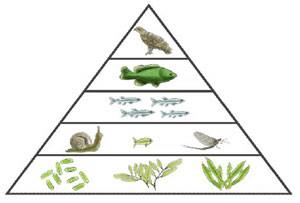
In the energy pyramid, what comes after the producers?
Producers
First-Level Consumers
Second-Level Consumers
Third-Level Consumers

The sun has been up for several hours, and it has been shining on these trees. What can the trees do because they are in sunlight? What does this mean for the number of energy storage molecules in the trees?
give off carbon to the air. Giving off carbon allows them to make energy storage molecules.
give off carbon to the air. Giving off carbon uses up energy storage molecules
take in carbon from the air. The carbon is used to make energy storage molecules.
take in carbon from the air. The carbon is used to break down energy storage molecules.

These goats are eating grass on a sunny day. What is happening to the carbon in the air around the living things on the mountain? Is carbon moving into the air, moving out of the air, or both?
Carbon is only moving into the air; it is not moving out of the air.
Carbon is moving into the air and out of the air at the same time.
Carbon is not moving into the air; it is only moving out of the air.
With this information, there is no way to know for sure.
Will has an aquarium with water, plants, and fish that eat the plants. It is sealed so no material can get in or out, and has glass sides that allow sunlight to come in. The aquarium can also be covered to prevent light from entering.
The amount of carbon in the aquarium’s water started out high. Now, the amount of carbon in the water is decreasing.
Is the aquarium now in sunlight or is it covered? What is happening to the number of energy storage molecules in the plants and fish as a result?
The aquarium is now in sunlight, and there are more energy storage molecules in the plants and fish.
The aquarium is now in sunlight, and there are fewer energy storage molecules in the plants and fish.
The aquarium is now covered so no light can get in, and there are more energy storage molecules in the plants and fish.
The aquarium is now covered so no light can get in, and there are fewer energy storage molecules in the plants and fish.
Scientists are studying photosynthesis in a forest ecosystem that has plants, animals, and decomposers (which consume dead things). Which group or groups of organisms in the forest carry out photosynthesis?
all organisms in the forest
animals and decomposers
plants and decomposers
plants
A herd of deer lives in a forest where they eat the leaves of trees. The number of energy storage molecules in the trees and in the deer has increased. What has happened to the amount of carbon in the trees and in the deer?
The amount of carbon in the trees and in the deer . . .
has increased.
has decreased.
has not changed.
is not related to the number of energy storage molecules.
This sea grass has had the sun shining on it for most of the day. What can the sea grass do because it is in sunlight? What does this mean for the number of energy storage molecules in the sea grass?
The sea grass can . . .
take in carbon from the air. The carbon is used to break down energy storage molecules.
take in carbon from the air. The carbon is used to make energy storage molecules.
give off carbon to the air. Giving off carbon allows the sea grass to make energy storage molecules.
give off carbon to the air. Giving off carbon uses up energy storage molecules.

This tortoise is eating cactus on a sunny day. Is carbon moving into the air, moving out of the air, or both?
Carbon is not moving into the air; it is only moving out of the air.
With this information, there is no way to know for sure.
Carbon is only moving into the air; it is not moving out of the air.
Carbon is moving into the air and out of the air at the same time.
Lily has an aquarium with water, plants, and fish that eat the plants. The aquarium is sealed so no material can get in or out, and has glass sides that allow light to come in.
The aquarium can also be covered to prevent light from entering. The number of energy storage molecules in the plants and fish started out low, but that number has been increasing over time.
Has the aquarium been in sunlight or has it been covered during this time? What has happened to the carbon in the water?
The aquarium has been covered so no light gets in, and there is less carbon in the water.
The aquarium has been covered so no light gets in, and there is more carbon in the water.
The aquarium has been in sunlight, and there is more carbon in the water.
The aquarium has been in sunlight, and there is less carbon in the water.
Scientists are studying cellular respiration in a jungle ecosystem that has plants, animals, and decomposers (which consume dead things). Which group or groups of organisms in the jungle carry out cellular respiration?
plants
animals and decomposers
all organisms in the jungle
animals
Giant pandas eat bamboo plants in the mountains of China. The number of energy storage molecules has decreased in both the bamboo and the pandas. What has happened to the amount of carbon in the bamboo and the pandas?
The amount of carbon in the bamboo and pandas . . .
has not changed.
is not related to the number of energy storage molecules.
has increased.
has decreased.
Giant kelp are plantlike organisms that grow in clear ocean water. Over the last few hours some kelp has been taking in carbon from the water around it. Is the kelp in sunlight? What has happened to the number of energy storage molecules in the kelp?
The kelp . . .
is in sunlight, and the number of energy storage molecules in the kelp has decreased.
is in sunlight, and the number of energy storage molecules in the kelp has increased.
is not in sunlight, and the number of energy storage molecules in the kelp has decreased.
is not in sunlight, and the number of energy storage molecules in the kelp has increased.

A rabbit is eating leafy plants on a sunny day. What is happening to the carbon in the plants and the rabbit?
Carbon is only moving out of the living things; it is not moving into them.
With this information, there is no way to know for sure.
Carbon is moving into and out of the living things at the same time.
Carbon is only moving into the living things; it is not moving out of them.
A scientist set up an experimental ecosystem in a sealed room with no windows. The experimental ecosystem has plants and animals that eat those plants. The scientist can control whether the room is light or dark with a light switch outside the room.
The amount of carbon in the air of the ecosystem started out low. Then the amount of carbon in the air started to increase. Is the increase because the scientist switched the light on or because she switched the light off? What happened to the number of energy storage molecules in the living things?
The scientist . . .
switched the light off, and the number of energy storage molecules in the living things decreased.
switched the light off, and the number of energy storage molecules in the living things increased.
switched the light on, and the number of energy storage molecules in the living things increased.
switched the light on, and the number of energy storage molecules in the living things decreased.
Scientists are studying photosynthesis in a desert ecosystem that has plants, animals, and decomposers (which consume dead things). Which group or groups of organisms in the desert carry out photosynthesis?
plants
plants and decomposers
all organisms in the desert
animals and decomposers
Scientists are studying cellular respiration in a river ecosystem that has plants, animals, and decomposers (which consume dead things). Which group or groups of organisms in the river carry out cellular respiration?
plants
animals and decomposers
all organisms in the river
animals
An ivy plant has been taking in carbon from the air for several hours. Is the ivy in sunlight? What has happened to the number of energy storage molecules in the ivy? The ivy . . .
is in sunlight. The number of energy storage molecules in the ivy has decreased.
is in sunlight. The number of energy storage molecules in the ivy has increased.
is not in sunlight. The number of energy storage molecules in the ivy has decreased.
is not in sunlight. The number of energy storage molecules in the ivy has increased.
A group of giraffes feeds on leaves and grasses during the daytime. Right now, it's the middle of the night. The sun is not shining and the giraffes are not eating. Is carbon moving into the living things, moving out of the living things, or both?
Carbon is moving into and out of the living things at the same time.
Carbon is only moving into the living things; it is not moving out of them.
Carbon is only moving out of the living things; it is not moving into them.
With this information, there is no way to know for sure.
Reza has a glass ball filled with water that contains tiny plants and shrimp that eat those plants. No material can get in or out, but light can get through the glass when it is placed in sunlight.
The number of energy storage molecules in the plants and shrimp started out high, but then the glass ball was moved, and the number of energy storage molecules decreased. Was the glass ball moved into the light or into the dark?
What happened to the amount of carbon in the water?
The glass ball was moved into the dark, and there is less carbon in the water.
The glass ball was moved into the dark, and there is more carbon in the water.
The glass ball was moved into the light, and there is less carbon in the water.
The glass ball was moved into the light, and there is more carbon in the water.
Plants, animals, and decomposers (which consume dead things) are in a forest ecosystem. Scientists are studying photosynthesis in the forest. Which group or groups of organisms should they study?
all organisms in the forest
animals and decomposers
plants and decomposers
plants
A jungle ecosystem has plants, animals, and decomposers (which consume dead things). Scientists are interested in studying cellular respiration in the jungle. Which group or groups of organisms should they study?
plants
animals and decomposers
all organisms in the jungle
animals
Giant pandas live wild in the mountains in China, where they eat bamboo from its forests. The number of molecules that store energy has decreased in both the bamboo and the pandas. What has happened to the amount of carbon in the bamboo and the pandas?
The amount of carbon in the bamboo and pandas . . .
has not changed.
is not related to the number of molecules that store energy.
has increased.
has decreased.
Climbing ivy grows on the sides of buildings. The ivy on one building has been taking in carbon from the air for several hours.
Is the ivy in sunlight? What has happened to the number of molecules that store energy in the ivy plants?
The ivy . . .
is in sunlight. The number of molecules that store energy in the ivy has decreased.
is in sunlight. The number of molecules that store energy in the ivy has increased.
is not in sunlight. The number of molecules that store energy in the ivy has decreased.
is not in sunlight. The number of molecules that store energy in the ivy has increased.
Pea plants have been in the sunlight since early morning. What can the pea plants do because they are in sunlight? What does this mean for the number of energy storage molecules in the pea plants?The pea plants can…
give off carbon to the air. Giving off carbon allows them to make energy storage molecules.
give off carbon to the air. Giving off carbon uses up energy storage molecules.
take in carbon from the air. The carbon is used to break down energy storage molecules.
take in carbon from the air. The carbon is used to make energy storage molecules.
Hippos spend most of their time in rivers, but they come out of the water to eat grass. It is dark out, and this hippo is not eating.
What is happening to the carbon in the air around the hippos and the grass nearby?
Carbon is not moving into the air; it is only moving out of the air.
With this information, there is no way to know for sure.
Carbon is moving into the air and out of the air, at the same time.
Carbon is only moving into the air; it is not moving out of the air.
Parrotfish live in the ocean and eat plantlike organisms called algae. Sunlight is shining on the fish and the algae. Is carbon moving into the living things, moving out of the living things, or both?
Carbon is moving into and out of the living things, at the same time.
Carbon is only moving into the living things; it is not moving out of them.
Carbon is only moving out of the living things; it is not moving into them.
There is no way to know for sure, with this information.
What are the smallest of all living things?
Atoms
Cells
Molecules
Viruses
Which of the following is Not living?
Bacteria
Fungus
Mushroom
Virus
Which organism can make its own food using the sun’s energy?
Consumer
Producer
Decomposer
Scavenger
Which organism must eat other living things for energy?
Consumer
Producer
Decomposer
Plants
Which organism breaks down dead plants and animals?
Consumer
Producer
Decomposer
Predator
What two parts does a plant cell have that an animal cell does not?
Cytoplasm and cell wall
Nucleus and cell membrane
Cell wall and chloroplasts
Cell membrane and cell wall
What cell part decides what gets in and out of the cell?
Cell wall
Nucleus
Cytoplasm
Cell membrane
What cell part is the brain of the cell?
Nucleus
Chloroplasts
Cell wall
Cytoplasm
The jelly-like substance that fills the cell.
Nucleus
Cell wall
Cytoplasm
Chloroplasts
What cell part provides shape and structure for plant cells?
Cell membrane
Cell wall
Cytoplasm
Chloroplasts
What cell part captures the sun’s energy and allow plants to make their own food?
Cytoplasm
Chloroplasts
Nucleus
Cell membrane
What shows the flow of energy in an ecosystem?
A flow chart
A diagram
A graph
A food chain
Where does the energy in a food chain come from?
Sun
Predators
Prey
Scavengers
A consumer that eats ONLY other consumers (meat) is a ___________.
Prey
Herbivore
Omnivore
Carnivore
A consumer that eats ONLY plants is a ___________________.
Predator
Omnivore
Herbivore
Carnivore
A consumer that eats both plants and animals is a ________________.
Omnivore
Producer
Carnivore
Herbivore
An animal that hunts and kills another animal for food is a __________.
Prey
Producer
Predator
Decomposer
An animal that is hunted and killed by another animal for food is ________________.
Predator
Prey
Scavenger
Decomposer
Several food chains interconnected together create a _____________.
A long food chain.
A food diagram
Living things
A food web
Which is NOT a life process?
Reproduce
Photosynthesis
Sensitivity
Grow
In the food web above, what eats the rabbit?
Fox
Hawk
Vole
Grass
In the food web above, what organism is missing from this food chain:
Grass --> Slug --> ________ --> Hawk
Vole
Frog
Insect
Thrush
In the energy pyramid, what is the bottom level composed of?
Producers
First-Level Consumers
Second-Level Consumers
Third-Level Consumers
In the energy pyramid, what comes after the producers?
Producers
First-Level Consumers
Second-Level Consumers
Third-Level Consumers


Position that an organism occupies based on what it eats
Producer
Trophic level
Heterotroph
Consumer


Using the food web what would happen if the eagle became extinct?
The frog population would decrease.
The frog population would increase.
The butterfly population would increase.
The snake population would decrease.


A raccoon eats plants and animals. It is an example of a(n)
omnivore
carnivore
herbivore
decomposer


After the sun, where does a food chain start?
with animals that eat plants
with plants that eat other animals
with plants that make their own food
Where would a decomposer be in a food chain?
at the beggining
at the end
between a producer and consumer
All food webs include
insects
mushrooms
producers
a series of chemical reactions that covert light energy, water, and carbon dioxide into the food- energy molecule glucose and gives off oxygen
glycolysis
photosynthesis
food web
condensation
all living things and nonliving things in a given area
food chain
consumer
ecosystem
producer
a series of chemical reactions that convert energy in food molecules into a useable form of energy called ATP
cellular respiration
detritivore
food web
precipitation
a process by which glucose, a sugar, is broken down into smaller molecules
photosynthesis
ecosystem
precipitation
glycolysis
an organism that uses an outside energy source, such as the Sun, and produces its own food
consumer
producer
food web
food chain
an organism that cannot make its own food and gets energy by eating other organisms
producer
detritivore
consumer
energy pyramid
an organism that consumes the bodies of dead organisms and wastes produced by living organisms
ecosystem
producer
consumer
detritivore
a model that shows how energy flows in an ecosystem through feeding relationships
food chain
food web
glycolysis
nitrogen fixation
a model of energy transfer that can show how the food chains in a community are interconnected
food chain
evaporation
food web
nitrogen fixation
a model that shows the amount of energy available in each link of a food chain
food web
energy pyramid
evaporation
condensation
the process of a liquid changing to a gas at the surface of the liquid
evaporation
condensation
precipitation
nitrogen fixation
the process by which a gas changes to a liquid
cellular respiration
photosynthesis
evaporation
condensation
water, in liquid or solid form, that falls from the atmosphere
evaporation
condensation
precipitation
nitrogen fixation
the process that changes atmospheric nitrogen into nitrogen compounds taht are usable by living things
precipitation
nitrogen fixation
evaporation
condensation
In the energy pyramid, who receives the most energy first?
Primary Consumers
Decomposers
Secondary Consumers
Producers
A primary Consumer is also called a:
Carnivore
Scavenger
Herbivore
Producer
Producers get energy by capturing what from the sun?
Chemical Energy
Big Energy
Light energy
No Energy
Matter is anything that has _____and takes up space.
energy
mass
chemicals
matter
Check all the primary consumers listed!
Snake
Rabbit
Zebra
Bear
Energy is the ability to do (a) and enables organisms to use matter in life processes.
What are the two ways different organisms can get energy? check the two boxes that apply.
Ground
Sun
Ocean
Other Organisms
Consumers take in both energy and matter at the same time when they eat.
True
False
Energy and Matter cannot leave ecosystems.
True
False
The law of conservation of energy and mass, says that they both cant be created or (a)
Although energy and matter can't be created or destroyed, they can change forms.
True
False

What is this called?
Energy Post
Energy Triangle
Energy Pyramid
Pyramid Triangle
The shape of an energy pyramid shows that there is more energy and more organisms at each level the higher it goes.
True
False

This picture shows us that matter _________through an ecosystem.
goes
cycles
leaves
falls
What do you think your final exam project will be?
A 5 Page Report
A 30 Page Question Sheet
A Biome Box
An Investigation Letter
The sun has been up for several hours, and it has been shining on these trees. What can the trees do because they are in the sunlight? What does this mean for the number of energy storage molecules in the trees? The trees can...
give off carbon to the air. Giving off carbon allows them to make energy storage molecules.
give off carbon to the air. Giving off carbon uses up energy storage molecules.
take in carbon from the air. The carbon is used to make energy storage molecules.
These goats are eating grass on a sunny day. What is happening to the carbon in the air around the living things on the mountain? Is carbon moving into the air, moving out of the air, or both?
Carbon is moving into the air and out of the air at the same time.
Carbon is not moving into the air; it is only moving out of the air.
With this information, there is no way to know for sure.
Will has an aquarium with water, plants, and fish that eat the plants. It is sealed so no material can get in or out, and has glass sides that allow sunlight to come in. The aquarium can also be covered to prevent light from entering. The amount of carbon in the aquarium's water started out high. Now, the amount of carbon in the water is decreasing. Is the aquarium now in sunlight or is it covered? What is happening to the number of energy storage molecules in the plants and fish as a result?
The aquarium is now in sunlight, and there are more energy storage molecules in the plants and fish.
The aquarium is now covered so no light can get in, and there are more energy storage molecules in the plants and fish.
The aquarium is now covered so no light can get in, and there are fewer energy storage molecules in the plants and fish.
Scientists are studying photosynthesis in a forest ecosystem that has plants, animals, and decomposers (which consume dead things). Which group or groups of organisms in the forest carry out photosynthesis?
all organisms in the forest
animals and decomposers
plants
A herd of deer lives in a forest where they eat the leaves of trees. The number of energy storage molecules in the trees and in the deer has increased. What has happened to the amount of carbon in the trees and in the deer? The amount of carbon in the trees and in the deer . . .
has increased
has not changed
is not related to the number of energy storage molecules.
This sea grass has had the sun shining on it for most of the day. What can the sea grass do because it is in sunlight? What does this mean for the number of energy storage molecules in the sea grass? The sea grass can...
take in carbon from the air. The carbon is used to make energy storage molecules.
give off carbon to the air. Giving off carbon allows the sea grass to make energy storage molecules.
give off carbon to the air. Giving off carbon uses up energy storage molecules.
This tortoise is eating cactus on a sunny day. Is carbon moving into the air, moving out of the air, or both?
With this information, there is no way to know for sure.
Carbon is only moving into the air; it is not moving out of the air.
Carbon is moving into the air and out of the air at the same time.
Lily has an aquarium with water, plants, and fish that eat the plants. The aquarium is sealed so no material can get in or out, and has glass sides that allow light to come in. The aquarium can also be covered to prevent light from entering. The number of energy storage molecules in the plants and fish started out low, but that number has been increasing over time. Has the aquarium been in sunlight or has it been covered during this time? What has happened to the carbon in the water?
The aquarium has been covered so no light gets in, and there is less carbon in the water.
The aquarium has been covered so no light gets in, and there is less carbon in the water.
The aquarium has been in sunlight, and there is less carbon in the water.
Scientists are studying cellular respiration in a jungle ecosystem that has plants, animals, and decomposers (which consume dead things). Which group or groups of organisms in the jungle carry out cellular respiration?
animals and decomposers
all organisms in the jungle
animals
Giant pandas eat bamboo plants in the mountains of China. The number of energy storage molecules has decreased in both the bamboo and the pandas. What has happened to the amount of carbon in the bamboo and the pandas? The amount of carbon in the bamboo and pandas .
has not changed
is not related to the number of energy storage molecules
has decreased.
Giant kelp are plantlike organisms that grow in clear ocean water. Over the last few hours some kelp has been taking in carbon from the water around it. Is the kelp in sunlight? What has happened to the number of energy storage molecules in the kelp? The kelp...
is in sunlight, and the number of energy storage molecules in the kelp has increased.
is not in sunlight, and the number of energy storage molecules in the kelp has decreased.
is not in sunlight, and the number of energy storage molecules in the kelp has increased.
A rabbit is eating leafy plants on a sunny day. What is happening to the carbon in the plants and in the rabbit?
Carbon is only moving out of the living things; it is not moving into them.
With this information, there is no way to know for sure.
Carbon is moving into and out of the living things at the same time.
A scientist set up an experimental ecosystem in a sealed room with no windows. The experimental ecosystem has plants, and animals that eat those plants. The scientist can control whether the room is light or dark with a light switch outside the room. The amount of carbon in the air of the ecosystem started out low. Then the amount of carbon in the air started to increase. Is the increase because the scientist switched the light on or because she switched the light off? What happened to the number of energy storage molecules in the living things? The scientist...
switched the light off, and the number of energy storage molecules in the living things decreased.
switched the light on, and the number of energy storage molecules in the living things increased.
switched the light on, and the number of energy storage molecules in the living things decreased.
Scientists are studying photosynthesis in a desert ecosystem that has plants, animals, and decomposers (which consume dead things). Which group or groups of organisms in the desert carry out photosynthesis?
plants
all organisms in the desert
animals and decomposers
Scientists are studying cellular respiration in a river ecosystem that has plants, animals, and decomposers (which consume dead things). Which group or groups of organisms in the river carry out cellular respiration?
animals and decomposers
all organisms in the river
animals
An ivy plant has been taking in carbon from the air for several hours. Is the ivy in sunlight? What has happened to the number of energy storage molecules in the ivy? The ivy . . .
is in sunlight. The number of energy storage molecules in the ivy has decreased.
is in sunlight. The number of energy storage molecules in the ivy has increased.
is not in sunlight. The number of energy storage molecules in the ivy has decreased.
A group of giraffes feeds on leaves and grasses during the daytime. Right now, it's the middle of the night. The sun is not shining and the giraffes are not eating. Is carbon moving into the living things, moving out of the living things, or both?
Carbon is moving into and out of the living things at the same time.
Carbon is only moving out of the living things; it is not moving into them.
With this information, there is no way to know for sure.
Reza has a glass ball filled with water that contains tiny plants and shrimp that eat those plants. No material can get in or out, but light can get through the glass when it is placed in sunlight. The number of energy storage molecules in the plants and shrimp started out high, but then the glass ball was moved, and the number of energy storage molecules decreased. Was the glass ball moved into the light or into the dark? What happened to the amount of carbon in the water?
The glass ball was moved into the dark, and there is more carbon in the water.
The glass ball was moved into the light, and there is less carbon in the water.
The glass ball was moved into the light, and there is more carbon in the water.
This space station has plants growing inside it, and astronauts who eat the fruits and vegetables from those plants. Because it is in space, the station is sealed so no material can get in or out. The space station is in Earth’s shadow, so no light is getting into it. The sensors in the space station show that carbon dioxide in the air is increasing. What is happening to the energy storage molecules in the plants and humans in the space station? Explain your answer as completely as possible.
a decrease in energy storage molecules
a increase in energy storage molecules
A scientist is studying an aquarium ecosystem that contains water, plants, and fish that eat those plants. The aquarium has glass walls so light can get in, but it is sealed so no material can move into or out of the tank. When the scientist turned the aquarium's light on, carbon in the water started decreasing. How is carbon moving and what is happening to the amount of carbon in the living things inside the aquarium? Explain your thinking as completely as possible.
the plants are performing photosynthesis.
the plants are not performing photosynthesis.


What does an energy pyramid show?
Energy flow in a community
Longest lifespans
The stronger animal the higher it is on the pyramid
In the food web above, what eats the rabbit?
Fox
Hawk
Vole
Grass
In the energy pyramid, what comes after the producers?
Producers
First-Level Consumers
Second-Level Consumers
Third-Level Consumers
In the food web above, what organism is missing from this food chain:
Grass --> Slug --> ________ --> Hawk
Vole
Frog
Insect
Thrush

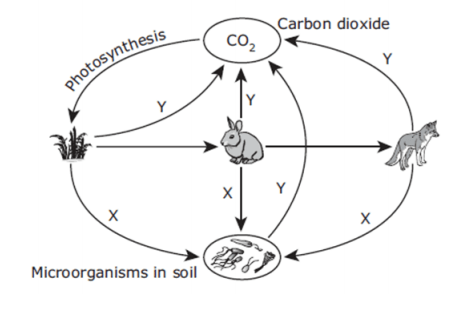
Y : Predation
Y : Decomposition
Y : Nitrogen Fixation
Y : Respiration

