wayground logo

Free Printable Worksheets

Font size

S
M
L
XL
Worksheets

Semester Review #2: Unit 4 & 5: Modern Atomic Theory & Bonding

Total questions: 151

Worksheet time: 4hrs 17mins

Name
Class
Date
1.

These particles are found in the nucleus of the atom.

a)

protons only

b)

protons and electrons

c)

electrons only

d)

protons and neutrons

2.

The mass number is the total of the protons plus the neutrons in the atom.

a)

True

b)

False

3.

How many neutrons would you expect the average gold atom to have given the information shown?

a)

79

b)

118

c)

197

d)

276

4.

Which subatomic particle has a negative charge?

a)

proton

b)

electron

c)

neutron

d)

quark

5.
The section labeled D is known as the?
a)
Electron cloud
b)
Neutron
c)
Nucleus
d)
Electron
6.
Value representing the number of protons in an element
a)
Atomic Mass
b)
Mass Number
c)
Valence Electrons
d)
Atomic Number
7.
What is the atomic number of this atom?
a)
2
b)
4
c)
6
d)
none of the above
8.
What is the mass number of this atom?
a)
1
b)
3
c)
4
d)
7
9.

How many valence (outer) electrons does an Oxygen atom have?

a)

2

b)

6

c)

8

d)

16

10.
What's a valence electron?
a)
electrons in the second energy level
b)
electrons in the outermost energy level
c)
the atomic number
d)
electrons in the first level
11.

Name this element.

a)

Neon

b)

Magnesium

c)

Sodium

d)

Manganese

12.

If an atom of Sodium has a mass number of 23, it will have...

a)

23 protons

b)

11 neutrons

c)

12 protons

d)

12 neutrons

13.
Isotopes are elements with a different amount of
a)
protons
b)
neutrons
c)
electrons
d)
atoms
14.
an element will always have the same number of 
a)
neutrons
b)
protons
c)
isotopes
d)
atoms
15.

Which subatomic particle has a positive charge and is found inside the nucleus?

a)

Electron

b)

Proton

c)

Neutron

d)

Nucleus

16.

Which subatomic particle has a neutral charge and is found inside the nucleus?

a)

Electrons

b)

Protons

c)

Neutrons

d)

Nucleus

17.

Which scientist developed this model?

a)

Dalton

b)

Thomson

c)

Rutherford

d)

Bohr

18.

What is the maximum number of electrons that can be found in the third shell (energy level)?

a)

2

b)

8

c)

18

19.

What is the maximum number of electrons that can be found in the second shell (energy level)?

a)

2

b)

8

c)

18

20.

What is the maximum number of electrons that can be found in the first shell (energy level)?

a)

2

b)

8

c)

18

21.

Which side of the periodic table are the nonmetals located?

22.

Which side of the periodic table are the metals located?

23.

Categorize the options into the right categories

Categorize the following

copper

potassium

strontium

magnesium

carbon

chlorine

nitrogen

argon

helium

silver

Metals
Nonmetals
24.

Which group is the Alkali Metals?

25.

Which group is the Alkaline Earth Metals?

26.

Which group is the Halogens?

27.

Which group is the Noble Gases?

28.

The ​ (a)   boarder the staircase & have properties of both metals and nonmetals. They are ​ (b)   , ​ (c)   , and ​ (d)   .

Choose from the below words
metalloids
shiny
brittle
semi-conductors
transition metals
dull
strong
good conductors
bad conductors
man-made
29.

According to Coulomb's Law, when the distance increases, the electrostatic force ____________; we call this relationship ____________ proportional.

a)

decreases; directly

b)

decreases; inversely

c)

increases; inversely

d)

increases; directly

30.

The Coulomb is the unit for:

a)

Charge

b)

Force

c)

Distance

d)

Mass

31.

Coulomb’s law states that the force between two charged objects will __________ when the magnitude (value) of the object’s charge increases.

a)

increase

b)

decrease

c)

stay the same

d)

first increase, then decrease

32.

Select all answer that apply:


What kinds of particles do Coulomb's Law apply to?

a)

electrons

b)

protons

c)

neutrons

d)

neutral atoms

33.

A repulsive force exists between which two particles?

a)

Two neutrons

b)

An electron and a neutron

c)

An electron and a proton

d)

Two protons

34.

What does "r" measure?

a)

the distance between the two charged objects

b)

the amount of charge carried by the objects

c)

the amount of force between two charged objects

d)

the constant value for forces between the objects

35.

An attractive force exists between which two particles?

a)

Two neutrons

b)

An electron and a neutron

c)

An electron and a proton

d)

Two electrons

36.

Electric charges exert which kind of force?

a)

a field force

b)

a contact force

c)

a gravitational force

d)

a frictional force

37.
As you move down the periodic table atoms get bigger.  This is because ____________.
a)
The atoms have more mass.
b)
The atoms have more protons.
c)
The atoms have more energy levels
d)
The atoms have more nuetrons
38.

As you move across the periodic table atoms tend to get smaller because, ______________.

a)

the atoms have more mass.

b)

the atoms have less mass

c)

the atoms have a bigger effective nuclear charge

d)

the atoms have less electrons.

39.

Which atom has the largest atomic radius?

a)

potassium

b)

rubidium

c)

francium

d)

cesium

40.

The atom with the largest atomic radius in Group 18 is

a)

Ar

b)

He

c)

Kr

d)

Rn

41.

Reorder the following with highest first ionisation energy first.

a)

Li - Lithium

b)

Na - Sodium

c)

Al - aluminium

d)

Mg - magnesium

e)

Si - silicon

1)
2)
3)
4)
5)
42.

Reorder the following elements largest atomic radius to smallest

a)

F (fluorine)

b)

Fr (Francium)

c)

Cs (caesium)

d)

O (oxygen)

e)

Fe (iron)

1)
2)
3)
4)
5)
43.

Reorder the following with most electronegative element first.

a)

F (fluorine)

b)

Fr (Francium)

c)

Cs (caesium)

d)

Br (bromine)

e)

Co (cobalt)

1)
2)
3)
4)
5)
44.

What element has the largest atomic radius?

a)

oxygen

b)

neon

c)

carbon

d)

sodium

45.

Which element has the smallest atomic radius?

a)

magnesium

b)

chlorine

c)

bromine

d)

argon

46.

What is ionization energy?

a)

The energy required to remove an electron from a neutral atom of an element.

b)

The energy change that occurs when an electron is acquired by a neutral atom.

c)

The measure of the ability of an atom in a chemical compound to attract electrons from another atom in the compound.

d)

How close an atom is to its neighboring atom.

47.

Which element has the highest ionization energy?

a)

oxygen

b)

sulfur

c)

silicon

d)

potassium

48.

What is the ability of an atom in a chemical compound to attract electrons from another atom in the compound?

a)

ionization energy

b)

electronegativity

c)

atomic radius

d)

electron affinity

49.

Which element has the largest electronegativity?

a)

barium

b)

oxygen

c)

iron

d)

lithium

50.

Energy levels are shown by:

a)

letters

b)

numbers

c)

a combination of letters and numbers

d)

subscripts

51.
There are 4 different types of subshells (orbitals) s,p,d,f.
a)
true
b)
false
52.

Each orbital can hold how many electrons?

a)

5

b)

4

c)

8

d)

2

53.
How many electrons can the first energy level hold?
a)
1
b)
2
c)
8
d)
0
54.
Which type of orbital is shaped like a sphere?
a)
s orbital
b)
p orbital
c)
d orbital
d)
f orbital
55.
What is the shape of a p orbital?
a)
sphere
b)
it's just too complex to thing about it
c)
dumbbell
d)
I don't know this stuff.
56.

Valence electrons are located...

a)

inside the nucleus

b)

in outer space

c)

on the outermost energy level of an atom

57.

Which of the following is not a sublevel

a)

s

b)

p

c)

n

d)

f

e)

d

58.
Electrons occupy orbitals of lowest energy first is part of what electron configuration rule?
a)
Hund’s Rule
b)
Aufbau Principle
c)
Pauli Exclusion Principle
59.
Electron arrangement that uses arrows
a)
Electron configuration
b)
Shorthand configuration
c)
Lewis dot structure
d)
Orbital diagram
60.
An orbital can at most hold how many electrons?
a)
1 electron
b)
2 electrons
c)
3 electrons
d)
4 electrons
61.

The name of this element is ​ (a)   .

An atom of this element would have ​ (b)   electrons total.

There would be ​ (c)   electrons on the first shell, ​ (d)   electrons on the second shell and ​ (e)   electrons on the third shell.

Choose from the below words
phosphorus
15
2
8
5
potassium
10
31
13
62.

The name of this element is ​ (a)   .

There would be ​ (b)   electrons on the first shell, ​ (c)   electrons on the second shell, ​ (d)   electrons on the third shell and ​ (e)   electrons on the last shell.

Choose from the below words
calcium
20
2
8
10
40
carbon
63.

What electron configuration matches an oxygen atom?

a)

1s22s22p63s2, 3p64s23d104p5

b)

1s22s22p4

c)

1s22s22p6

d)

1s22s22p63s23p64s23d1

64.

Identify the Electron Configuration for Aluminum (Al)

a)

1s2 2s2 2p6 3s2 3p1

b)

1s2 2s2 2p6 3s2 3p3

c)

1s2 2s2 2p6 3s2 4p1

65.

What atom matches this electron configuration?

1s22s22p63s23p64s23d10

a)

Zinc

b)

Copper

c)

Nickel

d)

Germanium

66.

What atom matches this electron configuration?

1s22s22p63s2

a)

Neon

b)

Magnesium

c)

Aluminum

d)

Potassium

67.

There are _____ types of atomic orbitals.

a)

1

b)

2

c)

3

d)

4

68.

Which of the following are TRUE of atomic orbitals?

a)

There is 1 s orbital

b)

There are 3 p orbitals

c)

There are 5 d orbitals

d)

There are 7 f orbitals

69.

How many electrons can fit in one orbital?

a)

1

b)

2

c)

3

d)

4

70.

Look at a periodic table. Count how many columns on the periodic table are in the "p" block. How many columns did you find?

a)

2

b)

6

c)

10

d)

14

71.

If the f block contains 14 columns, then it would make sense that an f orbital can hold up to _____ electrons.

a)

2

b)

5

c)

7

d)

14

72.
What atom matches this electron configuration?
1s2s2p3s2
a)
Neon
b)
Magnesium
c)
Aluminum
d)
Potassium
73.
Which is the electron configuration for an oxygen atom?
a)
1s22s22p63s23p64s2
b)
1s22s22p4
c)
1s22s22p6
d)
1s22s22p63s23p6
74.
What is the maximum number of electrons that an orbital can have?
a)
1 electron
b)
2 electrons
c)
3 electrons
d)
4 electrons
75.
How many d orbitals are there in a given sublevel?
a)
1
b)
3
c)
5
d)
7
76.
How many p orbitals are there in a sublevel?
a)
2
b)
1
c)
4
d)
3
77.
How many electrons can the d sublevel hold?
a)
8
b)
10
c)
2
d)
4
78.
What atom matches this electron configuration?
[Xe] 6s2 4f14 5d9
a)
Mercury
b)
Gold
c)
Platinum
d)
Thallium
79.
What is the shorthand electron configuration for Sulfur atom?
a)
[Ar] 3p4
b)
[He] 3s23p4
c)
[Ne] 3s23p4
d)
[Na] 3s23p3
80.
How many electrons can the first energy level hold?
a)
1
b)
2
c)
8
d)
0
81.
How many valence electrons does Chlorine have?
a)
5
b)
2
c)
7
d)
5
82.
How many valence electrons does phosphorus have?
a)
5
b)
2
c)
8
d)
15
83.
An electron occupies the lowest energy orbital that can receive it.
a)
Hund’s rule
b)
Pauli exclusion principle
c)
Bohr model of the atom
d)
Aufbau principle
84.
All orbitals of equal energy are occupied by one electron before any single orbital is occupied by a second electron.
a)
Aufbau principle
b)
Pauli exclusion principle
c)
Hund’s rule
d)
Core Notation
85.
No two electrons in the same atom can have the same four quantum numbers.
a)
Aufbau principle
b)
Pauli exclusion principle
c)
Hund’s rule
d)
Noble gas notation
86.

Which of the following states that electrons occupy orbitals of lowest energy first?

a)

Hund’s Rule

b)

Aufbau Principle

c)

Pauli Exclusion Principle

87.

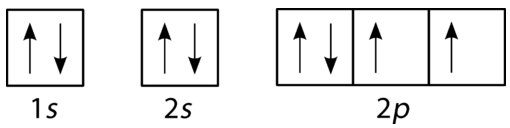
This orbital diagram represents:

a)

Carbon

b)

Boron

c)

Nitrogen

d)

Oxygen

88.

This orbital diagram represents

a)

Nitrogen

b)

Oxygen

c)

Carbon

d)

Neon

89.

What is incorrect about this orbital diagram?

a)

Both arrows in the 2p box should be pointing up

b)

There are too many electrons in the 1s orbital

c)

In the 2p boxes, there should only be 1 electron in the first 2p box and one in the 2nd 2p box

d)

All the arrows should be pointing up

90.

What does the Pauli Exclusion Principle state?

a)

An orbital can only hold a maximum of 2 electrons, each with opposite spins

b)

An orbital can hold a minimum of 6 electrons, each with opposite spins

c)

An orbital can hold a maximum of 6 electrons, each with the same spin

d)

An orbital can hold a maximum of 2 electrons, each with the same spin

91.

This orbital diagram represents

a)

Nitrogen

b)

Oxygen

c)

Carbon

d)

Neon

92.

This orbital diagram represents

a)

Sodium

b)

Magnesium

c)

Aluminum

d)

Iron

93.
Which element is pictured?
a)
neon
b)
fluorine
c)
magnesium
d)
argon
94.
Which element is depicted from this orbital diagram
a)
Fluorine
b)
Neon
c)
Chlorine
d)
Argon
95.
The maximum number of electrons that can be placed in an p orbital.  
a)
2
b)
6
c)
10
d)
14
96.
Maximum number of electrons that can be placed in an s orbital.  
a)
2
b)
6
c)
10
d)
14
97.

What electron configuration matches an oxygen atom?

a)

1s22s22p63s2, 3p64s23d104p5

b)

1s22s22p4

c)

1s22s22p6

d)

1s22s22p63s23p64s23d1

98.

What element has this orbital notation?

a)

lithium

b)

beryllium

c)

boron

d)

carbon

99.

Which atoms do not bond?

a)

Noble gases

b)

Alkali Earth Metals

c)

Alkaline Earth Metals

d)

Halogens

100.

Forms ionic bonds: ​ (a)   .

Forms covalent bonds: ​ ​ (b)   .

Choose from the below words
Metals and nonmetals
Nonmetals and nonmetals/nonmetals and metalloids
Nonmetals and nonmetals
Nonmetals and metalloids
Metals and metals
Metals and metalloids
Metalloids and metalloids
101.
What happens when the sodium atom loses an electron?
a)
It become negatively charged 
b)
It become positively charged
c)
none
102.
Which of the following has a full valence shell?
a)
Oxygen
b)
Neon
c)
Barium
d)
Carbon
103.
An ionic bond forms when atoms ___________ electrons.
a)
gain
b)
share
c)
increase
d)
transfer
104.
Which type of bond has a transfer of an electron from on atom to another?
a)
Polar Covalent 
b)
Non Polar Covalent
c)
Ionic
d)
Metallic
105.
If an atom loses two electrons what charge will it have?
a)
+ 2
b)
 - 2
c)
+1
d)
-1
106.
Which of the following is a characteristic property of ionic compounds?
a)
They form hard, brittle crystals with characteristic shapes
b)
They have low melting points
c)
They have low boiling points
d)
They contain no charged particles
107.
In what form can an ionic compound conduct electricity?
a)
when dissolved in water
b)
as a solid
c)
as a crystal
d)
when warmed slightly
108.
The bonds in Na2O are best described as 
a)
a.  covalent, because valence electrons are shared.
b)
covalent, because valence electrons are transferred
c)
ionic, because valance electrons are shared.
d)
ionic, because valance electrons are transferred. 
109.
Atoms gain or lose electrons to become stable by satisfying this rule.
a)
Lewis Structure rule
b)
Periodic Law
c)
octet rule
d)
Ionic Law
110.
What is a valence electron?
a)
an electron that is found in the outermost shell of an atom. 
b)
an electron found in the innermost shell of an atom.
c)
an electron found in the middle shell.
111.
How many more valence electrons does Oxygen need to be stable?
a)
6
b)
2
c)
4
d)
It's already stable with 8
112.
What happens when the sodium atom loses an electron?
a)
It become negatively charged 
b)
It become positively charged
c)
none
113.

Which atom has the negative dipole in this molecule?

a)

Hydrogen

b)

Fluorine

c)

Neither

114.
In covalent bonds, electrons are ___________.
a)
transferred
b)
gained
c)
lost
d)
shared
115.
In a polar covalent bond, electrons are shared ___________.
a)
equally
b)
unequally
c)
between non-metals with similar electronegativities
d)
between a metal and a non-metal
116.
Electronegativity is a measurement of the ability of a nucleus to...
a)
attract bonding electrons
b)
attract other nuclei
c)
attract elenece in the non-valence energy levels
117.
The most electronegative atom in the periodic table is:
a)
Fluorine
b)
Helium
c)
Neon
d)
Francium
118.
In this Lewis structure, the symbol above F means...
a)
electrons are being transferred to Fluorine
b)
electrons are less attracted to F than H
c)
electrons are more attracted to F than H
d)
Fluorine has formed a cation
119.
This is an example of a __________ bond.
a)
non-polar covalent
b)
polar covalent
c)
ionic
d)
metallic
120.
Partial charges like the ones shown here are called:
a)
dipoles
b)
deltas
c)
ions
d)
magnetic poles
121.
Which molecule contains bonds of GREATER polarity?
a)
H2O
b)
OF2
122.
Which molecule contains bonds with a GREATER polarity?
a)
HCl
b)
CCl4
123.
A bond with a partially negative end and a partially positive end is:
a)
ionic
b)
polar
c)
non-polar
d)
isometric
124.
A diatomic molecule like O2 is always_______ because electrons are shared ________.
a)
nonpolar; equally
b)
polar; equally
c)
nonpolar; unequally
d)
nonpolar; unequally
125.
If Boron bonds with Hydrogen, a ____________ bond forms.
a)
polar covalent
b)
nonpolar covalent
c)
metallic
d)
ionic
126.
If Bromine bonds with Hydrogen, a ____________ bond forms.
a)
polar covalent
b)
nonpolar covalent
c)
metallic
d)
ionic
127.

H-H is...

a)

polar

b)

nonpolar

128.

MgO is...

a)

ionic

b)

metallic

c)

covalent

129.

CO2 is...

a)

polar

b)

nonpolar

130.

SOCl2 is...

a)

polar

b)

nonpolar

131.

HCl is...

a)

polar

b)

nonpolar

132.

This molecule is...

a)

polar

b)

nonpolar

133.

Water is...

a)

polar

b)

nonpolar

134.

NH3 is...

a)

polar

b)

nonpolar

135.

Butane is...

a)

polar

b)

nonpolar

136.

Ethanol is...

a)

polar

b)

nonpolar

137.

CF4 is...

a)

polar

b)

nonpolar

138.

Which atom has the negative dipole in this molecule?

a)

Hydrogen

b)

Fluorine

c)

Neither

139.
In covalent bonds, electrons are ___________.
a)
transferred
b)
gained
c)
lost
d)
shared
140.
In a polar covalent bond, electrons are shared ___________.
a)
equally
b)
unequally
c)
between non-metals with similar electronegativities
d)
between a metal and a non-metal
141.
Electronegativity is a measurement of the ability of a nucleus to...
a)
attract bonding electrons
b)
attract other nuclei
c)
attract elenece in the non-valence energy levels
142.
The most electronegative atom in the periodic table is:
a)
Fluorine
b)
Helium
c)
Neon
d)
Francium
143.
In this Lewis structure, the symbol above F means...
a)
electrons are being transferred to Fluorine
b)
electrons are less attracted to F than H
c)
electrons are more attracted to F than H
d)
Fluorine has formed a cation
144.
This is an example of a __________ bond.
a)
non-polar covalent
b)
polar covalent
c)
ionic
d)
metallic
145.
Partial charges like the ones shown here are called:
a)
dipoles
b)
deltas
c)
ions
d)
magnetic poles
146.
Which molecule contains bonds of GREATER polarity?
a)
H2O
b)
OF2
147.
Which molecule contains bonds with a GREATER polarity?
a)
HCl
b)
CCl4
148.
A bond with a partially negative end and a partially positive end is:
a)
ionic
b)
polar
c)
non-polar
d)
isometric
149.
A diatomic molecule like O2 is always_______ because electrons are shared ________.
a)
nonpolar; equally
b)
polar; equally
c)
nonpolar; unequally
d)
nonpolar; unequally
150.
If Boron bonds with Hydrogen, a ____________ bond forms.
a)
polar covalent
b)
nonpolar covalent
c)
metallic
d)
ionic
151.
If Bromine bonds with Hydrogen, a ____________ bond forms.
a)
polar covalent
b)
nonpolar covalent
c)
metallic
d)
ionic