
Font size
 Worksheets
EMCE Exam Review
Total questions: 76
Worksheet time: 1hrs 24mins
Democritus believed that the universe was made of empty space and __________ .
molecules
compounds
elements
atoms
James Chadwick named the uncharged particles in the atomic nucleus
protons
electrons
neutrons
alpha particles
An element's atomic number is the number of __________ in the nucleus of each atom of that element.
neutrons
protons
electrons
positrons
Most of an atom's mass is contained in __________.
the electron orbits
the electron cloud
its outer energy shell
its nucleus
A calcium ion has 20 neutrons, 20 protons, and 18 electrons. What is the ion's charge?
2+
1+
1-
2-

Match the following.
Proton
Positive (+)
Electron
Negative (-)
Neutron
Neutral (0)

When Mendeleev published his periodic table, there were some spaces for undiscovered elements. Below is a section of a similar table. A reasonable value for the atomic mass of the missing element is _____.
101
72.3
68.2
34.8
In the modern periodic table, elements are arranged according to increasing _____.
atomic number
atomic mass
date of discovery
electrical conductivity
The elements in the second column from the left edge of the periodic table are the _____.
alkali metal
alkaline earth metals
transition elements
lanthanide and actinide series
Main-block transition metals, such as iron, make good building materials for all of the following reasons EXCEPT _____.
high density
insulation
strength
resistance to corrosion
At room temperature, most of the metals are _____.
soft
malleable
liquids
solid
In general, metals are _____.
poor conductors of heat
brittle
poor conductors of electricity
good conductors of heat
A halogen is found in group ______.
14
15
16
17
Which elements are located between the metals and the nonmetals on the periodic table?
halogens
metalloids
noble gases
synthetics

Which two elements share common characteristics based on the periodic table?
Sodium and Magnesium
Chlorine and Sulfur
Argon and Neon
Calcium and Bromine

What is the name of the element? (Periodic table will be needed)
sodium
magnesium
vanadium

What group and period does this element belong in? *
period 1 and group 3
period 3 and group 1
period 2 and group 3
period 3 and group 2

Which of these elements is in this group?
Lithium
Silicon
Aluminum
Strontium
Which two elements on the periodic table are in the same group?
Na and He
O and C
Li and Ne
He and Ar
Which pair of properties describes the elements in Group 1?
They are chemically stable
They have 8 valence electrons
They are the most reactive metals
They are the most reactive non metals

Which two atoms are elements in the same group in the periodic table?
Atom 3 and Atom 4
Atom 1 and Atom 4
Atom 3 and Atom 2
Atom 1 and Atom 2

Based on the data, which number shows the correct location of the element that is brittle and dull.
1
2
3
4
Based on the data, which number shows the correct location of the element that is malleable and a good conductor.
1
2
3
4

To which group does this atom belong?
1
3
13
11
Adding salt to ice _____ the melting point.
increases
decreases
Lithium
1 valence electrons
Barium
2 valence electrons
Aluminum
3 valence electrons
Bromine
7 valence electrons
Phosphorus
5 valence electrons
Which of the following is the correct atomic model for Boron?


Use your Periodic Table to match the following.

Lithium

Phosphorus

Carbon

Neon

Bromine

How many different types of molecules are pictured?
2
3
4
8

What type of substance is pictured?
element
compound
mixture
solution

What type of substance is pictured?
element
compound
mixture
solution
Substances are not evenly mixed; you can see all the different substances that it is made of.
Homogeneous mixture
Heterogeneous mixture
Fruit Loops, pizza, and Skittles are examples of ____________________ mixtures.
heterogeneous
homogeneous
pure
A pure substance shows ------------------ spot on chromatogram
0
1
2
3

What is the Rf value of the purple dye?
0.6
0.2
0.4
0.8
1.0
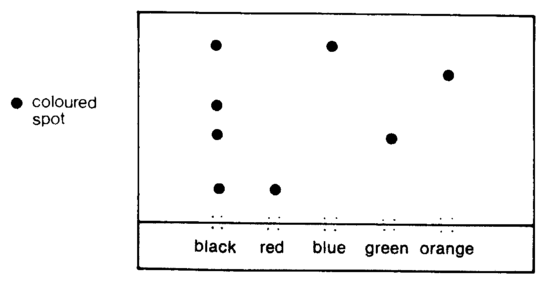
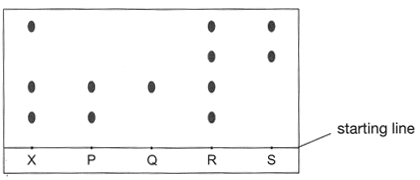

In the diagram below, there are four different colored inks represented by letters
S,G, F and H put on a filter paper along a pencil line. Which ink is made of more than one colour?
S
G
F
H

Is this an example of a physical or chemical change?
physical
chemical

Which of the dyes was a pure substance?
1
2
3
4

According to the pH scale, which item is more acidic than lemons?
battery
vinegar
milk
blood

According to the pH scale, which item is a stronger base than soap?
baking soda
ammonia solution
tomato
drain cleaner
A solution with a pH of 11.3 would be...
Acid
Base
Neutral
Acid and Base
Rohan and Daniel are conducting a science experiment. They are testing various substances to determine if they are acidic or basic. They squeeze a lemon into a test tube. What would they classify the lemon juice as?
acid
base
Harper and Kai were doing a science experiment. They had to identify the nature of vinegar. What should they conclude?
Vinegar is an acid
Vinegar is a base
Mia, Abigail, and Evelyn are conducting a science experiment in their school lab. They are testing various solutions to determine their pH levels. If a solution is neutral, what would be its pH level?
pH 1
pH 4
pH 7
pH 10
In a reaction A + B ----> C, reactant A has 4g and product C has 9g. How many grams does reactant B should have?
4g
5g
9g
14g
Bob puts 300 grams of ice into a pitcher with 900 grams of water. He gets distracted and comes back later to find that the ice has melted in the water. How many grams of water does Bob now have in the pitcher?
200 g
700 g
1,100 g
1,200 g
24 g of magnesium reacts with 14 g of fluorine to produce _____ g magnesium fluoride
62
38
24
14

What is the atomic number of silicon (Si)?
42
28
14
17
How many electrons do atoms need to be stable?
1
4
6
8

H2O
H2SO4
2H2 + O2 --> 2H2O
Which of the following IS a physical change?
Getting a haircut
Rusty metal
sour milk
A compound
In a Kool-Aid solution, water is the ______.
solute
solvent
solution
material

