
 Worksheets
Big Fun Semester Review
Total questions: 160
Worksheet time: 5hrs 54mins
Astronauts need all of the following to survive in space EXCEPT-
gravity
oxygen to breathe
exercise
protective clothing
Space stations require an oxygen system because the atmosphere in space -
is airless
is poisonous
smells bad
is humid
Which of the following accommodations on the space station is used by astronauts to combat the effects of microgravity on their bones?
special handles
velcro straps
exercise equipment
oxygen system
Radios are not required for astronauts to talk to each other when they are in the same room inside the space station because -
A space station is filled with air that carries sound waves
astronauts keep their helmets on inside the space station
computers are used to communicate inside the station
astronauts communicate with sign language in the space station
Spacesuits have layers that have high capacity for thermal insulation in order to -
regulate body temperature in the extremes of space
prevent the spread of bacteria that thrive in space
allow communication with the space station
prevent the astronaut from sweating inside the suit
What design element of an astronaut’s spacesuit protects him or her from micrometeoroids, which are tiny bits of space debris travelling at high speeds?
large oxygen tank
powerful jet packs
small radio communicator
tough outer shell
Phototropism
A plants growth response to gravity
A plants growth response to light
A plants growth response to touch
A plants growth response to water
Geotropism
A plants growth response to gravity
A plants growth response to light
A plants growth response to touch
A plants growth response to water
Thigmotropism
A plants growth response to gravity
A plants growth response to light
A plants growth response to touch
A plants growth response to water
Hydrotropism
A plants growth response to gravity
A plants growth response to light
A plants growth response to touch
A plants growth response to water
Downward growth of roots are _____________ response to gravity?
Positive
Negative
Neutral
There is no response
upward growth of stems are _____________ response to gravity?
Positive
Negative
Neutral
There is no response
Tropisms
Growth responses in plants; such as movement away from or toward a stimulus
The bodies way of keeping in balance
The which process causes a plant to wilt in response to too much or too little water
The bodies way of reacting to a stimulus

What tropism is being depicted
Thigmotropism
Phototropism
Gravitropism
Hydrotropism

What tropism is being depicted
Thigmotropism
Phototropism
Gravitropism
Hydrotropism

What tropism is being depicted
Thigmotropism
Phototropism
Gravitropism
Hydrotropism

Which plant would be stiff and rigid?
A
B

Which plant would be wilted or limp?
A
B
The plant wilts when pressure .....
increases
decreases
stays the same
none of the above

Turgor pressure is a result of water in what plant cell organelle?
Mitochondrion
Nucleus
Cell wall
Vacuole


Which organelle is responsible making food (Glucose) using sunlight?
Ribosomes
Nucleus
Chloroplast
Mitochondria

The raw materials of a chemical reaction. Located on the left side of a chemical equation.
water
energy
resources
reactants

The 'outputs' of a chemical reaction. Located on the right side of a chemical equation.
products
produce
consumers
detritis

Pigment which 'fills' chloroplast. This pigment absorbs sunlight.
nodules
stomata
chlorine
chlorophyll

A process plants use to turn sunlight into food: Conversion of light energy from the sun into chemical energy (stored in glucose).
toxoplasmosis
photosynthesis
aqua-synthesis
homeosynthesis

Taken in by the leaves of the plant to give the chloroplasts energy for food production.
chlorophyll
oxygen
water
sunlight
Sunlight provides what type of energy?
chemical energy
thermal energy
radiant energy
The reactants to photosynthesis are...
glucose and oxygen
carbon dioxide and water
The process of photosynthesis transforms _______ energy to _______ energy
radiant : thermal
thermal : chemical
radiant : chemical
chemical : radiant
In an ecosystem, the ultimate source of energy is
Sunlight
Water
Soil
Air

Animal that gets its energy and nutrition from eating plants.
Parasite
Herbivore
Carnivore
Ominvore

Animal that gets its energy and nutrition from eating meat.
Detritivore
Ominvore
Carnivore
Herbivore

Heterotrophs that get energy and nutrition from dead or decaying organisms or their waste products and recycle nutrients back to the ecosystem.
Producer
Trophic
Decomposer
Autotrooph
Autotrophs--The bottom trophic level where all organisms produce their own food, usually by photosynthesis.
Trophic Levels
Producers
Ominvores
Herbivores
How much energy is available to be passed on to the next level in a food web?
100%
10%
50%
75%


Carnivores that eat herbivores are considered
Secondary Consumers
Primary Consumers
Tertiary Consumers
Quaternary Consumers
What is the primary role of decomposers in an ecosystem?
To recycle nutrients
To produce energy
To capture sunlight
To provide shelter
In a food web, an organism that feeds on multiple types of organisms is called a
Omnivore
Carnivore
Herbivore
Producer
Herbivores--The second trophic level where herbivores eat the primary producers.
Detritivores
Autotrophs
Producers
Primary Consumers
The fourth trophic level where animals eat secondary consumers or below.
Herbivore
Autotroph
Tertiary Consumer
Tertiary Producer

Which of the following is a sign that a chemical reaction (or change) has occurred?
change in shape
melting
formation of a gas
dissolving

Is melting butter for popcorn a chemical or physical change?
chemical
physical


A change that does not result in a new substance.
smoke
physical
chemical
react
A chemical change
changes the physical properties of an object, but does not create a new substance.
creates a new substance and cannot be undone.
Which picture is an example of abrasion?


Weathering and erosion are NOT the same.
True
False

Freezing and Thawing are a part of...
Erosion
Deposition
Weathering
What is the effect of weathering on rocks and materials?
Weathering breaks down material and then moves it.
Weathering breaks down material but does not move it.
Chicken Pot Pie.
How is weathering different from erosion?
Weathering usually happens after erosion.
Weathering usually moves materials.
Weathering breaks down (disintegrates) materials, but does not move them. Erosion moves them.
Chicken Pot Pie.

These falling rocks, sand and debris are an extreme example of _____________.
Weathering
Erosion
Both
Neither
Chemical weathering is caused by:
Wind
Temperature Change
Acid Rain
Rust
Physical weathering is caused by:
Water
Temperature Change
Wind
Acid Rain

Over long periods of time, deposition may change the Earth’s surface by _____.
forming new land features.
breaking down large rocks into smaller ones.
washing away beaches.
moving topsoil.

_____ is the process by which soil and sediment (weathered rock) are transported (moved) from one place to another by water, wind, glaciers, and gravity
Erosion
Deposition
Weathering
Running Water
______________________ occurs when eroded materials stop moving and begin to build up.
Weathering
Erosion
Deposition
"Break, Take, Drop" =
Erosion, Weathering, Deposition
Deposition, Erosion, Weathering
Weathering, Erosion, Deposition
Weathering, Deposition, Erosion
Which would most likely result in primary succession?
old forest growing
undisturbed prairie
pollution kills mountain lake species
a Newly formed volcanic island
Both primary and secondary succession start with...
modifying an area to allow more complex organisms to appear
lichens and moss
never reach climax community
start from a volcano always
What best describes the term succession?
rapid changes that create an ecosystem overnight
gradual changes over time to fully create or restore and ecosystem
forest with the tallest trees
the rate species produce offspring
Why do grasses appear before shrubs in ecological succession?
loosen the dirt for new trees to take roots?
provide food for animals returning to the area
require plenty of sunlight to make their own food
can grow even in areas with shallow soil


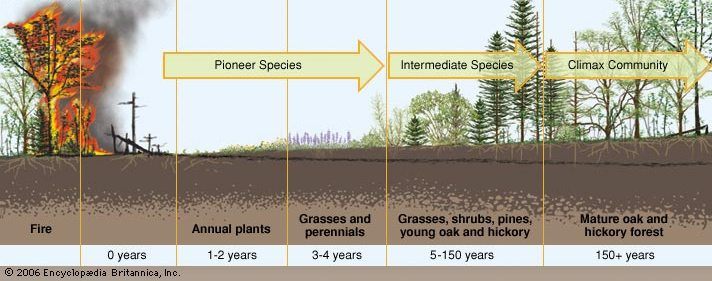
Previously occupied area is re-colonized following a disturbance that kills much or all of its community.
Primary Succession
Secondary Succession
Lichen
Political Succession
The end result of succession is...
Climax Community
Lichen
Volcano
Glacier Receding

What catastrophic event could cause contaminated water?
Tornado
Flood
Forest Fire
Volcanic Eruption

A diagram of the areas surrounding the Gulf of Mexico is provided.
A hurricane that comes in from the Gulf of Mexico will most likely have which of the following effects on a Texas habitat?
Plants on Goose Island are killed by a flash flood.
Trees in and around Austin are uprooted by heavy winds.
Birds that eat fish on Galveston Island become extinct.
Rains create new marshland habitats in Brazos Bend.
A forest fire can have which of the following positive effects?
Provides heat mammals need in colder seasons.
Increases annual rainfall by forming more clouds.
Clears underbrush to allow new plants to grow.
Drives away predators that eat smaller animals.
An species that influences the survival of many other species in an ecosystem.
invasive species
keystone species
producers
gemstone species
Low genetic diversity is a risk for organisms to become extinct. True or False?
True
False
The ability of an ecosystems to maintain biodiversity and production at a certain rate.
sustainability
ecosystems services
conservation


Abiotic is non-living

How do biodiversity and stability work together?
The lower the biodiversity the greater the stability of an ecosystem.
The higher the biodiversity, the less stable the ecosystem
The higher the biodiversity, the greater the stability of the ecosystem.
Biodiversity has nothing to do with ecosystem stability.

What is the best definition of animal adaptation?
Changes to an animal's diet.
Characteristics that help animals survive.
Characteristics of an animal's habitat.
Skills learned in order to hunt.
Animals who travel to warmer habitats in the winter to escape the cold are using which behavioral adaptation?
Mimicry
Camouflage
Hibernation
Migration
When animals go into a deep sleep during the winter, they are using which behavioral adaptation?
Hibernation
Mimicry
Migration
Camouflage
Fill in the blank: A ______________ adaptation is the way an animal looks in order to help them survive.
simple
behavioral
physical
extreme
I am a polar bear who lives in the arctic. My fur is a beautiful white, just like the snow I live in. What adaptation is this adaptation called?
camouflage
mimicry
migration
hibernation
Which part of the plant above is a variance that stores food for the plant?
Bulb
Leaves
Stem
Flower
a structure, behavior or trait in an organims that helps it survive (e.g. long neck)
adaptation
primary succession
secondary succession
mimicry

Some animals pretend to be dead to protect themselves from predators
Structural
Behavioral

What is a random change in a gene?
mutation
trait
chromosome
nucleus
How do you "win" at natural selection?
survive
go extinct
survive & reproduce
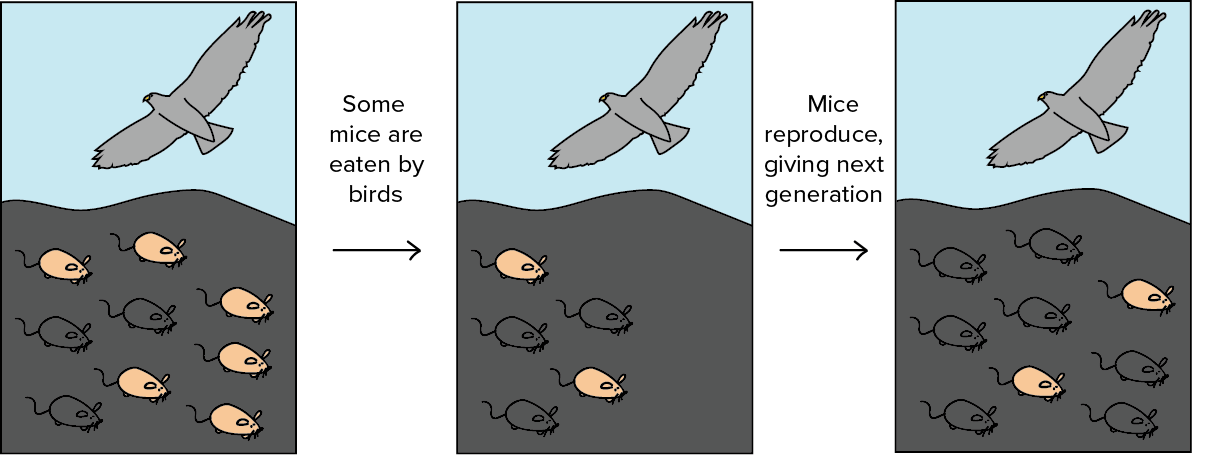
An example of selective breeding is
a dog breeder mating 2 dogs to make more dogs
a farmer grows bees to pollinate the plants on his farm
a person pollinates 2 white rose plants to only create white roses
One problem with selective breeding is
creating a new species
gene variety is lost
extinction of a species
Problems with selective breeding include
Better animals
Increased meat production
Animals can have bad health problems
more diversity
The purpose of selective breeding is to
get bigger animals
get smaller animals
create animals with desirable traits
create animals with bad traits
Selective breeding
organisms better adapted to their environment tend to survive and produce more offspring
process used by humans to develop new organisms with desirable characteristics

A student's model of an area near a city depicts many activities that affect the quality of the water in the area.
How does the agricultural activity most likely affect the surface water of the area?
F. Excess crop fertilizer is carried by runoff into the river, causing excess growth of water plants.
G. Excess crop material accumulates on the riverbanks, slowing the movement of the river water.
H. Crops reduce erosion, increasing the amount of soil entering the river.
J. Crops absorb pure water from the soil, causing the remaining water to contain more salt.
Many processes occur on the digestive system. Which process is best classified as a physical change?
F. Saliva converting the starch molecules in crackers into simple sugars.
G. Digestive enzymes breaking down proteins into smaller fragments.
H. Bacteria converting lactose into simple sugars in the intestines.
J. Teeth grinding an almond into smaller pieces in the mouth.

Ripping a piece of paper is an example of
Physical Change
Chemical Change

A chemical change is something that can be undone
True
False

Which of the following is NOT an example of a chemical change?
burning a log
rust forming on an object
gas burning on a stove
cutting lemons

Fireworks in an example of
Physical change
Chemical change

If a banana turns colors because it is rotten it is an example of
Physical change
Chemical change
both
niether

Biome with many different species of cacti and reptiles and very little rainfall.
Desert
Temperate Rainforest
Tropical Rainforest
Arctic Tundra

Which biome contains large populations of grazing herbivores, few species of birds, and deep, rich soil?
tropical rain forest
desert
deciduous forest
grassland


What biome is this?
rain forest
deciduous forest
Taiga
tundra

What biome is this?
deciduous forest
taiga
desert
grassland
How does the food chain start?
Plant life uses energy from the sun to make food.
Insects like grasshoppers eat plant life.
Animals like rats eat insects.
Humans eat large animals and plant life.

The model above is an example of a ...
food chain
food web
habitat
ecosystem

Which of these is an organism that does not depend on another living thing for food?
the Sun
an insect
a plant
an animal

What does the arrow point to in a food chain?
only the plants in a food chain
only the animals in a food chain
the organism that gets the energy
the organism that lives the longest
Which of the following is a structural adaptation for the underlined animal?
A butterfly has bright colors to warn predators that it is poisonous.
A hognose snake rolls over, slows its breathing, and hangs its tongue out to play dead.
A herd of buffalo encircle their young to protect them from a pack of wolves.
A dung beetle rolls a piece of dung across the desert.
An example of a structural adaptation is...
a turtle hiding inside its shell
The spikes on a porcupine fish
a rabbit burrowing underground
a viper biting when threatened
____________occurs when one animal displays physical or behavioral traits that copy those of a different species.
Adaptation
Hibernation
Mimicry
Camouflage

What catastrophic event is most likely to occur in a grassland?
Tsunami
Wildfire
Volcanic Eruption
Hurricane

The river on the left is a younger version of the river on the right. What caused the river to change its shape?
Volcanic eruptions and weathering
Glaciation and earthquakes
Crustal uplift and compression
Deposition and erosion

Fertilizer can seep through the ground to reach groundwater, what effect can it have?
Fertilizer can cause groundwater to reverse flow
Fertilizer can cause groundwater to freeze
Fertilizer can cause groundwater to become undrinkable
It will seep into the school
Is erosion a physical or chemical change?
Physical Change
Chemical Change
TRUE OR FALSE: All mutations are bad
TRUE
FALSE
Which word describes the word "variation"?
Adaptations
Differences
Traits
Genetics
What was the name of Charles Darwin's book where he discussed natural selection?
"Natural Selection and Evolution: a Discussion"
"A Study on Life Origins"
"Galapagos Discoveries"
"On the Origin of Species"

