
 Worksheets
Semester 1 Review 2023
Total questions: 76
Worksheet time: 3hrs 35mins
a force is best defined as ---
the application of weight
a push or pull that is exerted on matter
the flow of electric charges
a bond in which electrons are shared
A student pushes against a wall with 20 N of force and the wall does not move. In this situation, the wall exerts --
0 N of force
less than 20 N of force
20 N of force
more than 20 N of force

The diagram below show the forces acting on a soccer ball.
In which of the diagrams will the ball remain motionless?
W
X
Y
Z

In the diagram below, a girl sits on a sled and slides down a hill of snow. Which arrow represents the force of friction opposing the motion of the sled down the hill?
Arrow A
Arrow B
Arrow C
Arrow D
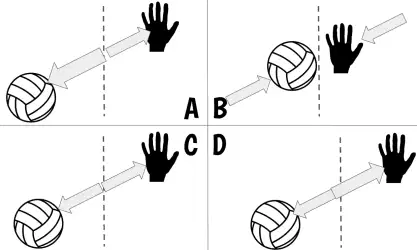
A volley ball player hits a ball. A free body diagram for this system would look like...
Diagram A
Diagram B
Diagram C
Diagram D
Changes in motion during a collision are caused by...
transfer of kinetic energy.
forces between objects.
Changes in shape during a collision are caused by...
transfer of kinetic energy.
forces between objects.
Peak force is...
The maximum amount of force that can be applied to an object before it permanently deforms.
The maximum amount of deformation that an object can experience before it breaks.
The largest amount of force an object experiences during a collision.
The largest amount of force an object can experience and only deform temporarily.
When the speed of one or more objects in a collision increases...
The peak force in the collision decreases.
The peak force in a collision increases.
The kinetic energy in the system decreases.
The kinetic energy in the system increases.
When the mass of one or more objects in a collision increases...
The peak force on the heavier object is greater.
The peak force on the lighter object is greater.
The peak force on both objects is less, but still equal.
The peak force on both objects is greater but still equal.
When the speed of one or more objects in a collision increases...
The peak force on the faster object is greater.
The peak force on the slower or stationary object is greater.
The peak force on both objects is less, but still equal.
The peak force on both objects is greater but still equal.
If the mass of the objct doubles, the amount of Kinetic Energy (a) .
If the speed od an object doubles, the amount of kinetic energy (a) .
How does the mass of a moving object affect its kinetic energy?
(assume the objects are all moving at the same speed)
Moving objects with less mass have more kinetic energy.
Moving objects with more mass have more kinetic energy.
Moving objects with more mass have less kinetic energy.
The mass of a moving object doesn't affect its kinetic energy.
How does the speed of a moving object affect its kinetic energy?
(assume the objects have the same mass)
Faster moving objects have more kinetic energy.
Slower moving objects have more kinetic energy.
Faster moving objects have less kinetic energy.
The speed of a moving object doesn't affect its kinetic energy.
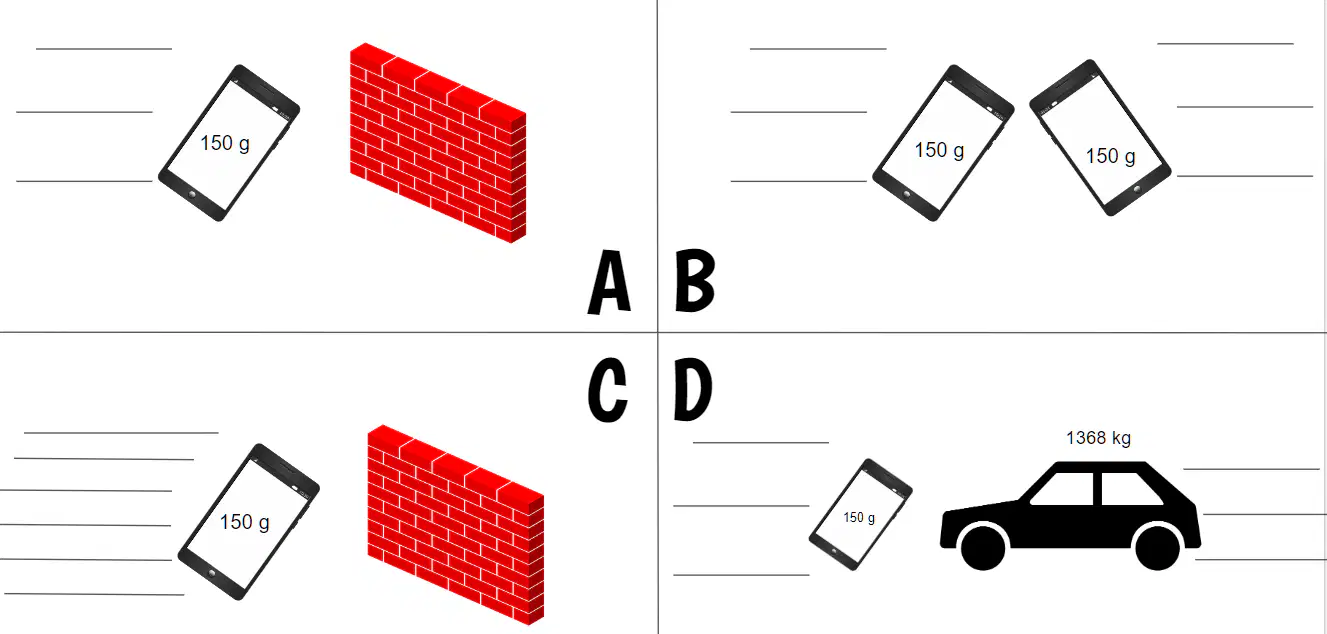
Which system has the MOST peak force?
System A
System B
System C
System D
Which system has the LEAST kinetic energy?
System A
System B
System C
System D
What is the elastic limit of a material?
the maximum amount of kinetic energy that can be applied before an object breaks
the maximum amount of force that can be applied before an object breaks
the maximum amount of force that can be applied before an object deforms permanently
the maximum amount of kinetic energy that can be applied before an object deforms permanently
The breaking point of a baseball bat is 756 Newtons, the elastic limit of a baseball bat is 530 Newtons. When a baseball hits the bat, both objects experience a force of 500 Newtons. What happens to the bat?
The bat bends and it permanently deformed.
The bat bends, but isn't permanently deformed.
The bat breaks.
The bat does not deform.
What best explains what usually happens to a volleyball during the collisions that happen during a game?
A volleyball doesn't deform because there isn't enough force in the collisions.
A volleyball doesn't deform because the force is less than the elastic limit.
A volleyball deforms temporarily because the force is less than the elastic limit.
A volleyball deforms permanently because the force is greater than the elastic limit.

What kind of sound would be heard with this type of wave?
Quiet, low pitch
Loud, low pitch
Quiet, high pitch
Loud, high pitch

What kind of sound would be heard with this type of wave?
Quiet, low pitch
Loud, low pitch
Quiet, high pitch
Loud, high pitch

What is being labeled in this picture?
Amplitude
Frequency
Wavelength
Peak

What part of the wave is labeled here?
Amplitude
Frequency
Peak
Wavelength

What part of the wave is labeled here?
Amplitude
Frequency
Peak
Wavelength

What part of the wave is labeled here?
Amplitude
Frequency
Wavelength
Valley

Which wave would be the result of higher energy transfer?
left
right

When the speaker vibrates, why do the air particles move?
The air particles move because the speaker pushes on the air particles.
The air particles move because of the sound.

How do the air particles between the speaker and sound detector move?
The particles travel across the whole space to the sound detector.
The particles vibrate back and forth.

What moves across the whole sound wave?
Air particles
Energy

If the sound had a large amplitude, how would the particles move?
They would vibrate back and forth farther away from the speaker.
They would vibrate back and forth closer to the speaker.
They would vibrate back and forth faster.
They would vibrate back and forth slower.

Why does the sound detector vibrate?
It vibrates because the speaker is playing sound.
It vibrates because the air molecules are pushing on the sound detector.

Match these parts of a sound wave
Amplitude
volume
Frequency
pitch
Compression
wave close together
rarefaction
wave spread out
Match these parts of a light wave
Amplitude
height of the wave
wavelength
distance from wave to wave; gives light its color
crest
top
trough
bottom
frequency
how often waves occur
Select all that apply. Sound -
requires a medium (matter) to travel through
does NOT require a medium (matter) to travel through.
CANNOT be heard in the vacuum of space
CAN be heard in the vacuum of space
is mechanical energy
Select all that apply. light-
requires a medium (matter) to travel through
does NOT require a medium (matter) to travel through.
CANNOT be seen in the vacuum of space
CAN be seen in the vacuum of space
is radiant energy

What material is attracted to a magnet?
Water
Iron
Metal
Silver
What happens when two north poles of magnets are placed together?
they attract
they cancel each other out
the strength of the magnet is doubled
they repel
A north pole of one magnet and a south pole of another magnet will attract
False
True
both options are correct
both options are wrong
Magnetism is a type of __________
book
animal
force
plant
The space around a magnet where the force of a magnet can attract best is called a _________
horseshoe magnet
magnetism
magnetic field
bar magnet
Magnetic field around the magnet is strongest at the-----------.
middle
Poles
inside
outside
When the coil of copper acts like a magnet when it is connected to a battery (or electricity), it is known as _____________
a compass needle
an electromagnet
current
matter
In which way can the strength of an electromagnet be increased?
add more loops of copper wire
decrease the number of loops of copper wire
use only a straight piece of copper wire
decrease the amount of the current

What part of the atom contains the negative charge?
Proton
Neutron
Electron
When matter becomes charged, what particels are moved?
Protons
Neutrons
Electrons
Like charges (+ and +) or (- and -)...
Attract
Repel

Why does the charged balloon stick to the wall?
Gravity holds it there
The negative charge on the balloon pushes the positive charges away.
The negative charge on the balloon pushes the negative charges away.

In the Balloon Lab, why did the balloons move away from each other?
They both have positive charge.
They both have negative charge.
The have opposite charge.

What is Electric Current?
Getting shocked.
The flow of electrons.
The buildup of electrons.
The light shining.
Which factor DOES NOT affect the strength of the electric force?
distance between objects
magnitude of the charges
mass of the objects
What is the INDEPENDENT variable? You are testing which type of paper airplane goes furthest?
the paper used
the type of paper airplane
the distance of each plane's flight
how hard the plane is thrown
Does the flavor of ice cream effect how fast the ice cream melts? The flavor of ice cream is the....
independent variable
dependent variable
Does the type of shoe worn during a 30 meter dash affect the speed of the runner? The speed of the runner is the...
independent variable
dependent variable
How does increasing the slope of a ramp affect how far a marble travels? Increasing the slope is the...
independent variable
dependent variable
What effect does decreasing the temperature of a room have on a lifespan of a battery? The temperature of the room is the...
independent variable
dependent variable
How does watching TV during studying affect a student’s test grades? Student's grades are the....
independent variable
dependent variable
How does adding cardio to one’s daily schedule affect their heart rate? The heart rate is the...
independent variable
dependent variable
What is an independent variable?
the variable that changes because another variable changes
independent variables are only found on pie charts.
a variable most often found on the y-axis
the variable the experimenter changes or manipulates.
What is a dependent variable?
the variable the experimenter changes or manipulates.
the variable that changes because another variable changes
dependent variables are only found on pie charts
a variable most often found on the x-axis
Which type of graph best represents data that shows a change over a period of time?
line
bar
table
circle


A ____________ shows the overall trend of all the data taken in an experiment.
line of best fit
slope
position
direction
What is a data table?
Is a visual tool that uses that uses bars to compare data among categories
Used to compare the parts of a whole
Any display of information in tabular form, with rows and or columns named
Is a visual tool that uses that uses lines to compare data among categories

The cooler the temperature, the louder the crickets chirp.
The crickets cannot chirp at temperatures lower than 10 degrees C.
The warmer the temperature, the more often crickets chirp.
The temperature and the chirping of crickets are not related.



