
 Worksheets
Module 7 Survive and Thrive Review
Total questions: 37
Worksheet time: 1hrs 14mins


The bottom graph shows what happens when the two species are grown together. It shows that:
One population goes down because both species have a similar niche
Both populations go up because they have different niches
Both populations go up because they have a similar niche
A niche ________________.
includes everything the organism does and needs in its environment.
is specific to each individual animal and plant.
Both are true.
What happens when two species have similar niches?
The two species will learn how to cooperate with each other.
Increase in population size for both species.
There will be an increase in competition and one species may die from lack of resources.
There is no effect or impact on the population size or survival of either species.
Which of the following represents a way animals separate their niches?
They eat at different heights of the same plant
They eat different types of food
They eat at different times of day
All of the above!

What was the Independent Variable?

The factor that is observed or measured during an experiment; the data collected
Independent Variable
Constant
Dependent Variable
Control Group
The factor that is tested or that the scientists changes during an experiment
Independent Variable
Constant
Dependent Variable
Control Group

Maya designed an experiment to answer the following question: How does the amount of water given to a lima
bean seed affect how tall it grows?
In this experiment, what is the INDEPENDENT VARIABLE?
the amount of water
the kind of plant
the type of soil
the amount of sunlight it gets
Steve wanted to see how temperature affected heart rate. What is the DEPENDENT variable?
temperature
heart rate
Mrs. Barton wanted to see how different types of music affected students' pulse rates. She played different types of music: heavy metal, rap, R&B, alternative, pop, country, and classical music. What constant should be considered when doing this experiment?
Which of the following is a reason seeds would sprout more often in elephant dung than in soil?
The dung has less nutrients than soil
The seeds get broken down less in dung
The seeds can move to areas where there is less competition

This is an onion root cell in the process of mitosis. Look at the cell identified by the black pointer. Which part of the cell cycle is it going through?
Interphase
Mitosis

These plant cells are in various phases of the cell cycle. Which phase of the cell cycle is the cell labeled "A" in?
INTERPHASE
MITOSIS
Which of the following can you see when a cell is in mitosis?
A nucleus
dark chromosomes
loose DNA
chloroplasts
Why is mitosis necessary?
To make more cells to help organisms grow
To make food for the cell
To keep cells from exploding
The gas taken in by plants from humans and other animals is
H2O
C2
CO2
COOH3
In order to conduct photosynthesis plants need
Sunlight, O2 gas, CO2 gas
Water, Sunlight, H2O
Sunlight, Shade and Fertilizer
Sunlight, Water, CO2 gas
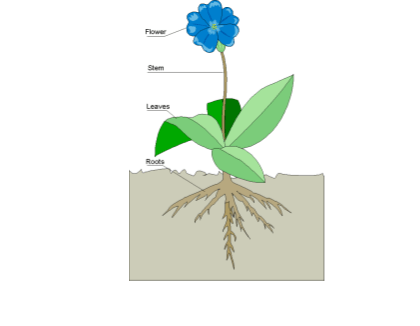
Which plant part absorbs water ?

Which plant part collects the sun's energy and water?

This equation is for
cellular respiration
photosynthesis
Which of the following statements best describes the term photosynthesis?
When plants absorb the energy from the sun.
How plants reproduce.
The process by which plants make their own food.
The process by which animals make their own food.
In what plant part does photosynthesis occur?
Cell Wall
nucleus
Chloroplast
Cytoplasm
What type of organisms will perform photosynthesis?
plants and animals
animals only
plants only
humans only

The graph above has oxygen as the Dependent Variable and light intensity as the Independent variable. According to the graph, at what point is the rate of photosynthesis the HIGHEST?
0 light units
5 light units
12 light units
The graph does not give this information


What are the reactants of Cellular Respiration? (What is needed for Cellular Respiration to occur?)
Glucose and Oxygen
Carbon Dioxide and Water
Glucose and Water
Carbon Dioxide and Oxygen
What are the products of Cellular Respiration? (What is made in Cellular Respiration?)
Glucose and Oxygen
Carbon Dioxide and Water
Glucose and Water
Carbon Dioxide and Oxygen
Cellular Respiration occurs in what cell organelle?
chloroplast
cytoplasm
mitochondria
animal

What is the purpose of cellular respiration?
Make glucose
Make energy
Make oxygen

Photosynthesis requires _________ where as cellular respiration requires ____________.
Glucose; ATP
Sunlight; Glucose
Sunlight; Sunlight

How are the photosynthesis and cellular respiration related?
The products of photosynthesis are the reactants of cellular respiration.
The reactants of photosynthesis are the reactants of cellular respiration.
The products of cellular respiration are the products of photosynthesis.

In cellular respiration, organisms need _____________ and release ___________.
Carbon Dioxide; Oxygen
Oxygen; Carbon Dioxide

This equation represents
cellular respiration
photosynthesis

