wayground logo

Free Printable Worksheets

Font size

S
M
L
XL
Worksheets

adaehad

Total questions: 95

Worksheet time: 2hrs 32mins

Name
Class
Date
1.

The (a)   absorb water and minerals

2.

The flower produce...

(a)  

3.

it is the process of ...

(a)  

4.

Transport water and nutrients around the plant is the function of...

(a)  

5.

Hold the plant in the soil is the function of...

(a)  

6.

The sunflower can produce...

(a)  

7.

Attract the insect to pollinated is the function of...

(a)  

8.

The air taken from leaves is called...

(a)  

9.

The fruits is part of...

(a)  

10.

(a)   produce oxygen and food.
11.
Leaves need nutrients and water to __________.
a)
Make food for the plant
b)
Make energy for the plant.
c)
Keep the plant cool in the summer.
d)
Make water.
12.
Plants _________ with air.
a)
turn oxygen into carbon dioxide
b)
always breathe
c)
do not do anything
d)
turn carbon dioxide into oxygen
13.
Would a seed planted in the winter start to grow right away?
a)
Yes
b)
No
14.
Short Answer: Why wouldn't a seed planted in winter start growing right away?
a)
It will grow during the winter.
b)
There is not enough water during winter.
c)
the temperature is too cold.
d)
None of the above.
15.
What do the roots of a plant do?
a)
take in sunlight for the plant
b)
make food for the plant
c)
take in water and nutrients
d)
none of the above
16.
The _______ of the plant makes food from sunlight.
a)
leaves
b)
roots
c)
stem
d)
flowers
17.
What is the function of the stem of a plant?
a)
takes in water and nutrients
b)
moves water and nutrients to other parts of the plant
c)
makes flowers on the plant
d)
none of the above
18.
Plants need sunlight to ________.
a)
breathe
b)
keep the plant warm
c)
make food for the plant
d)
plants do not need sunlight
19.
Which of the following list all basic things that plants need to live and grow.
a)
carbon, air, big ceramic pot
b)
rocks water, air, sun
c)
correct temperature, sun, water
d)
water, air, sunlight, nutrients, correct temperature
20.
The flower _______ for the plant.
a)
makes food
b)
makes seeds
c)
collects water and nutrients
d)
does not do anything
21.
Short Answer on the Test (You have to know the correct order.) What part of the plant life cycle is shown?
a)
Seed Germination
b)
Growth
c)
Making New Seeds
d)
Death
22.
Short Answer on the Test (You have to know the correct order.) What part of the plant life cycle is shown?
a)
Seed Germination
b)
Growth
c)
Making New Seeds
d)
Death
23.
Short Answer on the Test (You have to know the correct order.) What part of the plant life cycle is shown?
a)
Seed Germination
b)
Growth
c)
Making New Seeds
d)
Death
24.
Short Answer on the Test (You have to know the correct order.) What part of the plant life cycle is shown?
a)
Seed Germination
b)
Growth
c)
Making New Seeds
d)
Death
25.
What part of the plant is the top arrow pointing at?
a)
Flower
b)
Leaves
c)
Stem
d)
Roots
26.
What part of the plant is the second arrow pointing at?
a)
flower
b)
leaves
c)
stem
d)
roots
27.
What part of the plant is the third arrow pointing at?
a)
flower
b)
leaves
c)
stem
d)
roots
28.
What part of the plant is the bottom arrow pointing at?
a)
flower
b)
leaves
c)
stem
d)
roots
29.
Plants need the following:
a)
air, water, space, sunlight
b)
air, water, oxygen, space
30.
Which part of the plant makes the food?
a)
roots
b)
stem
c)
leaf
d)
flower
31.
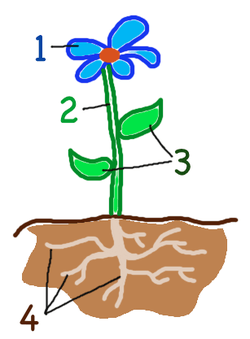
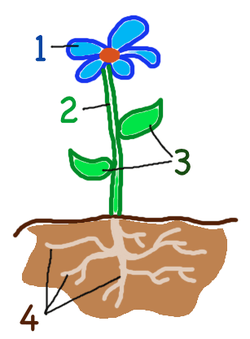
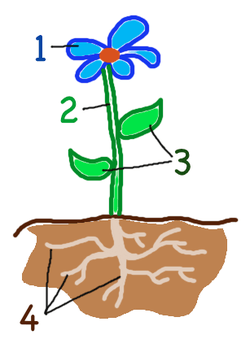
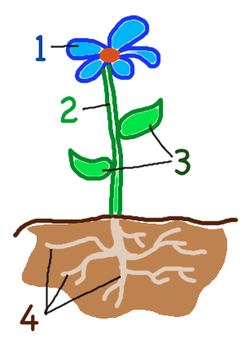
What part of the plant is #1?
a)
flower
b)
stem
c)
root
d)
leaf
32.
What part of the plant is #2?
a)
leaf
b)
flower
c)
stem
d)
root
33.
What part of the plant is #3?
a)
leaf
b)
root
c)
flower
d)
stem
34.
What part of the plant is #4?
a)
leaf
b)
flower
c)
stem
d)
root
35.
The part of the plant that holds the plant in place and absorbs water and minerals from the soil.
a)
stem
b)
roots
c)
leaves
36.
This part of the plant acts like an "elevator" carrying nutrients to the plant.
a)
roots
b)
stem
c)
leaves
d)
flower
37.
who uses photosynthesis 
a)
us
b)
no body
c)
i dont know 
d)
plants
38.
The function of a ___ is to absorb water, store food, and anchor plants. 
a)
flower
b)
leaf
c)
stem
d)
root
39.
The roots absorb what for the plant? 
a)
Water and Nutrients
b)
Soil and Sun
c)
Warmth and Water
d)
Sun and Photosynthesis
40.
The process of plants creating their own food is called?
a)
Germinate 
b)
Nutrients 
c)
Photosynthesis
d)
Plant Life 
41.
All seeds have 
a)
Seed Coat
Seed Coat 
b)
First Seed
c)
Embryo
d)
All of the above
42.
Which are substances that living things need to grow. Nutrients include food, air, water, and vitamins and minerals.
a)
Plants
b)
Soil
c)
Nutrients 
43.
The movement of pollen from one plant to another. 
a)
Reproduce
b)
Photosynthesis 
c)
Pollunation 
44.
Which is like a straw absorbing water and minerals from the soil
a)
Roots
b)
Stems
c)
Leaves 
45.
Which acts like the plant's plumbing system, conducting water and nutrients from the roots and food in the form of glucose from the leaves to other plant parts.
a)
Roots
b)
Stems
c)
Leaves 
46.
The green pigment, or color, found in plants that helps the plant make food is called?
a)
Photosynthsis 
b)
Chylorophyl 
c)
Polluniation 
47.
Plants give off which of the following?
a)
Carbon Dioxide
b)
Oxygen 
c)
All of the Above 
48.
Humans breathe out which of the following?
a)
Oxygen 
b)
Carbon Dioxide
c)
All of the above 
49.
Which do plants do?
a)
Make Oxygen
b)
Make Food
c)
Make Animal Habitats 
d)
All of the above
50.

__________ is the process that plants use to breathe and make food.

a)

Photographs

b)

Oxygen

c)

Hydrogen

d)

Photosynthesis

51.

What 3 things do plants need for the process of photosynthesis?

a)

Sunlight, oxygen and sugar.

b)

Water, soil and oxygen.

c)

Sunlight, carbon dioxide and water.

d)

Sunlight, soil and water.

52.

What energy does the plant need from the Sun to make food (or carry out photosynthesis)?

a)

light energy

b)

heat energy

c)

electrical energy

53.

What do plants take in through their ROOTS to make food (or carry out photosynthesis)?

a)

Carbon Dioxide

b)

Water

c)

Light

54.

What do plants take in through the STOMATA, which are found in the leaves, for photosynthesis?

a)

Carbon Dioxide

b)

Oxygen

c)

Light

55.

Why is leaf Z not able to make food?

a)

The leaf could not receive light.

b)

The leaf could not receive water.

c)

The leaf could not receive carbon dioxide.

56.

Why is leaf Y not able to make food?

a)

The leaf could not receive light.

b)

The leaf could not receive water.

c)

The leaf could not receive carbon dioxide.

57.

Both plants were watered daily. Which plant will be able to photosynthesize?

a)

Plant A only

b)

Plant B only

c)

Plant A and Plant B

58.

What does germination mean?

a)

When the tiny plant in a seed (embryo) begins to grow

b)

When a plant dies

c)

When a plant needs food

d)

When a plant needs sunlight

59.

What is the first plant part that comes out of the seed?

a)

Flower

b)

Fruit

c)

Root

d)

Stem

60.

What grows after the root?

a)

Stem

b)

Leaves

c)

Flower

d)

Fruit

61.

What does the gardener do to improve the soil?

a)

By not putting water

b)

By putting oil over it

c)

By adding compost and manure to it

62.

What will happen if we do not water a plant?

a)

It will grow

b)

It will stay the same

c)

It will die

63.

What does a plant need to grow

a)

Darkness and a cold place

b)

Light and warmth

64.

After the roots and stem the _______ grow

a)

Flower

b)

Fruit

c)

Vegetable

d)

Leaves

65.

What do we get from trees that’s used to make things?

a)

wood

b)

steel

c)

milk

d)

plastic

66.

Conifers are sometimes called:

a)

deciduous

b)

ferns

c)

cacti

d)

evergreens

67.

Trees with needles are in a group called:

a)

deciduous

b)

algae

c)

conifers

d)

mosses

68.

Deciduous trees have leaves that are:

a)

flat and broad

b)

pointy

c)

purple

d)

evergreen

69.

By counting annual growth rings you can estimate the:

a)

age of tree

b)

type of tree

c)

color of tree

d)

personality of tree

70.

Stems of trees are called:

a)

roots

b)

runners

c)

leaves

d)

trunks

71.

You can think of leaves and needles on trees as:

a)

animals

b)

food factories

c)

parasites

d)

insects

72.

Trees are held into the ground by:

a)

roots

b)

stems

c)

leaves

d)

trunks

73.

A tree is tall. A shrub is:

a)

very tall

b)

underground

c)

short

d)

tiny

74.

Trees have stems and branches made of:

a)

grass

b)

wood

c)

steel

d)

dirt

75.

What would most likely happen to a tree during a drought?

a)

It would have lots of fruit.

b)

It would have many leaves.

c)

It would melt.

d)

It would die.

76.

A tree is a good habitat for:

a)

squirrels

b)

birds

c)

insects

d)

all of the above

77.

Forest is an area in which the main living things are

a)

mountains

b)

animals

c)

trees

d)

animals and trees

78.

There are ____ types of Forest Ecosystem.

a)

2

b)

3

c)

4

d)

5

79.

The Four Types of Forest Ecosystem are......

a)

Deciduous, Tropical Rain Forest, Coastal Forests, and Coniferous Forests

b)

Deciduous, Tropical Fruit Forest, Coastal Forests, and Island Forests

c)

Delicious, Tropical Rain Forest, Coastal Forests, and Coniferous Forests

d)

Deciduous, Tropical Rain Forest, Portal Forests, and Coniferous Forest

80.

Deciduous Forests are

a)

made up mostly of Banana and Pineapple Trees.

b)

made up mostly of Tangan-tangan and Mango Trees.

c)

made up mostly of Coconut and Avocado Trees.

d)

made up mostly of Maple and Oak Trees.

81.

Deciduous Forests can be found in places that have...

a)

cold weather

b)

warm, wet summers, and cold winters.

c)

sunny weather

d)

rainy weather

82.

Tropical Rain Forests grow in places that are ...... like Hawai'i and Costa Rica.

a)

cold all year

b)

rainy all year

c)

hot and wet all year

d)

sunny all year

83.

Coastal Forests grow where there is a lot of .........

a)

rain

b)

snow

c)

sunlight

84.

Coniferous Forests contain mostly of .......

a)

Conifers such as pines, spruces, and firs.

b)

Banana Trees

c)

Maple Trees

d)

Oak Trees

85.

This is a Deciduous Forest.

a)
b)
c)
d)
86.

This is a Tropical Rain Forest.

a)
b)
c)
d)
87.

This is a Coastal Forest.

a)
b)
c)
d)
88.

This is a Coniferous Forest.

a)
b)
c)
d)
89.
It is dark in this layer of the rain forest.
a)
canopy
b)
forest floor
90.
Rain forests are near the...
a)
equator
b)
ocean
91.
This layer has most of the plants and animals
a)
canopy
b)
understory
92.
This habitat is ...
a)
hot and dry
b)
very warm and wet
93.
This layer has some sunlight, and some animals.
a)
forest floor
b)
understory
94.
This layer has the tallest trees.
a)
understory
b)
emergent layer
95.
People are cutting down the rain forests to use the land. Other people are making laws to stop cutting the trees. The laws help ________ the rain forests.
a)
grow
b)
protect