
 Worksheets
Human Anatomy Midterm Review
Total questions: 101
Worksheet time: 1hrs 24mins


Coccyx is located which part of skeletal system?
Head
Neck
Tailbone
Fist
Which tissue is associated with having a matrix?
Epithelial
Nervous
Muscular
Connective
cells→ ___→ organs→ organ systems→ organism
What can fit in the blank?
Macromolecules
Cell Products
Proteins
Tissues
The muscles are ____ to the skin.
Superficial
Proximal
Distal
Deep
The heart is located ____ to the diaphragm.
Superior
Inferior
Medial
Lateral
The shoulder JOINT is ____ to the elbow JOINT.
Proximal
Distal
Superior
Inferior
Anatomical terms that apply to the backside of the body when it is in anatomical position:
Ventral and Anterior
Back and Rear
Posterior and Dorsal
Cephalic and Lateral
The gluteal region is located on the _____ surface of the body.
Superior
Inferior
Anterior
Posterior
A sagittal section cuts the body into ____ and ____ parts.
Right and Left
Superior and Inferior
Anterior and Posterior
A frontal section divides the body into ____ and ____ parts.
Right and Left
Superior and Inferior
Anterior and Posterior
A transverse or cross section divides the body into _____ and ____ parts.
Right and Left
Superior and Inferior
Anterior and Posterior
Cells in your body get together to form:
Tissues
Atoms
Organs
The Axial parts are in line with the center of your body
true
false
The top of your body is called
upstairs
cranial
anterior
"Proximal" means closer, while "distal" means further
true
false
Ventral cavity that houses the lungs.
Thoracic
Abdominal
Pelvic
Cranial
Lateral means what?
To the right
To the left
To the side
At the top
Which plan divides the body into anterior and posterior?
Coronal Plane
Transverse Plane
Sagital Plane
Which plane divides the body into superior and inferior?
Sagital
Coronal
Transverse

What are the functions and characteristics of connective tissue?
Contracts to produce movement
Covers and protects body surfaces and organs
Transmits electrical signals throughout the body
Provides support and structure to the body

What are the functions and characteristics of nervous tissue?
Contracts to produce movement
Provides support and structure to the body
Transmits electrical signals throughout the body
Covers and protects body surfaces and organs

How are tissues organized into organs and organ systems?
By generating electrical impulses
By secreting hormones
By grouping together cells with similar functions
By forming a network of blood vessels

What are the functions of the skeletal system?
To contract and relax to produce movement
To cover and protect body surfaces and organs
To provide support and structure to the body
To transmit electrical signals throughout the body

What bone(s)?
Ulna
Radius
Humerus
Phalanges

What bone(s)?
Sacrum
Pelvis
vertebrae
ribs

What bone(s)?
Humerus
Fibula
Tibia
Tarsals

What bone(s)?
Hyoid bones
Clavicles
Scapulas
Vertebrae

What bone(s)
Patella
Femur
Tibia
Fibula

What bone(s)?
Ribs
Cartilage
Sternum
Clavicle

What bone(s)?
parietal
frontal
temporal
lacrimal

Which bone(s)?
parietal
temporal
saggital
maxillary

What bone(s)?
maxilla
mandible
lamboidal
parietal

What bone(s)?
frontal
parietal
occipital
temporal
What is the study of the structure and relationships between body parts called?
Anatomy
Physiology
Chemistry
Physics
What is the science of how body parts come together to function called?
Anatomy
Physiology
Chemistry
Physics
Which term describes structures closer to the center of the body?
Medial
Lateral
Proximal
Distal
Your collar bone is also known as what?
Sternum
Sacrum
Clavicle
Manubrium
Your radius bone is on which part of your lower arm?
Thumb Side
Pinky Side
True or false: Carpals are in the hand, and tarsals are in the foot.
True
False

What is the part of the human skeletal system shown by no. 11 from the picture below?
Ulna
Humerus
Clavicle
Femur
Which direction is defined as back of the body?
Anterior
Posterior
Superior
Inferior

What is the part of the human skeletal system shown by no. 6 from the picture below?
Ulna
Radius
Skull
Patella
Which bone is the thigh bone?
femur
tibia
coxal
humerus
Which bone is the shin?
tarsals
fibula
scapula
tibia
The skeleton of the hand consists of the ___, the metacarpals, and the phalanges.
tarsals
metatarsals
carpals
fibula
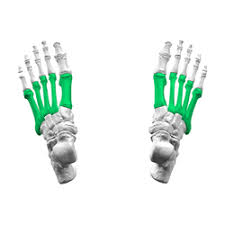
Which bones are highlighted
metatarsals
metacarpals
tarsals
carpals
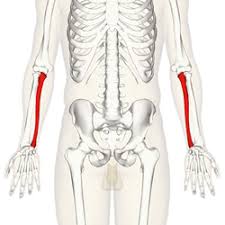
Which bones are highlighted
humerus
radius
ulna
fibula

What is the name of the bones in red? These are one half of the bones that make up the hip joint.
Elvis
Shoulder
Knee Cap
Pelvis
What are the functions of the muscular system. Select all correct answers. (more than 1)
Helps you see
Helps you move
Helps fight diseases
Creates heat
Helps your heart beat
The Integumentary System is made of ... (mark all correct answers)
Skin
Hair
Nails
Liver

Identify the skeletal bone in the picture highlighted in green; cartilage surrounds this bone to act as a shock absorber
femur
mandible
humerus
patella
What are the main layers of the skin from superficial to deep?
epidermis, dermis, hypodermis
dermis, hypodermis, epidermis
dermis, epidermis, hypodermis
hypodermis, dermis, epidermis
True or False: Our skin helps to control your body's temperature by sweating when it's too hot and getting goose bumps when it's too cold.
True
False
What are the different types of tissues
Epithelial, Connective, Muscle, Nervous
Epithelial, Connective, Bone, Nervous
Epithelial, Muscle, Bone, Nervous
Epithelial, Connective, Muscle, Skeletal
What connects, supports, and binds or separates other tissue or organs?
connective tissue
epithelial tissue
muscle tissue
nervous tissue
What tissue forms the covering on all internal and external surfaces of the body, lines body cavities and hollow organs; major tissue in glands
connective tissue
epithelial tissue
muscle tissue
nervous tissue

Which bones are highlighted
carpals
tarsals
metacarpals
metatarsals
Describes the back or direction toward the back of the body.
Posterior
Anterior
Superior
Inferior
It describes a position in a limb that is nearer to the point of attachment or the trunk of the body.
Inferior
Proximal
Superior
Anterior
Describes the front or direction toward the front of the body
Anterior
superior
posterior
Inferior
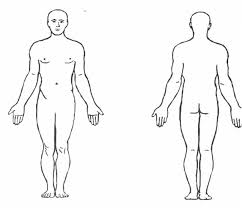
*right and left refer to "right" and "left" of the body in position.


Superficial
describes a position closer to the surface of the body. The skin is superficial to the bones.
The peripheral nervous system is made up of nerves that branch off from the spinal cord and extend to all parts of the body.
describes a position farther from the surface of the body. The brain is deep to the skull.
The arteries carry blood away from the heart; the veins carry it back to the heart.
Deep
back region of the body
describes a position closer to the surface of the body. The skin is superficial to the bones.
describes a position farther from the surface of the body. The brain is deep to the skull.
away from the midline of the body


The bones in your back make up what?
fingers
phalanges
vertebral column
toes


The highlighted bone(s) is/are known as the ________.
clavicle
vertebrae
scapula
carpals

What is the point of a feedback loop?
To provide the body with more energy
To provide the body with more food
To make sure the conditions in the body are always changing
To make sure the conditions in the body remain stable
Which of these does homeostasis most directly relate?
Stability
Evolution
Scale and Structure
Interacting systems
Homeostasis
is impossible in vertebrates
Is the maintenance of a relatively stable INTERNAL environment
Is the maintenance of a relatively stable EXTERNAL environment
Allows for a wildly fluctuating internal environment
This feedback system that returns the body back to the normal set point.
positive
negative
neutral
returnable
What is cell differentiation?
Process by which cells produce MORE cells.
Process by which cells become UNSPECIALIZED
Process by with cells become SPECIALIZED
Process by which cells become old and DIE
Which system provides oxygen and removes carbon dioxide?
digestive
muscular
respiratory
nervous
Which system controls all parts of your body and sends/receives messages?
muscular
digestive
circulatory
nervous
Which system carries blood to and from body cells?
muscular
circulatory
skeletal
respiratory
What does the excretory system do?
gets rid of waste that your body sees as poison
controls what you do
moves blood throughout your body
breaks food down so we can be healthy
What does the digestive system do?
gets ride of the waste in our body that it sees as poison
moves blood throughout the body
breaks down food so we can be healthy
controls the muscles in our body by making them work together
Which is an example of a hinge joint
knee and elbow
shoulder and hip
neck
ankle and wrist
What type of bone is the patella?
Sesamoid
Irregular
This bone type is described to usually be as long as they are wide
long bone
short bone
irregular bone
flat bone
The femur is what type of bone?
Long Bone
Short Bone
Flat Bone
Irregular Bone
Sesamoid Bone
What are the four types of bones?
Long, short, medium, thin
Regular, long, flat, short
Flat, short, long, Irregular
None of the options
What is an example of a fixed joint?
Vertebrae
Elbow
Skull
Which is a ball-and-socket joint
The thumb
The shoulder
The elbow
The radioulnar joint

