
 Worksheets
Semester Final
Total questions: 57
Worksheet time: 57mins
Select the text that best illustrates the examples of unalienable rights.
"We hold these truths to be self-evident, ►
that all men are created equal, that they are endowed bytheir Creator with certain unalienable Rights, ►
that among these are Life, Liberty and the pursuit ofHappiness. ►
That to secure these rights, Governments are instituted among Men, deriving theirjust powers from the consent of the governed, That whenever any Form of Government becomesdestructive of these ends, ►
it is the Right of the People to alter or to abolish it, and to institute newGovernment, laying its foundation on such principles and organizing its powers in such form, as tothem shall seem most likely to effect their Safety and Happiness...."
that all men are created equal, that they are endowed bytheir Creator with certain unalienable Rights,
that among these are Life, Liberty and the pursuit ofHappiness.
hat to secure these rights, Governments are instituted among Men, deriving theirjust powers from the consent of the governed, That whenever any Form of Government becomesdestructive of these ends
t is the Right of the People to alter or to abolish it, and to institute newGovernment, laying its foundation on such principles and organizing its powers in such form, as tothem shall seem most likely to effect their Safety and Happiness...."
"Governments are instituted among Men, deriving their just powers from the consent of the governed"
-Declaration of Independence
Which section of the Constitution was influenced by the principle expressed in the above excerpt.
Article 2:
The executive power shall be vested in a President of the United States of America. He shall hold his Office during the Term of four Years, and together with the Vice President, chosen for the same Term, be elected as follows:
Amendment 1:
Congress shall make no law respecting an establishment of religion, or prohibiting the free exercise thereof; or abridging the freedom of speech, or of the press; or the right of the people peaceably to assemble, and to petition the Government for a redress of grievances.
Article 6
This Constitution, and the Laws of the United States which shall be made in
0 Pursuance thereof; and all Treaties made, or which shall be made, under the Authority of the United States, shall be the supreme Law of the Land; and the Judges
in every State shall be bound thereby, any Thing in the Constitution or Laws of any state to the Contrary notwithstanding.
Preamble
We the People of the United States, in Order to form a more perfect Union, establish
Justice, insure domestic Tranquility, provide for the common defense, promote the
general Welfare, and secure the Blessings of Liberty to our selves and our Posterity. do ordain and establish this Constitution for theUnitedStates of America.
Read the quote from John Locke's 2nd treaties of Government.
"The only way whereby any one divest himself of his natural liberty, and puts on the bonds of civil society, is by agreeing with other men to join and unite into a community for their comfortable, safe, and peaceable living one amongst another, in a secure enjoyment of their properties, and a greater security against any, that are not of it."
A student is reading John Locke's Two Treaties of Government for a paper she is writing. The student is most likely writing her paper about which of these topics?
the use of war by national governments
different social contracts around the world
the expansion of suffrage [voting] in the United States
the use of civil disobedience In achieving equality
What term below would best represent a "doctrine in political theory that government is created by and subject to the will of the people."
Popular Sovereignty
Due Process of Law
Separation of Powers
Natural Rights Theory
Which are the strengths of the Articles of the Confederation (more than one applies)
Natural Rights Theory
Created a National (Central) Government
Lacked an Executive branch to enforce laws
Required a unanimous vote (13/13 States) to amend the Articles
Which are the weaknesses of the Articles of the Confederation (more than one applies)
National (Central) Government didn't have the power to tax
Lacked Judicial branch to solve disputes between states
Lacked an Executive branch to enforce laws
Required a unanimous vote (13/13 States) to amend the Articles
:: Congress could declare war and make treatie_s
The Articles of Confederation represented the
early effort to improve United States ties to other nations
acceptance of British rule in the colonies
rejection of weaknesses in the Bill of Rights
first attempt at self-government in the United States as a country
3/5 Compromise
Created a bicameral Congress where representation in the House of Representatives
is based on a states
population and the Senate would have 2 Senators per state.
Called for a legislature where each state's representation in Congress would be based on its population
Provided states equal representation in a one-bodied legislature
Allowed states to count slaves as a partial person for purposes of representation
Great Compromise
Created a bicameral Congress where representation in the House of Representatives
is based on a states
population and the Senate would have 2 Senators per state.
Called for a legislature where each state's representation in Congress would be based on its population
Provided states equal representation in a one-bodied legislature
Allowed states to count slaves as a partial person for purposes of representation
Virginia Plan
Created a bicameral Congress where representation in the House of Representatives
is based on a states
population and the Senate would have 2 Senators per state.
Called for a legislature where each state's representation in Congress would be based on its population
Provided states equal representation in a one-bodied legislature
Allowed states to count slaves as a partial person for purposes of representation
New Jersey Plan
Created a bicameral Congress where representation in the House of Representatives
is based on a states
population and the Senate would have 2 Senators per state.
Called for a legislature where each state's representation in Congress would be based on its population
Provided states equal representation in a one-bodied legislature
Allowed states to count slaves as a partial person for purposes of representation
Anti-Federalist arguments for limited government to protect individual rights
Men when they enter into society, yield up a part of their natural liberty, for the sake of
being protected by government. ........ Without such a bill of rights, firmly securing the
privileges of the subject, the government is always in danger of degenerating into tyranny.
j The authorities essential to the common defense...powers ought to exist without limitation, because it is Impossible to foresee or define the extent and variety of
national exigencies [urgent need]
Federalist arguments fora strong central government
Men when they enter into society, yield up a part of their natural liberty, for the sake of
being protected by government. ........ Without such a bill of rights, firmly securing the
privileges of the subject, the government is always in danger of degenerating into tyranny.
The authorities essential to the common defense...powers ought to exist without limitation, because it is Impossible to foresee or define the extent and variety of
national exigencies [urgent need]
In this type of election, only members of a political party can vote.
Open Primary
Closed Primary
Petition
Nominating Convention
The major difference between an interest group and a political party is that political parties
tend to focus on a single issue.
have members that pay to join and gain benefits.
have known members list.
run candidates for office.
A wealthy businessman
Likely Republican Voter
Likely Democratic Voter
A minority college graduate
Likely Republican Voter
Likely Democratic Voter
A rural Missouri resident
Likely Republican Voter
Likely Democratic Voter
Middle age black female
Likely Republican Voter
Likely Democratic Voter
Protesting an unjust law
Civic Duty
Civic Responsibility
Writing a letter to your Senator
Civic Duty
Civic Responsibility
Attending jury duty
Civic Duty
Civic Responsibility
Obeying the law
Civic Duty
Civic Responsibility
Being informed about issues on the next ballot
Civic Duty
Civic Responsibility
Paying your taxes on time
Civic Duty
Civic Responsibility
Registering for the draft when you turn 18 for men
Civic Duty
Civic Responsibility
Voting in the next election
Civic Duty
Civic Responsibility
The first Tuesday after the first Monday in November is what day?
Veterans Day
Thanksgiving
Election Day
Tax Day
Which statement best describes Gerrymandering.
The legally permitted process of limiting who may register to vote for an election.
The legally permitted practice of voting for representatives of one party over another.
The legally permitted practice of electing a President with the most electoral votes
even if they lose the popular vote.
The legally permitted practice of drawing political lines to unfairly favor one party over another

Properly identify which color wins the gerrymander maps.
Red wins 3 Districts, Blue wins 2 Districts
:: Blue wins 3 Districts, Red wins 2 Districts
Blue wins 5 Districts
Red wins 5 Districts
The Supreme Court ruling that stated spending money on campaigns is equal to freedom of speech was
Marbury v. Madison
Citizens United v. Federal Election Commission
McCulloch v. Maryland
Buckley v. Veleo
The major difference between an interest group and a political party is that political parties
have members that pay to join and gain benefits.
have known members list.
run candidates for office.
tend to focus on a single issue.
Can spend unlimited money during elections so long as as is about an issue
PACS
Super PACs
Can directly help a candidate with by giving money, but is limited to how much it may give
PACS
Super PACS
Properly determine whether a scenario represents a political party or interest group.
A Doctor decides to run for the US Senate in order to change medical laws.
Political Parties
Interest Groups
Properly determine whether a scenario represents a political party or interest group.
The National Rifle Association hires a lobbyist to meet with legislatures.//
Political Parties
Interest Groups
An environmentalist joins a protest to stop a local logging operation
Political Parties
Interest Groups
An environmentalist joins a protest to stop a local logging operation
A candidate goes on a local news station to encourage people to vote on election day
Political Parties
Interest Groups
Which of the following is the most important communication tool for modern political candidates during a campaign.
Advertising in a local newspaper.
Advertising on the local radio station.
Ensuring yard signs are posted in town.
Advertising on and using social media platforms.
From the following choices, which is the most important determinant of party identification?
parents' political party
geographic location
level of education
yearly income
Select the boxes to identify which branch has the following powers.
May veto a law, reject, or propose a law
Legislative
Executive
Judicial
Select the boxes to identify which branch has the following powers.
Sets the budget for the Federal government
Legislative
Executive
Judicial
Select the boxes to identify which branch has the following powers.
May pass laws regarding issues not directly
addressed in the Constitution
Legislative
Executive
Judicial
Select the boxes to identify which branch has the following powers.
Declares laws and governmental actions
unconstitutional
Legislative
Executive
Judicial
The ________clause in the Constitution is often referred to as the elastic clause.
commerce
override
appropriation
necessary and proper
The Constitution identifies two powers of the Vice President. One power is to succeed the president and the other is
Prepare and submit the annual budget to Congress
Head the federal bureaucracy
Provide geographical diversity for balancing the presidential ticket
Preside over the Senate and cast a tie-breaking vote when necessary
Article 3 of the US Constitution establishes which branch of government?
Judicial
Executive
States
Legislative
The ability of the President to offer legal forgiveness of a federal crime is called
reprieve
pardon
parole
judicial review

Identify how many States made it illegal for same-sex couples to marry?
10
13
26
50
Read the below summary of the the Supreme Court case and answer the following question.
Obergefell v. Hodges is a landmark case. Writing for the majority, Justice Anthony Kennedy asserted that the right to marry is a fundamental right ..inherent in the liberty of the person··and is therefore protected by the due process clause of the Fourteenth Amendment, which prohibits the states from depriving any person of "life, liberty or property without the due process of law."' The marriage right is also guaranteed by the equal protection close, by virtue of the close connection between liberty and equality. In this decision Justice Kennedy also declared that "the reason marriage is fundamental. ..apply with equal force to same-sex couples", so they may "exercise the fundamental right to marry.'' The majority decision was signed by Justices Breyer, Ginsburg, Kagan and Sotomayor. Justices Roberts, Scalia, Thomas and Alita dissented.
What was the effect of the Supreme Courts decision?
The Federal government now provides marriages license to all citizens.
The 1O Amendment ensures States have the right to regulate marriage.
The Supremacy clause ensures States have the right to define marriage.
States can no longer deny marriage to same-sex couples.
Select the statement that best reflects Federalism in America.
Federalism ensures States rights over the interest of the Federal Government.
Federalism creates one central government to ensure the general welfare and common defense of Americans.
Federalism is ensures equality and freedom for all citizens in every State.
Federalism is a complex division of power between the Federal government and the States.
Congress shall have the power...To make all Laws which shall be necessary and proper for carrying into Execution the foregoing Powers, and all other Powers vested by this Constitution in the Government of the United States, or in any Department or Officer thereof."
Which of the following scenarios is the best example of the above Constitutional power?
Establish public schools in major cities with large immigrant populations.
Pass the Selective Service Act which allows men 18 and older to be drafted into the ' U.S. military.
Issue drivers license to American Citizens.
Declare war against China for flying into Alaska's airspace.
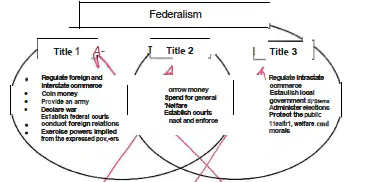
Title one goes with ______
Concurent (Shared)
Reserved (State)
Enumerated (Federal)
Title 2 goes with ______
Concurent (Shared)
Reserved (State)
Enumerated (Federal)
Title 3 goes with ______
Concurent (Shared)
Reserved (State)
Enumerated (Federal)
What happens when a state law conflicts with a federal law?
The state must follow the federal government's law.
The federal government must change its law.
The federal government can penalize the state.
The state government can enforce its own law.
Which of the following Supreme Court cases established Congress's implied powers.
Madison v. Marbury
Brown v. Board of Education
McCulloch v. Maryland
Obergefell v. Hodges

