
 Worksheets
Minerals Review
Total questions: 59
Worksheet time: 51mins
Which of the following is NOT a property of minerals?
ore
luster
fracture
color
Part of a gemstone's value is based on the way it shines in reflected light. The way a mineral reflects light is described as the mineral's
streak
color
luster
fracture
Which of the following best explains a hardness scale?
a scale that tests the hardness of a mineral by scratching other materials
a scale that tests the hardness of a rock by scratching other materials
a scale that tests the hardness of a mineral by being rubbed on other materials
a scale that tests the hardness of a rock by being rubbed on other materials

Which of the following properties of minerals is described with the Mohs scale?
luster
fracture
fluorescence
hardness
A pure substance that cannot be broken down into a simpler substance and is made of only one type of atom is a(n)
element
compound
atom
molecule
How can minerals be identified?
By their physical properties
By their color, luster, and hardness
By their form, streak, and cleavage
All of the above
Whether or not a mineral will float in water is based on its _________.
Luster
Hardness
Cleavage
Density

What are two types of luster?
Metallic
Metalilc
Nonmetallic
Nonmetallc
What is the characteristic geometric shape of a mineral called?
Lustre
Hardness
Streak
Crystal shape
Which property describes the tendency of a mineral to break along planes of weakness?
Lustre
Hardness
Streak
Cleavage
What is the softest mineral on the Mohs scale of hardness?
Quartz
Talc
Feldspar
Diamond
What is the softest mineral on the Mohs scale of hardness?
Quartz
Talc
Feldspar
Diamond
This word means that a mineral did NOT come from something once living
inorganic
organic
naturally occurring
not living

This means that atoms in a mineral line up in a pattern that repeats over and over again
chemical composition
crystal structure
fracture
solid
90% of the minerals found in the Earth's crust are _________
carbonates
silicates
sulfates
halides
Which element(s) would be found in a mineral classified as a silicate?
carbon and oxygen
sodium
sulfur and oxygen
silicon and oxygen
Minerals are divided into groups based on their ____________________.
ability to react
chemical composition
luster
physical properties


Graphite is used...
glass
in gunpowder, medicines, and rubber
in pencils, paint, lubricants, and batteries
as wiring, in coins and jewelry, building ornaments

Quartz is used...
in gunpowder, medicines, and rubber
as glass
in pencils, paint, lubricants, and batteries
as wiring, in coins and jewelry, building ornaments

Whether or not a mineral will float in water is based on its _________.
Luster
Hardness
Cleavage
Density
A minerals mass and volume
Color
Streak
Density
Fracture
The formula for density is ___________.
D = M x V
D = M + V
D = M / V
D = V / M
Which mineral has cleavage?


Which mineral has metallic luster?
If a mineral was shaped like a cube, it would have this crystal structure...


Which mineral has fracture?


What is the hardest mineral on the Mohs scale?
diamond
gypsum
calcite
quartz

A student investigated minerals by conducting tests of their physical properties. The student noticed that an unknown mineral could be scratched by quartz and could be scratched by calcite. The results of the test were compared to the hardness chart below.
Based on the chart, which mineral could the unknown substance be?
feldspar
topaz
gypsum
flourite
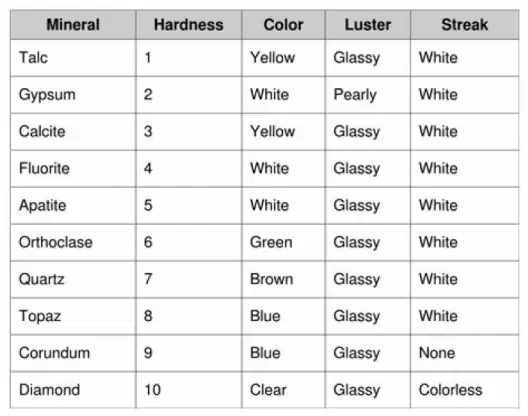
The table below shows the physical properties of ten different minerals.
A scientist is trying to use a metal knife to cut an unknown mineral. The metal knife has a hardness of 5. The knife cannot scratch the sample but the sample is scratched by topaz. Which additional property on the table should the scientist observe about the mineral in order to identify it?
color
streak
luster
hardness
Match the following words to their definitions.
Color
only used to identify a few minerals
Streak
color of mineral's powder
Luster
light reflected from a mineral's surface
Hardness
measured on a scale of 1-10
Density
mass/volume

Which statement best describes the essential characteristics of nonsilicate minerals?
not solid
no crystal structure
no oxygen atoms
no silicon-oxygen compounds
This mineral is used to preserve and season food. It is the mineral name for salt.
magnetite
graphite
gypsum
halite
Which mineral is easily identified by smell?
graphite
galena
halite
sulfur

What mineral is this? It is a type of Quartz.
Diamond
Muscovite
Quartz
Amethyst

This mineral can be mistaken for gold. What mineral is this?
Amethyst
Gold
Pyrite
Geode

Which mineral is in the cubic crystal system and commonly known as table salt?
Quartz
Pyrite
Sulfur
Halite

Sand is used to make glass. Sand is mostly which mineral?
Gold
Halite
Rutile
Quartz

Which mineral is used for jewelry, drill bits, and saw blades?
Diamond
Topaz
Calcite
Quartz


yellow, "smell"
Pyrite
Talc
Sulfur
Mica

brownish, thin, peels
Sulfur
Mica
Pyrite
Obsidian

50 mL of water was added to the graduated cylinder. After we drop in the object, the new water level goes up to 60 mL. What is the volume of the blocks? (Hint: new volume- old volume)
8 mL
10 mL
60 mL
5 mL

Look at the Moh's scale of hardness to the left. Which mineral is harder than fluorite but softer than topaz?
Talc
Calcite
Feldspar
Corundum
Which special property is an example of calcite bubbling or fizzing with acid?
Texture
Odor
Chemical Reactivity
Fluorescence
Which special property has an example of sulfur smelling like a match?
Magnetism
Odor
Texture
Chemical Reactivity

