wayground logo

Free Printable Worksheets

Font size

S
M
L
XL
Worksheets

Geologic Time Review

Total questions: 41

Worksheet time: 2hrs 11mins

Name
Class
Date
1.
Which era of geologic time do we currently live in?
a)
Cenozoic
b)
Mesozoic
c)
Paleozoic
d)
Archaen
2.
What time period makes up 90% of Earth's history?
a)
Mesozoic Era
b)
Phanerozoic Eon
c)
Precambrian Time
d)
Jurassic Period
3.
Identify the Era:
where dinosaurs thrived
a)
Precambrian
b)
Paleozoic
c)
Mesozoic
d)
Cenozoic
4.
Identify the Era:
Humans live in this era
a)
Precambrian
b)
Paleozoic
c)
Mesozoic
d)
Cenozoic
5.
Eras of the geologic time scale are
divided into ______.
a)
periods
b)
ages
c)
units
d)
epochs
6.
Identify the Era:
This eras name means "ancient" or  "early" life.
a)
Precambrian
b)
Paleozoic
c)
Mesozoic
d)
Cenozoic
7.
Identify the Era:
Amphibians first developed in this era.
a)
Precambrian
b)
Paleozoic
c)
Mesozoic
d)
Cenozoic
8.
How did the Earth change 2.5 billion years ago when many organisms began using photosynthesis to make food?
a)
the amount of oxygen in the atmosphere increased
b)
mass extinction occurred
c)
the oceans became larger
d)
rainfall increased
9.
Why were the dinosaurs able to evolve in the Triassic Period?
a)
There was very little competition due to a mass extinction.
b)
They were better suited than the mammals around them.
c)
They were able to fight the large arthropods currently living on Earth.
d)
The mammals were wiped out by the mass extinction.
10.

The earth is ______________of years old

a)

Hundreds

b)

Millions

c)

Billions

d)

Trillions

11.

What era did the formation of the earth occur?

a)

Paleozoic

b)

Precambrian

c)

Cenozoic

d)

Cambrian

12.

How old do Paleontologists believe the Earth is?

a)

2019 years old

b)

3.6 billion years old

c)

4.6 billion years old

d)

4.6 million years old

13.

What type of event usually marks the end of an Era

a)

A Mass Extinction

b)

A Quinceanera

c)

An earthquake

d)

A Volcanic Eruption

14.

What are the four eras in order from OLDEST to NEWEST?

a)

Pre-Cambrian, Paleozoic, Mesozoic, Cenozoic

b)

Pre-Cambrian, Mesozoic, Paleozoic, Cenozoic

c)

Cenozoic, Mesozoic, Paleozoic, Pre-Cambrian

d)

Mesozoic, Pre-Cambrian, Cenozoic, Paleozoic

15.

What era did trilobites, fishes, and other marine organisms dominate?

a)

Precambrian

b)

Paleozoic

c)

Mesozoic

d)

Cenozoic

16.

Scientists chose where units of geologic time began and ended based on the appearance or disappearance of life.

a)

true

b)

false

17.

Why may fossil of the same organism be found on different continents?

a)

Because the continents were once together

b)

Similar fossils should not be found on different continents

c)

Because fossils change over time

d)

Because of the Evolution of the Earth

18.

When classifying time using the Geologic Time Scale which unit is the largest unit of time?

a)

Period

b)

Eon

c)

Epoch

d)

Era

19.

The Mesozoic Era is found in which Eon?

a)

Phanerozoic

b)

Precambrian

20.

Put the following units of geological time in order from largest to smallest unit of time.

a)

Epoch, Eon, Era, Period

b)

Epoch, Period, Era, Eon

c)

Eon, Era, Period, Epoch

d)

Period, Eon, Period, Era

21.

Fossils provide evidence of __________.

a)

how life and the environment has remained stable over time

b)

how the climate and weather has remained stable over time

c)

how life and the environmental conditions have changed over time

22.
States that younger rocks lie above older rocks if the layers have not been disturbed
a)
Law of crosscutting
b)
Law of superposition
c)
Relative Dating
d)
Unconformity
23.

Determining whether an object or event is older or younger than other objects or events is called _____________.

a)

fossil

b)

geologic column

c)

relative dating

d)

super position

e)

unconformity

24.
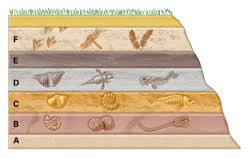
Which rock layer in the diagram seems to be the oldest?
a)
F
b)
E
c)
B
d)
A
25.
According to the law of superposition, which layer is the youngest?
a)
A
b)
B
c)
C
26.
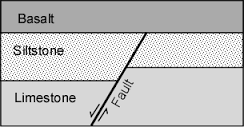
How does the law of crosscutting explain the age of a fault?
a)
The fault is younger than the rocks above it.
b)
The fault is younger than the rocks it cuts through.
c)
The fault is older than the rocks above it.
d)
The fault is older than the rocks it cuts through.
27.
In which type of rock are most fossils found?
a)
igneous
b)
sedimentary
c)
volcanic
d)
metamorphic
28.
Which rock layer contains the newest fossils?
a)
F
b)
E
c)
B
d)
C
29.
How does sedimentary rock usually form?
a)
Vertically
b)
Diagonally
c)
Folding
d)
Horizontally
30.
What are the relative ages of the features in order from oldest to youngest?
a)
Limestone, Basalt, Fault, Siltstone
b)
Siltstone, Fault, Basalt, Limestone
c)
Limestone, Fault, Basalt, Siltstone
d)
Limestone, Siltstone, Fault, Basalt
31.

Which layer is OLDER? Layer E or Intrusion A?

a)

Layer E

b)

Intrusion A

32.

Which layer is OLDER? Intrusion M or Layer D?

a)

Intrusion M

b)

Layer D

33.
The length of time required for half of the radioactive atoms in a sample to decay is its...
a)
era
b)
age
c)
half-life
d)
eon
34.
How does absolute age differ from relative age?
a)
only absolute dating indicates which rock is older than another
b)
only absolute dating finds the age in years
c)
only relative dating finds the age in years
35.
If the half-life of a radioactive group of atoms is 100 years, then how old is the rock if there have been two half-lives?
a)
25 years
b)
200 years
c)
400 years
d)
800 years
36.
The original element that undergoes radioactive decay is known as the...
a)
daughter element
b)
half-life
c)
parent element
d)
carbon-14
37.
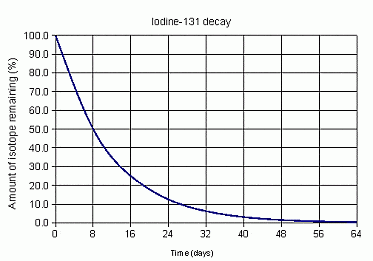
What is the half-life of iodine-131?
a)
32 days
b)
8 days
c)
16 days
d)
24 days
38.

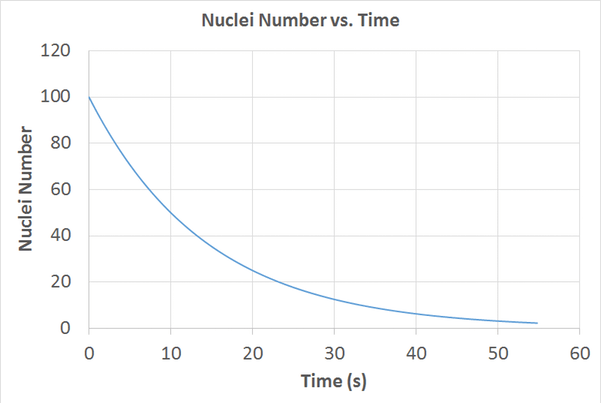
What is the Half life of this isotope?

a)

5 seconds

b)

10 seconds

c)

15 seconds

d)

20 seconds

39.

What is the half life of Carbon-14?

a)

5730 yrs

b)

1.2 billion years

c)

713 million years

d)

1.3 billion years

40.
What element is usually used to date fossils?
a)
uranium-235
b)
carbon-14
c)
mercury-203
d)
thorium-234
41.

Which of the logs have experienced 2 half-lifes?