
 Worksheets
1st Semester Full Review Honors
Total questions: 97
Worksheet time: 49mins
Name
Class
Date
1.
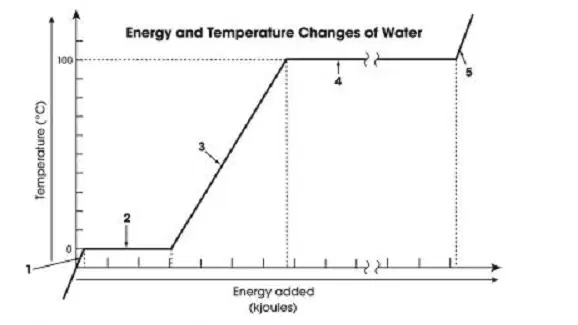
The following graph shows the change in temperature of a sample of water begins as ice, as thermal energy is added. Which region of the graph represents water in the liquid state?
a)
1
b)
2
c)
3
d)
4
2.
Which would have the greatest gravitational potential energy?
a)
A 2 kg rat on a school desk
b)
A 25 kg dog in an oak tree
c)
A 10 kg platypus on swing
d)
A 45 kg child on a bike
3.
The law of conservation of energy states that energy _______.
a)
is created from motion.
b)
cannot be created or destroyed.
c)
is always equal and opposite.
d)
can only be converted into heat.
4.
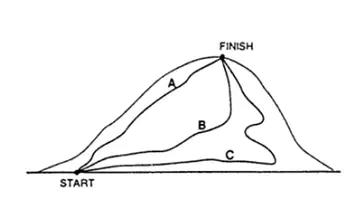
Three people of equal mass climb a mountain using paths A, B, and C shown in the diagram above. Along which path(s) does a person gain the greatest amount of gravitational potental energy from start ot finish?
a)
A only
b)
B only
c)
C only
d)
the gain is the same along all paths
5.
A dropped racquetball will not return to its original position because ______.
a)
potential energy is inefficient.
b)
the mechanical energy is stored up for later bounces.
c)
some of the mechanical energy is converted to nonmechanical energy.
d)
energy is not conserved.
6.
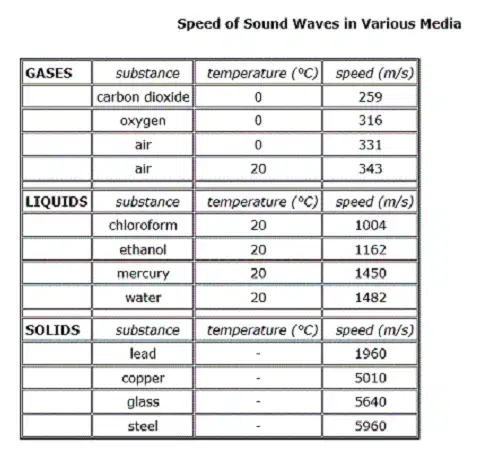
The table shows the speed of sound waves in various media. This table can be used as evidence for which of the following statements?
a)
Reasoning: Sound travels fastest through a gas.
b)
Claim: Water is the best substance to transfer all sound waves. Reasoning: Water has a very high specific heat and will transfer sound faster.
c)
Claim: Steel is more dense than copper. Reasoning: Sound can travel faster through steel because the particles are closer together allowing the energy to be transferred faster.
d)
Claim: Lead will transfer sound the fastest because it has a high specific heat. Reasoning: Specific heat is the best indicator of how fast a sound wave will travel.
7.

The diagram shows a cart at four positions as it moves along its track. At which position is the sum of the potential energy and kinetic energy of the cart the same?
a)
A and B
b)
B and C
c)
C and D
d)
all positions, A through D
8.
The kind of energy associated with bonds holding molecules together are ______.
a)
nuclear
b)
light
c)
chemical
d)
kinetic
9.
A plant leaf changes _________________energy to ___________________energy.
a)
Water energy --> growing energy
b)
Chemical energy --> elerctrical energy
c)
Light energy --> chemical energy
d)
Thermal energy --> radiant energy
10.
A battery is a device that can change
a)
Kinetic energy --> electric energy
b)
Electric energy --> potential energy
c)
Chemical energy --> electric energy
d)
Stored mechanical --> electric energy
11.
Fusion is the process that occurs in the sun. What is the primary source of the sun’s energy?
a)
chemical
b)
nuclear
c)
thermal
d)
electrical
12.
When a turbine rotates to produce electricity, what energy transformation takes place?
a)
Thermal --> mechanical
b)
Electrical --> electromagnetic
c)
Chemical --> electrical
d)
Mechanical --> electrical
13.
When you rub your hands together on a cold day, you use friction to convert
a)
mechanical energy into thermal energy.
b)
thermal energy into nuclear energy.
c)
nuclear energy into electrical energy.
d)
electrical energy into electromagnetic energy.
14.
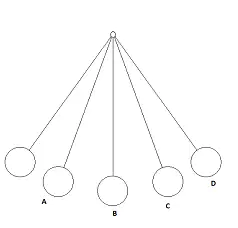
A pendelum swings as shown in the diagram above. At which position is the kinetic energy of the pendelum the least?
a)
A
b)
B
c)
C
d)
D
15.
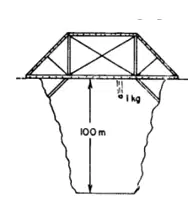
The diagram above shows a 1-kilogram stone being dropped from a bridge 100 meters above a gorge. As the stone falls, the gravitational potential energy of the stone
a)
decreases
b)
increases
c)
remains the same
d)
increases then decreases
16.
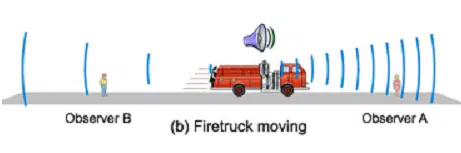
Tow students are standing along a sidewalk and observe a passing firetruck with its siren blaring. Which statement is correct?
a)
Observer B will hear a higher pitch sound because the wavelength is larger.
b)
Obersver B will hear a lower pitch sound because the wavelength is larger.
c)
Observer A will hear a higher pitch sound because the wavelength is larger.
d)
Observer A will hear a lower pitch sound because the wavelength is smaller.
17.

If the observe is stationary and the plane accelerates constantly from point A to D and the engine produces a constant sound during this trip, at which point will the observer hear the highest frequency?
a)
a
b)
b
c)
c
d)
d
18.
Which of the following statements is true?
a)
Chemical and electrical energy are both types of potential energy.
b)
Nuclear and radiant are both types of kinetic energy
c)
Sound and nuclear energy are both types of kinetic energy
d)
Nuclear and chemical energy are both types of potential energy
19.
What type of conversion is taking place when natural gas is used to heat water?
a)
chemical energy into thermal energy
b)
thermal energy into mechanical energy
c)
mechanical energy into electromagnetic energy
d)
electromagnetic energy into chemical energy
20.
What do you call change from one form of energy to another?
a)
energy change
b)
conversion of power
c)
energy conversion
d)
energy transfer
21.
Which type of wave must the teacher be describing and why? 1. The wave travels at m/s through air 2.The wave has an amplitude of 2nm 3. The wave is self-propogating
a)
Electromagnetic wave because it has a very high speed and can travel using electric and magnetic fields
b)
Electromagnetic wave because it has a low amplitude
c)
Mechanical wave because it has a very high speed and is traveling through air; EM waves cannot travel through air.
d)
Mechanical wave because it has a low amplitude
22.
A student drew models of an electromagnetic wave and a water wave. Which scientific question did the student MOST LIKELY ask to know how to draw these models?
a)
Are water waves and electromagnetic waves examples of transverse waves?
b)
Do water waves travel at a slower speed than electromagnetic waves?
c)
Can water waves and electromagnetic waves travel through the different media?
d)
How do water waves and electromagnetic waves increase their amplitude?
23.
What is a question they could you the teacher to determine if awave is electromagnetic or mechanical?
a)
What is the wavelength of the wave?
b)
Can the wave travel through a solid, liquid, and gas?
c)
Does the wave speed increase or decrease as it moves from a solid to a liquid?
d)
What is the amplitude of the wave?
24.

Which of the following statements are true?
a)
II, III, and IV only
b)
II and III only
c)
I, II, and IV only
d)
I and IV only
25.
You notice after you walk across a room, you feel a spark when you touch the doorknob. What energy transformation must have taken place?
a)
Mechanical --> electrical
b)
Electromagnetic --> mechanical
c)
Thermal --> electromagnetic
d)
Mechanical --> nuclear
26.
What energy transformation happens in a toaster?
a)
Mechanical --> electrical
b)
Electrical --> thermal
c)
Thermal --> chemical
d)
Chemical --> thermal
27.

Listed below are the frequencies of 4 popular radio stations in the Metro Atlanta area. Atlanta Radio Station. Which of the above has radio waves with the LONGEST wavelength?
a)
WRFG 89.3 MHz
b)
WZGC 92.9 MHz
c)
WVEE 103.3 MHz
d)
WYAY 106.7 MHz
28.

Which of the following explains the transformation of energy shown in the image above?
a)
electrical to radiant
b)
electrical to thermal
c)
chemical to thermal
d)
chemical to radiant
29.
Which color on the visible light spectrum has the greatest amount of energy?
a)
Red; it has the longest wavelength
b)
Red; it has the shortest frequency
c)
Violet; it has the longest wavelength
d)
Violet; it has the shortest frequency
30.
The wavelengths of radio waves are much _______________ than the wavelength of microwaves. Therefore, radio waves carry much __________ energy than a microwave.
a)
longer, more
b)
shorter, more
c)
shorter, less
d)
longer, less
31.
Assuming all the graphs below are drawn to the same scale, which of the electromagnetic waves has the GREATEST energy?
a)
amplitude is low; amplitude and energy are inversely related
b)
amplitude is high; amplitude and energy are inversely related
c)
frequency is high; frequency and energy are directly related
d)
frequency is low; frequency and energy are directly related
32.
Which of the following shows the transformation of energy in the process of photosynethsis?
a)
Radiant energy to chemical energy
b)
Thermal energy to chemical energy
c)
Radiant energy to nuclear energy
d)
Chemical energy to radiant energy
33.
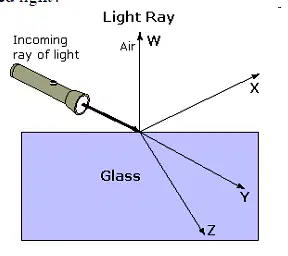
Which of these arrows would represent the path of refracted light?
a)
W
b)
X
c)
Y
d)
Z
34.
Lars yells at his sister, and the sound waves from his voice travel across the front of the house and around the side. Which property of sound waves allows Inga to hear Lars' voice from around the corner?
a)
reflection
b)
diffraction
c)
constructive interference
d)
destructive interference
35.
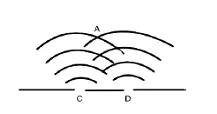
Points C & D on this image represent breaks in a dam that is hold water. Which type of wave behavior is represented by the water passing through the dam and why?
a)
Diffraction because the waves are coming together and getting bigger.
b)
Diffraction because the water is bending around the opening in the dam.
c)
Refraction because the water waves are changing speed going from the air to the water in the picture.
d)
Reflection because the angle of the waves at Point C must be equal to the waves at Point D.
36.

When a bear sees a fish in the water, it uses experience with refraction to know exactly where the fish is actually located. The image of the fish appears in a different spot because the light rays forming this image
a)
are bent due to the difference in index of refraction between the water and air.
b)
are bent due to the different direction the fish is swimming.
c)
are bent due to the dissolved particulates in the water.
d)
are bent due to the time of day.
37.

Leah is 2 meters away from a mirror hanging on the wall. When she stands at a 60 degree angle to the normal line,
a)
Leah can see her partner’s reflection because they are positioned at the same angle to the normal line.
b)
Leah can see her partner’s reflection because they are positioned at the same distance from the focal point.
c)
Leah cannot see her partner’s reflection because they are positioned at the same angle to the normal line.
d)
Leah cannot see her partner’s reflection because they are not positioned directly in front of the mirror.
38.
Railroad tracks have metal rails placed so there is a small space between each rail. Why are the rails placed this way?
a)
to prevent a train from stopping
b)
to allow room for expansion during hot weather
c)
to prevent soil erosion around the tracks
d)
because they wanted to
39.
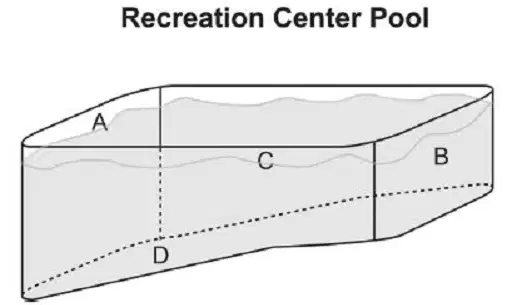
Where should hot water enter the pool to better heat the warm water
a)
A
b)
B
c)
C
d)
D
40.
A container of cold water is dumped into a larger container of hot water. It is mixed and then left alone for a long time interval. The water temperature is found to
a)
randomly vary from region to region in the container
b)
be uniform throughout the container
c)
fluctuate at all positions in the container
d)
be greater at the bottom of the container
41.
Which of the following helps explain why honey dissolves more rapidly in hot water than in cold water?
a)
The honey and hot water form more covalent bonds
b)
the hot water is more chemically reative with honey
c)
the honey breaks down into free atoms more quickly in the hot water
d)
the great motion of hot water molecules disperses the honey more quickly
42.

The masses are specific heats of some samples of liquids are shown in the table below. The temperature of which sample will rise most when 1000J of heat is added?
a)
water
b)
glycerin
c)
methanol
d)
cooking oil
43.
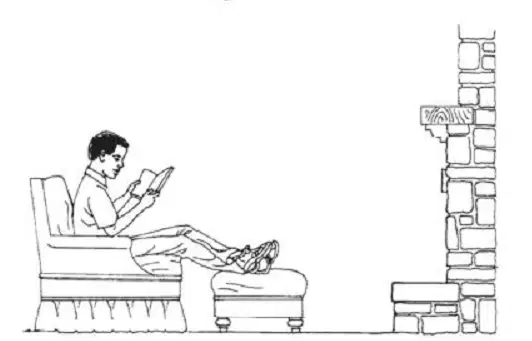
he drawing below shows a person sitting on a sofa in front of a fireplace. Which of the following are the primary modes of heat transfer from the fire in the fireplace to the person?
a)
radiation and convection
b)
radiation and condensation
c)
convection and conduction
d)
conductino and condensation
44.
A 10g sample of aluminum and 10g sample of iron were each heated by 100J of energy. The temperature of the aluminum rose 11 degrees, white the iron rose by 23 degrees. Which statement best accounts for these results?
a)
Iron is twice as dense as aluminum
b)
atoms of aluminum are smaller than atoms of iron
c)
using equal masses results in similar heat capacities
d)
the specific heat of iron is less than aluminum
45.
The primary reason an ice cube feels cold to the touch is that
a)
conduction causes coldness to leave the ice
b)
radiation from the hand enters the ice
c)
conduction causes heat to leave the hand
d)
convecation currents leave the hand
46.

The graph below represents a substance being heated from -30oC to 110oC. If 50 kJ of heat are removed from the substance when it is at 50oC, what will be the state and temperature of the substance?
a)
gas at 70oC
b)
gas at 0oC
c)
liquid at 100oC
d)
liquid at 10oC
47.

This table shows the specific heat of four substances. If each substance is exposed to the same amount of energy for one minute, which substance will get the hottest?
a)
lead
b)
iron
c)
glass
d)
ice
48.

The graph below compares three states of a substance. Which of the following choices is the best label for the y-axis?
a)
molecular density
b)
molecular motion
c)
molecular size
d)
molecular conductivity
49.
Much of the heat producted by a fireplace is carried up the chimney by rising air. Which of the following processes is responsible for this loss of heat energy to the outside environment?
a)
conduction
b)
convection
c)
evaporation
d)
radiation
50.
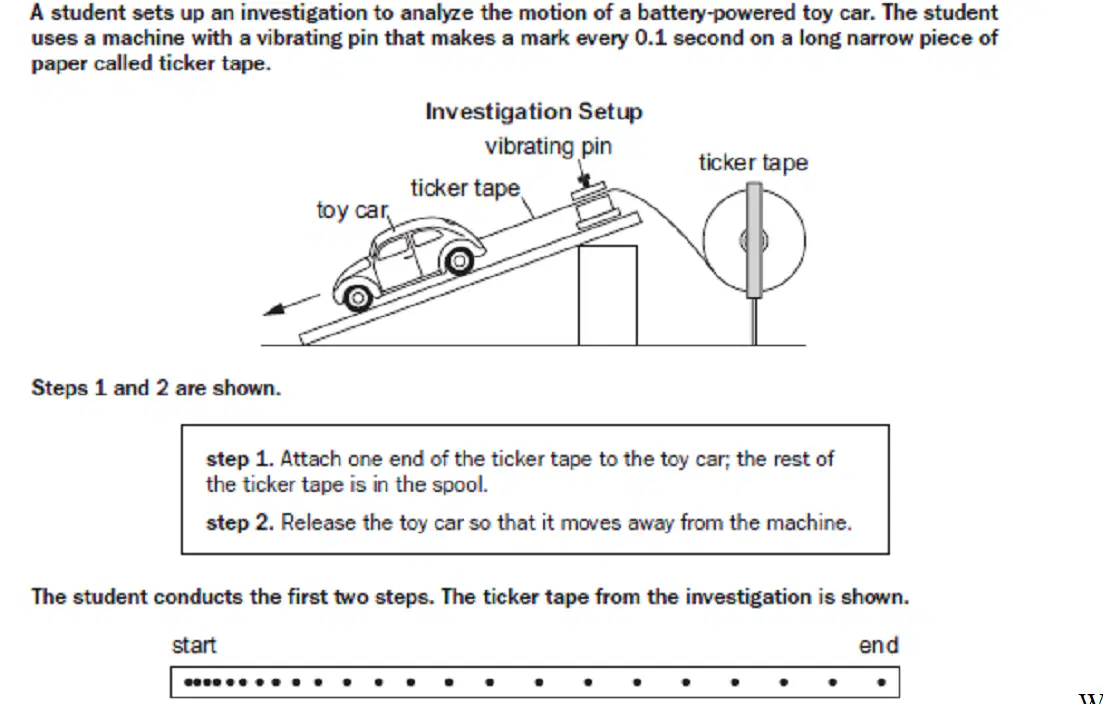
Which action should the student take in step 3 to determine the speed of the car, and which analysis of the speed of the car is correct?
a)
step 3. Count the total number of dots on the ticker tape. analysis: The speed remained constant during the entire period.
b)
step 3. Measure the distance between each successive dot on the ticker tape. analysis: The speed decreased at first and then became constant.
c)
step 3. Count the total number of dots on the ticker tape. analysis: The speed continued to increase during the entire period.
d)
step 3. Measure the distance between each successive dot on the ticker tape. analysis: The speed increased at first and then became constant.
51.
A cyclist is traveling at an initial speed of 10.0 m/s. She accelerates at a rate of 0.500 m/s2. What is her final speed after 9.0 s?
a)
5.50 m/s
b)
14.5 m/s
c)
14.5 m/s2
d)
5.50 m/s2
52.
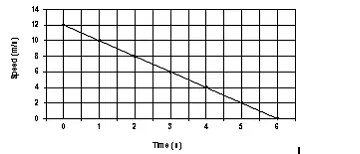
Cassonja runs in a constant direction on a straight road. The speed vs. time graph of Cassonja’s motion shows a straight line with a negative slope. What does the line tell you about Cassonja’s speed?
a)
It is constant.
b)
It is decreasing, then increasing.
c)
It is decreasing.
d)
It is increasing.
53.
You are pushing a heavy crate across a cement floor when you hit a section of flooring covered with smooth steel plates. Suddenly, it is somewhat easier to push the crate. This happens because
a)
The steel has a lower temperature
b)
The crate becomes lighter
c)
The cement creates less friction
d)
The steel creates less friction
54.
What unbalanced force is neeed to give a 976 kg vehicle an acceleration of 2.5 m/s2
a)
390 N
b)
390 lb
c)
2440 lb
d)
2440 N
55.

If each horse is pulling with the same force, in which direction will the rock move?
a)
north
b)
south
c)
west
d)
east
56.
How much does a 59.0 kg woman weigh on Earth?
a)
590 N
b)
59.0 lb
c)
145 lb
d)
6.02 N
57.
An airplane is flying at 635 mi/h at an altitude of 35,000 ft. It is currently over Kansas and is approximately 16 minutes ahead of its scheduled arrival time. What is its velocity?
a)
635 mi/h
b)
This cannot be determined without further information about its direction.
c)
16 mi/min
d)
35,000 ft/s
58.
Friction is defined as the _____.
a)
speed of an object in a particular direction.
b)
resistance of an object to a change in its velocity.
c)
rate at which velocity changes.
d)
force that opposes motion between two surfaces that are touching.
59.
A cheetah can accelerate at up to 6.0 m/s2. How long does it take for a cheetah to speed up from 10.5 m/s to 12.2 m/s?
a)
3.5 s
b)
0.28 s
c)
1.7 s
d)
10 s
60.
It took 50 joules to push a chair 5 meters across the floor. With what force was the chair pushed?
a)
300 N
b)
60 N
c)
0.1 N
d)
10 N
61.
A hocky player swings her hocky stick and strikes a puck. According to Newton’s third law of motion, which of the following is a reaction to the stick pushing on the puck?
a)
the stick pushing on the player
b)
the puck pushing on the player
c)
the player pushing on the stick
d)
the puck pushing on the stick
62.
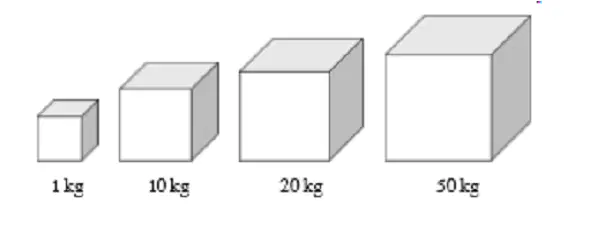
Use the drawing above to answer the following question. All of the boxes shown above can slide easily. Which box will move farthest if each is struck with the same amount of force?
a)
the 1 kg box
b)
the 50 kg box
c)
the 10 kg box
d)
the 20 kg box
63.
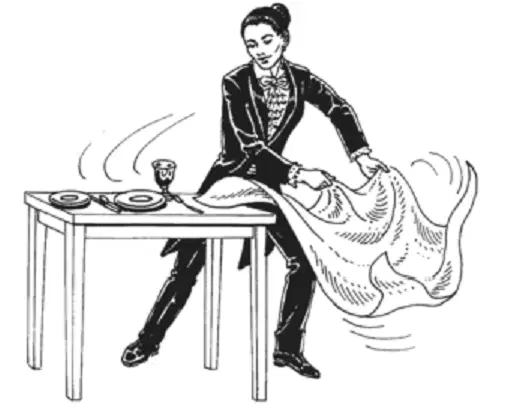
Mindy pulls a tablecloth out from under a complete set of dinnerware as shown in the illustration above. Which of the following best explains the Mindy’s success at leaving all the dinnerware on the table?
a)
the inertia of the dinnerware
b)
the rough material of the tablecloth
c)
the large mass of the tablecloth
d)
the placement of the dinnerware
64.

On the distance vs. time graph, what shows the value of the velocity?
a)
final speed
b)
x-axis
c)
y-axis
d)
the slope of the line
65.
Which of the following does not indicate velocity?
a)
40 mi/h toward the town square along the main street
b)
80 km/h going from New York toward New Jersey
c)
14 ft/s Southeast
d)
28 miles from Los Angeles to Catalina Island
66.
When a machine increases the size of the force exerted, the distance through which the force is exerted
a)
must double
b)
must decrease
c)
must stay the same
d)
must increase
67.
Near Earth’s surface, the strongest gravitational force would occur between an elephant and
a)
a cat
b)
Earth
c)
the moon
d)
the sun
68.
A force of 105 newtons was necessary to lift a rock. A total of 150 joules of work was done. How far was the rock lifted?
a)
0.070 m
b)
1.4 m
c)
260 m
d)
16,000 m
69.
In the absence of air resistance, how would the acceleration of a 1.5 kg book and the acceleration of a 15 kg rock differ if the objects were dropped from the same height?
a)
The rock would accelerate twice as fast as the book.
b)
The book would accelerate twice as fast as the rock.
c)
They would not differ; they would be the same
d)
The book would accelerate ten times as fast as the rock.
70.
A force of 560.0N causes an object to accelerate at 9.40 m/s2. What is the mass of the object?
a)
0.0168 kg
b)
59.6 kg
c)
550.6 kg
d)
5264 kg
71.
A machine can increase
a)
force at the expense of distance.
b)
distance at the expense of force.
c)
neither distance nor force.
d)
both force at the expense of distance and distance at the expense of force.
72.
Which is an example of balanced forces acting on an object?
a)
a kangaroo jumping
b)
a cyclist slowing down
c)
a leaf lying on the grass
d)
a car turning a corner
73.
In the absence of air resistance, all objects on Earth fall with a constant acceleration of
a)
10N
b)
10m/s2
c)
10m/s
d)
10kg
74.
Speeding up, slowing down, and changing direction is best described as
a)
distance
b)
velocity
c)
acceleration
d)
displacement
75.
What happens when a car slows down and velocity changes?
a)
positive acceleration
b)
constant acceleration
c)
resultant acceleration
d)
negative acceleration
76.

A ramp is a simple inclined plane that allows one to apply an input force _____ the output force.
a)
equal to
b)
perpendicular to
c)
greater than
d)
less than
77.
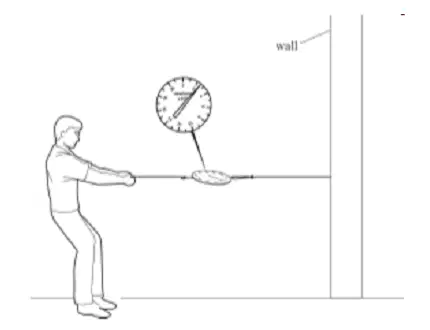
The picture above shows a student pulling on a rope that is attached to a wall. Which statement correctly describes the amount of force applied by the wall as the student continues to apply a 250 newton force?
a)
The wall exerts twice as much force as the student.
b)
The wall pulls with a force of 250 newtons against the student
c)
The wall exerts no force since it is stationary.
d)
The wall pulls with a force of 125 newtons against the student
78.
Effort force
a)
is work done by the machine after you have applied a force to the machine.
b)
is always equal to the weight of the object you are moving.
c)
changes in size or direction when done by a machine.
d)
opposes the forces you and the machine are working against.
79.
Which statement illustrates Newton’s first law?
a)
all of the statements
b)
a stone will not move unless something pushes or pulls it
c)
as a car comes to a stop, the passengers continue to move forward
d)
a ball rolling across the floor eventually slows down
80.
Which statement about weight is incorrect?
a)
The weight of an object depends on gravity.
b)
A change in an object’s location can change the object’s weight.
c)
An object weighs more on the moon than it weighs on Earth.
d)
An object’s weight is directly proportional to its mass.
81.
Weight is best described as _____.
a)
a force solely dependent on an object’s mass.
b)
the downward force exerted on an object due to gravity.
c)
what causes an object to fall.
d)
an object’s resistance to acceleration.
82.
Which object has the greatest inertia?
a)
a volleyball
b)
a bowling ball
c)
a beach ball
d)
a tennis ball
83.

The graph above shows the velocity of a car that is moving in a straight line. During which of the following intervals are forces on the car balanced?
a)
t to u
b)
r to s
c)
s to t
d)
q to r
84.
If the net force acting on a stationary object is zero, then the object will _____.
a)
accelerate in the direction of the strongest force.
b)
decelerate at a steady rate of speed.
c)
remain at rest.
d)
begin moving backwards.
85.
Which statement about weightlessness is true?
a)
Weightlessness occurs when an object’s distance is so far away from the body that there is no gravity. As a result, gravitational force no longer affects the body.
b)
Weightlessness occurs when an object is in orbit around a body. Gravity does not affect things in orbit.
c)
There is no such thing as weightlessness. Objects that appear to be weightless are actually falling. This condition is called free-fall.
d)
Weightlessness occurs when an object’s distance is so far away from the body that the objects mass has become too small to be affected by the gravitational force produced by the body.
86.
You apply 200 N to a machine and the machine applies 2,000 N to an object. What is the mechanical advantage?
a)
1,800
b)
10
c)
400,000
d)
1/10
87.

Four forces are acting on a box as shown. This box increases speed
a)
upward and to the right.
b)
downward and the right.
c)
downward and to the left.
d)
upward and to the left.
88.
The distance traveled by an object divided by the time it takes to travel that distance is called
a)
negative acceleration.
b)
average velocity.
c)
average acceleration.
d)
average speed.
89.
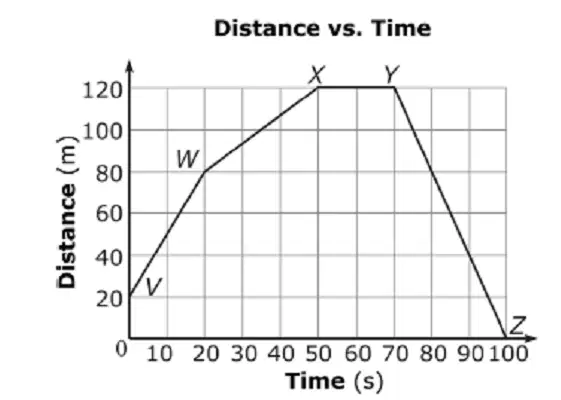
The graph shows the distance Curveion traveled over 100 seconds. What is Curveion’s speed between points W and X?
a)
0.4 m/s
b)
1.6 m/s
c)
0.75 m/s
d)
1.3 m/s
90.

A force is acting on each of the objects above. What can be concluded about these forces?
a)
They are the same because they have the same magnitude.
b)
They are the same because they point toward the objects.
c)
The are different because they have different magnitudes.
d)
They are different because they have different directions.
91.

This graph represents the changing motion of a cheetah. Which best explains the motion of the cheetah between areas 3 and 4 on the graph?
a)
None of these choices are correct.
b)
The cheetah is not moving.
c)
The cheetah is moving faster and faster.
d)
The cheetah is slowing down.
92.
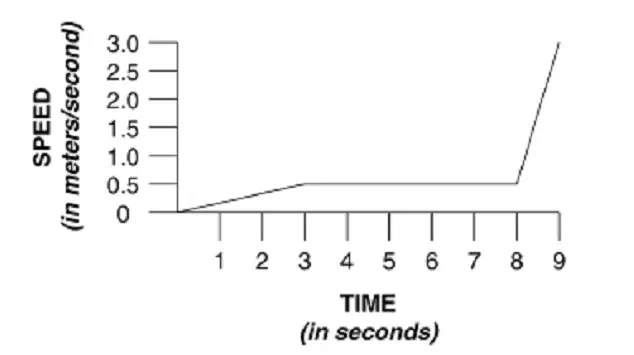
The graph shown below provides information about the motion of Lanesha on her bicycle. When is Lanesha”s bicycle’s acceleration the greatest?
a)
at 0 seconds only
b)
from 8 to 9 seconds
c)
from 3 to 8 seconds
d)
from 0 to 3 seconds
93.
Astronauts “float” when inside an orbiting spaceship because they are _____.
a)
in free fall
b)
weightless
c)
outside Earth's gravity
d)
in a vacuum
94.

The distance vs. time graph below shows data collected as Camryn’s remote-controlled car moved in a parking lot. According to the graph, which of the following conclusions about Camryn’s car’s motion is supported?
a)
The car is traveling at a constant velocity.
b)
The car is moving through an obstacle course.
c)
The car is accelerating.
d)
The car is traveling stopping and starting.
95.

Use the figure below to help answer this question. When the motion of an object is shown by a straight line on a distance vs. time graph with distance on the y-axis, the slope of the line is the
a)
displacement.
b)
distance traveled.
c)
speed.
d)
time of travel.
96.

The same F pushes in three different ways on a box moving with a velocity v, as shown in the drawings above. Which box would have the most work done by the force?
a)
B
b)
A and B
c)
C
d)
A
97.
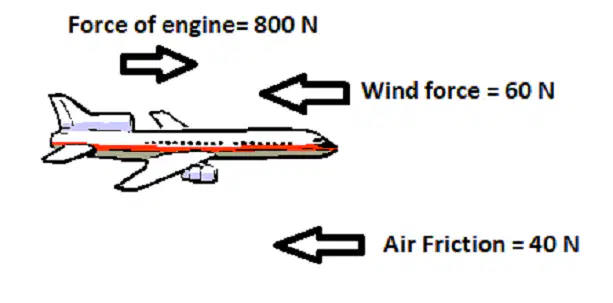
The airplane is moving with a force of 800 N. However, there are two forces moving in opposite directions on the airplane, a wind force of 60 N and an air friction of 40 N. What is the net force on the plane?
a)
900N
b)
700N
c)
800 N
d)
860 N
100 %

