wayground logo

Free Printable Worksheets

Font size

S
M
L
XL
Worksheets

Bio Finals practice

Total questions: 114

Worksheet time: 3hrs 0mins

Name
Class
Date
1.

what are the products of photosynthesis

a)

Carbon and oxygen

b)

ATP and oxygen

c)

Oxygen and glucose

d)

Carbon and ATP

2.

Whos the Smartest girl in STU edgewater

a)

sailin

b)

sailin

c)

sailin

d)

sailin & onje

3.

Select all that are products of Photosynthesis.

a)

Water

b)

Carbon Dioxide

c)

Oxygen

d)

Sunlight (Light Energy)

e)

Glucose (Sugar/food)

4.
Why do plants conduct photosynthesis?
a)
To make light
b)
To make mitochondria
c)
To make glucose
d)
To release carbon dioxide
5.
Which choice correctly shows the gases that enter and exit plants during photosynthesis?
a)
Enter: Oxygen
Exit: Carbon dioxide
b)
Enter: Water vapor
Exit: Glucose
c)
Enter: Carbon dioxide
Exit: Oxygen
d)
Enter: Light
Exit: Water vapor
6.

Which of the following is the correct equation for PHOTOSYNTHESIS?

a)

light + carbon dioxide + water --> glucose + oxygen

b)

carbon dioxide + sugar + water --> oxygen + light

c)

oxygen + light + water --> carbon dioxide + sugar

d)

carbon dioxide + oxygen + water --> Light+ Sugar

7.
Which organisms perform Photosynthesis?
a)
Only Autotrophs
b)
Only Heterotrophs
c)
Autotrophs and Heterotrophs
8.
Which of the following is an example of an AUTOTROPH?
a)
Appletree
b)
Dog
c)
Mushroom
d)
Human
9.
Plants need ________ for photosynthesis
a)
oxygen
b)
soil
c)
carbon dioxide
d)
sugar
10.
Glucose is a ...
a)
sugar
b)
carbohydrate
c)
source of quick energy
d)
all are correct
11.
The formula for glucose is...
a)
C12 H22 O11
b)
NaCl
c)
NaOH
d)
C6 H12 O6
12.

Why are plants considered autotrophs

a)

They make their own food

b)

They provide food for others

13.

What organelle does photosynthesis

a)

chloroplast

b)

mitochondrion

c)

nucleus

d)

leaf

14.

Photosynthesis is a process that converts . . .

a)

chemical energy into chemical energy

b)

light energy into light energy

c)

chemical energy into light energy

d)

light energy into chemical energy

15.
What gas does the process of photosynthesis release into the atmosphere?
a)
oxygen
b)
carbon dioxide
c)
water
d)
nitrogen
16.

Which of the following equations represents the overall chemical reaction for photosynthesis?

a)

6O2+ 6H2O → C6H12O6+ 6O2

b)

C6H12O6 + 6H2O→ 6O2+ 6O2

c)

6CO2+ 6H2O→ C6H12O6+ 6O2

d)

6O2 + 6H2O→ C6H12O6 + 6CO2

17.

Is Water (H2O) a reactant (Ingredient) or product of Photosynthesis?

a)

Product

b)

Reactant

c)

Niether

d)

Both

18.

What are the reactants of photosynthesis? (Select all that apply.)

a)

Carbon Dioxide (CO2)

b)

Oxygen (O2)

c)

Water (H2O)

d)

Light

19.

What are the products of photosyntheis? (Select all that apply.)

a)

Oxygen (O2)

b)

Glucose (C6H12O6)

c)

Light

d)

Carbon Dioxide (CO2)

20.
What is the function of ATP in living things?
a)
provides energy for cells
b)
stores genetic information
c)
provides structure in the nucleus
21.
Autotroph or Heterotroph?
a)
Autotroph
b)
Heterotroph
22.
What is Anaerobic Respiration?
a)
process of producing energy without oxygen.
b)
process of producing energy with oxygen.
23.
Aerobic respiration is different from anaerobic respiration in that aerobic respiration needs...
a)
chlorophyll
b)
carbon dioxide
c)
glucose
d)
oxygen
24.
What is the correct equation for cellular respiration?
a)
6O2 + C6H12O6 -> 6CO2 + 6H2O + Energy
b)
6O2 + C6H12O6 + Energy -> 6CO2 + 6H2O
c)
6CO2 + 6H2O -> 6O2 + C6H12O6 + Energy
d)
6CO2 + 6H2O + Energy -> 6O2 + C6H12O6
25.

Which of the following is a product of cellular respiration?

a)

Radiant Energy

b)

Oxygen

c)

Glucose

d)

Water

26.

What happens to the carbon atoms in glucose during cellular respiration?

a)

They are exhaled as CO2CO_2  

b)

They disappear

c)

They are broken down and dissolve

d)

They stay in the mitochondria forever

27.

Aerobic cellular respiration uses 1 molecule of glucose to produce approximately

a)

2 ATP molecules

b)

4 ATP molecules

c)

32-34 ATP molecules

d)

36-38 ATP molecules

28.
What does it mean for something to be anaerobic?
a)
It requires CO2
b)
It does not require CO2
c)
It requires oxygen
d)
It does not require oxygen
29.

What type of respiration requires oxygen?

a)

Aerobic

b)

Anaerobic

30.
Fermentation involves
a)
aerobic respiration
b)
anaerobic respiration 
31.
Which type of respiration is most efficient?
a)
Aerobic
b)
Anaerobic
32.
Where in the cell does aerobic respiration take place?
a)
Nucleus
b)
Cytoplasm
c)
Mitochondria
d)
Cell membrane
33.
What are the products of anaerobic respiration?
a)
Glucose and oxygen
b)
Carbon dioxide and water
c)
Lactic acid
d)
Carbon monoxide
34.
How can photosynthesis be related to cellular respiration?
a)
What's produced (made) by one is needed (the reactants) for the other
b)
They both produce the same products (outputs)
c)
They both have the same reactants (inputs)
d)
These 2 processes have nothing in common
35.

Identify the process that is represented by the chemical equation below.


C6H12O6 + 6O2 → 6H20 + 6CO2 + ATP

a)

Photosynthesis

b)

DNA Replication

c)

Cellular Respiration

d)

Human Respiration

36.

Identify the process that is represented by the chemical equation below.


6CO2 + 6H20 + Light Energy → C6H12O6 + 6O2

a)

Photosynthesis

b)

DNA Replication

c)

Cellular Respiration

d)

Human Respiration

37.

The processes of photosynthesis and cellular respiration are dependent on each other, because

a)

both processes use the same reactants.

b)

both processes produce what the other uses as reactants.

c)

both processes produce the same materials.

d)

both processes require light energy.

38.

Photosynthesis takes place in the _______ of the plant cell.

a)

mitochondria

b)

nucleus

c)

chloroplast

d)

ribosome

39.

Cellular respiration takes place in the _______ of cells.

a)

mitochondria

b)

nucleus

c)

chloroplast

d)

ribosome

40.

Protein are made at the _______ of cells.

a)

mitochondria

b)

nucleus

c)

chloroplast

d)

ribosome

41.

DNA is stored in the _______ of eukaryotic cells.

a)

mitochondria

b)

nucleus

c)

cytoplasm

d)

ribosome

42.

___________________ is a process where water molecules move across a semipermeable membrane from higher concentration to lower concentration.

a)

Osmosis

b)

Protein synthesis

c)

Homeostasis

d)

Diffusion

43.

Proteins are made of monomers called

a)

nucleic acids.

b)

monosaccharides.

c)

amino acids.

d)

fatty acid and glycerol.

44.

Mitosis produces

a)

two identical cells with two sets of chromosomes.

b)

two unique cells with two sets of chromosomes.

c)

four identical cells with one set of chromosomes.

d)

four unique cells with one set of chromosomes.

45.

Meiosis produces

a)

two identical cells with two sets of chromosomes.

b)

two unique cells with two sets of chromosomes.

c)

four identical cells with one set of chromosomes.

d)

four unique cells with one set of chromosomes.

46.

An individual's fitness is determined by

a)

its ability to reproduce & survive in its environment.

b)

its inability to reproduce & survive in its environment.

c)

its strength and speed.

d)

its lack of genetic variation.

47.

bb is crossed with BB. What is the probability their offspring are Bb?

a)
0%
b)
25%
c)
50%
d)
100%
48.

Cellular Respiration occurs within me and I am in BOTH plant and animal cells. I am a....

a)

Nucleus

b)

Golgi Body

c)

Cytoskeleton

d)

Mitochondria

49.
Enzymes are made of which monomer?
a)
monosaccharides
b)
fatty acids and glycerol
c)
amino acids
d)
nucleotides
50.
What is facilitated diffusion?
a)

Transport of molecules across a member without energy and with help from proteins.

b)

Movements of substances across a membrane using energy.

c)
When molecules spread from High to Low concentration on their own. 
d)
When pressure pushes something through a membrane. 
51.
Which is true about active transport?
a)
It requires energy
b)
it does not require energy
c)
It moves substances down the concentration gradient
d)
it moves material from high to low concentration
52.
A molecule that diffuses down a concentration gradient goes from an area of ______ concentration into an area of ______ concentration.
a)
high, low
b)
low, high
c)
passive, active
d)
active, passive
53.
The stages of mitosis in order
a)
Metaphase, Anaphase, Prophase, Telophase
b)
Prophase, Anaphase, Metaphase, Telophase
c)
Prophase, Metaphase, Anaphase, Telophase
d)
Anaphase, Prophase, Telophase, Metaphase
54.
What does it mean for something to be anaerobic?
a)
It requires CO2
b)
It does not require CO2
c)
It requires oxygen
d)
It does not require oxygen
55.

What type of respiration requires oxygen?

a)

Aerobic

b)

Anaerobic

56.
What number indicates an electron?
a)
1
b)
2
c)
3
d)
4
57.
electrons have this type of charge?
a)
negative
b)
positive
c)
neutral
58.
Monosaccharides are monomers of
a)
Carbohydrates
b)
Lipids
c)
Proteins
d)
Nucleic Acids
59.
Chromosomes are copied during which phase of the cell cycle?
a)
M phase
b)
G1 phase
c)
G2 phase
d)
S phase
60.
Fruit fly body cells have 8 chromosomes. After mitosis, you would expect a resulting fruit fly daughter cell to have -
a)
16 chromosomes.
b)
46 chromosomes.
c)
8 chromosomes.
d)
4 chromosomes.
61.

Which component is part of a plant cell?

a)

Cell wall

b)

Endoplasmic reticulum

c)

Cell membrane

d)

Flagella

e)

Golgi apparatus

62.

What is the function of a ribosome?

a)

Photosynthesis

b)

Protein synthesis

c)

Respiration

d)

Storage

e)

Regulation of the cell activities

63.

What type of cells are procaryotic?

a)

Animal

b)

Plant

c)

Bacterial

64.

In which direction do water particles move by osmosis?

a)

High to low concentration

b)

Low to high concentration

c)

They don't move

d)

Whatever direction they want

65.

Which substance moves by osmosis?

a)

Oxygen

b)

Water

c)

Carbon dioxide

d)

Nitrogen

66.

What happens to the rate of diffusion if the temperature is increased

a)

It increases

b)

It stays the same

c)

It reduces

67.

What must water molecules move through in osmosis?

a)

A cell wall

b)

A partially permeable membrane

c)

A totally permeable membrane

d)

Any of above

68.

What happens to animal cells that are placed into a dilute solution?

a)

They swell

b)

Nothing

c)

They shrink

69.

Which of these processes requires energy?

a)

Diffusion

b)

Active transport

c)

Osmosis

70.

After a sugary meal, which process will take glucose into the blood from the small intestine?

a)

Active transport

b)

Osmosis

c)

Diffusion

71.

Whos the best girl in student home EdgeWater

a)

Sailin

b)

Sailin

c)

Sailin

d)

Sailin

72.

Is the coolest and most pretty baddie in the student home

(a)  

73.
Which term is used to support Darwin’s theory of evolution and explains that only the the organisms best suited to their environment will survive?
a)
common ancestry
b)
survival of the fittest
c)
overpopulation
74.

Which term best describes describes the structures shown in the picture?

a)

heterologous

b)

analogous

c)

homologous

d)

vestigial

75.
What is the term for a feature that allows an organism to survive in its environment?
a)
adaptation
b)
variation
c)
homologous structure
d)
vestigial structure
76.
Ostrich wings are examples of
a)
homologous structures
b)
vestigial structures
c)
adaptations
d)
traits
77.
Change over time is
a)
evolution
b)
generation
c)
growth
d)
biogenesis
78.

Average phenotypes are favored in the environment, while extremes have lower survival rates.

a)

seasonal selection

b)

distruptive selection

c)

directional selection

d)

stabilizing selection

79.
Genetic variation can arise from a random change in the DNA of a gene.  The change is called a(n)
a)
mutation
b)
gene flow
c)
gene pool
d)
allele
80.
There are three species of birds on an island.  Bird A has a heavy bill for eating seeds.  Bird B has a pointed bill for eating insects.  Bird C has a sharp bill for eating both insects and seeds.  If all insects on the island suddenly disappeared, which bird or birds would be the LEAST affected? 
a)
Bird A
b)
Bird B
c)
Bird C
d)
Bird A and Bird B
81.

Over the years, white mice became extinct and darker mice survived. This is

a)

stabilizing selection

b)

directional selection

c)

disruptive selection

d)

due to exercise

82.

Two populations of the same species are separated by land barriers like rivers or mountains.

a)

geographical isolation

b)

temporal isolation

c)

adaptive ratiation

d)

behavioral isolaton

83.

When the environment determines which heritable traits are most beneficial for survival, which is being considered?

a)

Artificial selection

b)

Natural selection

c)

Environmental selection

d)

Mutation

84.
Why are advantageous traits more likely to be passed onto offspring?
a)
Because they are more likely to survive and reproduce.
b)
Because they come from dominant alleles.
c)
Because they come from recessive alleles.
d)
Because the trait is an acquired phenotype.
85.
This occurs when no more of a species is living.
a)
Fossilization
b)
Adaptation
c)
Extinction
d)
Natural selection
86.
Survival of the fittest or when favorable adaptations reproduce faster is called what?
a)
Evolution
b)
Adaptation
c)
Natural selection
d)
Fossilization
87.

Why do scientist use Punnett Squares?

a)

A tool scientist use to to see alleles

b)

A tool scientist use to see which alleles are dominant

c)

A tool scientist use to determine possible genotypes for offspring

88.

Which of the following is a Homozygous Dominant Genotype?

a)

Yy

b)

XX

c)

zz

89.

Which of the following is a homozygous recessive genotype?

a)

HH

b)

dd

c)

Aa

90.

Which of the following is a heterozygous genotype?

a)

Gg

b)

UU

c)

pp

91.

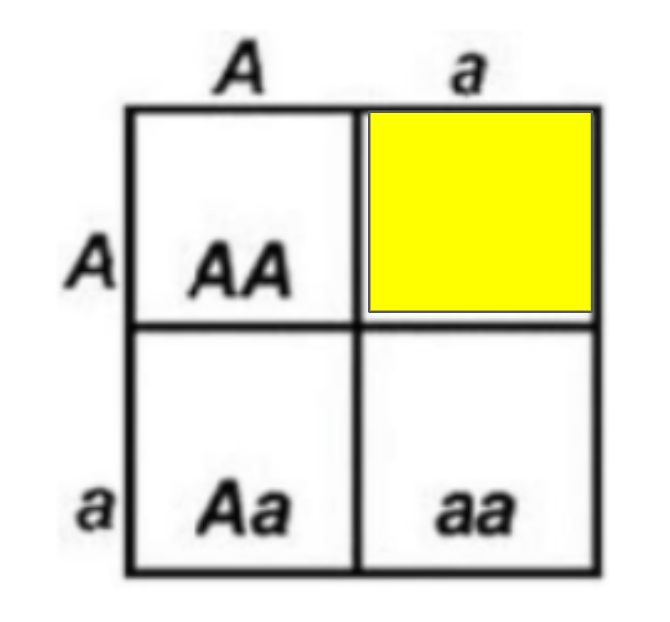
Fill in the Yellow Box

a)

AA

b)

Aa

c)

aa

92.

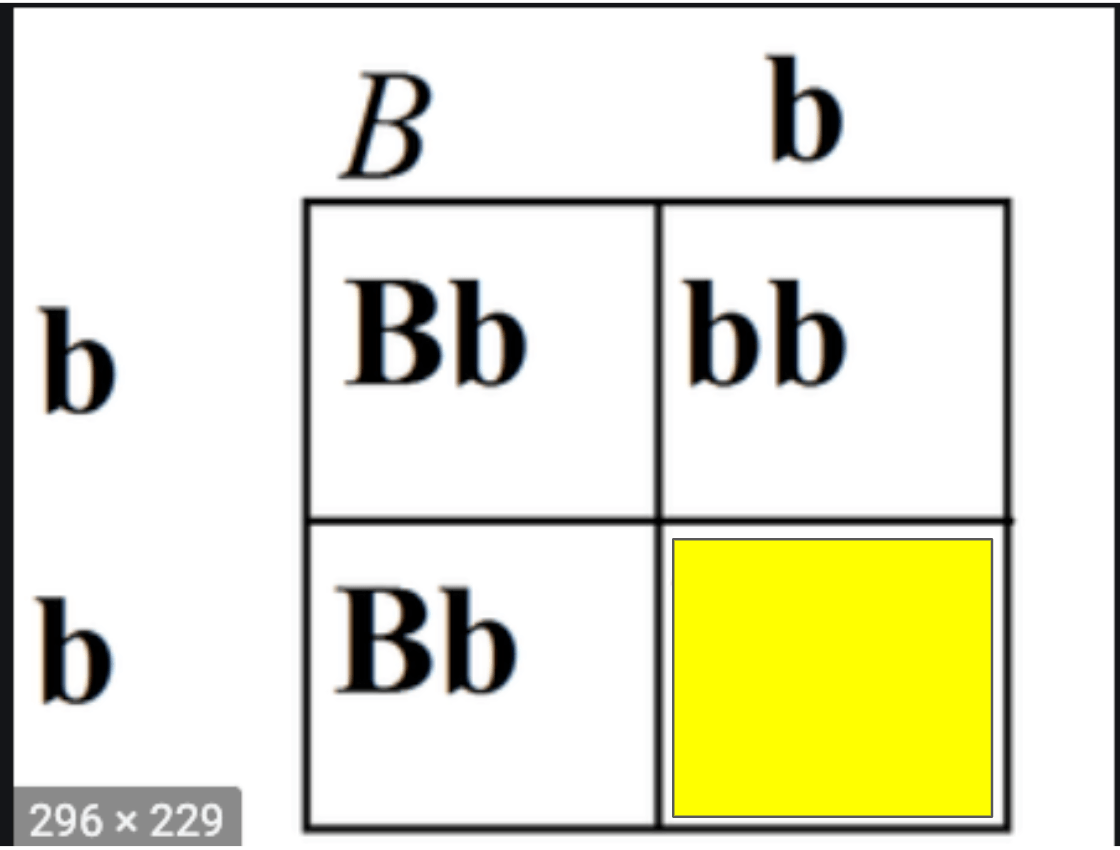
Fill in the Yellow Box

a)

Bb

b)

BB

c)

bb

93.

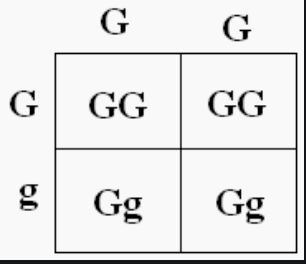
How chance the offspring born from this cross will have a homozygous dominant genotype?

a)

25%

b)

50%

c)

75%

d)

100%

94.

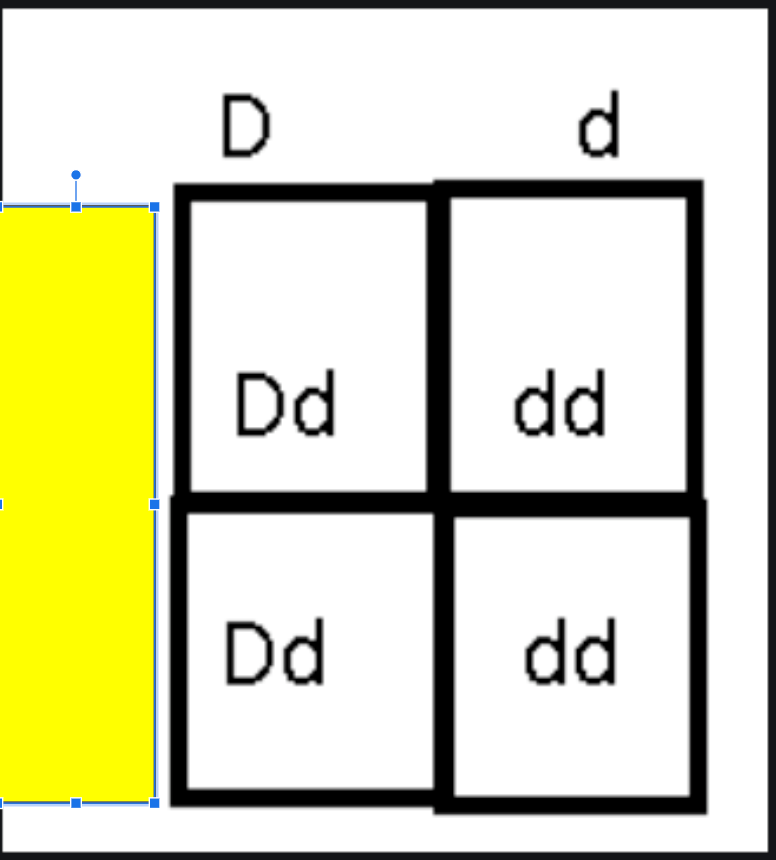
What is the mother's genotype?

a)

DD

b)

Dd

c)

dd

95.

In a heterozygous genotype, the ___________ allele takes over in the phenotype.

a)

recessive

b)

dominant

c)

both

96.

G = green, g = yellow

The genotype for a yellow plant is...

a)

GG

b)

Gg

c)

gg

d)

all of the choices result in yellow

97.

Which of the following alleles is purebred recessive?

a)

Tt

b)

tt

c)

TT

98.

Aa, DD, Ba, and yy are all examples of ---

a)

genotypes

b)

phenotypes

99.

AA and Aa always show up as ---

a)

dominant.

b)

recessive.

100.

Which of the following genotypes is homozygous dominant?

a)

aa

b)

Aa

c)

AA

101.

A trait controlled by a recessive allele only appears in the organism's phenotype ---

a)

if the organism is a hybrid.

b)

if the organism does not have any dominant alleles.

c)

if the organism is a purebred.

102.
Homozygous is when...
a)
the alleles are the same
b)
the alleles are different
c)
the alleles are absent
d)
the alleles are present
103.
What is a phenotype?
a)
The expression of a trait; physical appearance.
b)
refers to the genetic makeup of an individual
c)
An organism that has the same genes for a trait (ex. TT or tt)
d)
the passing of traits from parent to offspring
104.
What is heredity?
a)
A kind of genetic disorder
b)
The way DNA divides
c)
A trait you inherit from your parents
d)
The passing down of traits from parents to children
105.
Why are your chromosomes arranged in pairs?
a)
Scientists have no idea
b)
Because you get one from your mom and one from your dad
c)
Because pairs can divide easier
d)
Because DNA is awesome
106.
Inherited traits are controlled by 
a)
genetic information in the genes
b)
the environment a baby is born into
c)
the nucleus and mitochondria
d)
none of the above
107.
Which of the following alleles is homozygous (purebred) recessive?
a)
Tt
b)
tt
c)
TT
d)
t
108.
Which of the following is a phenotype?
a)
Aa
b)
red hair
c)
heterozygous genes
d)
mutated DNA
109.
Who is considered the "father of genetics"?
a)
Gregor Mendel
b)
Reginald Punnett
c)
James Watson
d)
Justin Bieber
110.
T = tall an t = short
What is the phenotype for Tt?
a)
short
b)
tall
c)
medium sized
d)
neither tall or short
111.
How many alleles (letters) do each person carry for a trait?
a)
1
b)
2
c)
3
d)
4
112.

What is codominance?

a)
Codominance is when only one allele is expressed in the phenotype.
b)
Codominance is when alleles blend together to create a new phenotype.
c)
Codominance is when one allele is completely dominant over another.
d)

Codominance is when both alleles contribute to the phenotype in separate, distinguishable ways.

113.

what is incomplete dominance

a)

Incomplete dominance is when two traits mix together so both alleles are present but mixed.

b)
Incomplete dominance is a form of inheritance where both alleles are expressed equally
c)
Incomplete dominance results in a phenotype that is identical to one of the parent phenotypes
d)
Incomplete dominance is when one allele completely dominates over the other allele
114.

What is complete dominance?

a)
Complete dominance is when one allele completely masks the effect of another allele in a heterozygous genotype.
b)
Complete dominance is when one allele is only expressed in a homozygous genotype.
c)
Complete dominance is when one allele is partially expressed in a heterozygous genotype.
d)
Complete dominance is when both alleles are equally expressed in a heterozygous genotype.