
 Worksheets
Physics Final
Total questions: 115
Worksheet time: 3hrs 31mins
What causes objects to change, move or do work?
Chemicals
Falling objects
Heat
Energy
If something is moving, what kind of energy does it have?
Gravitational Potential
Kinetic
Chemical Potential
Thermal
If an object is sitting still in a position above the ground it has
Kinetic energy
Chemical potential Energy
Gravitational potential energy
Thermal energy
What is the difference between an energy transformation and an energy transfer?
The energy type changes in a transformation.
The energy type doesn't change in a transformation.
The energy type changes in a transfer.
They are the same.
Recording marble speeds on roller coaster ramps with photogates proved that the most kinetic energy is at the bottom of the tallest hill.
True
False
If you dropped a can on a piece of clay, at which height would it have the least amount of gravitational potential energy?
25 cm
50 cm
75 cm
100 cm

A cheetah can run briefly with a speed of 31 m/s. Suppose a cheetah with a mass of 47 kg runs at this speed. What is the cheetah’s kinetic energy?
1457 J
728.5 J
45,167 J
22,583.5 J

A ping pong ball has a mass of about 2.45 g. Suppose that ball is hit across the table with a speed of about 4.0 m/s. What is its kinetic energy?
19.6 J
0.0196 J
4.9 J
0.0049 J
Also known as heat energy
thermal
thermos
electrical
electricity
energy is produced by the movement of charged particles
energy
radiant
light
electrical
Energy that moves by electromagnetic waves
thermal
kinetic
radiant
mechanical

What type of energy?
electric
mechanical
thermal
radiant


Generated when photovoltaic cell convert heat from sun into electricity.
wind power
hydroelectric power
ethanol
solar energy
Sally is researching the differences that exist in each layer of the Earth. Which of the following best describes Earth's crust?
Solid, rocky
Liquid, metallic
Semisolid, convecting
Dense, extremely hot
Which of the following is true regarding the composition of the lithosphere?
The lithosphere is mostly liquid, with some medium-density materials, such as silicon.
The lithosphere is more plastic and flows slowly compared to the solid crust of Earth.
The lithosphere includes the core and the lower portion of the mantle.
The lithosphere includes the crust and the uppermost portion of the mantle, which is sold and rigid.

Which layer of the Earth is the THICKEST?
crust
mantle
outer core
inner core
Which layer is the hottest?
crust
mantle
outer core
inner core
Which layer is made (mostly) of LIQUID iron and nickel?
crust
mantle
outer core
inner core
8) Which of the following best describes the tectonic plates of the Earth?
The area of the Earth that is sometimes called the lithosphere
The thinnest layer of the four layers that make up the composition of the Earth
It consists of liquid iron and nickel
It resides between the crust and the outer core
It is under such immense pressure that, even though it is very hot, it is still a solid
1) When the boundaries of the ______ bump up against each other they can cause earthquakes.
Crust
Mantle
Outer Core
Inner Core
Tectonic plates
Oceanic crust is _____ than continental crust.
denser
less dense
____ takes place in the mantle.
conduction
convection
radiation
The soft layer of rock that the lithosphere moves on is the _________________________.
core
asthenosphere
lithosphere
crust

What type of boundary is this?
convergent
divergent
transform
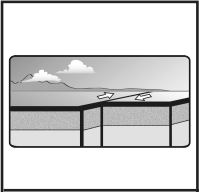
What type of boundary is this?
convergent
divergent
transform

What type of boundary is this?
convergent
divergent
transform
The point where one plate slides beneath another is known as the ______________.
lithosphere
Pangaea
subduction zone
tectonic
Wegener
What is the difference between magma and lava?
lava is magma but it is on the surface of the Earth
lava is the chamber that magma flows
lava is the Earth's crust
lava has a different chemical composition than magma
What is the Ring of Fire?
A misshapen horseshoe of volcanic lava flow
A burning ring of fire
A pattern of volcanic eruptions around the world
A story of earthquakes and volcanoes
What causes magma to rise to the Earth's surface and create volcanoes?
Subduction of ocean plates
Collisions of tectonic plates
Hot spots within tectonic plates
All of the above
What type of tectonic plate boundary leads to earthquakes?
Divergent boundary
Subduction boundary
Transform boundary
Hot spot boundary
What is known as the Ring of Fire?
A circle of peaceful islands in the Pacific
A huge arc of geological destruction surrounding the Pacific
A series of underwater volcanoes in the Atlantic
A constellation visible from the Southern Hemisphere
How is the magnitude of an earthquake measured?
The magnitude of an earthquake is measured using seismographs and scales like the Richter scale or moment magnitude scale.
The magnitude is measured using GPS technology.
Seismologists use weather patterns to determine magnitude.
Magnitude is assessed by the color of the earthquake's epicenter.
How do tsunamis form?
Tsunamis form primarily due to underwater earthquakes, volcanic eruptions, or landslides that displace water.
Tsunamis form from the gravitational pull of the moon.
Tsunamis are created by large ships traveling at high speeds.
Tsunamis are caused by high winds over the ocean.
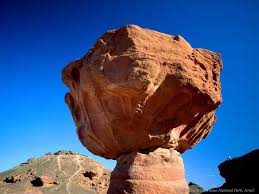
The dropping off of sediments in a new place.
Weathering
Erosion
Deposition
Volcano
This is the movement of sediment by water ice ,gravity, and wind.
glacier
erosion
water cycle
precipitation

Limestone dissolves in the presence of acid rain
physical weathering
chemical weathering
Which process involves the breakdown of rocks without changing their chemical composition?
physical weathering
chemical weathering
Which of the following is an example of physical weathering?
rust formation on iron
cracking of rocks due to freeze-thaw cycles
limestone dissolving in acid rain
Which of the following is a result of chemical weathering?
the cracking of rocks due to freeze-thaw cycles
the rusting of a metal fence
the formation of sand dunes by wind
What cycle are fossil fuels part of ?
carbon
oxygen
nitrogen
phosphorus
What do the water, carbon, oxygen, nitrogen, a phosphorus cycles have in common?
All involve liquid substances falling to the Earth from the atmosphere?
None of the processes works at low temperature.
All involve the constant cycling of substances between animals, plants, and the Earth.
All involve the transfer of substances between the earth and outer space.

What is the smallest 'building block' of the elements that make up the universe?
An atom
An electron
A proton
A cell
Which two subatomic particles are found in the nucleus of an atom?
Neutrons and Protons
Shells and Electrons
Electrons and Protons
Electrons and Neutrons

How many protons are in carbon?
12
6
0
7

In the periodic table of elements, the periods are shown
horizontally
vertically
diagonally
upside down
What is the best definition of valence electrons?
The outermost electron NOT involved in chemical reactions
The innermost electrons involved in chemical reactions
The outermost electrons involved in chemical reactions.
The innermost electrons NOT involved in chemical reactions
How many valence electrons do atoms want to be stable or to follow the octet rule?
2
8
10
18

Which group of elements could have the characteristic of brittle?
Metal
Nonmetal
Conductivity is the ability to
reflect light from a lustrous surface
transfer thermal and electrical energy
exist as a solid, liquid, or gas
be hammered into thin sheets
ductile means...
can be made into wire
can be bent or hammered
can light up a light bulb
it's shiny
What is the difference between a conductor and an insulator?
An insulator allows electricity to flow through it easily and a conductor does not
A conductor allows electricity to flow through it easily and an insulator does not.
An insulator is magnetic and a conductor is not
A conductor is magnetic and an insulator is not
Show answersExplanationPreviousNext
What type of matter makes good conductors?
Gases
Nonmetals
Metals
What type of matter makes good insulators?
people
nonmetals
metals
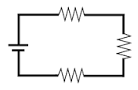


True/False: in an open circuit, a light bulb will light up
True
False

How much voltage would be necessary to generate 10 amps of current in a circuit that has 5 ohms of
resistance?
10V
50V
100V
150V

An object becomes electrically charged when the atoms in the object gain or lose
electrons
protons
neutrons
all of the above
What causes lightning?
The movement of clouds in the sky
A large electric field causing the air to be ionized and creating a conductive path
The sun heating the earth
Static electricity from rubbing two clouds together
Why do we hear thunder after we see lightning?
Because thunder travels faster than lightning
Because lightning is silent
Because the speed of light is much faster than the speed of sound
Because thunder is caused by something else
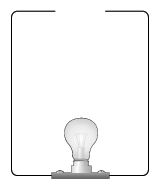
What is the unit used for voltage?
Ampere
Ohm
Volt
Meter
One amp is defined as the rate of charge flow equal to __ coulomb per second.
3
2
4
1
What resistance is needed to cause a 20A current flow with a 100V battery (Ώ=symbol for Ohm)?
0.2Ώ
2000Ώ
200Ώ
5Ώ
According to Coulomb's Law, when the distance increases, the electrostatic force ____________.
increases
decreases
remains unchanged
has no relationship to distance
What does the Law of Conservation of Charge state?
like charges repel and opposites attract
positive charge fields point away from a charge; negative points toward
charges cannot be created nor destroyed, only transferred

Like charges ________.
repel
attract
Opposite charges ________.
repel
attract

When you rub a balloon up against your shirt, the shirt becomes positively charged. This means that
more protons were created on the shirt.
electrons left the shirt and moved to the balloon.
protons left the balloon and moved to the shirt.
neutrons left the shirt and moved to the balloon.

A region around a charged particle that can exert a force on another charged particle is called an
electric force.
electric pulse.
electric field.
electric charge.

