
 Worksheets
Semester Midterm (Sci.Mthd., Variables, Forces and Motion)
Total questions: 82
Worksheet time: 7hrs 50mins
Select the FIRST step in the Scientific Method.
The results of this experiment show that the boiling point of water does rise as the amount of salt in the water increases.
I will put a thermometer in each of 3 pots of boiling water. Each pot will contain a different amount of salt. I will observe and compare the temperatures in each pot when the water begins to boil.
If adding salt to water increases the density of water, then it requires more energy to make it boil, thus increasing the boiling point temperature.
Do heavier objects fall faster than lighter obects?
The temperature when boiling begins (salt quantity) Pot 1: 214.2 F (0g) Pot 2: 216.3 F (50g) Pot 3: 218.3 F (100g)
I will drop a variety of objects from a height of 10 feet and use a stopwatch to record the time it takes for them to hit the ground.
The rock sample is reddish brown.
One leaf is 9 cm long.
The balloon increased in size from 5 inches to 8 inches round.
It is light green in color.
Lisa earned a 93% on her science quiz.
The variable that you measure is the _____________?
The results of this experiment showed that green light was the least effective color for growing plants. Blue and red lights caused the greatest amount of growth. This statement is an example of _____________
The cake recipe requires 3 cups of flour.
The temperature of the room increases by 8 degrees C.
The sand paper feels rough.
Mrs. Palmer is planning an experiment to find out how the height from which she drops a ball affects how high the ball bounces. What is a CONSTANT in this scenario?
Mr. Lyons set up an experiment to see how the different masses of a ball affect the distance it rolls off a ramp. Identify the DEPENDENT VARIABLE.
Mario studied how far room temperature water would squirt out of a plastic milk carton when 3 mm holes were punched at different heights from the bottom of the container. Identify the DEPENDENT VARIABLE.
Nick wanted to see how high an ice cube would float in different temperatures of water. Identify the INDEPENDENT VARIABLE.
Three redwood trees are kept at different humidity levels inside a greenhouse for 12 weeks. One tree is left outside in normal conditions. The height of the tree is measured once a week. Identify the DEPENDENT VARIABLE.
Three redwood trees are kept at different humidity levels inside a greenhouse for 12 weeks. One tree is left outside in normal conditions. The height of the tree is measured once a week. Identify a CONSTANT.
You water three sunflower plants with salt water. Each plant receives a different concentration of salt solutions. A fourth plant receives pure water. After two weeks, the height of the plants is measured. Identify the INDEPENDENT VARIABLE.
You water three sunflower plants with salt water. Each plant receives a different concentration of salt solutions. A fourth plant receives pure water. After two weeks, the height of the plants is measured. Identify the DEPENDENT VARIABLE.
A(n) __________________ variable is what we know before we start the experiment. It is what we are testing.
Changing the mass and release point does not affect the average amount of swings the pendulum makes.
A(n) _________________ variable is what we found out or measured in the experiment.
_____________ is an invisible force that pulls objects towards each other.
Which variable had a greater influence on the number of swings on the pendulum?
The greater number of swings, the ______________ the pendulum.
When you pull or push, you are applying a ___________.
In our pendulum lab, the "penny" acted as the ___________.
The force of attraction between two objects is known as __________.
Earth has a stronger gravity than the moon.
The strength of gravity between any two objects depends on the ________________.
In Investigation 1 Part 3 "Mass of the Bob", what was identified as the independent variable?
When the small, medium, and large steel balls were dropped from the same position, the distance traveled was the same.
The force pulling the steel ball down the ramp and into the runway was ___________.
If opposing forces are equal, the net force is ______________.
In Investigation 2 (Part 2) the ball is pushing the cork in one direction and another force is applied to the cork in the opposite direction. What is the force in the opposite direction?
When one of the steel balls is stationary, it has __________ energy.
The higher the position of the ball, the less kinetic energy it will have rolling down the ramp.
The higher the position of the steel ball the more speed it will have coming down the ramp.
How do we know that energy is transferred to the cork?
Our data table (for the steel ball and cork) showed that, no matter what the size of the steel ball, the higher positions always gave more kinetic energy. Which below was our evidence?
In both parts of our lab, overall, which size steel ball had the most kinetic energy at position 6?
At which position does the bowling ball have the most KINETIC energy?
At which position does the bowling ball have the most POTENTIAL energy?
The kinetic energy of the ball is transferred to the cork during a collision. We can say that _____________ is transferred.
Which tool is used to measure force in units called Newtons (N)?
Momentum is __________.
The more momentum an object has, the more force it takes to bring it to a stop.
If a ball is released from position 2 on the ramp, then what could you predict about the collision force(measured by a spring scale)?
A ball is rolling with a force of 15N. What amount of force would be needed to stop this rolling ball?
In the "Momentum" lab we saw the ball push the cork at varying distances. One of the variables that affected the distance the ball pushed the cork were mass and __________.
The ball at the highest position had the least amount of momentum.
How was the kinetic energy transferred in the "Momentum" lab?
In the cork and ball system, which force slowed down the system?
If two balls collide with the same momentum, the faster ball will bump and move the slower ball.
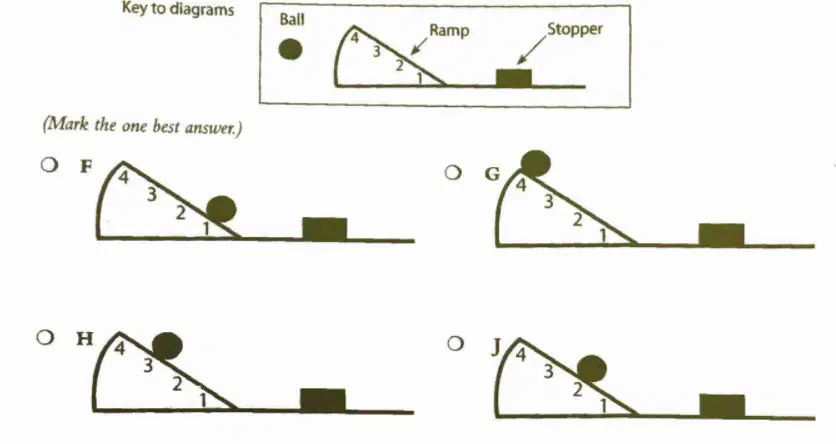
The four diagrams, to the left, show the setup of four similar tests. In which setup do you predict the stopper will move the farthest when the ball is released and collides with the stopper?
If a LARGER ball, like a baseball, rolls down the same ramp, it will roll ____________________ the golf ball.
As you release the ball from higher release positions, the collision force will ____________.
Any push or pull acting on an object is called a(n) _________________.
Holding down the flip stick or compressing it, is an example of _______________.
When the flip stick is released and the object launches, you now have ______________.
Which one of these objects uses a coil spring?
Which one of these objects uses a leaf spring?
The greater the force on an object, the greater the change in motion.
Less force is needed to launch heavier objects.
Which was true after we tested flip-stick length?
When does the bow have kinetic energy?
When you put pennies underneath a leaf spring (flip stick) to control how far it can bend, you are controlling the amount of ______________ you are putting into the system.
Part of the flipper system that launches the object.
_____________ is transferred to the flipper system by applying a downward force to the flip stick and the spring bends or compresses.
What type of energy is used when the flip-stick is released and launches the stopper? We have only talked about 2 types so far.
The more potential energy, the less energy can be transferred.
The more the spring compresses (holding it down in position), the more __________ energy it will have.
What is the relationship between the weight of the stone launched and the distance it travels according to the graph?
What type of energy is there when you let go of the flip stick and the object is launched into the air?
Select 2 objects below that you consider a "leaf spring".

