
Font size
 Worksheets
Chemistry 2023 Fall Final
Total questions: 75
Worksheet time: 57mins
Which part of an atom is most directly involved in chemical bonding?
nucleus
electron
proton
neutron
Which element has the highest electronegativity?
nitrogen
iodine
fluorine
selenium
Which set of tools will provide the most precise measurements for calculating the density of an irregularly shaped rock?
flask and beaker
flask and balance
balance and graduated cylinder
beaker and graduated cylinder
Which of these is an example of a chemical change?
Methane is burned in air.
Solid gold is melted to make jewelry.
A bar of copper is stretched into a long copper wire.
Iron is coated with bronze to prevent rusting.
Which element on the periodic table has a total of 16 protons?
germanium (Ge)
phosphorus (P)
oxygen (O)
sulfur (S)
The half-life of cobalt-60 is 5.27 years. Approximately how much of a 199 g sample will remain after 20 years?
10.0 g
12.5 g
40.0 g
50.0 g

The reaction shown represents the oxidation of ammonia (NH3 ). How many grams of water (H2O) will be formed when 34 grams of ammonia reacts with an excess of oxygen (O2)?
51 grams
54 grams
64 grams
110 grams
The equation represents an incomplete chemical reaction. Al + Cl2==> What is the product of the chemical reaction?
Al2Cl3
AlCl
AlC12
AlC13
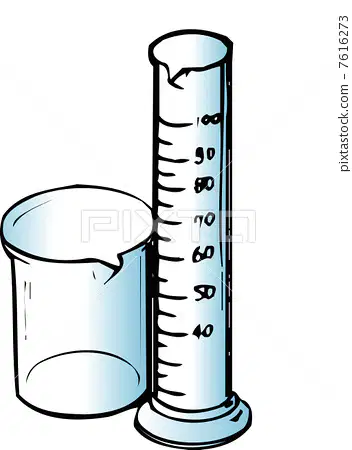
Two measuring tools are shown. Measuring Tools What is the most appropriate tool for measuring 30.0 mL of a sodium chloride solution?
the beaker because it is more stable and the liquid is less likely to spill
the beaker because it is calibrated to hold large amounts of liquid
the graduated cylinder because it is calibrated to measure the liquid more precisely
the graduated cylinder because it will be nearly filled with liquid
Isotopes of an element have different numbers of
protons
neutrons
electrons
positrons
What is the molarity of a 0.5 L sample of solution that contains 60.0 g of sodium hydroxide (NaOH)?
0.8M
1.5 M
3.0M
6.0M
Which element has the highest electronegativity?
beryllium (Be)
fluorine (F)
silver (Ag)
silicon (Si)
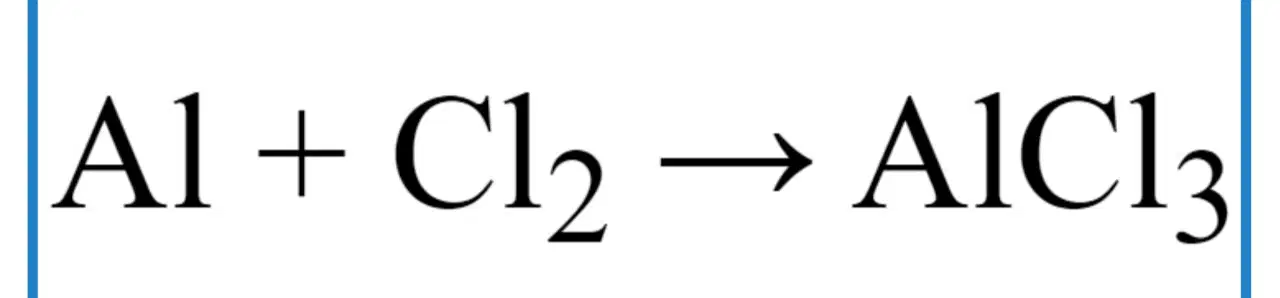
A chemical equation is shown. What is the molar ratio for the chemical reaction when the equation is balanced?
1: 2: 5
2: 1 : 1
4: 3: 1
4:3:2
Which characteristic of an exothermic reaction differs from that of an endothermic reaction?
An exothermic reaction absorbs heat as the reaction progresses.
The activation energy is higher in an exothermic reaction.
An exothermic reaction releases heat as the reaction progresses.
The products in exothermic reactions have more potential energy than the reactants.
Which illustration represents the region in which an electron of a hydrogen atom is most likely found at ground state?
F
G
H
J

Magnesium (Mg) and oxygen (O2) react to form magnesium oxide (MgO). Which type of chemical reaction does the equation represent?
decomposition
double replacement
single replacement
composition

Based on the graph, what change occurred when ice at 0°C was heated at a constant rate?
Molecules broke apart into atoms.
Elements dissociated into ions.
Intermolecular attractions were decreased.
Chemical energy was stored.
What is the percent composition by mass of sulfur in ammonium sulfate, (NH )2S0 4?
6.7%
24%
28%
32%
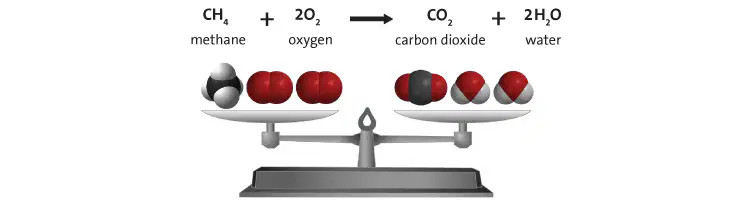
The chemical equation shows methane (CH4) burned in the presence of oxygen gas (O2). Which type of reaction does this equation represent?
composition
single replacement
double replacement
combustion

The diagram represents the Lewis electron-dot structure of a neutral element. Which element does this Lewis electron-dot structure most likely represent?
Na
Mg
Cl
Ar
A student fills a flask with 5.0 moles of nitrogen gas and then seals the flask. Which change will happen when the student warms the flask?
The temperature of the nitrogen gas will decrease.
The pressure inside the flask will increase.
The volume inside the flask will decrease.
The molar mass of the nitrogen gas will increase.
Which statement best describes the Bohr model of the atom?
Electrons are arranged in energy clouds.
Electrons have properties similar to waves.
Electrons orbit around the nucleus in set paths.
Electrons make up most of the mass of an atom.
What is the approximate percent composition of phosphorus in phosphoric acid (H3PO4)?
29.5%
31.6%
65.3%
98.0%
Which of these is an example of a homogeneous mixture?
a bowl of noodle soup
a container of water and sand
a glass of salt water
a bottle of oil and vinegar
A student sets up an experiment to investigate the effect of temperature on the volume of 50 grams of gas inside a balloon. Which statement correctly describes the design of the experiment?
The temperature is an experimental control, and the volume is the independent variable.
The volume is an experimental control, and the temperature is the dependent variable.
The mass of the gas is an experimental control, and the temperature is the independent variable.
The temperature is an experimental control, and the mass of the gas is the dependent variable.
What is the approximate mass of 1.50 moles of ammonia (NH3)?
10.0 grams
15.0 grams
17.0 grams
25.5 grams
What is the total number of electrons in all s orbitals of a neutral atom of phosphorus?
Which process represents a chemical change?
oxidation
sublimation
evaporation
condensation
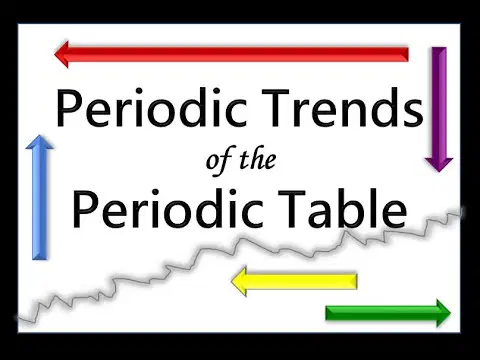
Which pair of arrows correctly represents how atomic radii change, from smallest electronegativity to largest electronegativity, on the periodic table of the elements?
red and blue arrows
blue and green arrows
purple and green arrows
yellow and purple arrows
What are the products of the decomposition of mercury(II) oxide (HgO)? 2 answers
Hg2 and O2
Hg2 and O
Hg and O2
HgO and O2
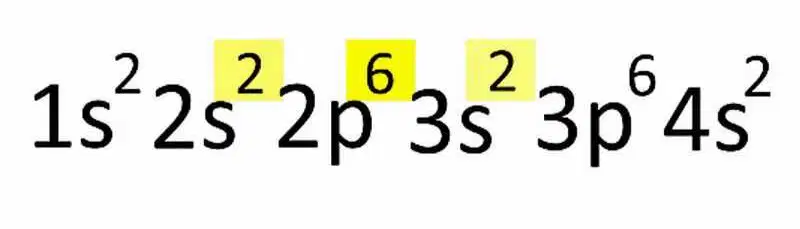
The electron configuration of a neutral atom of calcium is shown. How many valence electrons are in the atom?
6
8
2
10

What quantities of nitrogen gas (N2) and oxygen gas (O2) will react completely to produce 2 moles of dinitrogen pentoxide (N2O5)?
4 moles of N2 and 10 moles of O2
4 moles of N2 and 5 moles of O2
2 moles of N2 and 10 moles of O2
2 moles of N2 and 5 moles of O2
According to the quantum mechanical model of the atom, what is the maximum number of electrons that can occupy the second energy level?
8
18
10
6
A gas has a volume of 3.0 L at a pressure of 3.0 atm. What will be the final volume of the gas if the pressure is increased to 5.0 atm at a constant temperature?
0.56 L
1.8 L
3.0L
5.0L

The chemical equation represents the reaction between sodium (Na) and oxygen (O2). What is the product of this reaction?
Na2O
NaO
NaO2
Na2O2

The diagram shows the Lewis electron-dot structure of Element X at ground state. Which of these could be the atomic number of Element X? choose 2
2
6
16
46
How many atoms are in 3.50 moles of calcium (Ca)?
140.28
3.5
2.1 x 10^24
8.4 x 10^25
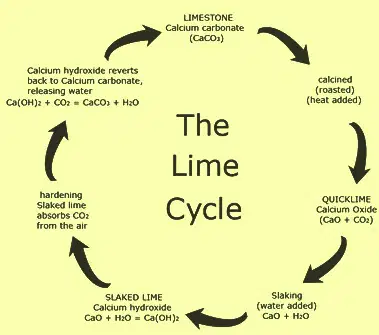
The chemical equation shows the production of calcium oxide (CaO) and carbon dioxide (CO2) from CaCO3.. How should this reaction be classified?
decomposition
composition
single replacement
double replacement
Which of these gives an example of a chemical change?
burning a piece of wood
cracking an egg
folding a piece of paper
melting an ice cube
Which of these describes how gallium forms a 3 + ion?
The gallium loses 3 electrons.
The gallium loses 3 protons.
The gallium gains 3 electrons.
The gallium gains 3 protons.
During the production of aspirin, 2.6 g of aspirin can be formed from 2.0 g of salicylic acid. What is the percent yield if only 1.7 g of aspirin is produced?
35%
65%
77%
85%

What is the volume of a piece of zinc with measurements 5.0 cm x 5.0 cm x 5.0 cm?
15 cm3
125 cm3
15 cm
125 cm

What is the volume of the fluid in the graduated cylinder shown?
12.0 ml
13.0 ml
13.5 ml
12.5 ml

If the graph represents the energy of the reactants and products of a chemical reaction, which of the following is true of the reaction?
there is an exothermic reaction
there is an endothermic reaction
the activation energy is lower than the energy released
the total energy is higher than the starting energy

1 ml is the same as which af the following? (Mark all that apply)
1 cc
1 cm3
1 μl
1 dm3

There are seven naturally occurring diatomic elements; which of the following is NOT a diatomic element?
H
O
Cl
N
C

A material that is made of different substances that are NOT chemically combined is called a(an)
compound
mixture
ion
atom

In a solution, the substance that causes the dissolving is known as a ________
solute
solvent
suspension
colloid

_________ mixtures are evenly blended and appear to be the same throughout.
homogeneous
heterogeneous

A mixture, like salt water, containing one substance dissolved in another, is known as a ____________ (mark all that apply).
homogeneous mixture
solution
suspension
colloid

An atom of beryllium contains 4 protons, 5 neutrons, and 4 electrons. What is the mass number of this atom?
13
9
8
5

A 220 g piece of metal was submerged in a graduated cylinder containing 50 ml of water. The level of the water rose to 150 ml. What is the density of the metal?
2.2 g/ml
0.45 ml/g
320 g/ml
20 g/ml
Elements in the same column of the periodic table always have the same # of _______ as one another.
Protons
Neutrons
Electrons
Valence Electrons
Which group of the periodic table is composed of inert (not reactive) gases?
alkali metals
alkaline earth metals
halogens
noble gases
metallic

Which element easily gives up 1 electron to form a cation with +1 charge?
F
Cl
Mg
Li

Which atom will have the strongest affinity for electrons, becoming an anion with a -1 charge?
K
F
O
Fe

Where on the periodic table do you find elements that form the strongest bases?
left
right
middle
inert gases

If two atoms bond in such a way that one-member beomes a positive cation and the other a negative anion, what type of bond is formed?
ionic bond
covalent bond
polar bond
Vanderwaals bond

Isotopes are atoms with different numbers of ________.
protons
neutrons
electrons

The scientist whose alpha-particle scattering experiment led him to conclude that the nucleus of an atom contains a dense center of positive charge is
JJ Thomson
Ernest Rutherford
Neils Bohr
John Dalton

This scientist is responsible for the model that we use today to illustrate and help understand the atoms' energy levels.
JJ Thomson
Ernest Rutherford
Neils Bohr
John Dalton
An atom has 10 protons, 15 neutrons and 10 electrons what is its mass number.
20
10
35
25
What atom matches this electron configuration?
1s2 2s2 2p6 3s2
Neon
Magnesium
Aluminum
Potassium
Solve this equation for alpha decay.
85209At = ___ + 24He
83205Bi
86209Rn
81207Tl
85208At

According to the graph, what fraction of the original parent isotope still exists after 3 half lives?
0,5000 g
0,2500 g
0,1250 g
0.0625 g
The correct name for LiCl is
lithium monochloride
lithium chloride
lithium I chloride
monolithium monochloride
Cu + 2Ag(NO3) → 2Ag + Cu(NO3)
Synthesis Reaction
Decomposition Reaction
Single Replacement Reaction
Double Replacement Reaction
The correct formula for the ammonium ion is
NH4
N4H+
NH4+
Am+
Which of the following is a double replacement reaction?
2Mg + O2 → 2MgO
2Al+6HCl→2AlCl3 +3H2
Na2S+2HCl→2NaCl+H2S
PCl5 → PCl3 +Cl2
P4+O2 --> P2O3

