wayground logo

Free Printable Worksheets

Font size

S
M
L
XL
Worksheets

Chemistry Review

Total questions: 75

Worksheet time: 2hrs 20mins
Name
Class
Date
1.
The molar mass of an element is equal to its...
a)
Atomic mass
b)
Atomic number
c)
Oxidation number
d)
Valence electrons
2.
The mass of one mole of substance is called...
a)
molecular mass
b)
mole constant
c)
molar mass
d)
atomic weight
3.
What is the molar mass of CO2?
a)
12
b)
16
c)
32
d)
44
4.
How many particles are in a mole?
a)
602
b)
602 million
c)
602 moles
d)
6.02 x 10²³
5.
What is the molar mass of CO2?
a)
12
b)
16
c)
32
d)
44
6.
What is the molar mass of NaOH?
a)
40 g/mol
b)
38.989 g/mol
c)
23.998 g/mol
d)
57.004 g/mol
7.
The technetium-99 isotope has a half-life of 6.0 hours. If 100.0 mg were injected into a patient how much remains after 18 hours?
a)
33.0 mg
b)
12.5 mg
c)
.33 mg
d)
15.8 mg
8.
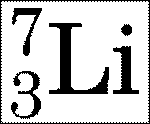
How many protons are in this atom?
a)
3
b)
4
c)
6
d)
10
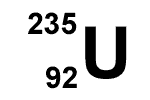
9.
How many neutrons are in this isotope of Uranium?
a)
235
b)
92
c)
327
d)
143
10.
Which nuclear power plant has not had a meltdown
a)
Three Mile Island (US)
b)
Chernobyl (Ukraine)
c)
Taishan (China)
d)
Fukushima (Japan)
11.
What type of nuclear radiation can be stopped by 10 mm of wood or 3 mm of aluminum?
By Lewis Ronald (Own work) [CC BY-SA 3.0 (http://creativecommons.org/licenses/by-sa/3.0)], via Wikimedia Commons
a)
Alpha particle (α)
b)
Beta particle (β)
c)
Gamma ray (γ)
d)
Neutron emission
12.
Alpha particles have a _____ charge.
a)
+2
b)
0
c)
+1
d)
-1
13.

In the symbol 167N what the 7 stand for?

a)

Mass number

b)

Atomic number

c)

Atomic mass

d)

Number of neutrons

14.

What is the missing isotope that will balance the following nuclear equation?

26 12 Mg → _____ + 42He

a)

105B

b)

105Ne

c)

22 10Ne

d)

63C

15.
The time taken for half of an amount of radioactive atoms to decay.
a)
Nuclear fusion
b)
Full-life
c)
Dead time
d)
Half-life
16.
Which process involves the joining of small nuclei?
a)
Beta decay
b)
Alpha decay
c)
Nuclear fission
d)
Nuclear fusion
17.
Scientist involved with discovery of radioactivity.
a)
Albert Einstein
b)
Ernest Rutherford
c)
Marie Curie
d)
Isaac Newton
18.
The nuclear process occurring at a nuclear power plant.
a)
Nuclear fusion
b)
Nuclear fission
c)
Combustion
d)
Multiplication
19.
Complete the sentence: As time passes the level of radiation produced by a radioactive material...
a)
Decreases
b)
Increases
c)
Remains constant
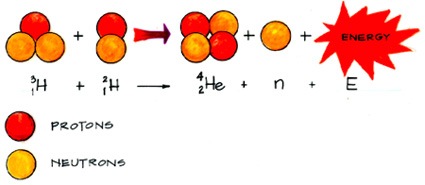
20.
Classify this process.
a)
Nuclear fission
b)
Nuclear fusion
c)
Alpha decay
d)
Beta decay
21.

Carbon-14 has a half-life of 5730 years. How old is a wooden spoon if 6.25% of the Carbon-14 radioactivity is left?

a)

30500 years

b)

22920 years

c)

11000 years

d)

5000 years

22.
It is the energy producing reaction that takes place in our sun and other stars.
a)
Fission
b)
Chain Reaction
c)
Fusion
23.
The energy produced can be controlled and harnessed to produced electricity.
a)
Chain Reaction
b)
Fission
c)
Fusion
24.

The half-life of technetium is 6.0 hours. How many half-lives will it take for 3.125% of a 10.0g sample to be left? How much time would have passed?

a)

3 half-lives, 50 hours

b)

5 half-lives, 30 hours

c)

5 half-lives, 60 hours

d)

10 half-lives, 40 hours

25.

Selenium-83 has a half-life of 25.0 minutes. How many years would it take for a 10.0 mg sample to decay and have only 1.25 mg of it to remain?

a)

50 minutes

b)

25 minutes

c)

100 minutes

d)

75 minutes

26.

Iron-59 is used as a radiotracer in red blood cells. It has a half-life of 45 days. How much of a 15.0 mg sample would be left after 180 days?

a)

9.3750 mg

b)

0.9375 mg

c)

0.09375 mg

d)

0.009375 mg

27.
Balance the following equation:
146C --> 0-1e + ________
a)
145B
b)
146C
c)
147N
d)
42He
28.
Arrange in order of increasing ability to penetrate matter.
a)
Beta, gamma, alpha
b)
Alpha, gamma, beta
c)
Gamma, beta, alpha
d)
Alpha, beta, gamma
29.
Which type of radiation has the greatest penetrating power?
a)
Alpha
b)
Beta
c)
Gamma 
d)
Microwaves
30.

The technetium-99 isotope has a half-life of 6.0 hours. If 100.0 mg were injected into a patient how much remains after 18 hours?

a)

33.0 mg

b)

12.5 mg

c)

.33 mg

d)

15.8 mg

31.
What happens to the atomic number during alpha decay?
a)
The atomic number decreases by 4
b)
The atomic number increases by 1
c)
The atomic number decreases by 2.
d)
The atomic number stays the same.
32.
What do carbon-12 and carbon-14 have in common? 
a)
They have the same number of protons
b)
They have the same number of neutrons
c)
 They have the same atomic mass
d)
They have the same atomic weight
33.
How is carbon-12 different from carbon-14?
a)
They have a different number of protons 
b)
They have a different number of electrons
c)
They have a different number of neutrons
d)
They are different elements 
34.
Which of the following best describes the process of nuclear fission? 
a)
Splitting an atom's nucleus apart 
b)
Separating an atom's electrons from its nucleus 
c)
Fusing two atomic nuclei together 
d)
Splitting an atom's electrons in half 
35.
How does nuclear fusion compare to nuclear fission? 
a)
Nuclear fusion produces no radioactive waste
b)
Nuclear fusion produces more radioactive waste
c)
. Nuclear fusion is cheaper and easier to produc
d)
Nuclear fusion requires rare, expensive elements to work
36.
Has a mass of 4 and a charge of +2
a)
Alpha
b)
Beta
c)
Gamma
d)
neutron
37.
In order of most to least penetrating radiation we have
a)
Alpha , Beta,  Gamma
b)
Beta , Gamma , Alpha
c)
Gamma, Beta, Alpha
d)
Gamma, Alpha, Beta
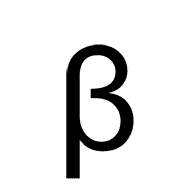
38.
Has the symbol
a)
Alpha
b)
Beta
c)
Gamma
d)
neutron
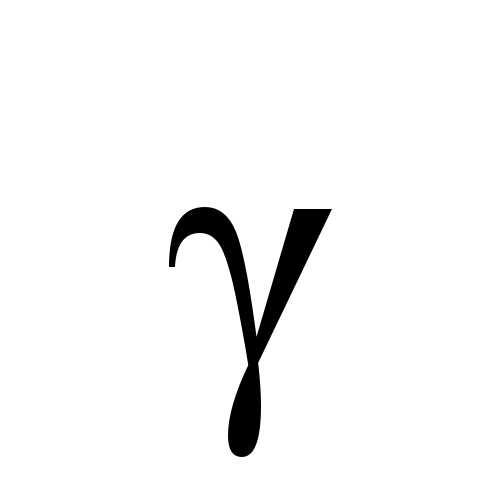
39.
Has the symbol
a)
Alpha
b)
Beta
c)
Gamma
d)
proton
40.
Has the symbol
a)
Alpha
b)
Beta 
c)
Gamma
d)
electron
41.
What is NOT a characteristic of gamma radiation?
a)
Most dangerous type of radiation
b)
High energy, high penetration
c)
stopped by thin metal
d)
Stopped by several feet of concrete or several inches of lead
42.
A substance that has a definite shape and volume.
a)
evaporation
b)
gas
c)
liquid
d)
solid
43.
Freezing point and melting point are the same temperature.
a)
True
b)
False
c)
It depends on the substance
44.
What are 3 of the states of matter?
a)
solids, liquids, and gases
b)
solids, liquids, and solids
c)
liquids, gases, and density
d)
density, volume, and mass
45.
Which form of matter takes the shape of a container like this juice?
a)
liquid
b)
solid
c)
plasma
d)
gas
46.
Liquids and gases are similar because __________________________.
a)
they both take the shape of their container
b)
they both have their own shape
c)
liquids pour and gases don't
d)
liquids take the shape of the container but gases have their own shape
47.
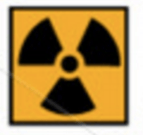
What safety symbol is this? 
a)
biohazard
b)
radiation
c)
toxic
d)
corrosive
48.

Flammable materials, like alcohol, should never be used or dispensed near:

a)

an open door

b)

an open flame

c)

another student

d)

a sink

49.
 If you do not understand a direction or part of a lab procedure, you should 
a)
skip it and go on to the next part.
b)
ask the instructor before proceeding
c)
try several methods until something works
d)
figure it out as you do the lab
50.
What safety symbol is this?
a)
Eye Protection
b)
Clothing Protection
c)
Hand Protection
d)
Heat Protection
51.
You are heating a substance in a test tube. Always point the open end of the tube 
a)
away from all people
b)
toward another classmate
c)
toward your lab partner
d)
toward yourself
52.
 The following footwear is best in the laboratory. 
a)
shoes appropriate for the weather
b)
open-toed shoes
c)
closed-toed shoes
d)
sandals
53.
 After completing an experiment, all chemical wastes should be
a)
taken home
b)
dumped in the sink
c)
disposed of according to your instructor’s directions
d)
left at your lab station for the next class
54.
A series of steps used by scientists to solve a problem or answer a question. 
a)
scientific method
b)
recipe
c)
data collection
d)
metric system
55.
Which is NOT a step in the scientific method?
a)
Make observation
b)
Form a theory
c)
Collect data
d)
Form a hypothesis
56.
A testable explanation to a problem that has not yet been tested. 
a)
data
b)
theory
c)
hypothesis
d)
fact
57.
A testable explanation to a problem that has not yet been tested. 
a)
data
b)
theory
c)
hypothesis
d)
fact
58.
Which letter represents a proton?
a)
A
b)
B
c)
C
d)
D
59.
An element with a mass number of 11 and an atomic number of 5 has how many neutrons?
a)
11
b)
5
c)
6
d)
16
60.
An atom has 10 protons, 15 neutrons and 10 electrons what is its mass number.
a)
20
b)
10
c)
5
d)
25
61.
If an atom has 12 positively charged subatomic particles, which of the following must it also have to be considered a neutral atom?
a)
12 neutrons
b)
12 electrons
c)
12 protons
d)
24 protons and neutrons
62.
What is the number of protons that the element in this image contain?
a)
14
b)
7
c)
15
d)
18
63.
Which subatomic particles contribute the most to the mass of an atom?
a)
Protons, Neutrons, Electrons
b)
Protons only
c)
Protons and Electrons
d)
Protons and Neutrons
64.
What subatomic particles would you find in the nucleus of an atom?
a)
Protons only
b)
Protons and Neutrons
c)
Neutrons and Electrons
d)
Protons and Electrons 
65.
How many sig figs are there?
27000000
a)
2
b)
5
c)
8
66.
How many sig figs are there?
5.00000008
a)
2
b)
6
c)
9
67.
How many sig figs are there?
0.00400
a)
1
b)
3
c)
5
d)
6
68.
How many sig figs are there?
4004
a)
1
b)
2
c)
3
d)
4
69.
How many sig figs are there?
0.000008
a)
1
b)
2
c)
6
d)
7
70.
The summary at the end of an experiment that explains the results. 
a)
conclusion
b)
procedures
c)
materials
d)
responding variable
71.
Dependent variable means
a)
the scientist controls what to test
b)
educated guess
c)
ask a question
d)
what is being measured
72.
What is the first step in the scientific method?
a)
Ask a question
b)
Conclusion
c)
No Horse Play
d)
Observe
73.
This variable in an experiment is the one being changed by the scientist. 
a)
dependent variable
b)
independent variable
c)
data
d)
control group
74.
The technetium-99 isotope has a half-life of 6.0 hours. If 100.0 mg were injected into a patient how much remains after 18 hours?
a)
33.0 mg
b)
12.5 mg
c)
.33 mg
d)
15.8 mg
75.
What is NOT a characteristic of an alpha particle?
a)
A negatively charged electron
b)
Stopped by paper
c)
A positively charged particle
d)
Low penetration