
 Worksheets
Astronomy 2 Review Quiz
Total questions: 75
Worksheet time: 4hrs 45mins
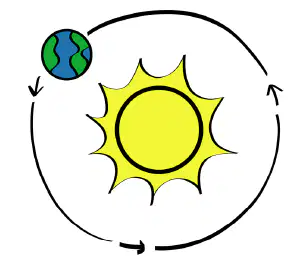
Causes day and night
Rotation
Revolution
Spinning on an axis
Rotation
Revolution
Takes one day, or 24 hours
Rotation
Revolution
Causes sunset in the west and sunrise in the east
Rotation
Revolution
Rotation
Revolution
to orbit around the sun
Rotation
Revolution

The Moon orbits around the Earth
Rotation
Revolution
What causes us to be able to see different constellations throughout the year
The Earth's revolution around the Sun
The Earth's rotation about its axis
The movement of the stars
The tilt of Earth's axis
How long is one revolution of the Earth around the Sun?
24 hours
27.3 days
23 hours and 56 minutes
365.25 days


Which model below includes EPICYCLES for Mars, Jupiter, and Saturn?
What does the Heliocentric system look like?


Why does the ball look like it's going straight when you're not on the merry-go-round and look like it's curving when you are on the merry go round?
the Coriolis Effect
the Doppler Effect
Redshift
the Tectonic Effect
Planetary winds and ocean currents are deflected [curved] to the right in the Northern Hemisphere and to the left in the Southern Hemisphere due to
seasonal changes
the Doppler effect
plate tectonics
the Coriolis effect
The Coriolis effect is a result of Earth’s
tilted axis
orbital shape
revolution
rotation

The best evidence of Earth’s rotation is provided by the
shape of Earth’s orbit
shape of the Milky Way galaxy
changes in the total yearly duration of insolation at a location on Earth
apparent changes in the direction of swing of a Foucault pendulum

At a location in the Northern Hemisphere, a camera was placed outside at night with the lens pointing at a group of stars. The shutter was left open for a few hours, resulting in the photograph of star trails shown below.
What is the name of the star in the center of the photograph that did not leave a star trail?
Betelgeuse
Sirius
the Sun
Polaris
Base your answer on the time-exposure photograph shown here The photograph was taken by aiming a camera at a portion of the night sky above a New York State location and leaving the camera's shutter open for a period of time to record star trails.
During the time exposure of the photograph, the stars appear to have moved through an arc of 120°. How many hours did this time exposure take?
5h
8h
12h
15h
Which photograph of star trails was taken by an observer facing directly north in New York?


Why do stars appear to move through the night sky at the rate of 15 degrees per hour?
The Earth actually moves around the Sun at a rate of 15º per hour.
The stars actually move around the center of the galaxy at a rate of 15º per hour.
The Earth actually rotates at a rate of 15º per hour.
The stars actually revolve around the Earth at a rate of 15º per hour.
Earth is tilted ______ degrees on its axis
12.5
20
23.5
30

The highly eccentric orbit of the the celestial object shown in white is most likely a
Planet
Asteroid
Comet

The eccentricity of a perfect circle is _____
The eccentricity of a straight line is _____
0
1
1
0
1
1
0
0
Which diagram best represents the location of polaris for an observer located at the Equator?


The value of the eccentricity of ANY orbit can range from ________ to ________.
0.1 to 0.9
-1 to 0
0 to 100
0 to 1
Which planet has an orbit with the lowest eccentricity?
Mercury
Venus
Earth
Mars


Base your answer to questions #5 & #6 on the diagram below and on your knowledge of Earth science. The diagram represents eight numbered positions of the Moon in its orbit around Earth.
Which two motions cause the Moon to show a complete cycle of phases each month when viewed from New York State?
Moon's rotation and Earth's rotation
Moon's revolution and Earth's rotation
Moon's rotation and Sun's revolution
Moon's revolution and Sun's rotation

Which phase of the Moon will be observed in New York State when the Moon is at position 8?


Base your answer on the diagram below and on your knowledge of Earth science. The diagram represents the Moon in eight positions, A through H, in its orbit around Earth. How many days are required for the Moon to complete a cycle of phases from the new Moon position represented in the diagram to the new Moon the following month?
2.2d
27.3d
29.5d
365.26

The diagram below shows the Moon as it revolves around Earth. The numbered locations represent different positions of the Moon in its orbit. Which Moon phase would be seen by an observer in New York State when the Moon is at position 2?


Which terms describe both the changes in the maximum altitude of the Moon and the changes in the Moon’s phases over a period of several years?
cyclic and predictable
cycle and unpredictable
noncyclic and unpredictable
noncyclic and predictable

The diagram shows Earth on a particular day in its orbit around the Sun. The dashed line represents Earth’s axis.
Which date is represented by the diagram?
March 21
June 21
September 23
December 21

Base your answer on the diagram, which represents the position of the Sun with respect to Earth’s surface at solar noon on certain dates. The latitudes of six locations on the same line of longitude are shown. The observer is located at 42° N in New York State. The date for the Sun at position A has been deliberately left blank.
At which New York State location could the observer be located?
Plattsburgh
Mount Marcy
New York City
Slide Mountain
Base your answer on the diagram, which represents the position of the Sun with respect to Earth’s surface at solar noon on certain dates. The latitudes of six locations on the same line of longitude are shown. The observer is located at 42° N in New York State. The date for the Sun at position A has been deliberately left blank.
At which New York State location could the observer be located?
Plattsburgh
Mount Marcy
New York City
Slide Mountain

Base your answer on the diagram, which shows a model of the apparent path and position of the Sun in relation to an observer at four different locations, A, B, C, and D, on Earth’s surface on the dates indicated. The zenith (z) and the actual position of the Sun in the model at the time of the observation are shown. [The zenith is the point directly over the observer.]
Where on Earth’s surface is the observer at location C located?
at the Equator
at the South Pole
at the North Pole
in Oswego, New York

The model below shows the apparent path of the Sun as seen by an observer in New York State on the first day of one of the four seasons.
This apparent path of the Sun was observed on the first day of
Spring
Summer
Fall
Winter

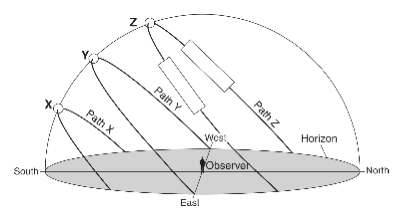
The diagram represents the Sun's apparent paths and the solar noon positions for an observer at 42° N latitude on December 21, September 23, and June 21.
In which direction will sunrise occur on June 21?
north of due west
north of due east
south of due west
south of due east
The reason we have seasons on our planet is because...
we are closer to the sun during the winter and further during the winter.
the tilt of Earth's axis allows for more direct sunlight in the summer and less direct sunlight in the winter.
seasonal wind patterns carry warmer winds during the summer and colder winds during the winter.
the Earth's orbit becomes more like an oval to give us different seasons.

Which of the following best describes the tilt of the earth during the spring and fall equinoxes?
The earth is tilted away from the sun (Northern hemisphere)
The earth is tilted neither toward or away from the sun (tilt is side to side)
The earth is tilted toward the sun (Northern hemisphere)
The earth is not tilted during spring and fall


