wayground logo

Free Printable Worksheets

NEW

Font size

S
M
L
XL
Worksheets

Biochem (Basic)

Total questions: 75

Worksheet time: 1hrs 4mins

Name
Class
Date
1.

Which type of macromolecule is made up of this type of monomer: monosaccharides?

a)

Carbohydrates

b)

Proteins

c)

Nucleic Acids

d)

Lipids

2.

What does the prefix di- mean?

a)

One

b)

Two

c)

Many

d)

Some

e)

Three

3.

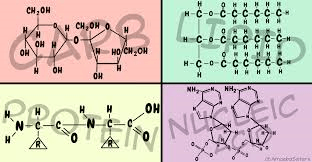
Which of the following images shows a monosaccharide?

a)

b)

c)

d)

e)

4.

Which of the following images shows a protein?

a)

b)

c)

d)

e)

5.

Which of the following images shows a triglyceride?

a)

b)

c)

d)

e)

6.

Which of the following images shows a phospholipid?

a)

b)

c)

d)

e)

7.

Which of the following images shows nucleic acids?

a)

b)

c)

d)

e)

8.
Which subunits make up the structure of all proteins?
a)
glucose
b)
amino acids
c)
carbohydrates
d)
fatty acids
9.
Carbon, Hydrogen, Oxygen and Nitrogen are elements in what biomolecule?
a)
Carbohydrate
b)
Lipid
c)
Protein
d)
Nucleic acid
10.

Halle and Hannah are studying macromolecules for their biochemistry test. Which of the following macromolecules is responsible for long term energy storage in mammals?

a)
Protein
b)
Lipid
c)
Carbohydrate
d)
Nucleic Acid
11.
Which of the following contains the genetic code for protein synthesis?
a)
carbohydrate
b)
lipid
c)
protein
d)
nucleic acid
12.
What are the single sugars that are the building blocks of carbohydrates?
a)
monosaccharides
b)
disaccharides
c)
polysaccharides
d)
amino acid
13.
Nucleotides are monomers of
a)
Carbohydrates
b)
Lipids
c)
Proteins
d)
Nucleic Acids
14.
Which macromolecule stores energy, insulates us, and makes up the cell membrane?
a)
lipids
b)
proteins
c)
carbohydrates
d)
nucleic acids
15.
What suffix (word ending) is used in the names of most carbohydrates?
a)
-ase
b)
-nic
c)
-ose
d)
-yme
16.
Which is an example of a lipid?
a)
Candy
b)
Olive Oil
c)
DNA
d)
Meat
17.
Building blocks of the body, hair , muscles etc.
a)
protein
b)
nucleic acid
c)
lipids
d)
carbohydrates
18.
All polymers are made up of...
a)
monosaccharides
b)
monomers
c)
proteins
d)
None of these
19.
Genetic information is stored in which class of organic compounds?
a)
proteins
b)
lipids
c)
nucleic acids
d)
carbohydrates
20.
Which group of biomolecules provide quick energy to organisms?
a)
proteins
b)
carbohydrates
c)
lipids
d)
nucleic acids
21.
This is one job proteins do NOT have in the body
a)
storing genetic information
b)
structure
c)
speed up chemical reactions
d)
transport things through cell membrane
22.
Many plants have waxy coatings on some surfaces. This coating reduces water loss because it is not water-permeable. This waxy coating is which of the following types of organic molecule?
a)
protein
b)
carbohydrate
c)
nucleic acid
d)
 lipid
23.
Like complex carbohydrates, proteins are macromolecules that serve many functions and can be chemically broken down and restructured. Both proteins and complex carbohydrates are which of the following?
a)
 polymers of smaller subunits
b)
sequence of sugars
c)
lipids of large molecules
d)
nucleotides of DNA
24.
A student is preparing to run in a school track competition. For the quickest source of energy, the student should eat a food that contains a high percentage of...
a)
carbohydrates
b)
fat
c)
proteins
d)
sodium
25.
Many land plants store energy in carbohydrates. When energy is needed, the carbohydrate molecules can be broken down quickly. This chemical reaction produces which of the following monomers?
a)
Amino Acids
b)
Lipids
c)
Monosaccharides
d)
RNA chains
26.
Scientists have found geysers on one of Saturn’s moons. The geysers release
water vapor containing complex organic compounds, which may indicate the presence of life. Which of the following elements is most likely abundant in the organic compounds in the water vapor?
a)
carbon
b)
chlorine
c)
iron
d)
zince
27.
Which organic molecule?
a)
Proteins
b)
Carbohydrates
c)
Nucleic Acids
d)
Lipids
28.
Identify the type of building block (monomer) that makes up the polymer. 
a)
Monosaccharide
b)
Triglycerides
c)
Amino Acids
d)
Nucleotide
29.
Like complex carbohydrates, proteins are macromolecules that serve many functions and can be chemically broken down and restructured. Both proteins and complex carbohydrates are which of the following?
a)
 polymers of smaller subunits
b)
sequence of sugars
c)
lipids of large molecules
d)
nucleotides of DNA
30.
Which macromolecule doesn't dissolve in water?
a)
Carbs
b)
Lipids
c)
Nucleic Acids
d)
Proteins
31.
Which of the following are nucleic acids?
a)
Saturated and unsaturated fats
b)
DNA and RNA
c)
collagen and keratin
d)
glucose and starch
32.
Nucleic acids, proteins, and other large biological molecules are known as polymers because...
a)
they are the base units used in the formation of plastics
b)
they all function as enzymes
c)
they contain only ionic bonds
d)
they contain many small, repeating subunits bonded together
33.
Sugars such as ribose, fructose and glucose are examples of ______________?
a)
proteins
b)
lipids
c)
nucleic acids
d)
carbohydrates
34.
Which organic molecule?
a)
Proteins
b)
Carbohydrates
c)
Nucleic Acids
d)
Lipids
35.
Which organic molecule?
a)
Proteins
b)
Carbohydrates
c)
Nucleic Acids
d)
Lipids
36.
Which organic molecule?
a)
Proteins
b)
Carbohydrates
c)
Nucleic Acids
d)
Lipids
37.
The process/reaction used to link compounds/monomers together.  Releases water.
a)
Dehydration
b)
Hydrolysis
c)
Enzomatic
d)
Tetratonic
38.
A monosaccharide is a:
a)
nucleic acid
b)
lipid
c)
carbohydrate
d)
protein
39.
A peptide is a compound consisting of 2 or more ________ .
a)
amino acids
b)
nucleic acids
c)
lipids
d)
carbohydrates
40.
When a carbohydrate polymer breaks apart using water it is called ______________
a)
hydrolysis
b)
carbolysis
c)
dehydration synthesis
d)
metabolism
41.
Which are the building blocks of most lipid molecules?
a)
glucose and protein
b)
glucose and fatty acids
c)
fatty acids and glycerol
d)
amino acids and glycerol
42.

Abigail, Bailey, and Emma are studying for their science quiz. They come across the term hydro. What does this term mean?

a)

Water

b)

Oil

c)

Completely full

d)

On the opposite side

e)

On the same side

43.

Devin is studying for their science quiz. They come across the term synthesis. What does this term mean?

a)

Water

b)

Oil

c)

Completely full

d)

On the opposite side

e)

Making something big from simple materials

44.

Ava studying for their science quiz. They come across the term monomer. What does this term mean?

a)

Building block

b)

One sugar

c)

Large molecule; many blocks

d)

Completely full

e)

Making something big from simple materials

45.

Dan is studying for their science quiz. They come across the term hydrophobic. What does this term mean?

a)

Water hating (repels)

b)

Water loving (attracts)

c)

Only drinks soda

d)

Makes glucose using light

e)

Making something big from simple materials

46.

Max is studying for their science quiz. They come across the term Starch. What does this term mean?

a)

It's a polysaccharide (made up of sugars)

b)

It's a polypeptide (made of many amino acids)

c)

ATP (the molecule used for energy)

d)

Denaturation

e)

Iodine turning blue/black

47.

Aubrey and Mia are studying for their science quiz. They come across the term Protein. What is the monomer for this macromolecule?

a)

Amino Acids

b)

Simple Sugars

c)

Nucleic Acids

d)

Fatty Acids

e)

Water

48.

Owen and Shawn are studying for their science quiz. They come across the term Lipid. What is the monomer for this macromolecule?

a)

Amino Acids

b)

Simple Sugars

c)

Nucleic Acids

d)

Fatty Acids

e)

Water

49.

Dirk and Dolan are studying for their science quiz. They come across the term Glycogen. What is the monomer for this macromolecule?

a)

Amino Acids

b)

Simple Sugars

c)

Nucleic Acids

d)

Fatty Acids

e)

Water

50.

Lynn and Monica are studying for their science quiz. They come across the term DNA (Deoxyribonucleic Acid). What is the monomer for this macromolecule?

a)

Amino Acids

b)

Simple Sugars

c)

Nucleic Acids

d)

Fatty Acids

e)

Water

51.

What does the word saturated mean?

a)

Water

b)

Protein

c)

Completely full

d)

On the opposite side

e)

Not completely full

52.

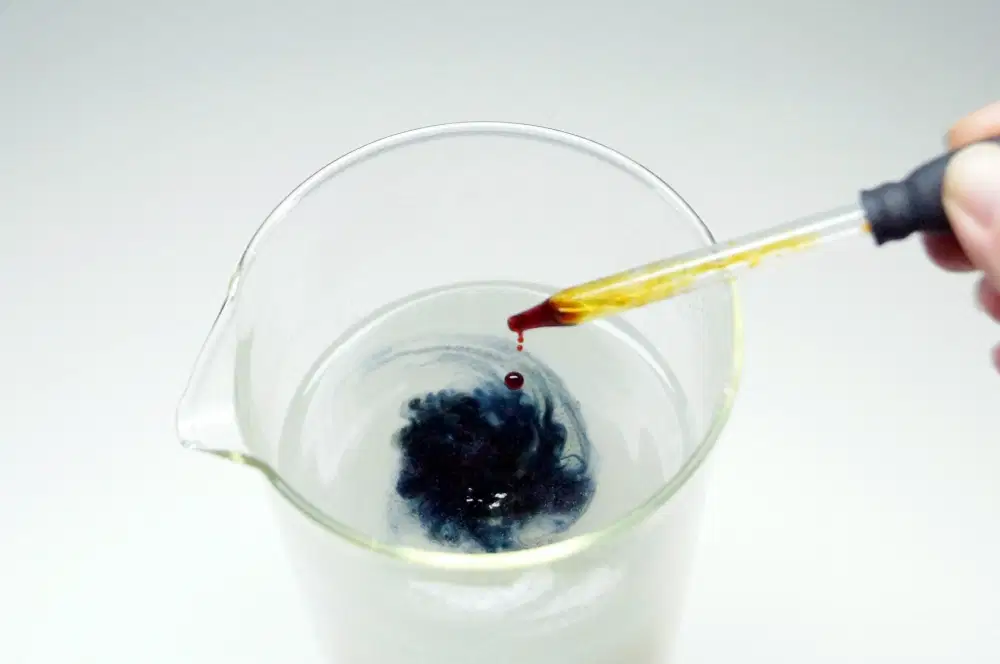
Lucas is studying indicators for their biochemistry test. What indicator is used to detect Starch?

a)

Iodine

b)

Benedicts

c)

Biurets

d)

Phenylethylene

53.

David is studying indicators for their biochemistry test. What color does iodine turn when in the presence of a starch?

a)

Blue

b)

Yellow/Amber

c)

Purple

d)

Periwinkle

54.

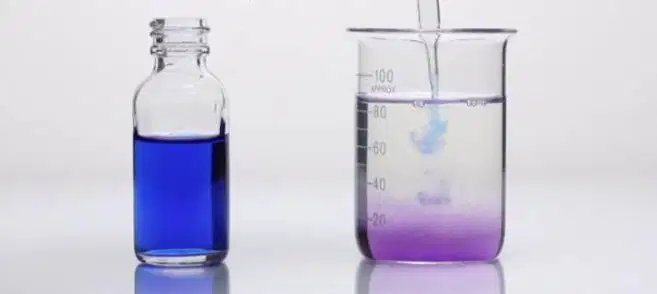
Camren is studying indicators for their biochemistry test. Biuret's solution is used to detect proteins. What color indicates a positive presence of proteins?

a)

Blue

b)

Purple

c)

Orange

d)

Green

55.

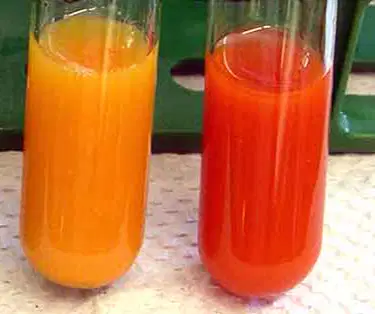
Ayden is studying indicators for their biochemistry test. Benedict's solution is used to determine the presence of simple sugars in a substance. What color indicates a positive reaction?

a)

Orange / Brick Red

b)

Yellow

c)

Purple

d)

Blue

56.

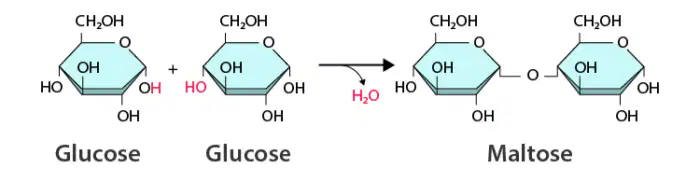
Mackenzie is studying for their biochemistry test. What type of chemical reaction is this?

a)

Nucleophilic Attack

b)

Photosynthesis

c)

Dehydration Synthesis

d)

Hydrolysis

e)

Electrophilic Attack

57.

Bryce and Caleb are studying for their biochemistry test. What type of chemical reaction is this?

a)

Nucleophilic Attack

b)

Photosynthesis

c)

Dehydration Synthesis

d)

Hydrolysis

e)

Electrophilic Attack

58.

Hannah is studying for their biochemistry test. Organisms use different chemicals for different uses. Generally, what are carbohydrates used for?

a)

Insulation, long term energy storage, and hormones.

b)

Source of energy / or Structure

c)

Storing genetic information

d)

Build and repair muscle and bone. Make enzymes and some hormones.
59.

Madison is studying for their biochemistry test. Organisms use different chemicals for different uses. Generally, what are proteins used for?

a)

Insulation, long term energy storage, and hormones.

b)

Source of energy / or Structure

c)

Storing genetic information

d)

Build and repair muscle and bone. Make enzymes and some hormones.

60.

Max is studying for their biochemistry test. Organisms use different chemicals for different uses. Generally, what are lipids used for?

a)

Insulation, long term energy storage, and hormones.

b)

Source of energy / or Structure

c)

Storing genetic information

d)

Build and repair muscle and bone. Make enzymes and some hormones.

61.

Ethan is studying for their biochemistry test. Organisms use different chemicals for different uses. Generally, what are nucleic acids used for?

a)

Insulation, long term energy storage, and hormones.

b)

Source of energy / or Structure

c)

Storing genetic information

d)

Build and repair muscle and bone. Make enzymes and some hormones.

62.

Conor is studying indicators for their biochemistry test. They used iodine to test a sample. Based on the image what macromolecule is present?

a)

Starch

b)

Sugar

c)

Protein

d)

Lipid

63.

Alaina is studying indicators for their biochemistry test. They used Benedict's solution to test a sample. Based on the image what macromolecule is present?

a)

Starch

b)

Sugar

c)

Protein

d)

Lipid

64.

Elijah and Logan are studying indicators for their biochemistry test. They used Biuret's solution to test a sample. Based on the image what macromolecule is present?

a)

Starch

b)

Sugar

c)

Protein

d)

Lipid

65.
What elements are common to all 4 biomolecules?
a)
Carbon, hydrogen, nitrogen
b)
Carbon, Nitrogen, Phosphorus
c)
Carbon, Hydrogen, Oxygen
d)
Carbon, Hydrogen, Phosphorus
66.
The bond between amino acids within a protein chain is called a ______ _______
a)
peptide bond
b)
hydrogen bond
c)
ionic bond
d)
sulfur bridge
67.
In ___________, either amino acid or carbohydrate monomers bond together.
a)
dehydration synthesis
b)
hydrolysis
c)
phosphodiester bonding
d)
hydrogen bonding
68.
________ are the main components of fats and oils.
a)
lipids
b)
amino acids
c)
nucleic acids
d)
carbohydrates
69.
Cellulose is a type of ____________
a)
carbohydrate
b)
nucleic acid
c)
lipid
d)
protein
70.
Carbohydrates are mostly soluble in ________
a)
protein
b)
water
c)
oil
d)
small quantities only
71.

Both lipids and carbohydrates are important in animal cells because both -

a)

provide insulation

b)

store energy

c)

contain nitrogen

d)

form cell walls

72.

Which of the following macromolecules are a prominent part of animal tissues that function in insulation, helping animals conserve heat?

a)

Proteins

b)

Lipids

c)

Carbohydrates

d)

Nucleic Acids

73.

Which of the following is NOT a function of proteins?

a)

Make up antibodies

b)

Serve as catalysts that control the rate of chemical reactions in the cell

c)

Store genetic information

d)

Form parts of tissues such as bone and muscle

74.

Which of the following pairs are inaccurate?

a)

amino acids - proteins

b)

DNA - nucleic acids

c)

lipids - enzymes

d)

carbohydrates - energy

75.

Proteins are formed from monomers (subunits) called -

a)

nucleic acids

b)

fatty acids

c)

nucleotides

d)

amino acids