wayground logo

Free Printable Worksheets

Font size

S
M
L
XL
Worksheets

Biology Fall Final

Total questions: 80

Worksheet time: 1hrs 1mins

Name
Class
Date
1.

Which biomolecule includes DNA, RNA and ATP?

a)

Protein

b)

Nucleic Acid

c)

Carbohydrate

d)

Lipids

2.
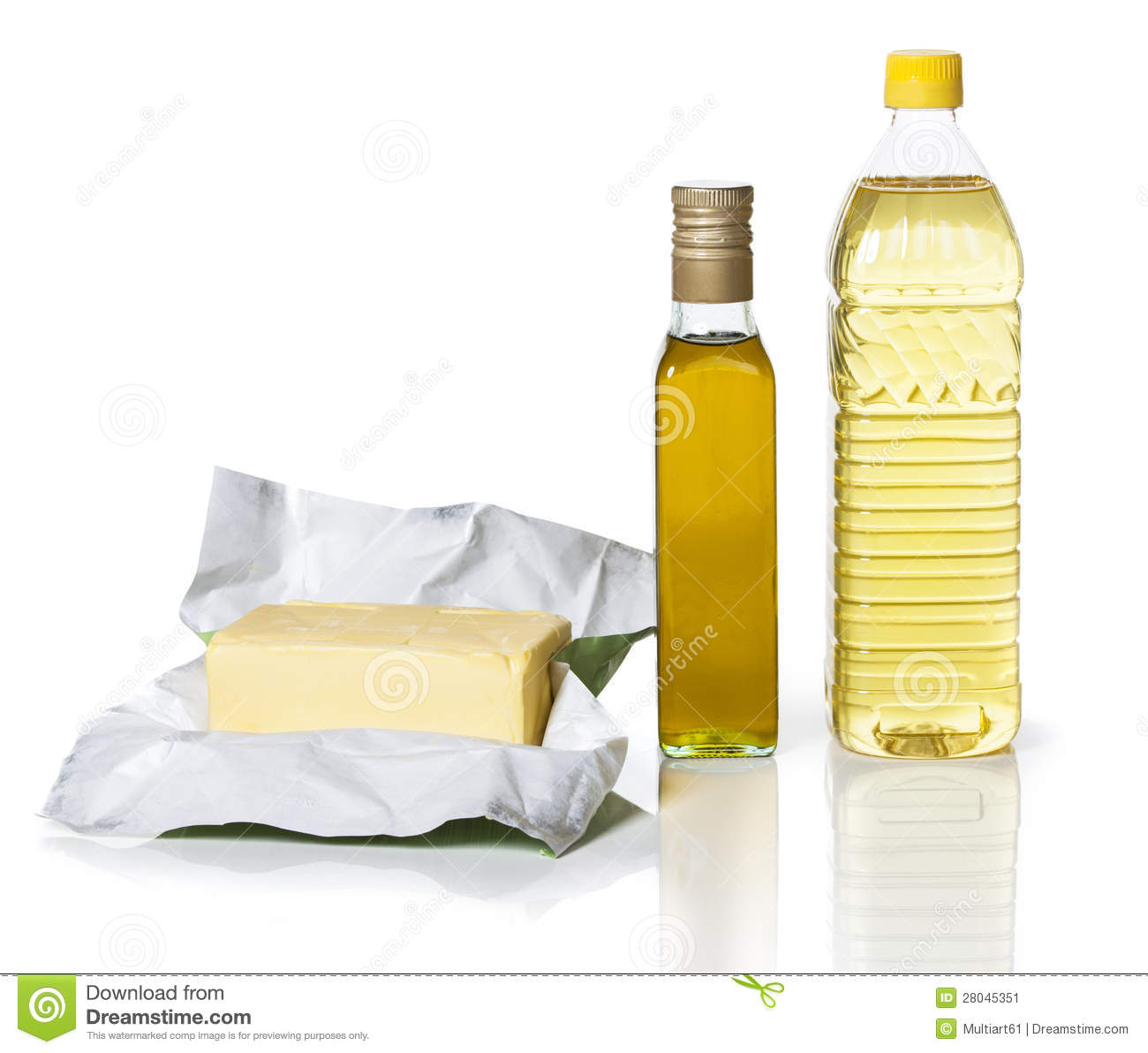
Which biomolecule is found in fats, oils, and waxes and is a source of long-term energy
a)
Proteins
b)
Nucleic Acid
c)
Lipids
d)
Carbohydrate
3.
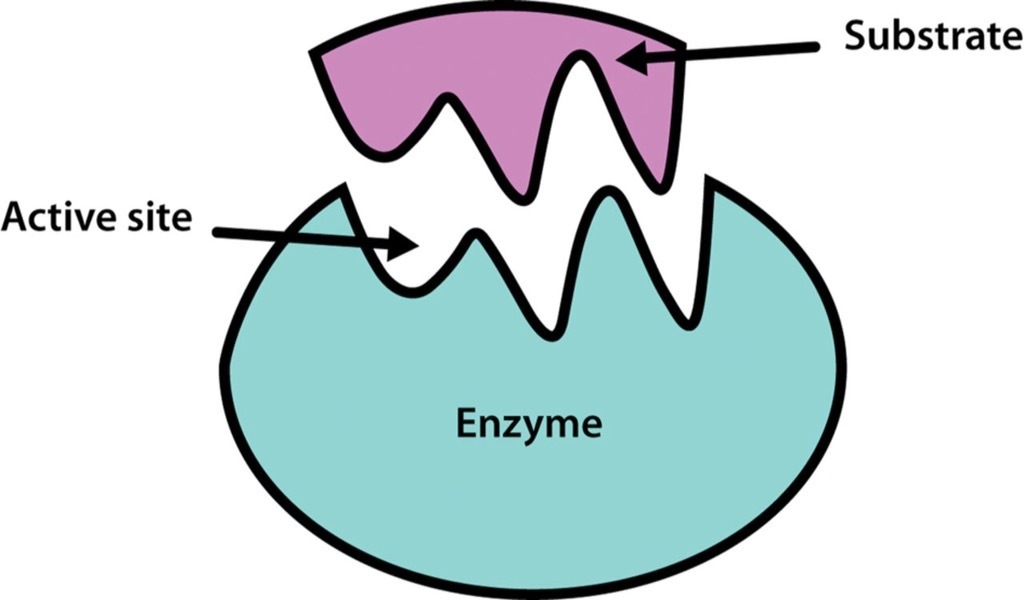
What biomolecule do enzymes belong to? 
a)
Carbohydrate
b)
Lipid
c)
Nucleic Acid
d)
Protein
4.

Which biomolecule is made up of amino acids and helps build muscles?

a)

Nucleic Acid

b)

Carbohydrate

c)

Protein

d)

Lipids

5.

What two things do enzymes do?

a)

speed up chemical reactions

b)

break things down

c)

provide quick energy

d)

provide long term energy

6.
Animal Cells are
a)
Prokaryotic
b)
Eukaryotic
7.
Cell Walls can be found in
a)
Animal Cells
b)
Plant Cells
8.
What is an example of a prokaryotic cell?
a)
Bacteria Cell
b)
Animal Cell
9.
Which does NOT have a nucleus?
a)
Prokaryotic
b)
Eukaryotic
10.
Do all cells have DNA?
a)
Yes
b)
NO
11.

Which type of cell has a nucleus?

a)

prokaryotic

b)

bacteria

c)

eukaryotic

d)

virus

12.
Which organelle is only found in a plant cell? 
a)
nucleus
b)
chloroplast
c)
mitochondria
d)
cell membrane
13.
The Golgi apparatus _____.
a)
packages cell products for export
b)
eliminates waste
c)
stores DNA
d)
makes energy
14.

Where is DNA stored in a eukaryotic cell?

a)

Cytoplasm

b)

Mitochondria

c)

Ribosomes

d)

Nucleus

15.
The chloroplast _____.
a)
uses sugar to make energy
b)
eliminates waste products from the cell
c)
uses light energy to make sugar
d)
manufactures proteins for cell export
16.

Starch is formed when plants produce (or make) too much ___________.

a)

water

b)

sugar

c)

oxygen

17.

Which of the following are reactants of photosynthesis?

a)

CO2 and H2O

b)

O2

c)

H2O and Glucose

d)

None of the above

18.
What is the pigment in chloroplasts that performs photosynthesis?
a)
Chlorosynthesis
b)
Chlorophyll
c)
ADP
d)
Electron Transport
19.
What is the ultimate ORIGINAL source of energy for living things
a)
Sugar
b)
Sun
c)
Moon
d)
Carbon Dioxide
20.

What is the correct equation for photosynthesis?

a)

C6H12O6 + 6O2 --> 6CO2 + 6H2O

b)

6CO2 + 6O2 --> C6H12O6 + 6H2O

c)

6CO2 + 6O2 --> 6H2O + C6H12O6

d)

6CO2 + 6H2O + sunlight --> 6O2 + C6H12O6

21.

What are the reactants in cell respiration?

a)

water, carbon dioxide, light

b)

oxygen, glucose

c)

glucose, water, carbon dioxide

22.

Aerobic means

a)

without oxygen

b)

with oxygen

c)

without effort

23.

Anaerobic means

a)

with oxygen

b)

without oxygen

c)

to run for a long time

24.

Which type of respiration produces more ATP?

a)

aerobic

b)

anaerobic

25.

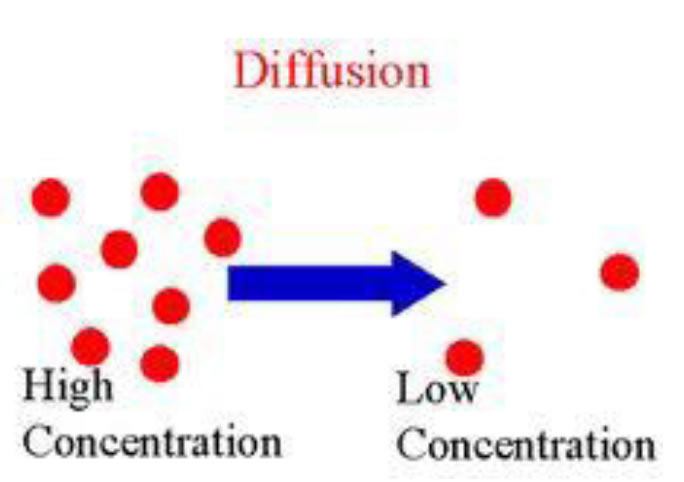
The movement of particles from an area of high to low concentration is known as--

a)

Passive Transport

b)

Active Transport

26.

How does a cell maintain homeostasis?

a)

By controlling what enters and leaves the cell

b)

Flexibility

c)

Protective barrier

d)

Structure and support

27.

Cell membrane transport that occurs without energy is called--

a)

active transport

b)

endocytosis

c)

passive transport

d)

exocytosis

28.
What is the difference between active and passive transport?
a)
Active does not need energy and passive uses ATP (energy)
b)
Active uses ATP (energy) and passive does not need energy
c)
Active stores transport proteins and passive releases 
d)
Active uses hormones and passive does not 
29.

The movement of molecules from low to high is known as

a)

simple diffusion

b)

facilitated diffusion

c)

active transport

d)

osmosis

30.
Osmosis is the movement of _____ across a membrane.
a)
food
b)
energy
c)
oxygen
d)
water
31.
What type of transport is illustrated?
a)
facilitated diffusion
b)
active transport
c)
diffusion
d)
osmosis
32.
The picture is an example of...
a)
active tranport
b)
passive transport
c)
diffusion
d)
osmosis
33.
The cell membrane of the red blood cell will allow water, oxygen, and carbon dioxide to pass through. Because other substances are blocked from entering, this membrane is called
a)
perforated
b)
semi-permeable
c)
non-conducive
d)
permeable
34.
What is the longest stage of the cell cycle called?
a)
Cytokinesis
b)
M phase
c)
Interphase
d)
G1 Phase
35.
During what stage does the G1, S and G2 phases happen?
a)
Interphase
b)
M phase
c)
Mitosis
d)
Cytokinesis
36.
During which stage of the cell cycle does mitosis and cytokinesis occur?
a)
Interphase
b)
S phase
c)
M phase
d)
G1 phase
37.
During what phase of the cell cycle does cell division occur?
a)
Interphase
b)
M phase
c)
S phase
d)
G2 phase
38.
During what phase of the cell cycle is DNA replicated?
a)
G1 phase
b)
S phase
c)
G2 phase
d)
M phase
39.
During what phase of the cell cycle does the cell grow?
a)
G1 phase
b)
S phase
c)
M phase
d)
Cytokinesis
40.
Put the following stages of mitosis in order: anaphase, prophase, metaphase, and telophase. 
a)
prophase, metaphase, telophase, anaphase
b)
prophase, anaphase, metaphase, telophase
c)
prophase, metaphase, anaphase, telophase
d)
prophase, telophase, metaphase, anaphase
41.

What are the "X" shaped things in the drawing.

a)

PMATs

b)

Chromosomes

c)

Ribosomes

d)

Telophase

42.

During what phase of Mitosis do the chromosomes line up in the Middle

a)

Metaphase

b)

Prophase

c)

Telophase

d)

Anaphase

43.

PMAT helps us remember the correct order of the phases of Mitosis. Which of the following has the phases of Mitosis in the correct Order

a)

Interphase, Mitosis, Cytokinesis

b)

Prophase, Metaphase, Anaphase, Prophase

c)

Anaphase, Telophase, Prophase, Telophase

d)

Prophase, Metaphase, Anaphase, Telophase

44.

In which phase of Mitosis do the Chromosomes pull Apart

a)

Metaphase

b)

Prophase

c)

Anaphase

d)

Telophase

45.
Cells spend 90% of their time in this stage of the cell cycle. This is the reason you would see most cells in this stage if viewed under a microscope.
a)
Prophase
b)
Metaphase
c)
Anaphase
d)
Interphase
46.
What phase of mitosis is pictured?
a)
Metaphase
b)
Telophase
c)
Prophase
d)
Anaphase
47.
Which phase comes NEXT?
a)
prophase
b)
metaphase
c)
anaphase
d)
telophase
48.

CROSSING OVER INCREASES

a)

LIFE SPAN

b)

GENETIC VARIATION

c)

THE NUMBER OF OFF-SPRING

d)

ALL ARE TRUE

49.

CROSSING OVER TAKES PLACE DURING

a)

PROPHASE II

b)

PROPHASE I

c)

INTERPHASE

d)

METAPHASE I

50.
Which process and type of resulting cells are represented?
a)
mitosis, gametes
b)
mitosis, body cells
c)
meiosis, gametes
d)
meiosis, body cells
51.
Compared to the number of chromosomes contained in a body cell, how many chromosomes would normally be contained in a gamete?
a)
The same number
b)
One-fourth as many
c)
Twice as many
d)
Half as many
52.
What causes genetic variation in meiosis?
a)
chromosomes lining up
b)
crossing over of chromosomes
c)
separation of chromosomes
d)
chromosomes pulling apart
53.
Females have ____ and males have _____ chromosomes.
a)
XX, XY
b)
XY, XX
c)
XX, XX
d)
XY, XY
54.
How many daughter cells are produced at the end of mitosis?
a)
1
b)
2
c)
3
d)
4
55.
The purpose of sexual reproduction and meiosis is to form ________ cells.
a)
body
b)
sex
c)
somatic
d)
brain
56.

What are the parts of a nucleotide?

a)

phosphate, sugar, base

b)

A, T, G, C

c)

Nucleic Acids

d)

two base pairs connected

57.

Which of the following is correctly matches: ATT GTA CGA

a)

TAA CAT GCT

b)

ATT GTA CGA

c)

TAA GTA TCG

d)

GCC ACG TAC

58.

What is this a picture of?

a)

nucleotide

b)

DNA strand

c)

chromosome

d)

gene

59.

DNA is shaped in a:

a)

double helix

b)

tightly packed swirl

c)

twisted ladder

d)

nucleotide

60.
nitrogen base that pairs with guanine
a)
adenine
b)
cytosine
c)
nucloetide
d)
deoxyribose
61.
the base that pairs with Thymine in DNA
a)
adenine
b)
guanine
c)
helicase
d)
nucleotide
62.
the process of making a copy of DNA
a)
transcription
b)
double helix
c)
DNA replication
d)
replication fork
63.
In RNA, Uracil pairs with ______. 
a)
cytosine
b)
adenine
c)
guanine
d)
thymine
64.

Choose the sequence of the mRNA strand that would be match up with to the following strand:

GTAGTCA

a)

UATUAGA

b)

ACGACTG

c)

CAUCAGU

d)

CATCAGT

65.
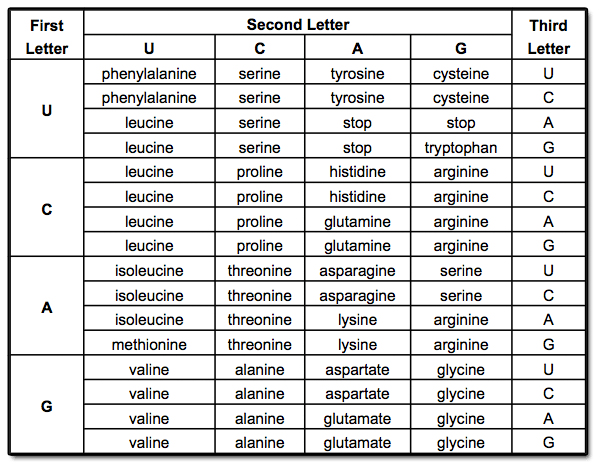
What amino acid is represented by the codon UUA?
a)
Phenylalanine
b)
Tyrosine
c)
Leucine
d)
Stop codon
66.

What is the correct amino acid sequence for the mRNA code AUGCCAGUAUGA

a)

Met-Pro-Ala-Val

b)

Met-Pro-Val

c)

Tyr-Gly-His

d)

Tyr-Gly-Arg-His

67.
The process to go from DNA to mRNA is _______
a)
translation
b)
transcription
c)
replication
68.
The process to go from mRNA to a protein is called ____
a)
transcription
b)
rRNA
c)
replication
d)
translation
69.

The alleles that an organism has/inherits are its

a)

genotype

b)

phenotype

c)

chromosome

d)

recessive

70.

The observable expression of a trait is its

a)

phenotype

b)

genotype

c)

chromosome

d)

allele

71.

When an organism has two of the same alleles, it is called

a)

homozygous

b)

heterozygous

c)

recessive

d)

dominant

72.

When an organism has two different alleles, it is called

a)

homozygous

b)

heterozygous

c)

recessive

d)

dominant

73.

What are the blood types of the possible children that a woman (type O) and man (type AB) can have?

a)

O and AB

b)

O and A

c)

O and B

d)

A and B

74.

In mice, black fur (B) is dominant to brown fur (b). A Bb mouse would have the phenotype of

a)

brown fur

b)

black fur

c)

white fur

75.
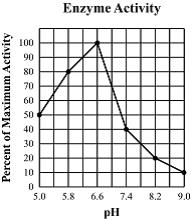
Which of the following conclusions can be drawn from this graph?
a)
The optimum pH of the enzyme is 6.6.
b)
The optimum pH of the enzyme is 5.8
c)
The enzyme’s activity increases as pH increases 5.0 to 9.0
d)
The enzyme’s activity is greater around pH of 8.0 .
76.
What is the function of an enzyme?
a)
enzymes break themselves into small pieces
b)
enzymes slow down chemical reactions
c)
enzymes speed up chemical reactions
d)
enzymes combine products to form reactants 
77.

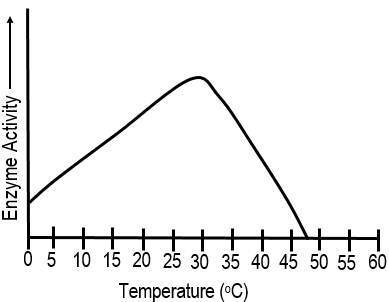
Based on the graph, what temperature does this enzyme work best?

a)

15 C

b)

40 C

c)

30 C

d)

50 C

78.

A fox develops black patches on its fur after an ice pack was placed on its back. What is controlling the expression this gene (the fur pigment gene)?

a)

Sunlight

b)

Temperature

c)

Genetics

79.

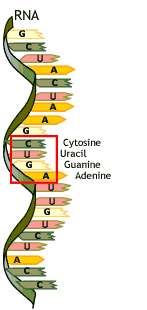
What is the role of the boxed structure?

a)

carry amino acids to ribosomes

b)

replicate RNA

c)

transcribe DNA

80.

What process is taking place in the picture?

a)

transcription

b)

translation

c)

DNA replication

d)

amino acids