wayground logo

Free Printable Worksheets

Font size

S
M
L
XL
Worksheets

Seventh Grade - Science Pre Test

Total questions: 120

Worksheet time: 1hrs 9mins

Name
Class
Date
1.
A cell is...
a)
the basic unit of structure and function in living organism
b)
an organism
c)
a basic part of everything that we see
d)
found only in animals, not plants
2.
Which of the following are NOT found in animal cells
a)
chloroplasts and cytoplasm
b)
chloroplasts and cell wall
c)
cell wall and cell membrane
d)
mitochondria and nucleus
3.
The nucleus is like the ____________ of the cell.
a)
foot
b)
hand
c)
stomach
d)
brain
4.

Which of the following converts food into energy for the cell?

a)

vacuole

b)

mitochondria

c)

cytoplasm

d)

cell membrane

5.

The fluid that surrounds the organelles is... (hint... "Try to pull a fast one and..."

a)

chloroplast

b)

cytoplasm

c)

vacuole

d)

cell wall

6.
If you were some bad guy trying to sneak into an animal cell, who would be there to stop you?
a)
nucleus
b)
mitochondria
c)
cell membrane
d)
cell wall
7.
Which of the following, found ONLY in plant cells, provides structure?
a)
cell wall
b)
chloroplast
c)
mitochondria
d)
vacuole
8.
What in the cell has the instructions to tell it what type of cell it needs to be?
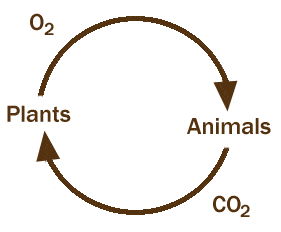
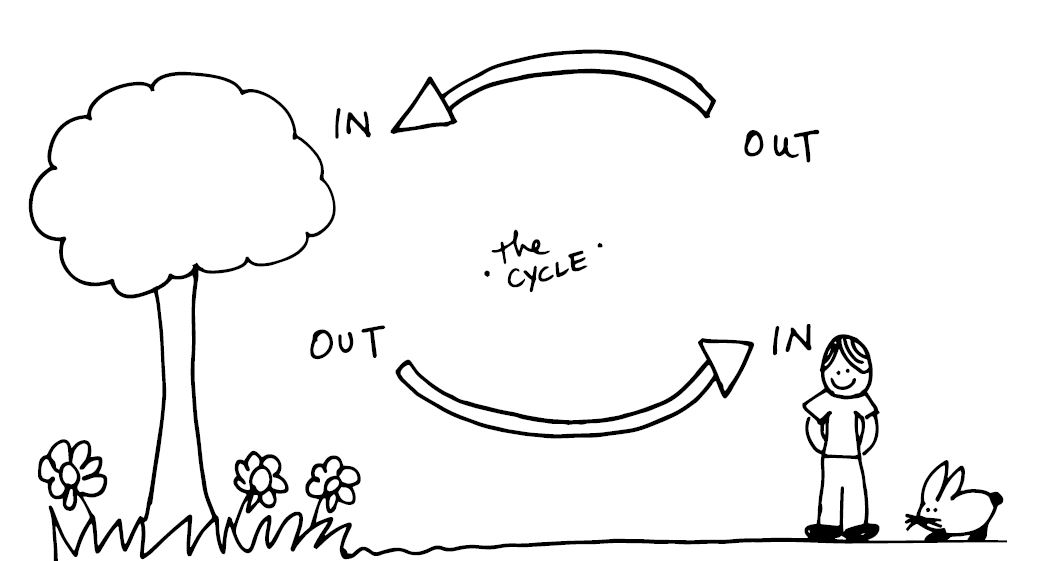
a)
DNA / Genes
b)
Cytoplasm
c)
Cell Membrane
d)
Mitochrondria
9.
In mitosis, the two resulting cells are
a)
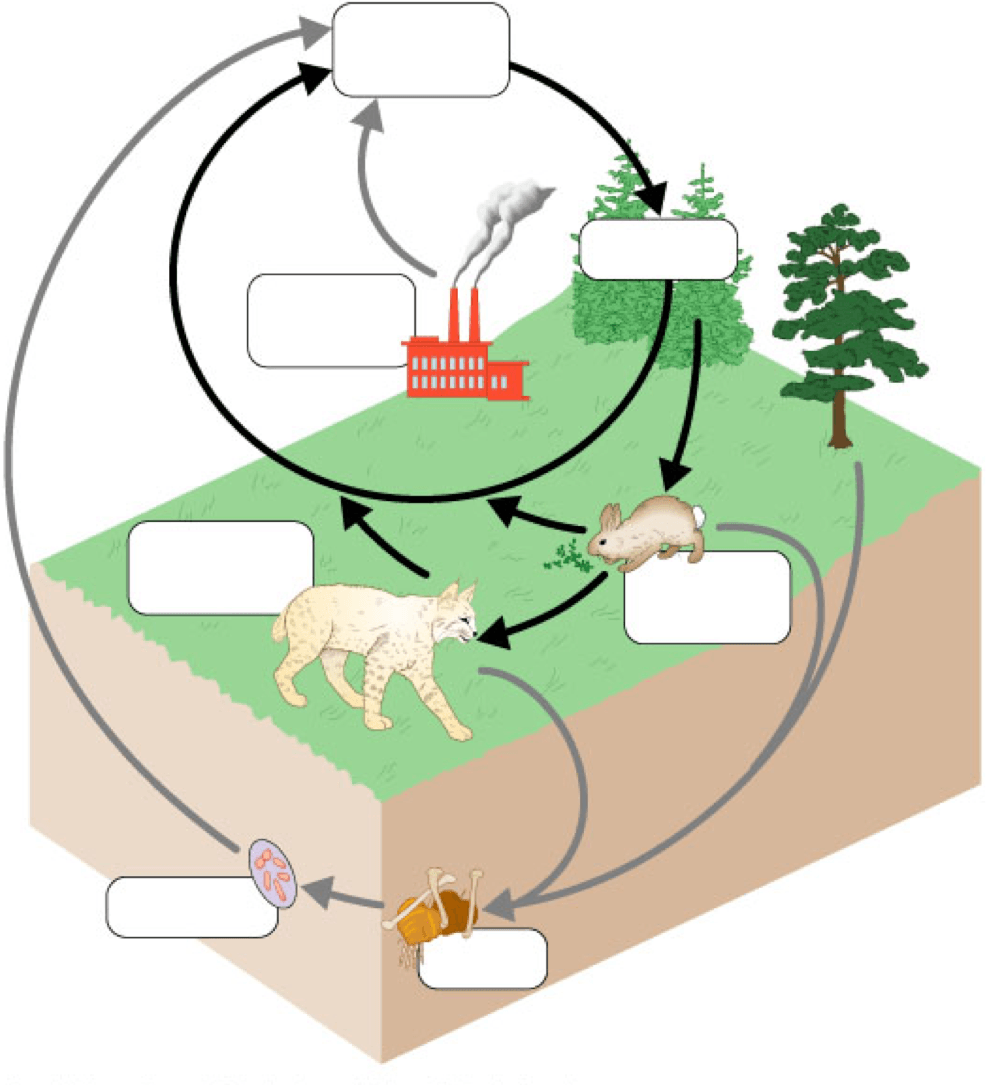
different from the starting cell and identical to each other.
b)
different from the starting cell and different from each other.
c)
identical to the starting cell and different from each other.
d)
identical to the starting cell and identical to each other.
10.

What happens in interphase (choose 2)

a)

Cell grows and developes

b)

DNA lines up in middle

c)

DNA pulls apart

d)

DNA replicates

11.

What happens in Prophase (choose 3)

a)

DNA condenses (packs up)

b)

Spindle fibers appear

c)

Daughter cells separate

d)

DNA lines up in middle

e)

Nuclear envelope (membrane) dissolves

12.

What happens in metaphase? (choose 1)

a)

DNA splits apart

b)

Cell divides

c)

DNA lines up in middle

d)

New nuclei form

13.

What happens in anaphase? (choose 1)

a)

DNA replicates

b)

Chromatids pull apart to opposite sides

c)

DNA lines up in middle

d)

Cell divides

14.

What happens in telophase? (choose 2)

a)

Two new nuclei form

b)

Daughter cells separate into two cells

c)

DNA pulls apart to opposite sides

d)

cytoplasm begins to pinch apart

15.

What happens in cytokinesis? (choose 1)

a)

Daughter cells separate completely as cytoplasm is split into two

b)

Nuclear envelope dissolves

c)

DNA separates apart to opposite sides of the cell

d)

DNA replicates

16.
a)
Prophase
b)
Interphase
c)
Anaphase
d)
Telophase
17.
a)
Anaphase
b)
Cytonkinesis
c)
Interphase
d)
Prophase
18.
a)
Cytokinesis
b)
Interphase
c)
Anaphase
d)
Metaphase
19.
a)
Anaphase
b)
Cytokinesis
c)
Telophase
d)
Metaphase
20.
a)
Cytokinesis
b)
Anaphase
c)
Telophase
d)
Prophase
21.
Condition of Earth's atmosphere at a particular time & place
a)
climate
b)
biogeography
c)
precipitation
d)
weather
22.
Place energy comes from for weather on Earth
a)
the Earth's core
b)
volcanoes
c)
geothermal vents
d)
the Sun
23.
Earth's atmosphere is held down by
a)
radiation
b)
gravity
c)
magnetism
d)
conduction
24.
The layer of the atmosphere containing the ionosphere and auroras is _?_.
a)
troposphere
b)
mesosphere
c)
stratosphere
d)
thermosphere
25.
The layer of the atmosphere where meteors burn up _?_.
a)
mesosphere
b)
thermosphere
c)
troposphere
d)
stratosphere
26.
The layers of the atmosphere that get colder as altitude increases are _?_.
a)
thermosphere and troposphere
b)
mesosphere and troposphere
c)
stratosphere and thermosphere
d)
thermosphere and mesosphere
27.
The layers of the atmosphere that get hotter with increased altitude are the _?_.
a)
thermosphere and mesosphere
b)
troposphere and mesosphere
c)
thermosphere and stratosphere
d)
stratosphere and mesosphere
28.
The layers of the atmosphere that get hotter with increased altitude are the _?_.
a)
thermosphere and mesosphere
b)
troposphere and mesosphere
c)
thermosphere and stratosphere
d)
stratosphere and mesosphere
29.

The hottest layer from the provided choices is the _?_.

a)

thermosphere

b)

stratosphere

c)

mesosphere

d)

troposphere

30.

The hottest layer from the provided choices is the _?_.

a)

thermosphere

b)

stratosphere

c)

mesosphere

d)

troposphere

31.
The troposphere gets colder as you go up.  What is the reason for this?
a)
The troposphere is heated by the sun. reacting with oxygen (ozone)
b)
The troposphere is heated by Earth's surface.
c)
The troposphere is heated by carbon dioxide heat release.
d)
It is getting closer to outer-space.
32.
What makes up 99% of the atmosphere?
a)
nitrogen
b)
oxygen
c)
carbon dioxide
d)
nitrogen and oxygen together
33.
The layer of gases that surrounds the Earth is known as its _?_.
a)
lithosphere
b)
hydrosphere
c)
atmosphere
d)
biosphere
34.
The layer of gases that surrounds the Earth is known as its _?_.
a)
lithosphere
b)
hydrosphere
c)
atmosphere
d)
biosphere
35.

What separates the layers of the atmosphere from one another?

a)

changes in pressure

b)

changes in color

c)

changes in altitude

d)

changes in temperature

36.
As you increase in altitude, pressure _?_.
a)
increases
b)
decreases
c)
remains the same
37.
This is the coldest layer of the atmosphere.
a)
troposphere
b)
thermosphere
c)
mesosphere
d)
stratosphere
38.
This is the coldest layer of the atmosphere.
a)
troposphere
b)
thermosphere
c)
mesosphere
d)
stratosphere
39.
Earth's current atmosphere is _?_.
a)
78% nitrogen, 21% oxygen, 0.9% argon and 0.037% carbon dioxide
b)
78% oxygen, 21%nitrogen, 0.9% argon, 0.037% carbon dioxide
c)
78% nitrogen, 21% argon, 1% oxygen
d)
78% oxygen, 21% nitrogen, 1% carbon dioxide
40.
The layers of the atmosphere in order from bottom to top are _?_.
a)
troposphere, stratosphere, mesosphere, thermosphere, exosphere
b)
troposphere, mesosphere, atmosphere, thermosphere
c)
mesosphere, thermosphere, troposphere, stratosphere, exosphere
d)
thermosphere, stratosphere, mesosphere, troposphere, exosphere
41.
The layer of the atmosphere containing the ozone layer is _?_.
a)
troposphere
b)
stratosphere
c)
thermosphere
d)
mesosphere
42.
The layer of the atmosphere containing our weather is _?_.
a)
thermosphere
b)
stratosphere
c)
troposphere
d)
mesosphere
43.
The layer of the atmosphere containing the ionosphere and auroras is _?_.
a)
troposphere
b)
mesosphere
c)
stratosphere
d)
thermosphere
44.
The layer of the atmosphere where meteors burn up _?_.
a)
mesosphere
b)
thermosphere
c)
troposphere
d)
stratosphere
45.
The layers of the atmosphere that get colder as altitude increases are _?_.
a)
thermosphere and troposphere
b)
mesosphere and troposphere
c)
stratosphere and thermosphere
d)
thermosphere and mesosphere
46.
The layers of the atmosphere that get hotter with increased altitude are the _?_.
a)
thermosphere and mesosphere
b)
troposphere and mesosphere
c)
thermosphere and stratosphere
d)
stratosphere and mesosphere
47.

The hottest layer from the provided choices is the _?_.

a)

thermosphere

b)

stratosphere

c)

mesosphere

d)

troposphere

48.
The troposphere gets colder as you go up.  What is the reason for this?
a)
The troposphere is heated by the sun. reacting with oxygen (ozone)
b)
The troposphere is heated by Earth's surface.
c)
The troposphere is heated by carbon dioxide heat release.
d)
It is getting closer to outer-space.
49.
What makes up 99% of the atmosphere?
a)
nitrogen
b)
oxygen
c)
carbon dioxide
d)
nitrogen and oxygen together
50.
What does ozone in the atmosphere do?
a)
It absorbs and traps heat energy.
b)
It provides a place for water vapor to condense.
c)
It protects against harmful UV radiation.
d)
It helps plants grow.
51.
The layer of gases that surrounds the Earth is known as its _?_.
a)
lithosphere
b)
hydrosphere
c)
atmosphere
d)
biosphere
52.

What separates the layers of the atmosphere from one another?

a)

changes in pressure

b)

changes in color

c)

changes in altitude

d)

changes in temperature

53.
As you increase in altitude, pressure _?_.
a)
increases
b)
decreases
c)
remains the same
54.
This is the coldest layer of the atmosphere.
a)
troposphere
b)
thermosphere
c)
mesosphere
d)
stratosphere
55.
This layer of the atmosphere contains most of the ozone.
a)
troposphere
b)
thermosphere
c)
mesosphere
d)
stratosphere
56.
This is the layer where most commercial jet airliners fly.
a)
troposphere
b)
stratosphere
c)
mesosphere
d)
thermosphere
57.

The layer not always recognized is the _?_.

a)

exosphere

b)

stratosphere

c)

mesosphere

d)

thermosphere

58.

Ground level ozone (also known as tropospheric ozone) is ______________________.

a)

a significant source of air pollution and contributes to the formation of smog

b)

also found in the exosphere

c)

found only in rural areas

d)

a significant source of air pollution and contributes to the increase in the hole in the ozone layer.

59.

Ozone is made up of __________________ oxygen atoms.

a)

3

b)

2

c)

1

d)

5

60.

The atmospheric layer that humans live in is known as the _____________________.

a)

troposphere.

b)

stratosphere.

c)

exosphere.

d)

thermosphere.

61.

"Criteria Air Pollutants" were established by the _________________________________.

a)

Environmental Protection Agency (EPA)

b)

Department of the Interior (DI)

c)

Center for Disease Control (CDC)

d)

United Nations (UN)

62.

Nitrous oxides enter the atmosphere from _____________________.

a)

fossil fuels

b)

meteorites

c)

ozone depletion

d)

CFC's

63.

Chlorofluorocarbons is represented by the abbreviation _________________.

a)

CFC

b)

ChFC

c)

Chl

d)

hydrocarbons

64.

Bad or Hazardous ozone is found in the _______________________________.

a)

troposphere

b)

stratosphere

c)

mesosphere

d)

thermosphere

65.

The most common source of carbon monoxide comes from _____________________________.

a)

vehicles

b)

swamp gases

c)

industrial sources

d)

none of these

66.

Which of the following is an adverse health effect from air pollution?

a)

allergic reactions

b)

bronchial inflammation

c)

eye and lung irritants

d)

All of these are correct

67.
Over the past 30 years, air quality in the United States has generally _______________
a)
improved
b)
declined
68.
One cause of ________________ is the burning of coal that contains a lot of sulfur.
a)
acid rain
b)
soot
69.
Harmful substances in air, water, or soil are called ________________.
a)
pollutants
b)
particles
70.
The majority of air pollution comes from __________________.
a)
burning fossil fuels
b)
particulate matter
71.

A pet goldfish needs fish food.


Which characteristic of life does this refer to?

a)

Living things need energy

b)

Living things are composed of one or more cells

c)

Living things respond to their environment

d)

Living things grow and reproduce

e)

Living things maintain a stable internal environment

72.

A plant need sunlight to make food for itself.


Which characteristic of life does this refer to?

a)

Living things need energy

b)

Living things are composed of one or more cells

c)

Living things respond to their environment

d)

Living things grow and reproduce

e)

Living things maintain a stable internal environment

73.

Streptococcus, a round cell, is the bacteria that causes strep throat.


Which characteristic of life does this refer to?

a)

Living things need energy

b)

Living things are composed of one or more cells

c)

Living things respond to their environment

d)

Living things grow and reproduce

e)

Living things maintain a stable internal environment

74.

Human skin is constantly losing dead cells, while new cells are also forming underneath.


Which characteristic of life does this refer to?

a)

Living things need energy

b)

Living things are composed of one or more cells

c)

Living things respond to their environment

d)

Living things grow and reproduce

e)

Living things maintain a stable internal environment

75.

"Germ-eating" macrophages take in and destroy germs.


Which characteristic of life does this refer to?

a)

Living things need energy

b)

Living things are composed of one or more cells

c)

Living things respond to their environment

d)

Living things grow and reproduce

e)

Living things maintain a stable internal environment

76.

Bees create their hive on existing structures such as trees.


Which characteristic of life does this refer to?

a)

Living things need energy

b)

Living things are composed of one or more cells

c)

Living things respond to their environment

d)

Living things grow and reproduce

e)

Living things maintain a stable internal environment

77.

Cells in your body divide to create new cells.


Which characteristic of life does this refer to?

a)

Living things need energy

b)

Living things are composed of one or more cells

c)

Living things respond to their environment

d)

Living things grow and reproduce

e)

Living things maintain a stable internal environment

78.

Tigers have cubs.


Which characteristic of life does this refer to?

a)

Living things need energy

b)

Living things are composed of one or more cells

c)

Living things respond to their environment

d)

Living things grow and reproduce

e)

Living things maintain a stable internal environment

79.

Shivering when your cold generate heat to warm your body.


Which characteristic of life does this refer to?

a)

Living things need energy

b)

Living things are composed of one or more cells

c)

Living things respond to their environment

d)

Living things grow and reproduce

e)

Living things maintain a stable internal environment

80.

An amoeba lets certain amounts of water in and out of its membrane based on what else is in the water.


Which characteristic of life does this refer to?

a)

Living things need energy

b)

Living things are composed of one or more cells

c)

Living things respond to their environment

d)

Living things grow and reproduce

e)

Living things maintain a stable internal environment

81.

Look at the image carefully.


Is the object living or non-living?

a)

Living

b)

Non-living

82.

Look at the image carefully.


Is the object living or non-living?

a)

Living

b)

Non-living

83.

Look at the image carefully.


Is the object living or non-living?

a)

Living

b)

Non-living

84.

Look at the image carefully.


Is the object living or non-living?

a)

Living

b)

Non-living

85.

Look at the image carefully.


Is the object living or non-living?

a)

Living

b)

Non-living

86.
What does an "exchange of gases" mean?
a)
It means that gases are apart of everything. 
b)
It means that orange juice is an upside down milkshake with a missing tail.
c)
It means that humans and plants trade gases back and forth.
d)
It means that carbon in apart of all living things. 
87.
Which type of organism gets its energy directly from the Sun?
a)
producer
b)
consumer
c)
composer
d)
decomposer
88.
Which statement is true about the carbon dioxide-oxygen cycle?
a)
animals breathe in nitrogen and release oxygen which is used by plants
b)
animals breathe in oxygen and release carbon dioxide which is used by plants
c)
animals breathe in nitrogen and release carbon dioxide which is used by plants
d)
animals breathe in carbon dioxide and release oxygen which is used by plants
89.
Animals and plants use substances that cycle through the environment.  Which substance is needed by plants to survive and is released into the environment by animals?
a)
oxygen
b)
sugar
c)
salt
d)
carbon dioxide
90.
The CO2/O cycle is important to animals because it provides
a)
a gas they take in when breathing
b)
chemicals that build bones
c)
energy they need to move
d)
fresh water for their survival
91.
Plants use _____________ to make their own food during photosynthesis.
a)
water
b)
energy from the Sun
c)
CO2
d)
water, energy from Sun, CO2
92.
In the CO2/O cycle arrows in a diagram represents __________.
a)
The cycling of water through the environment.
b)
The cycling of nitrogen through the environment.
c)
The cycling of CO2 and O through the environment.
d)
The cycling of energy through nonliving parts of the environment.
93.
Which of the following is an example of a decomposer?
a)
Owl
b)
Fish
c)
Tree
d)
Mushroom
94.
Organisms that do not decompose can be buried and become what?
a)
water
b)
nutrients
c)
air
d)
fossil fuels
95.
All of the carbon in existence is continually recycled in the carbon cycle
a)
True
b)
False
96.
In what process is Carbon transformed into chemical energy?
a)
Photosynthesis
b)
Respiration
c)
Primary Production
d)
Secondary Production
97.
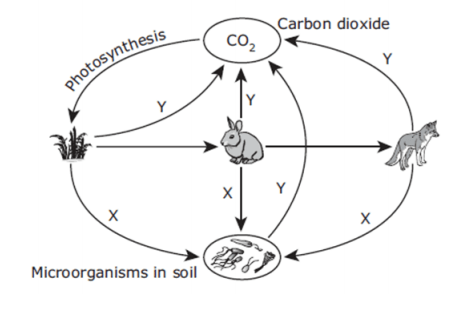
The diagram shows the flow of organic molecules through an ecosystem. What two processes are identified by the labels X and Y?
a)
X : Respiration
Y : Predation
b)
X : Adaptation
Y : Decomposition
c)
X : Fermentation
Y : Nitrogen Fixation
d)
X : Decomposition
Y : Respiration
98.

How do animals get carbon?

a)

By eating plants and or other animals.

b)

They absorb it from the atmosphere.

c)

From the ground

d)

They do not get carbon from anywhere.

99.

Which of the following are fossil fuels?

a)

Coal, water, oil

b)

Oxygen, coal, oil

c)

Coal, Oil, Natural Gas

d)

None of the above

100.
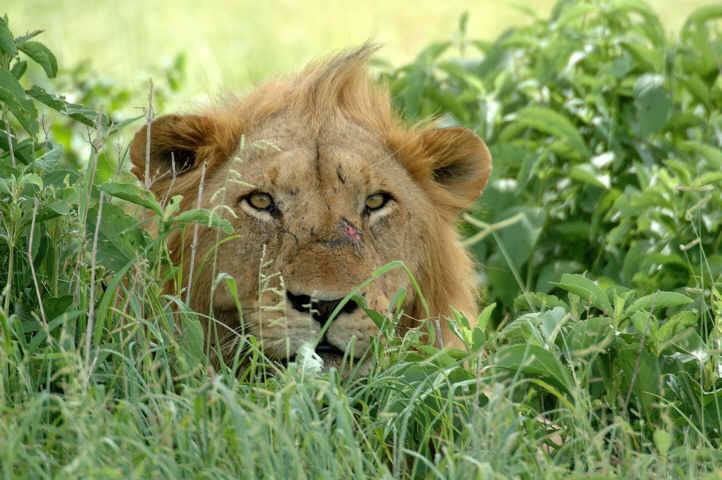
How does the carbon in grass become part of a lion?
a)
The lion eats the grass
b)
Carbon from grass doesn't end up in a lion. 
c)
The carbon ends up in the lion's food chain. 
d)
The lion breathes in carbon given out by the plant
101.
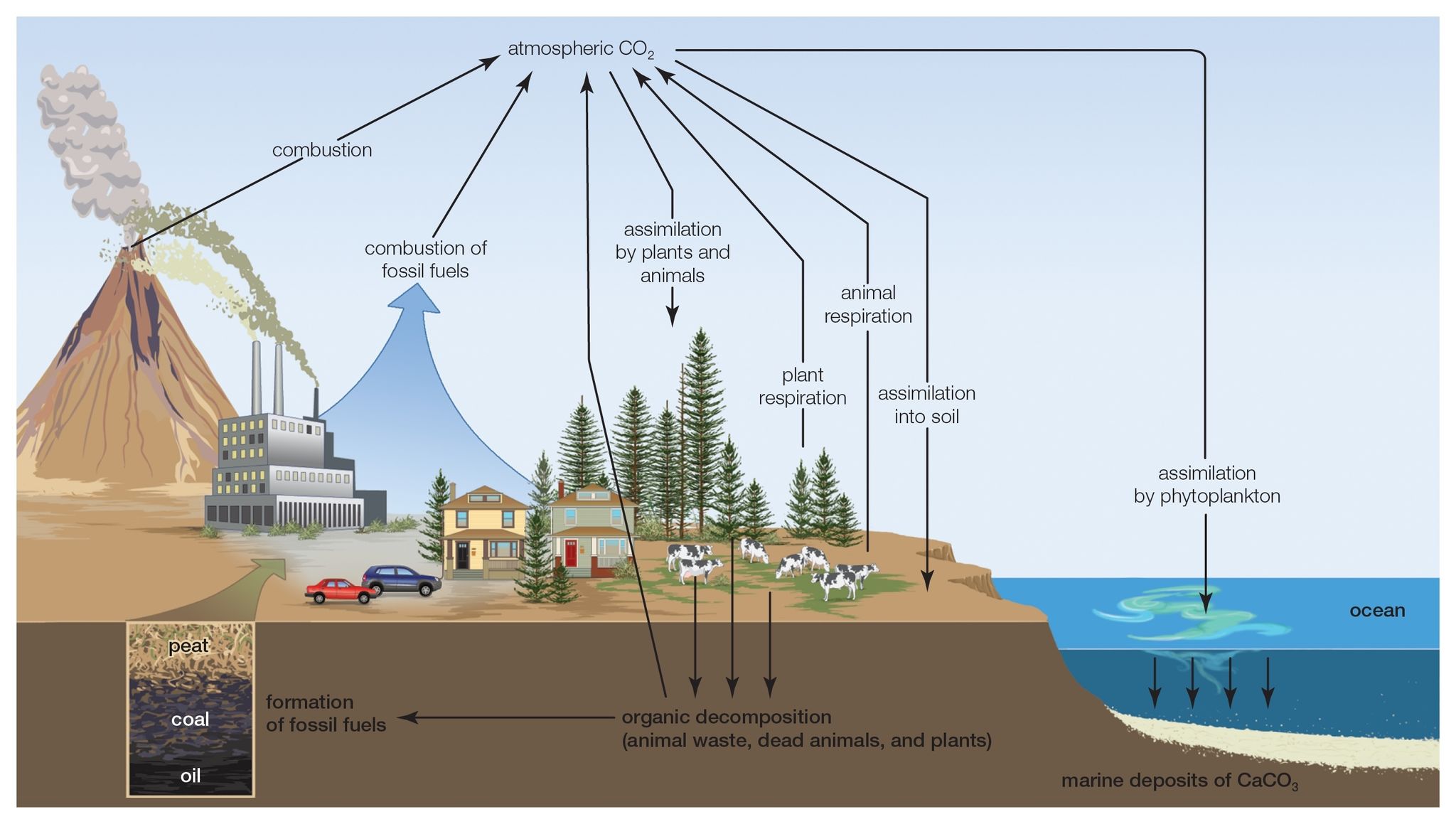
Burning fossil fuel has which effect in the carbon cycle?
a)
It removes carbon dioxide from the atmosphere.
b)
It puts carbon dioxide under the ground.
c)
It adds carbon dioxide to the atmosphere.
d)
It has no effect in the carbon cycle.
102.
Which of the following add carbon dioxide to the atmosphere?
a)
volcanoes
b)
combustion of fossil fuels
c)
animal and plant respiration
d)
all of these
103.
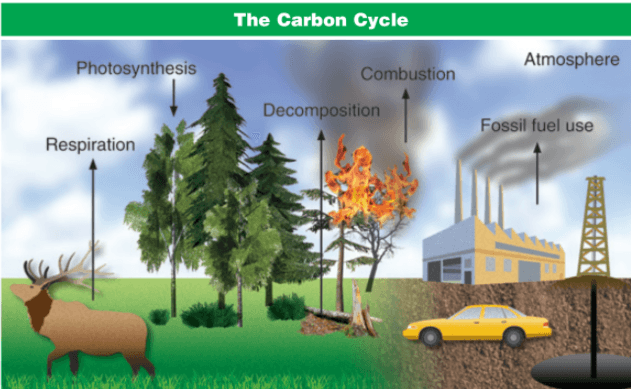
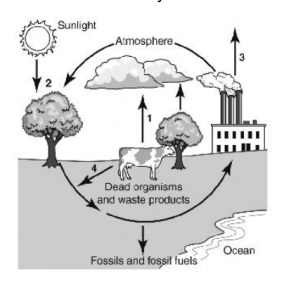
What is happening at 1?
a)
respiration: releasing CO2
b)
decomposing CO2 in the soil
c)
photosynthesis: absorbing CO2
d)
turning CO2 from the atmosphere into organic molecules
104.

What is happening at 2?

a)

respiration: releasing CO2

b)

decomposing CO2 in the soil

c)

photosynthesis: absorbing CO2

d)

turning CO2 from the atmosphere into organic molecules

105.

Water vapor leaves a plant in the biosphere and goes into the atmosphere through

a)

transpiration

b)

respiration

c)

precipitation

d)

evaporation

106.

biosphere

a)

all the water on Earth

b)

regions that contain all the living things on Earth

c)

the envelope of gases that surrounds Earth

d)

living things on land

107.

_____ moves underground to the ocean

a)

sea water

b)

groundwater

c)

lake water

d)

rain drops

108.

What happens when water vapor loses thermal energy?

a)

it expands into millions of droplets that form clouds

b)

it condenses into millions of droplets that form clouds

c)

it condenses into millions of droplets that form lakes and rivers

d)

it expands on the surface of plants and goes into the air

109.

atmosphere

a)

all the water on Earth

b)

regions that contain all the living things on Earth

c)

the envelope of gases that surrounds Earth

d)

living things on land

110.

When is energy absorbed during the water cycle?

a)

during evaporation

b)

during transpiration

c)

during condensation

d)

during precipitation

111.

hydrosphere

a)

all the water on Earth

b)

regions that contain all the living things on Earth

c)

the envelope of gases that surrounds Earth

d)

living things on land

112.

____ happens when liquid turns into a gas on Earth's surface

a)

evaporation

b)

condensation

c)

respiration

d)

transpiration

113.

How does energy from the Sun drive evaporation?

a)

it slows down the water molecules and breaks their bonds

b)

it makes the water molecules too big

c)

it speeds up the water molecules and breaks their bonds

d)

it speeds up the water molecules and creates new bonds

114.

reservoirs

a)

water storage areas during the water cycle

b)

places reserved for water usage by humans and animals

c)

made from water and ice that are too big to remain suspended in air

d)

made up of water droplets or ice crystals that are so small they remain suspended in the air

115.

Which statement does NOT apply to the water cycle?

a)

it has no beginning

b)

it has no end

c)

it is continuous

d)

it very rarely changes

116.

clouds

a)

water storage areas during the water cycle

b)

places reserved for water usage by humans and animals

c)

made from water and ice that are too big to remain suspended in the air

d)

made up of water droplets or ice crystals that are so small they remain suspended in the air

117.

Where does water from mountains or land NOT end up?

a)

lakes

b)

rivers

c)

the ocean

d)

space (unless sent there by a volcanic eruption!)

118.

Which of the following drive the movement of water in the water cycle? (choose all that apply)

a)

sunlight

b)

transpiration

c)

gravity

d)

evaporation

119.

Where is groundwater stored?

a)

in lakes and rivers

b)

in underground lakes

c)

in cracks and pores beneath Earth's surface

d)

in mid-ocean ridges

120.

Evaporation adds water to the

a)

biosphere

b)

atmosphere

c)

lithosphere

d)

geosphere