
 Worksheets
Protein Synthesis and Cell Division
Total questions: 49
Worksheet time: 1hrs 8mins


Which amino acid sequence can be coded from the DNA sequence CAG TAG CGA?
Valine - Isoleucine - Glycine
Valine - Aspartic Acid - Alanine
Valine - Isoleucine - Alanine
Valine - Phenylalanine - Alanine
A scientist treats a cell with a chemical that destroys the ribosomes. As a result, which cell process will be stopped?
osmosis
photosynthesis
protein synthesis
respiration
How would you correctly transcribe the following DNA sequence? TAC-GAC
TAC-GAC
AUG-CUG
ATG-CTG
GTA-CAU
Once the DNA has been transcribed to produce mRNA, the mRNA goes to the _____________ for ____________.
Ribosome; translation
Ribosome; transcription
Nucleus; transcription
Nucleus; translation
Thirty percent of a particular DNA strand is made of adenine. During transcription, a new mRNA molecule is made from this DNA strand. Which is most correct about the mRNA molecule produced?
50% is cytosine
40% is guanine
30% is thymine
30% is uracil
A chemical is applied to cells which prevents the formation of RNA. A disruption of this process would most likely have a direct impact on which other process within the cell?
ATP production
photosynthesis
DNA replication
protein synthesis
What is the relationship between nucleic acids and proteins?
Nucleic acids and proteins both contain peptide bonds.
Nucleic acids are the basic building blocks for proteins.
Nucleic acids provide the instructions on how to build proteins.
Nucleic acids store energy used by proteins during chemical reactions.

An original strand of DNA has the sequence: GGC ATG AAC. A point mutation results in a change in the sequence: GGC ATG AAT.
Using the mRNA codon chart above, what is the most likely result from this change?
One amino acid will change to asparagine.
One amino acid will change to phenylalanine.
All three amino acids in the sequence will change.
All three amino acids in the sequence will remain the same.


Which effect could a mutation in mRNA have on the production of proteins?
The protein produced will have a different identity.
The protein produced will have a coiled shape.
The protein produced will produce excess nitrogen.
The protein produced will produce excess water.

A certain mutation in the gene for hemoglobin results in the red blood cells becoming sticky, rigid, and irregularly shaped. These irregularly shaped red blood cells block the flow of blood throughout the body. A single base mutation is responsible for these irregularly shaped blood cells.
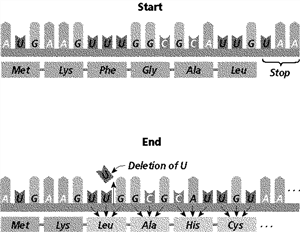
Which of these mutations most likely results in the mutated hemoglobin gene?
Insertion
Deletion
Duplication
Substitution


What is the division of cytoplasm called?
chromosome
mitosis
cytokinesis
the cell cycle

In mitosis, the two resulting cells are
different from the starting cell and identical to each other.
different from the starting cell and different from each other.
identical to the starting cell and different from each other.
identical to the starting cell and identical to each other.

Which process and type of resulting cells are represented?
mitosis, gametes
mitosis, body cells
meiosis, gametes
meiosis, body cells

What is the result when a single cell reproduces by meiosis?
two cells that have twice the genetic information as the parent cell
four cells that have half the genetic information as the parent cell

These diagrams show a variety of cells from the same organism. How can cells from the same organism have such different shapes and functions?
As each cell differentiates, the DNA changes so that each type of cell has different DNA once it reaches maturity.
Mutations in the cells' nuclei lead to new combinations of DNA, resulting in different shapes and functions in the different types of cells.
During differentiation, different parts of the DNA in each type of cell are activated, resulting in the different structure and function of the cells.
During differentiation, different types of cells produce proteins which destroy the nonactive DNA, leading to cell specialization.
Which of the following best explains why meiosis results in greater genetic diversity than mitosis?
After meiosis, daughter cells are diploid and have twice as much genetic material, which can be divided in many more possible combinations.
After meiosis, haploid daughter cells are fertilized, which doubles their number of chromosomes and increases the number of possible genes.
During meiosis, chromosomes assort themselves independently of each other, which allows for more different possible combinations of chromosomes.
During meiosis, more daughter cells are produced, which increases the likelihood that fertilization will occur.
Which best describes the interaction between DNA and RNA during protein synthesis?
RNA carries the code to the nucleus where DNA translates the code into a protein.
DNA travels to the ribosome where RNA translates the code into a protein.
RNA carries the code from DNA in the nucleus to the ribosome for protein synthesis.
DNA travels to the cytoplasm while RNA remains in the nucleus.
Stage of the cell cycle when the cell grows and carries out regular cell functions.
G1 phase
S phase
Cytokinesis
Interphase
A stage of protein synthesis when tRNA carries amino acids to form a chain.
Translation
Transcription
_____ is cell division that produces gametes.
Meiosis
Mitosis
_____ is a stage of the cell cycle when the cell completes all activities needed to divide itself.
Meiosis
Mitosis
SC.912.L.16.17 How are sexual reproduction and asexual reproduction different from each other?
sexual reproduction requires two parents and asexual reproduction requires
only one parent
asexual reproduction requires two parents and sexual reproduction requires
only one parent
mutation rates are lower in sexual reproduction than in asexual reproduction
asexual reproduction occurs only in multicellular organisms
SC.912.L.16.17 Mitosis and meiosis are processes involved in cellular reproduction. Which of the following
describes and event that results from mitosis but NOT meiosis?
two stages of cell division
replication of cellular genetic material
daughter cells that are identical to the parent cell
four daughter cells that are produced from each parent cell
SC.912.L.18.11 Many of the proteins in the human body are enzymes that catalyze chemical reactions. What is
the relationship between enzymes and activation energy?
When an enzyme catalyzes a reaction, it increases the activation energy of the reaction
When an enzyme catalyzes a reaction, it increases the activation energy of the product.
When an enzyme catalyzes a reaction, it decreases the activation energy of the reaction.
When an enzyme catalyzes a reaction, it does not affect the activation energy of the
reaction
SC.912.L.16.13 Which of the following describes fertilization?
Cell differentiation to form a blastula
Formation of germ layers in a deuterostome
A sperm joining an egg to form a zygote
Sperm and egg production

SC.912.L.16.5 During transcription the DNA base sequence is transcribed into a complimentary mRNA
sequence. A codon table like the one shown below lists the amino acids coded for by particular triads
of mRNA bases. A segment of DNA has undergone a mutation in which one nucleotide has been
changed. The original sequence was ACG and the new sequence is ACA. Use the codon table to
determine whether or not this mutation will cause a change in the phenotype of the organism.
yes, the phenotype of the organism would change because a new amino acid will be coded
for
yes, the phenotype of the organism would change because any change in the DNA
sequence will cause a change in phenotype.
Even though the DNA sequence changed, the sequence still codes for the
same amino acid, so no change in phenotype will occur
It is impossible to determine if a change in phenotype will occur using only the
DNA sequence.

The four butterflies in the illustration represent the offspring in the F1 generation. Which statement is best supported by the phenotypes of these offspring?
The F1 generation is composed only of males.
Two of the offspring in the F1 generation will not be able to reproduce.
The F1 generation is the result of a dihybrid cross.
Two of the offspring in the F1 generation will experience a spontaneous mutation

The initial steps in gene expression are modeled. Double-stranded DNA first unwinds into two strands. Which process and product are represented in the diagrams?
Process: transcription; product: mRNA
Process: translation; product: protein
Process: replication; product: tRNA
Process: recombination; product: polymerase


the section of dna has these bases:
TAG CAG TAC
which mRNA sequence is produced from this DNA section
ATC GTC ATG
AUC GUC AUG
AUG CUG AUC
UTC GTC UTG
What are homologous chromosomes?
gene pair where each allele in the pair is the same version
the physical expression of a set of genes for a particular trait
chromosome pairs (one from each parent) that are similar size and carry genes for the same trait
What is a gene
organism's complete set of genetic material (DNA) that contains all the information needed to build and maintain that organism
a distinct portion of your cell's DNA that carries genetic instructions for a particular protein
molecules that will bond together, such as adenine with thymine and cytosine with guanine
Which cells in the body are referred to as somatic cells?
Gametes
Skin cells
Muscle cells
What does diploid mean?
A cell with three sets of chromosomes
A cell with two sets of chromosomes
A cell with four sets of chromosomes
A cell with one set of chromosomes

