Wayground logo

Free Printable Worksheets

Font size

S
M
L
XL
Worksheets

Geology Midterm

Total questions: 76

Worksheet time: 49mins

Name
Class
Date
1.
Using this scale, which mineral can scratch fluorite?
a)
Talc 
b)
Gypsum 
c)
Apatite 
d)
Calcite 
2.
Rock that forms when magma or lava cools and hardens to become solid, either beneath or on Earth’s surface
a)
Sedimentary Rock
b)
Metamorphic Rock
c)
Igneous Rock
d)
Rock Cycle
3.
Rock that forms when minerals form from solutions or sediment from older rocks get pressed and cemented together.
a)
Sedimentary Rock
b)
Metamorphic Rock
c)
Igneous Rock
4.
Rock that forms when pressure, temperature, or chemical processes change existing rock.
a)
Igneous Rock
b)
Sedimentary Rock
c)
Metamorphic Rock
d)
Rock Cycle
5.
Scientists think that convection currents that move the plates flow in Earth's
a)
Continental crust
b)
oceanic crust
c)
Asthenosphere
d)
Lithosphere
6.
The Earth is made up of two types of crust.  Which is more dense?
a)
Oceanic crust -basalt
b)
Oceanic crust- granite
c)
Continental crust- granite
d)
continental crust- basalt
7.

Which earth layer is made up of the upper mantle and the crust?

a)

core

b)

lower mantle

c)

asthenosphere

d)

lithosphere

8.

The study of the solid earth and the processes that change the physical landscape of the planet is____

a)

Physical Geology

b)

Structural Geology

c)

Historical Geology

d)

Geomorphology

9.

Which statement best describes the principle of uniformitarianism? (Mark the one best answer.)

a)

Deposition occurs faster today than it did in ancient environments.

b)

Rocks form by the same processes today as in the past

c)

Weathering and erosion can be fast or slow, depending on the type of rock.

d)

Earth’s geological features were formed by a few catastrophic events.

10.
A rock formed from fragments of other rocks is a(n)
a)
Metamorphic Rock
b)
Sedimentary Rock
c)
Extrusive Rock
d)
Igneous Rock
11.
If heat and pressure inside the Earth cause a rock to melt, the material that formed would be
a)
Metamorphic
b)
Magma
c)
Sedimentary
d)
Igneous
12.
As lava cools and crystallizes, what type of rock will form?
a)
Sedimentary
b)
Metamorphic
c)
Extrusive Igneous
d)
Intrusive Igneous
13.

Which state of matter is the earth's inner core?

a)

plasma

b)

liquid

c)

solid

d)

gas

14.
Which type of plate is older?
a)
continental
b)
oceanic
15.
Scientist think the Earth is ___ years old.
a)
4,500
b)
45,000
c)
4.5 million
d)
4.5 billion
16.
How light reflects off of a mineral is called the mineral's 
a)
luster
b)
streak
c)
cleavage
d)
fracture
17.
Diamond has a hardness of ___ on Mohs Hardness Scale.
a)
1
b)
5
c)
8
d)
10
18.
By definition, a mineral has which of the following characteristic(s)?
a)
definite chemical composition
b)
crystal structure
c)
naturally occuring
d)
all of the above
19.
A mineral breaks into pieces like are shown in the picture. How would you describe its breakage?
a)
Fracture
b)
Cleavage
c)
Glassy
d)
Waxy
20.
Refer to the Mohs Hardness Scale. A mineral with a hardness of 7 can scratch -
a)
orthoclase feldspar, but cannot scratch talc
b)
calcite, but cannot scratch apatite.
c)
topaz, but cannot scratch fluorite
d)
gypsum, but cannot scratch corundum
21.

A mineral can be scratched by feldspar and quartz.

What is the hardness range?


a)

1-5

b)

2-7

c)

2-10

d)

7-10

22.

A mineral could be scratched by quartz but NOT by fluorite.

What is the hardness range?

a)

1-4

b)

5-6

c)

4-10

d)

8-10

23.
Mineral containing silicon, oxygen, and usually one or more other elements
a)
carbonate
b)
halide
c)
silicate
d)
sulfate
24.

Which is NOT the characteristic of Ferromagnesian (Mafic) Silicate mineral.

a)

Light in color

b)

Combination of Silicate and Mg OR Fe

c)

Dark color of mineral

25.

Is ice a silicate or non-silicate?

a)

silicate

b)

non-silicate

c)

neither, it's not a mineral

26.

If a mineral contains iron (Fe) or magnesium (Mg), what would it be classified as?

a)

light silicate

b)

dark silicate

c)

nonsilicate

27.

If a mineral contains aluminium (Al), potassium (K), calcium (Ca), or sodium (Na), what would it be classified as?

a)

light silicate

b)

dark silicate

c)

nonsilicate

28.
What is the most common Extrusive igneous rock?
a)
Granite
b)
Basalt
c)
Pumice
d)
Scorie
29.
Is Granite high or low in Silica?
a)
high
b)
low
30.
What is the most common Intrusive Igneous rock?
a)
Basalt
b)
Gabbro
c)
Diorite
d)
Granite
31.
Where can we find Basalt?
a)
mountains
b)
valleys
c)
deserts
d)
ocean floor
32.
High or Low Silica?
a)
high
b)
low
33.
This rock cools so quickly that crystals have no time to form.
a)
Basalt
b)
Obsidian
c)
Gabbro
d)
Pumice
34.

Describe the texture of the following igneous rock.

a)

glassy

b)

rough

c)

vesicular

d)

coarse

35.

Describe the texture of the following igneous rock.

a)

smooth

b)

coarse

c)

vesicular

d)

glassy

36.

Describe the mineral composition of the following igneous rock.

a)

felsic

b)

mafic

37.

Describe the mineral composition of the following igneous rock.

a)

felsic

b)

mafic

38.

According to the Bowen's reaction series, which mineral forms at the lowest temperature?

a)
Olivine
b)
Pyroxene
c)
K-spar
d)
Quartz
39.
What is the name of a mafic, intrusive (phaneritic) igneous rock?
a)
Granite
b)
Rhyolite
c)
Gabbro
d)
Basalt
40.
Sheet-like intrusions that lie parallel to previous rock units are:
a)
dike
b)
sill
c)
pluton
d)
batholith
41.
Sheet like intrusions that cut across previous rock units are:
a)
dike
b)
sill
c)
pluton
d)
batholith
42.
The largest intrusive body is a
a)
dike
b)
sill
c)
pluton
d)
batholith
43.
What is letter A in the picture?
a)
Vent
b)
Crater
c)
Conduit
d)
Tephra
44.
__________ volcanoes are formed from fast flowing, lava which flows easily over the surface, forming larger volcanoes with gentle sides.
a)
Cone
b)
Composite
c)
Angel
d)
Shield
45.
What factor(s) determine(s) whether an eruption will be explosive?
a)
The amount of gases in the magma
b)
The amount of silica in the magma
c)
The amount of gas and silica in the magma
d)
None of these affect the explosiveness of the volcano
46.
What size sediment makes sandstone?
a)
Pebble
b)
Silt
c)
Sand
47.
How is sediment formed?
a)
Weathering and Erosion
b)
Melting
c)
Pressure
48.
This rock is made of the remains of dead sea creatures (which have turned into oil). What type of sedimentary rock is it?
a)
Clastic
b)
Chemical
c)
Organic
49.
Which of the following orders sediment particle size from smallest to largest?
a)
silt, sand, clay
b)
sand, silt, clay
c)
clay, sand, silt
d)
clay, silt, sand
50.
Which of the horizons in the soil profile shown represent the organic material?
a)
Horizon O (Humus)
b)
Horizon A
c)
Horizon B
d)
Horizon C
51.

Which layer is the parent material?

a)

Horizon O

b)

Horizon A

c)

Horizon B

d)

Horizon C

e)

Horizon R

52.

What kind of detrital rock forms in lakes?

a)

conglomerate

b)

sandstone

c)

shale

53.

_________ lava has solidified as rounded masses, characteristic of eruption under water.

a)

Aa

b)

Pillow

c)

Pahoehoe

d)

Blocky

54.

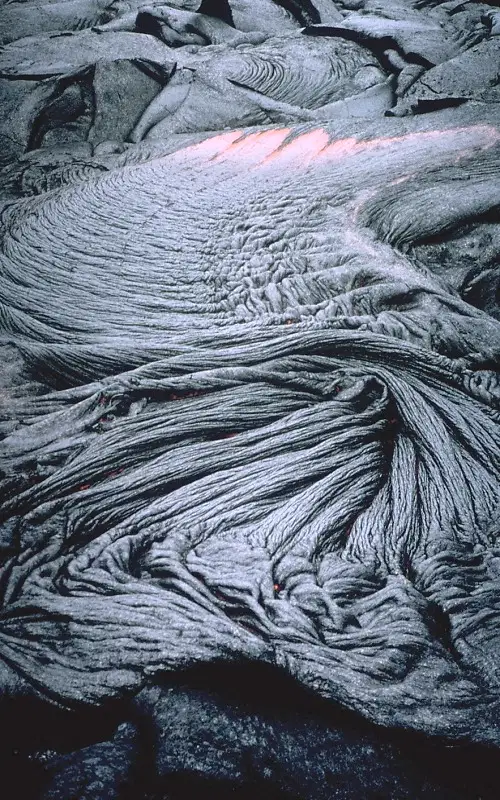
_______ lava moves slowly and has a smooth, billowy or ropey surface.

a)

Aa

b)

Pahoehoe

c)

Pillow

d)

Blocky

55.

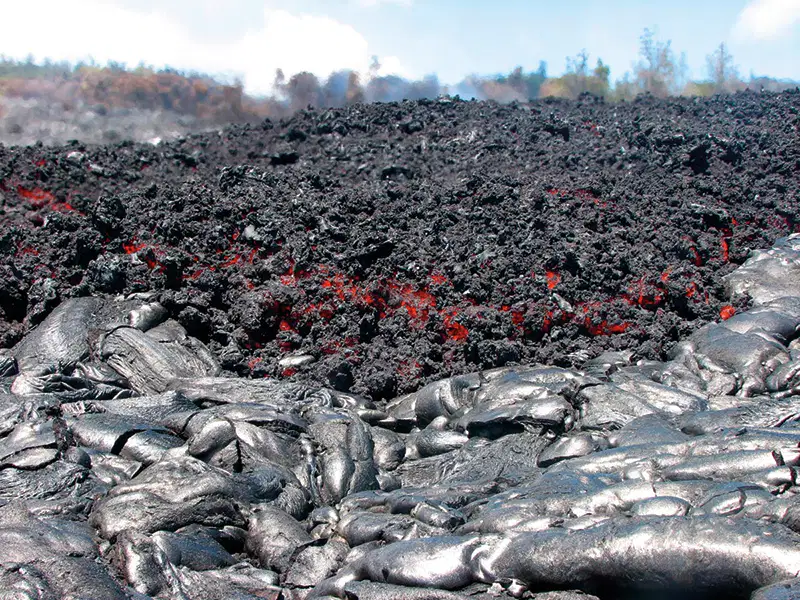
When _______ lava cools down, it forms fragmented, rough sometimes spiny or black surfaces.

a)

Aa

b)

Pahoehoe

c)

Pillow

d)

Blocky

56.
Each rock type can follow only one pathway of the rock cycle.
a)
True
b)
False
57.
Fossils are often found in ____________ because it is formed from the remains of once living things.
a)
metamorphic
b)
magma
c)
igneous
d)
sedimentary
58.

How is chalk formed?

a)

hard bits of sea creatures get compressed

b)

soft bits of sea creatures get compressed

c)

smooth bits of sea creatures get compressed

d)

rough bits of sea creatures get compressed

59.
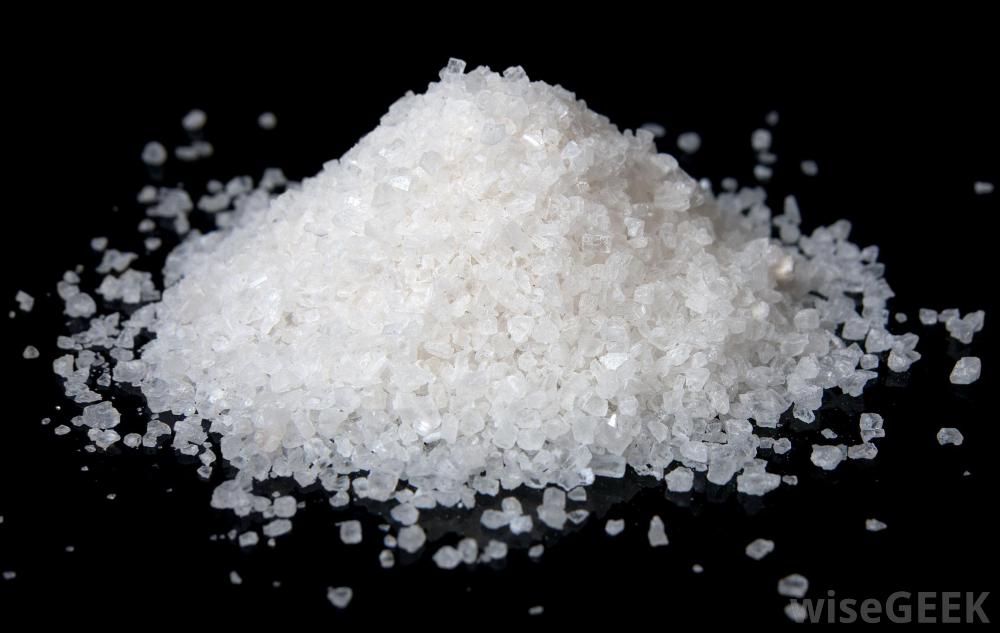
What mineral is salt?
a)
quartz
b)
sulfur
c)
halite
d)
calcite
60.
A mineral breaks into pieces like are shown in the picture. How would you describe its breakage?
a)
Fracture
b)
Cleavage
c)
Glassy
d)
Waxy
61.

Which one is not a property used to identify minerals?

a)

streak

b)

luster

c)

hardness

d)

size

62.
Ratio of a mineral's weight compared with the weight of an equal volume of water
a)
specific gravity
b)
physical property
c)
luster
d)
cleavage
63.

Biotite is a silicate mineral in group ___________

a)

Light Silicate

b)

Dark Silicate

c)

Nonsilicate

64.

The figure shows the _______________________ silicate mineral structure.

a)

Single chain

b)

Sheet

c)

Framework

d)

Double chain

65.

What color will a soil rich in iron appear?

a)

Red

b)

Yellow

c)

Black

d)

Grey

66.

What factors can lead to the formation of a sedimentary rock?

a)

evaporation and precipitation

b)

melting and solidification

c)

extreme heat and pressure

67.

Describe the texture of breccia.

a)

vesicular

b)

clastic

c)

crystalline

d)

bioclastic

68.

Which of the following is a chemically formed sedimentary rock?

a)

marble

b)

breccia

c)

rock salt

d)

quartz

69.

What is this rock? It is gritty/grainy and sedimentary.

a)

Gneiss

b)

Sandstone

c)

Granite

d)

Coal

70.
A type of igneous rock that cools on earth's crust
a)
Extrusive
b)
Chemical
c)
Intrusive
d)
Foliated
71.

What rock is this? It is an extrusive igneous rock with vesicular texture.

a)

oolitic sandstone

b)

pumice

c)

Scoria

d)

limestone

72.

Which rock shows a aphanitic texture?

a)
b)
c)
d)
73.

Which rock below shows a porphyritic texture?

a)
b)
c)
d)
74.

How would you describe this rock?

a)

Felsic

b)

Intermediate

c)

Mafic

75.

What type of rock is this?

a)

Sandstone

b)

Shale

c)

Welded Tuff

d)

Conglomerate

76.

What type of rock is this?

a)

Andesite

b)

Fossiliferous limestone

c)

Rhyolite

d)

Shale