wayground logo

Free Printable Worksheets

Font size

S
M
L
XL
Worksheets

Mid term Practice

Total questions: 140

Worksheet time: 2hrs 22mins

Name
Class
Date
1.
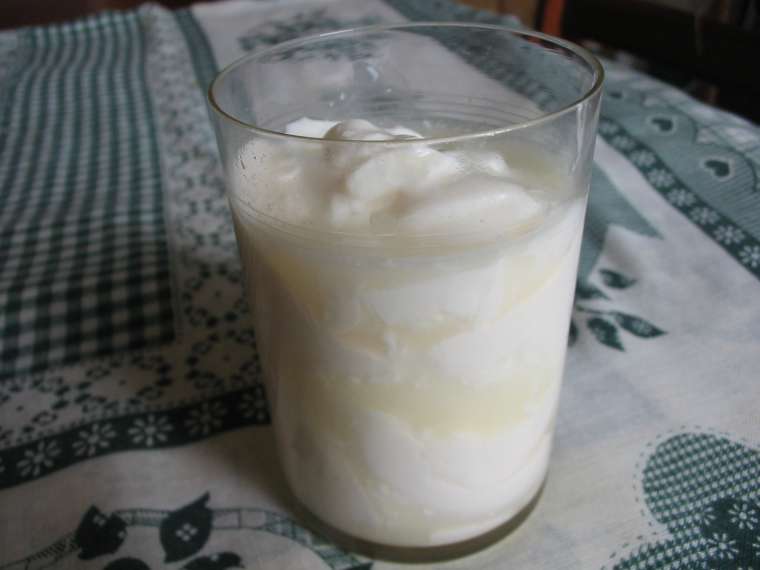
Dilcia wants to know how drinking milk affects how tall a Monica grows. Which is the independent variable?
a)
Monica's growth
b)
drinking milk
2.
Ramone wants to know: does the distance a person kicks a soccer ball effect how well they will do on their math test.  What is the dependent variable?
a)
How far they kick the soccer ball
b)
who the person is
c)
how well they do on the math test
d)
Type of soccer ball.
3.

What is the INDEPENDENT variable? You are testing which type of paper airplane goes furthest?

a)

the paper used

b)

the type of paper airplane

c)

the distance of each plane's flight

d)

how hard the plane is thrown

4.
Marcos wants to know: Does the type of gasoline put in a car effect how fast the car can drive? What is the independent variable?
a)
Type of gasoline
b)
which car the gas is put into
c)
how fast the car can drive
d)
how much gas is put into the car
5.

Which of the following is true regarding a hypothesis?

a)

A concise statement that summarizes the results of many experiments and observations

b)

A testable explanation for an observation or question

c)

A procedure in an experiment

d)

A well tested explanation for a broad set of observations

6.

The variable that is changed/manipulated in any experiment is know as _______.

a)

Independent variable

b)

Dependent

variable

c)

Control variable

d)

Qualitative

variable

7.

The variable that is observed in any experiment is known as the _______.

a)

Independent

variable

b)

Dependent

variable

c)

Control

variable

d)

Quantitative

variable

8.

Classifying the following: cooking a steak

a)

physical change

b)

chemical change

9.

Classify the following: melting ice

a)

physical

change

b)

chemical

change

10.

What happens to matter during a chemical change?

a)

Matter is neither created or destroyed

b)

Some matter is destroyed

c)

Some matter is created

d)

Some matter is destroyed and some is created

11.

Classify the following: bending a wire

a)

physical change

b)

chemical change

12.

Which state of matter is defined as having an indefinite shape and definite volume?

a)

Solid

b)

Liquid

c)

Gas

d)

Element

13.

A substance that can be separated into 2 or more substances only by a chemical change is identified as a(n) _________.

a)

Homogeneous solution

b)

Compound

c)

Mixture

d)

Element

14.

The chemical symbol for Calcium is ________.

a)

CA

b)

ca

c)

C

d)

Ca

15.

The group in experiment that does not receive treatment is know as the _______.

a)

Control group

b)

Experimental group

c)

Independent group

d)

Dependent group

16.

Which of the following would not be classified as matter?

a)

Concrete

b)

Brass

c)

Magnesium

d)

Light

17.

Which state of matter is defined as having a definite shape and definite volume?

a)

Solid

b)

Liquid

c)

Gas

d)

Element

18.

Which of the following is a physical change?

a)

Combusting

b)

Corroding

c)

Decomopsing

d)

Evaporating

19.

Which of the following is not a physical change?

a)

Rusting

b)

Subliming

c)

Evaporating

d)

Dissolving

20.

Classify the following: sugar water

a)

Element

b)

Compound

c)

Homogeneous Mixture

d)

Heterogeneous Mixture

21.

Classify the following: soda

a)

Element

b)

Compound

c)

Homogeneous Mixture

d)

Heterogeneous Mixture

22.

Classify the following: sodium chloride

a)

Element

b)

Compound

c)

Homogeneous Mixture

d)

Heterogeneous Mixture

23.

Classify the following: river water

a)

Element

b)

Compound

c)

Homogeneous Mixture

d)

Heterogeneous Mixture

24.

Classify the following: zinc

a)

Element

b)

Compound

c)

Homogeneous Mixture

d)

Heterogeneous Mixture

25.

In which type of mixture are the components evenly distributed throughout?

a)

Homogeneous

b)

Heterogeneous

c)

Compound

d)

Pure Substance

26.

Classify the following: air

a)

Element

b)

Compound

c)

Homogeneous Mixture

d)

Heterogeneous Mixture

27.

Which of the following is classified as a mixture?

a)

Pure Water

b)

Nitrogen

c)

Air

d)

Pure Gold

28.

Which of the following is a heterogeneous mixture?

a)

Laundry Detergent

b)

Air

c)

Salt Water

d)

Concrete

29.

What do chemical symbols and chemical formulas represent?

a)

Elements and Compounds

b)

Mixture and Pure Substances

c)

Elements and Ions

d)

Mixtures and Solutions

30.

Which of the following substances is a pure substance?

a)

Silver

b)

Muddy Water

c)

Trail Mix

d)

Salt Water

31.

What is the first step in the scientific method?

a)

Question

b)

Hypothesis

c)

Analysis

d)

Research

32.

What is the definition of a HYPOTHESIS?

a)

A question you want to solve

b)

Data you collect during an experiment

c)

A graph you create to show your data

d)

An educated guess to your question

33.

QUALITATIVE -VS- QUANITATIVE OBSERVATIONS:

Which of the following is NOT a quantitative observation?

a)

The class ordered 10 pizzas for their party.

b)

Each pizza had eight slices.

c)

There were 5 plain pizzas and 5 pepperoni pizzas.

d)

All the pizzas were very hot!

34.

QUALITATIVE -VS- QUANITATIVE OBSERVATIONS:

Which of the following is a QUALITATIVE observation?

a)

Ten puppies frolicked in the yard.

b)

Each puppy ate 2 treats.

c)

All the puppies were brown with white spots.

d)

Three of the puppies fell asleep.

35.

Boiling

a)

liquid to gas

b)

gas to solid

c)

gas to liquid

36.
Can a same substance undergo both physical and chemical changes.
a)
True
b)
False
37.
How do we know if it is a chemical change?
a)
can be undone
b)
cannot be undone
c)
both
d)
none
38.
Physical changes size and shape of something?
a)
False
b)
True
39.
Ice can be a physical change?
a)
False
b)
True
40.
When something new is created or a substance is broken down into diffrent chemicals, you have a chemical change.
a)
True
b)
False
41.
What kind of properties can only be observed when a substance changes into a different substance?
a)
physical properties
b)
chemical properties
c)
liquid properties
d)
real properties
42.
Is burning wood a chemical or physical change?
a)
chemical
b)
physical
43.
What is an example of a Chemical change?
a)
Ripped paper 
b)
boiled egg
c)
cracked egg
d)
sugar in water
44.
Is milk going sour a physical or chemical change?
a)
Physical 
b)
Chemical
45.
Rust on an iron bar is an example of chemical change.
a)
True 
b)
False
46.
Is burning wood a chemical or physical change?
a)
chemical
b)
physical
47.

Is glass breaking a chemical or physical change?

a)
chemical
b)
physical
48.
How many sig figs are there?
100.00
a)
1
b)
3
c)
4
d)
5
49.
How many sig figs are there?
100000000
a)
1
b)
9
c)
10
50.
How many sig figs are there?
4004
a)
1
b)
2
c)
3
d)
4
51.
How many sig figs are there?
0.000008
a)
1
b)
2
c)
6
d)
7
52.
How many sig figs are there?
0.00400
a)
1
b)
3
c)
5
d)
6
53.
How many sig figs are there?
9009.00
a)
2
b)
4
c)
5
d)
6
54.
How many sig figs are there?
0.0009009090000
a)
3
b)
10
c)
14
55.

Write the following number in scientific notation.

360

a)

3.6×1023.6\times10^2  

b)

0.36×1020.36\times10^2  

c)

3.6×1033.6\times10^3  

d)

3.6×1023.6\times10^{-2}  

56.

Write the following number in scientific notation.

0.052

a)

5.2×1015.2\times10^1  

b)

5.2×1015.2\times10^{-1}  

c)

5.2×1025.2\times10^{-2}  

d)

5.2×1025.2\times10^2  

57.

Write the following number in standard form. Type your answer with no spaces and no commas.

5.7×1015.7\times10^{-1}  

(a)  

58.

How close a measurement is to the accepted value is called..

a)

Accuracy

b)

Precision

c)

Significant

d)

Estimate

59.
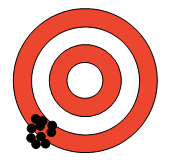
This bullseye demonstrates...
a)
High Accuracy & High Precision
b)
High Accuracy & Low Precision
c)
Low Accuracy & High Precision
d)
Low Accuracy & Low Precision
60.
The students measured length during a science experiement, they got 12 cm. But the actual measurement was 14.25 cm. What was the percent error?
a)
15.79%
b)
18.75%
c)
2.25%
d)
18%
61.
40 cm = ______ mm
( 1 cm = 10 mm)
a)
4000
b)
40
c)
400
d)
None of the Above
62.

6 kg = _____ g

a)

6

b)

6000

c)

600

d)

.006

63.
200 mm = ____ cm
(1 cm = 10 mm)
a)
20 mm
b)
20 km
c)
20 cm
d)
20 dm
64.
Ed fills his sports bottle with 1 liter of water. After his bike ride, he drinks 200 milliliters of the water. How much water is left in Ed's sports bottle?
(1 liter = 1000 ml)
a)
800 mm
b)
8000 ml
c)
80 ml
d)
800 ml
65.
900 cm ____ 9000 mm
(1 cm is 10 mm)
a)
<
b)
=
c)
>
66.

The particles of this state of matter are close together

a)

Solid

b)

liquid

c)

Gas

67.

Which ones can be units for density?

(Multiple responses)

a)

g/ mL

b)

g

c)

gcm3\frac{g}{cm^3}  

d)

cm4cm^4  

68.

What is the mass of a 25 cm3  liquid if it has a density of 5 g/cm3?

a)

125 g

b)

5 g

c)

5gcm3\frac{5g}{cm^3}  

d)

0.2 cm30.2\ cm^3  

69.

Calculate the density of the rectangular prism

a)

2 g/cm3

b)

4 g/cm3

c)

6 g/cm3

d)

8 g/cm3

70.

As a substance is COOLED its VOLUME...

a)

increase

b)

decreases

c)

remains equal

71.

100 Celsius is ? Kelvin (K = Celsius + 273)

a)

173 K

b)

373K

c)

273 K

d)

0 K

72.
Convert -89 oC to K
a)
184K
b)
362K
c)
-362K
d)
-184K
73.
Convert 300 K to oC
a)
27oC
b)
0oC
c)
-27oC
d)
573oC
74.
Discovered the electron
a)
Bohr
b)
Dalton
c)
Rutherford
d)
Thomson
75.
Planetary model
a)
Thomson
b)
Bohr
c)
Dalton
d)
Schrodinger
76.
Cathode Ray Tube Experiment
a)
Thomson
b)
Rutherford
c)
Bohr
d)
Dalton
77.
Billiard Ball Model
a)
Thomson
b)
Rutherford
c)
Bohr
d)
Dalton
78.
Plum pudding model
a)
Dalton
b)
Thomson
c)
Rutherford
d)
Chadwick
79.
Gold foil experiment
a)
Dalton
b)
Bohr
c)
Rutherford
d)
Schrondinger
80.
Discovered nucleus
a)
Thomson
b)
Rutherford
c)
Bohr
d)
Dalton
81.
Discovered energy levels
a)
Dalton
b)
Bohr
c)
Thomson
d)
Rutherford
82.

Viewed the atom as a solid sphere that could not be divided into smaller particles.

a)

JJ Thomson

b)

Ernest Rutherford

c)

John Dalton

d)

Niels Bohr

83.

Thought the atom contained negative electrons surrounded by positive material

a)

JJ Thomson

b)

Ernest Rutherford

c)

John Dalton

d)

Niels Bohr

84.

Discovered the atom has a nucleus with positively charged protons inside. The electrons circle the nucleus

a)

JJ Thomson

b)

Ernest Rutherford

c)

John Dalton

d)

Niels Bohr

85.

Proposed electrons orbit the nucleus in specific layers, called energy shells.

a)

John Dalton

b)

JJ Thomson

c)

Ernest Rutherford

d)

Niels Bohr

86.
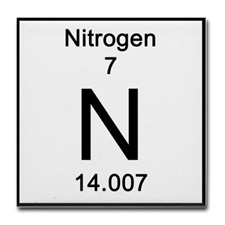
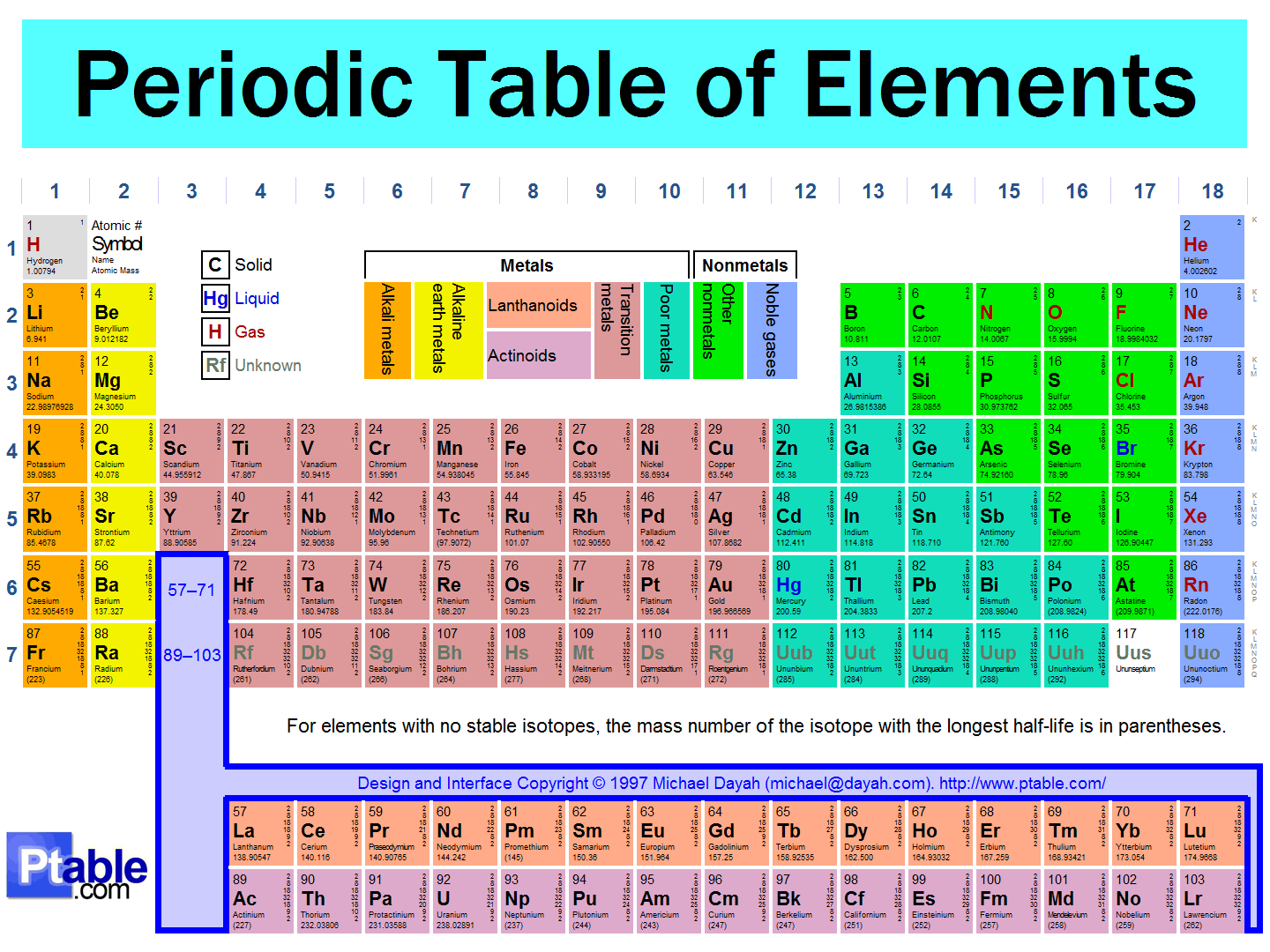
What is the number of protons that the element in this image contain?
a)
14
b)
7
c)
15
d)
18
87.
What is the atomic mass of "F"
a)
9
b)
18
c)
17
d)
19
88.
all matter is made of what 
a)
energy 
b)
atoms 
c)
electrons 
d)
compounds 
89.
The positive particles of an atom are 
a)
electrons 
b)
positrons 
c)
neutrons 
d)
protons 
90.
the central region of an atom where its neutrons and protons are is its 
a)
nucleus 
b)
electron cloud
c)
core 
d)
center 
91.
electrons have this type of charge?
a)
negative
b)
positive
c)
neutral
92.
What is the mass of an atom if it has 11 protons, 12 neutrons, and 11 electrons?
a)
22
b)
11
c)
34
d)
23
93.
What are the 3 particles that make-up the atom?
a)
protons, neutrons, and isotopes
b)
neutrons, isotopes, and electrons
c)
positives, negatives, and electrons
d)
protons, neutrons, and electrons
94.
What is in the nucleus of an atom?
a)
Neutrons and protons 
b)
Protons
c)
Protons and Electrons
d)
Electrons and Nuetrons
95.

The vertical (up and down) columns in the Periodic Table are called

a)

groups

b)

towers

c)

periods

d)

atomic numbers

96.
The horizontal row on the periodic table is called a
a)
group
b)
family
c)
period
d)
atomic number
97.
What does the 1.00794 stand for?
a)
Hydrogen
b)
atomic number
c)
atomic mass
d)
atomic explosion
98.

What are the columns referred to on the Periodic Table of Elements?

a)

Families or groups

b)

Periods

99.

Metals are on the:

a)

Left side

b)

Right Side

c)

Stairstep

100.

Metalloids are on the:

a)

Left side

b)

Right Side

c)

Stairstep

101.

Nonmetals are on the:

a)

Left side

b)

Right Side

c)

Stairstep

102.

A student is studying a mystery substance. It breaks easily. It has a very dull luster. It doesn't conduct any electricity. What is the most likely substance this is?

a)

Metal

b)

Metalloid

c)

Nonmetal

103.

The same student works with a new substance. He concludes it conducts electricity very well. It has a very shiny luster. When he hammers it, it simply dents and flattens. What is the most likely substance type?

a)

Metal

b)

Metalloid

c)

Nonmetal

104.

an arrangement of the elements according to their atomic numbers so that elements with similar properties are in the same column and properties repeat from row to row

a)

Periodic Table of Elements

b)

Atomic Theory

c)

Isotopes

d)

Subatomic Particles

105.
How many neutrons would Fe-56 have?
a)
56
b)
26
c)
30
d)
33
106.
How many protons does P-30 have?
a)
30
b)
16
c)
12
d)
15
107.
What element has 42 protons?
a)
Ca
b)
Mo
c)
Zr
d)
Po
108.
If an atom of nickel has a charge of +3, how many electrons does the atom have?
a)
28
b)
25
c)
26
d)
31
109.
How many neutrons would V-49 have?
a)
26
b)
49
c)
23
d)
50.94
110.
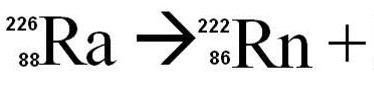
Complete the nuclear equation and determine the type of decay that is occurring in this reaction. 
a)
alpha
b)
beta
c)
gamma
d)
none
111.
A helium nucleus with two protons and two neutrons is called a(n) ____.  
a)
alpha particle
b)
electroscope
c)
beta particle
d)
gamma ray
112.
Negatively charged particles emitted from a nucleus at a high speed are ____.  
a)
alpha particle
b)
gamma rays
c)
beta particles
d)
X rays
113.
What type of decay?
a)
alpha
b)
beta
c)
gamma
114.
An isotope is an atom of an element with a different number of
a)
protons
b)
electrons
c)
neutrons
d)
pencils
115.
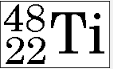
How many protons does this isotope of titanium have?
a)
48
b)
22
c)
26
d)
70
116.
What happens to the atomic number during alpha decay?
a)
The atomic number decreases by 4
b)
The atomic number increases by 1
c)
The atomic number decreases by 2.
d)
The atomic number stays the same.
117.
Arrange in order of increasing ability to penetrate matter.
a)
Beta, gamma, alpha
b)
Alpha, gamma, beta
c)
Gamma, beta, alpha
d)
Alpha, beta, gamma
118.
Balance the following equation:
146C --> 0-1e + ________
a)
145B
b)
146C
c)
147N
d)
42He
119.
Balance the following equation:
146C --> 0-1e + ________
a)
145B
b)
146C
c)
147N
d)
42He
120.
Which type of nuclear radiation is being emitted here?
a)
Alpha
b)
beta
c)
gamma 
d)
none
121.
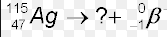
What particle completes this reaction?
a)
alpha particle
b)
beta particle
c)
gamma particle
d)
neutron
122.
What element is the ?
a)
Ag-115
b)
Cd-115
c)
Pd-115
d)
Not Listed
123.

If we start off with element 5024X after an gamma decay we get an element(product) that looks like...

a)

5124X

b)

5023X

c)

5024X

d)

5025X

124.
Takes two small nuclei and combines them into a larger nucleus
a)
fission
b)
fusion
125.
The splitting of a nucleus into smaller nuclei is
a)
fusion
b)
fission
c)
half-life
d)
gamma radiation
126.
How do nuclear power-plants work?
a)
Fusion
b)
Half-life
c)
Fission
d)
Fusion or fission
127.
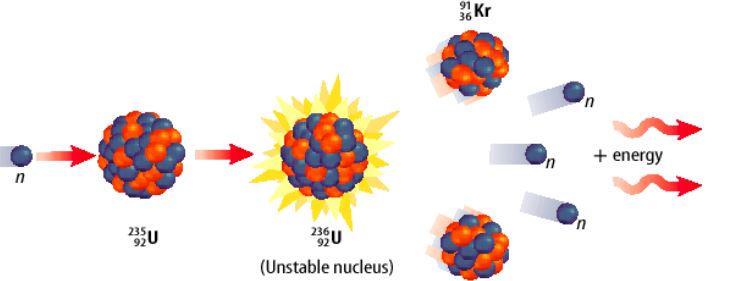
This is an example of...
a)
Fission  reaction
b)
Fusion reaction
c)
Decomposition reaction
d)
Decay
128.
What metal gives off radiation?
a)
carbon
b)
cobalt
c)
uranium
d)
titanium
129.

An isotope that has an unstable nucleus is called a(n):

(a)  

130.

After one ____________ of a radioactive element, half of the original radioactive material remains.

a)

half-life

b)

cycle

c)

decay

131.

The conversion of an atom of one element to an atom of another element is called (a)   .

132.

In a(n) ___________, particles released from one nuclear reaction collide with other particles and cause more nuclear reactions.

a)

nuclear fission reaction

b)

nuclear fusion reaction

133.

In ___ _____reactions, small nuclei combine, producing a large nucleus and releasing large amounts of energy.

a)

nuclear fission

b)

nuclear fusion

134.

spontaneous emission from the nucleus of an atom

a)

positron

b)

radioactivity

c)

alpha particle

d)

gamma radiation

e)

beta particle

135.
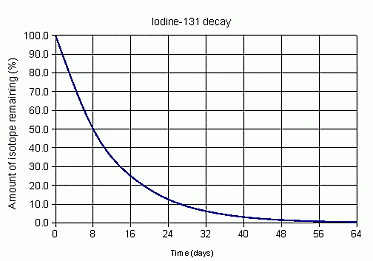
What is the half-life of iodine-131?
a)
32 days
b)
8 days
c)
16 days
d)
24 days
136.

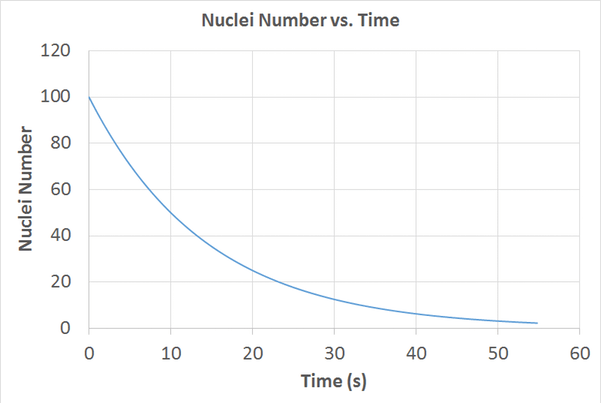
What is the Half life of this isotope?

a)

5 seconds

b)

10 seconds

c)

15 seconds

d)

20 seconds

137.

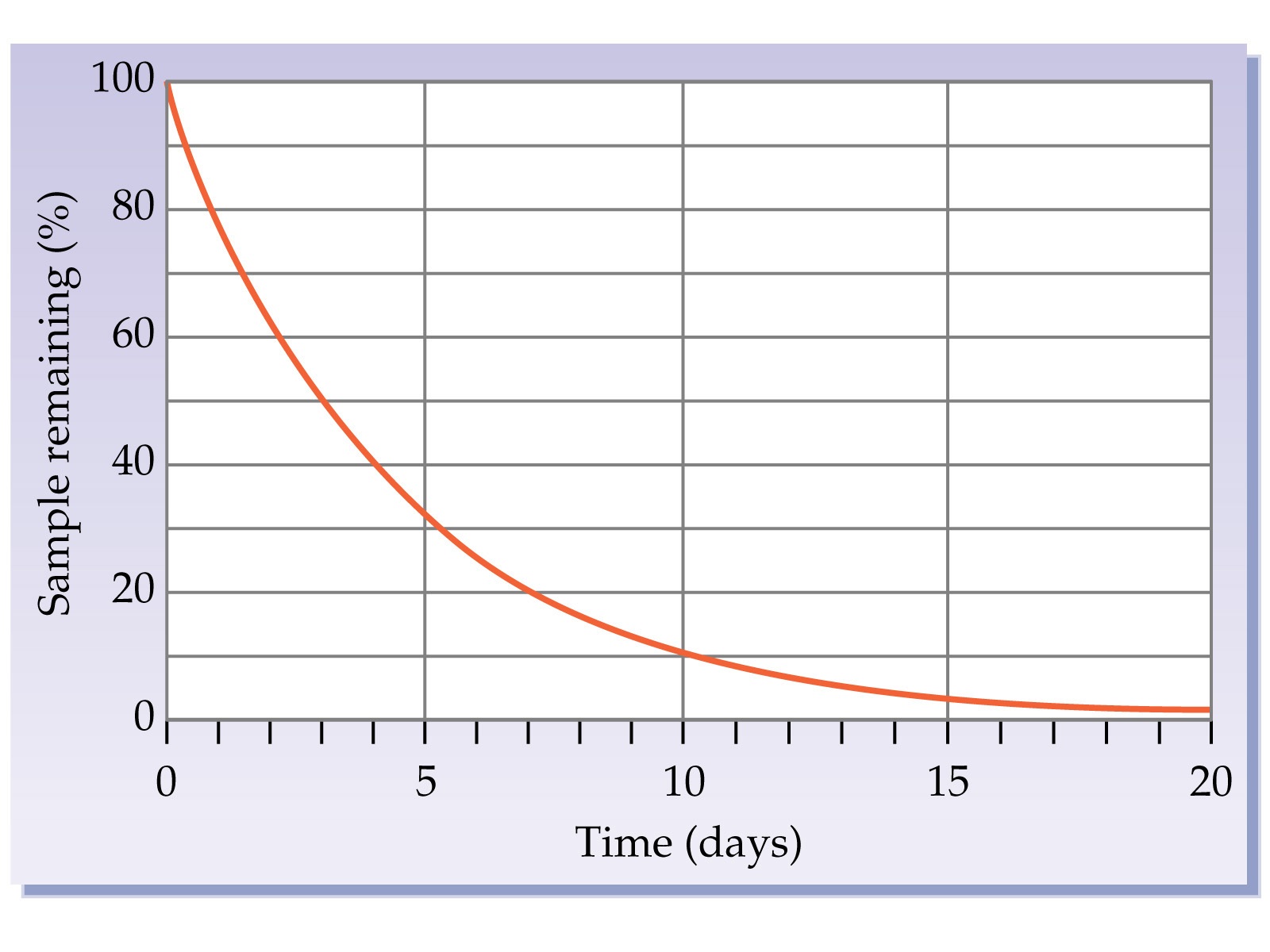
What is the Half Life of this isotope?

a)

3 days

b)

5 days

c)

8 days

d)

10 days

138.

A sample of wood that originally contained 100 grams of carbon-14 now contains only 25 grams of carbon-14. Approximately how many years ago was this sample part of a living tree?

a)

2,850 years

b)

5,700 years

c)

11,400 years

d)

17,100 years

139.

Barium-122 has a half-life of 2 minutes. A fresh sample weighing 80 g was obtained. If it takes 10 minutes to set up an experiment using barium-122, how much barium-122 will be left when the experiment begins?

a)

0.25g

b)

2.5g

c)

25g

d)

80g

140.

If 10 mg of iodine 131 is given to a patient, how much is left after 32 days? The half-life of iodine-131 is 8 days.

a)

1.25mg

b)

0.3125mg

c)

2.5mg

d)

0.625mg