
 Worksheets
History of the Earth Test
Total questions: 61
Worksheet time: 43mins
When classifying time using the Geologic Time Scale which unit is the largest unit of time?
Period
Eon
Epoch
Era
The Mesozoic Era is found in which Eon?
Phanerozoic
Precambrian
Earth is thought to be formed ______ years ago?
200 thousand
3 million
4.6 billion
who knows
During this period Earth was flowing with lava, the core was unstable, and was the first Era of the Precambrian Eon.
Paleozoic
Hadean
Archean
Cenozoic

During the Precambrian Eon all of the events happened except.
Fish began to evolve
Single cell organism like bacteria developed
Earth was flowing with lava and their was not oxygen in the atmosphere.
The Proterozoic Era was at the end of Precambrian Eon
During this Era Pangaea was being formed?
Paleozoic
Mesozoic
Cenozoic
Phanerozoic
What two methods are used to divide and classify the geological time scale?
Living organisms
rock strata or layers
DNA
fossils

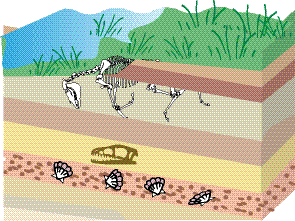
Which fossil is the youngest
1
2
3
4
Fossils provide evidence of __________.
how life and the environment has remained stable over time
how the climate and weather has remained stable over time
how life and the environmental conditions have changed over time
Scientists often use "mya" as an abbreviation for
Molecular Yields of Absolute
Meters You Access
Millions of Years Ago
Money You should Accept
The oldest eon is
Hadean
Cenozoic
Phanerozoic
Archean
How do scientists determine the number and length of time on the geologic time scale?
Gathering information from databases
Based on important events in earth's history
studying rocks in North America
Based on the time and distance that has passed
The time span that lasted the longest was the?
Phanerozoic
Pre-Cambrian
Proterozoic
Paleozoic
Only unicellular organism existed during the Precambrian eon?
True
False
An era is subdivided into periods
True
False
An organism that consist of only one cell
Phanerozoic
Unicellular
Multicellular
Epoch
An organism consisting of many cells
Multicellular
Unicellular
Phanerozoic
Epoch
The geologic time scale is divided into units of time based on what?
a specific amount of time
the evolution of humans
major or catastrophic events
no one knows
When looking at layers of rock, where would the OLDEST rocks and fossils be found?
on the top
on the bottom
In which EON do the Hadean, Archaean, and Proterozoic Eras belong?
Cenozoic
Paleozoic
Precambrian
Mesozoic
In which EON do the Paleozoic, Mesozoic, and Cenozoic Eras belong?
Archaean
Phanerozoic
Precambrian
Hadean
Which of the following lists the evolutionary events in order from first to last?
age of fish, simplest life, age of mammals, age of reptiles
simplest life, age of fish, age of reptiles, age of mammals
age of reptiles, age of mammals, simplest life, age of fish
age of mammals, age of reptiles, age of fish, simplest life
In which EON did the Earth and oceans form, and the first simple cells appear?
Paleozoic
Precambrian
Phanerozoic
Cenozoic
True or False: Life on land evolved long before life in the oceans.
True
False
Why are scientists more likely to find a shell fossil and not a jellyfish fossil
shells are formed in volcanoes
shells have body structures that are likely to be preserved.
Shells are found in top layers of rocks
Jellyfish are more likely to be preserved

What is an example of an early animal that developed one of the first spinal cords?
Sea Scorpion
Primitive fish
Giant spiders
jellyfish

According to most scientists, what is the ultimate cause of most mass extinctions?
overhunting
evolution of new species to replace old ones
major change in environment or climate
asteroid impact
At the end of the Mesozoic Era (Age of the Reptiles) there was a mass extinction. Which of the following is attributed as being the main cause?
What is the difference between extinction and mass extinction?
Mass extinctions are devastating for life that comes after it.
Extinction is a normal part of the cycle of life, and mass extinctions disrupt that balance.
Extinctions are proven fact, but mass extinctions are just hypothesized.
There is no difference. Extinct is extinct.
During the paleozoic era there were giant arthropods with exoskeletons living in the sea. What is an which of the following creatures would be considered an arthropod?
Fish
Sea Scorpion
Snails
Jellyfish


We sometimes find the fossils of seashells on the top of mountains. This is most likely because:
Some animals with shells can climb mountains
Birds carry animals with shells to the top of mountains
A large tidal wave threw the shells to the top of the mountain
That mountain was underwater in a previous era
In which eon do we know there was no life?
Carboniferous
Hadean
Miocene
Tithonian

What type of event usually marks the end of an Era
A Mass Extinction
A Quinceanera
An earthquake
A Volcanic Eruption
The fossil record gives us _____.
accurate data on the number of life-forms that lived.
accurate insight on how animals reproduced.
information on past life and environments on Earth.
information on past life and environments on Earth.
Fossils of a now extinct dinosaur have been near the east coast of South America and the west coast of Africa. The dinosaur could not swim or fly. What does this suggest about the continents of South America and Africa?
The continents were once connected.
A land bridge once connected the continents.
The same type of animals evolved on both animals.
Prehistoric man transported the dinosaur between the continents.
A fossil of a fern and other large-leafed tropical plants were found in an area of Alaska. What does this suggest about this area in Alaska?
A forest is now covered with snow.
A farm was once located in the area.
The area once had a warmer climate.
Prehistoric man ate large-leafed plants.
An archaeologist is digging through the rock layers and finds an index fossil in Layer B.
This fossil will help him do which of the following?
determine the minerals found in Layer B
determine the age of the rock in Layer B
determine the type of rock in Layer B
determine the thickness of Layer B

Based on the given rock and fossil evidence in the diagram to the right, which two letters most likely indicate parts of the same layers.
A & F
B & D
C & E
D & A
The Sandhills of South Carolina is a region consisting of very sandy soil & marine fossils. It is approximately 100 miles from the present coast. When comparing this area to the present coast, this suggests that ______.
marine organisms live in the fresh water in the Sandhills of South Carolina
land animals have similar remains as marine organisms
the coastline was once located in the Sandhills of South Carolina


What is the relative age of a rock?
The age determined by the things around it.
The age of an igneous rock.
The age determined by radioactive dating.
The time it takes for 1/2 of the radioactive atoms to decay in an element.


Which of these describes a likely reason why a species would become extinct after a major environmental change?
The environmental change means fewer predators are around.
There are more homes for the species in the changed environment.
The change in the environment opens new resources with less competition.
There are not enough members of the species born with a trait necessary to survive in the new environment.
True or False: Human beings are wiping out species much faster than nature creates them, causing what scientists call a 6th mass extinction
true
false
The Anthropocene is known "the age of humans" because:
It is the first time in Earth's history where humans have had an impact on the environment.
Technology we rely on is unsustainable and contributing to climate change and extreme weather events.
We are releasing CO2 into the atmosphere at alarming rates.
All of these choices are correct
started about 10,000 years ago
stable climate
most of our modern animals evolved to their present form during this time
started about 100 years ago
pushing ecological boundaries
considered the "Age of Man" because of all the major changes to Earth that has been made by us
happens when widespread and relatively sudden extinctions take place
Usually are closely related to a sudden change in the environment
the most recent event is happening right now!
Normal and natural event that takes place over time as species either evolve or stop existing
Happens all the time not just during mass extinction events

