
 Worksheets
HBS Unit 2 Review
Total questions: 58
Worksheet time: 39mins

Which lobe?
Frontal
Parietal
Temporal
Occipital

Which lobe?
Frontal
Parietal
Temporal
Occipital

Which lobe?
Frontal
Parietal
Temporal
Occipital

Name this structure.
Cerebrum
Cerebellum
Brain Stem
Basal Ganglia
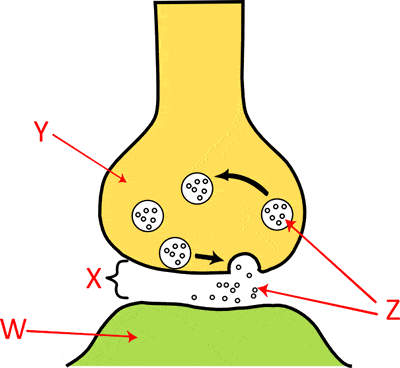

Z
Axon Terminal Button
Neurotransmitters
Dendrite
Synapse
which is the correct path that a nerve impulse will follow in a reflex arc?
motor neuron--> interneuron--> sensory neuron
interneuron--> motor neuron --> sensory neuron
motor neuron--> sensory neuron--> interneuron
sensory neuron--> interneuron--> motor neuron

If I step on a nail...what type of neuron take that signal TO the CENTRAL NERVOUS SYSTEM?
interneurons
motor
sensory
receptors

If I step on a nail...what type of neurons send the response from the brain to my muscles?
motor
interneurons
sensory
not neurons, muscle tissue sends the response
What does the neuron's nucleus do?
Controls the actions of the neuron
Produces food for the neuron
Carries information from the cell body to other neuronsThis is a wrong answer
Controls speed of electrical signal through the axon
What does the neuron's Myelin Sheath do?
Controls the actions of the neuron
Produces food for the neuron
Carries information from the cell body to other neuronsThis is a wrong answer
Surrounds and insulates the axon
What do Dendrites do?
Intakes information from other neurons
Produces fatty tissue for the Myelin Sheath
Sends information to the next cell
Controls the speed of electrical signal through the axon
What do Schwann Cells do?
Intakes information from other neurons
Produces fatty tissue for the Myelin Sheath
Sends information to the next cell
Controls the speed of electrical signal through the axon
What do Axon Terminals do?
Intakes information from other neurons
Produces fatty tissue for the Myelin Sheath
Sends information to the next cell
Controls the speed of electrical signal through the axon
An electrical impulse within a single neuron is called a
synapse
membrane potential
action potential
cell body
Which ion is pumped into the axon of a neuron to help maintain the resting potential?
calcium
hydrogen
potassium
sodium
Which one of the following is involved in maintaining a resting membrane potential?
Na+/K+ ATPase pump moves 3Na+ in for every 2K+ out
Na+/K+ ATPase pump moves 3K+ in for every 2Na+ out
Na+/K+ ATPase pump moves 3Na+ out for every 2K+ in
Na+/K+ ATPase pump moves 3K+ out for every 2Na+ in

Depolarization is occuring at number
1
2
4
5

An example of a reflex action includes
Touching a butterfly
Brushing your hand against the side of your body
Touching a hot stove
Your legs moving as you walk

What type of neuron is A?
Sensory
Inter
Motor
What type of neuron is B?
Sensory
Inter
Motor
What type of neuron is C?
Sensory
Inter
Motor

Name structure A
Pupil
Iris
Cornea
Retina

Name Structure B
Lens
Pupil
Sclera
Cornea

Name structure G
Lens
Pupil
Optic Nerve
Ciliary Muscles

What structure is responsible for carrying sensory impulses from the eye to the brain?
Retina
Iris
Optic Nerve
Rods & Cones

What will happen to your pupils if you are in a really bright room?
They will contract
They will expand
They will burst into flames
They will stay the same size

What structure of the eye controls the size of the pupils?
Ciliary Muscles
Iris
Lens
Retina

What is the function of the Lens?
Lining of the back of the eye that contains light receptor cells.
Regulates how much light enters the eye
Tough, transparent, protective coating that bends light as it enters the eye
Focuses light onto the retina

Name structure C
Ciliary Muscles
Retina
Optic Nerve
Iris

Name structure F
Sclera
Cornea
Optic Nerve
Lens

What happens to your eyes if you are in a dark room?
Your Iris will narrow to allow more light in
Your pupils will widen to let in more light
Your pupils will narrow to let in more light

Identify structure D
Retina
Optic Nerve
Sclera
Lens

Identify Structure E
Retina
Sclera
Optic Nerve
Lens
Gives the cornea its bulging, round appearance
Cornea
Vitreous Humor
Sclera
Aqueous Humor
Choroid
Allows passage of light to the retina through posterior cavity because of its clear appearance
Optic Nerve
Fovea
Lens
Cornea
Vitreous Humor
Farsightedness
Myopia
Hyperopia
both
Nearsightedness
Myopia
Hyperopia
both
Far objects appear blurry but close objects appear clear
Myopia
Hyperopia
Both
Close objects appear blurry but far objects appear clear
Myopia
Hyperopia
Both
May result from eyeball being too short
Myopia
Hyperopia
Both
May result from eyeball being too long
Myopia
Hyperopia
Both
Individuals may be more with this condition and grow out of it
Myopia
Hyperopia
Both
Caused by refractive error
Myopia
Hyperopia
Both
Focal point is behind the eyeball
Myopia
Hyperopia
Both
May be corrected with contacts and/or glasses
Myopia
Hyperopia
Both
Focal point is in front of retina
Myopia
Hyperopia
Both

