Wayground logo

Free Printable Worksheets

Font size

S
M
L
XL
Worksheets

Human Anatomy Muscles

Total questions: 58

Worksheet time: 30mins

Name
Class
Date
1.

the cordlike connective tissue that attaches a muscle to a bone is called

a)

a tendon

b)

a ligament

c)

a sarcomere

d)

a fascicle

2.

The entire muscle is encased by connective tissue called the

a)

sacromere

b)

sarcoplasm

c)

myosin

d)

epimysium

3.

the functional contractile unit within a muscle fiber is called the

a)

sarcomere

b)

fascia

c)

sarcoplasm

d)

tendon

4.

What are myofibrils composed of?

a)

muscle fibers

b)

muscle fascicles

c)

myofilaments

d)

myopathic fibers

5.

Which type of muscle tissue is both voluntary and striated?

a)

Skeletal

b)

Cardiac

c)

Smooth

d)

Connective

6.

Which of the following correctly lists the structures from largest to smallest

a)

Myofibril, Myofilament, Muscle fiber, Fascicle

b)

Fascicle, Myofibril, Muscle fiber, Myofilament

c)

Muscle, Muscle fiber, Fascicle, Myofibril

d)

Fascicle, Muscle fiber, Myofibril, Myofilament

7.

A bundle of muscle fibers

a)

Myofilament

b)

Fibril

c)

Muscle

d)

Fascicle

8.

Myofibrils are composed primarily of

a)

Actin and Myosin

b)

ATP and ADP

c)

Troponin

d)

Tropomyosin

9.

Muscle fatigue is most likely due to an accumulation of

a)

citric acid

b)

lactic acid

c)

creatine

d)

myosin

10.
What is the connective tissue covering of a muscle fascicle?
a)
endomysium
b)
perimysium
c)
epimysium
11.

An individual skeletal muscle cell

a)

muscle fiber

b)

fascicle

c)

sarcolemma

d)

aponeurosis

e)

agonist

12.

A fine protective sheath of connective tissue around a skeletal muscle fiber

a)

endomysium

b)

epimysium

c)

perimysium

d)

aponeurosis

e)

sarcolemma

13.

Identify the part

a)

bone

b)

muscle fiber

c)

fascicle

d)

blood vessel

e)

endomysium

14.

Identify the part

a)

bone

b)

muscle fiber

c)

fascicle

d)

blood vessel

e)

endomysium

15.

Identify the part

a)

tendon

b)

blood vessel

c)

epismysium

d)

perimysium

e)

endomysium

16.

Identify the part

a)

bone

b)

muscle fiber

c)

epimysium

d)

blood vessel

e)

endomysium

17.

Identify the part

a)

tendon

b)

blood vessel

c)

epismysium

d)

perimysium

e)

endomysium

18.

Where would you find cardiac muscle?

a)

in your stomach

b)

the heart

c)

attached to the skin on your face

d)

cardiac muscles doesn't exist

19.

Where would you find smooth muscle?

a)

lining the inside of digestive organs

b)

covering the heart

c)

your biceps and triceps

d)

only in your legs

20.
Identify the joint action being performed.
a)
Extension
b)
Flexion
c)
Abduction
d)
Adduction
21.
Identify the joint action being performed.
a)
Extension
b)
Flexion
c)
Abduction
d)
Adduction
22.
Identify the joint action being performed.
a)
Extension
b)
Flexion
c)
Abduction
d)
Adduction
23.
Identify the joint action being performed.
a)
Extension
b)
Flexion
c)
Abduction
d)
Adduction
24.
Identify the joint action being performed.
a)
Circumduction
b)
Lateral Rotation
c)
Medial Rotation
d)
Eversion
25.
The knee joint is
a)
Hinge
b)
Gliding
c)
Ball and socket
d)
Pivot
26.
Each Label D is indicating the...
a)
J Band
b)
A Band
c)
H Band
d)
I Band
27.
Each Label I is indicating the...
a)
J Band
b)
A Band
c)
H Band
d)
I Band
28.
The region indicated by the bracket 'just above' label J  is bracketing the...
a)
Intermediate Zone
b)
A Zone
c)
H Zone
d)
Zone of underlap
29.
Label A Represent the...
a)
Actin Protein
b)
Myosin Protein
c)
Troponin Protein
d)
Tropomyosin Protein
30.
Which of the following is composed of myosin protein?
a)
thin filaments
b)
Z-disks
c)
All myofilaments
d)
 thick filaments
31.
A sarcomere is
a)
 a compartment in a myofilament
b)
The contractile unit between Z-lines
c)
 the non-functional unit of skeletal muscle
d)
The area between two intercalated disks
32.
Endomysium covers
a)
an entire muscle
b)
myofibrils
c)
fascicles of muscle cells
d)
An individual muscle cell
33.
Muscle tissue has the ability to shorten when adequately stimulated, a characteristic known as
a)
Extensibility
b)
 contractility
c)
 irritability
d)
 elasticity
34.
The plasma membrane of a skeletal muscle cells called the
a)
Sarcoplasmic reticulum
b)
sarcolemma
c)
sarcomere
d)
 cross bridge
35.
Why are calcium ions necessary for skeletal muscle contractions?
a)
Calcium triggers events that lead to the binding of Myosin to Actin
b)
Calcium releases the inhibition on Z-disks
c)
Calcium increases the action potential transmitted along the sarcolemma
d)
 calcium binds to regulatory proteins on the myosin filaments changing both their shape and their position on the thick filament
36.
The mechanical force of contraction is generated by
a)
 the  "accordian-like " folding of the thin and thick filaments
b)
 shortening of the thick filaments
c)
Shortening of the actin filaments
d)
 a sliding of thin filaments past thick filaments
37.
During skeletal muscle contraction, myosin  cross bridges attach to binding sites associated with
a)
Thick filaments
b)
H-zone
c)
Z desks
d)
 actin filaments
38.
Which of the following actually shorten during muscle contraction
a)
Actin filaments
b)
Sarcomere
c)
 myofilaments
d)
 a band
39.
Creatine phosphate functions within the muscle cells by
a)
 forming a temporary chemical compound with myosin
b)
 forming a chemical compound with Actin
c)
storing energy that will be transferred to ADP to re-synthesize ATP as needed
d)
 storing energy that will be transferred to ATP to re-synthesize ADP as needed
40.
The________ is an organelle that wraps and surrounds the myofibril and stores calcium.
a)
Sarcoplasmic reticulum
b)
sarcolemma
c)
sarcomere
d)
 cross bridge
41.
When a skeletal muscle is fully contracted, the _________ are closer to the thick filaments.
a)
M lines
b)
 A bands
c)
Cross bridges
d)
 Z disks
42.
The amount of oxygen needed to support the conversion of lactic acid to glucose after vigorous activity is called the
a)
anaerobic concentration 
b)
oxygen debt 
c)
aerobic conversion
d)
refractory quantity
43.
The I band is lighter than the A band because it contains  
a)
both actin and myosin
b)
actin
c)
crossbridges 
d)
myosin
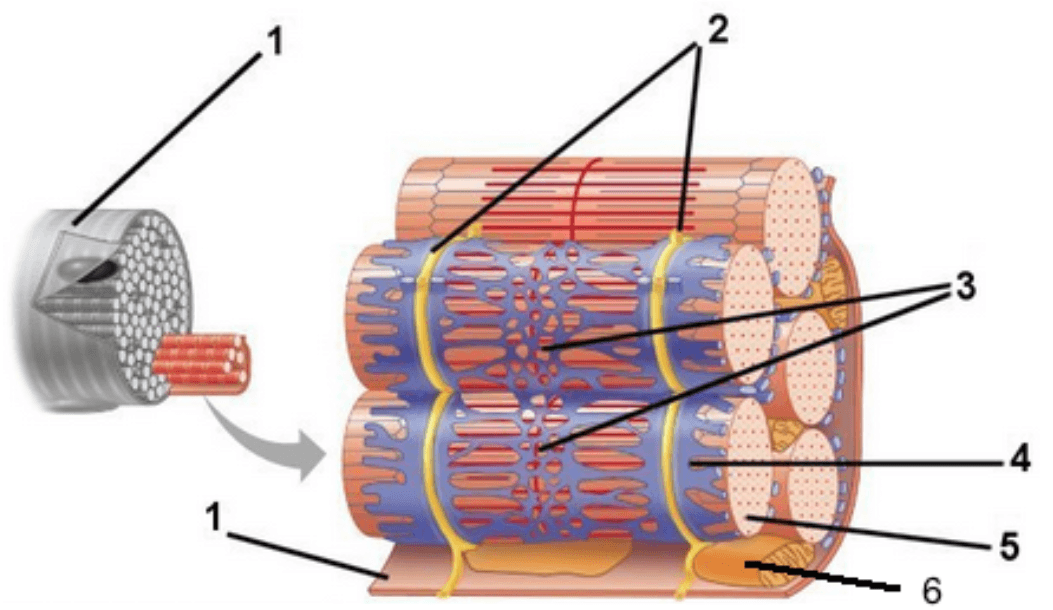
44.

What is shown in the colored part of this diagram?

a)

a whole muscle

b)

five muscle fibers

c)

five muscle fascicles

d)

five myofibrils

45.

What is labeled "1" in the diagram?

a)

sarcolemma

b)

sarcoplasmic reticulum

c)

transverse tubules

d)

myofibril

46.

What is labeled "2" (the yellow part) in the diagram?

a)

sarcolemma

b)

sarcoplasmic reticulum

c)

transverse tubules

d)

myofibril

47.

What is labeled "4" (the blue/purple part) in the diagram?

a)

sarcolemma

b)

sarcoplasmic reticulum

c)

transverse tubules

d)

myofibril

48.

Name the following in order from largest to smallest:

a)

muscle, muscle fascicle, muscle cell, myofibril, filaments

b)

muscle, muscle fascicle, muscle cell, filaments, myofibril

c)

muscle, muscle cell, muscle fascicle, myofibril, filaments

d)

muscle, muscle cell, muscle fascicle, filaments, myofibril

49.

What happens in the transverse tubules of a muscle cell?

a)

excess ATP is stored in the tubules

b)

calcium ions are released into tubules' extracellular fluid

c)

action potentials are conducted through the tubules to the inside of the cell

d)

ATP is produced in the mitochondria found in the tubules

50.

Which type of muscle tissue connects bones to other bones, allowing for movement of our joints?

a)

cardiac

b)

smooth

c)

skeletal

d)

sympathetic

51.

Which type of muscle tissue is involuntary and found in places such as the stomach and intestines?

a)

cardiac

b)

smooth

c)

skeletal

d)

myofibrilic

52.

What is labeled "6" in the diagram? These help convert oxygen and sugars into ATP for the muscle cell to use.

a)

actin

b)

sarcoplasmic reticulum

c)

myosin

d)

mitochondria

53.

Which of the following is NOT a molecule?

a)

ATP

b)

fascicle

c)

actin

d)

myosin

54.

Which of these is the smallest?

a)

myofilament

b)

myofibril

c)

muscle fiber

d)

fascicle

55.

What do you call a single bundle of muscle cells?

a)

muscle

b)

fascicle

c)

fiber

d)

myofibril

56.

Where are the calcium ions in a muscle fiber stored when the muscle isn't contracting?

a)

mitochondria

b)

myofibrils

c)

T-tubules

d)

sarcoplasmic reticulum

57.

What is the length between Z-lines of an actin molecule called?

a)

fascicle

b)

sarcomere

c)

myosin binding site

d)

sarcoplasmic length

58.

For a signal to get from a neuromuscular synapse to a T-tubule, it must travel along what?

a)

sarcolemma

b)

sarcoplasmic reticulum

c)

myofibril

d)

myofilament