
 Worksheets
Semester 1 Exam Review - All Chapters
Total questions: 64
Worksheet time: 51mins
Match each macromolecule to its monomer.
Protein
Amino Acids
Lipid
Glycerol and Fatty Acid
Carbohydrate
Monosaccharide (Sugar)
Nucleic Acid
Nucleotide
Match each function to its macromolecule.
Control reaction rates, regulate cell processes; help fight disease; transport substances; form cell structures
Protein
Stores energy; part of membranes and waterproof (waxy) coverings
Lipid
Store and release energy; provide structural support and protection
Carbohydrate
Store and transmit hereditary or genetic
Nucleic Acid
Which biological macromolecules contain nitrogen?
Carbohydrates
Proteins
Lipids
Nucleic Acids
Which of the four biological macromolecules can be broken down into identical subunits (monomers)?
Carbohydrates
Proteins
Lipids
Nucleic Acids
Which of the four biological macromolecules has a globular (3D) shape?
Carbohydrates
Proteins
Lipids
Nucleic Acids
Which of the four biological macromolecules is not soluble in water because it is nonpolar?
Carbohydrates
Proteins
Lipids
Nucleic Acids
You are given four test tubes containing purified samples of biological macromolecules (each test tube only has one kind of macromolecule in it). The test tubes are unlabeled except for the letter A, B, C, or D. You are told that one test tube contains a protein, one contains a lipid, one contains a carbohydrate, and one contains a nucleic acid. You then perform some tests on the macromolecules collecting the following information.
**Test tubes B and D contain nitrogen, the other tubes do not.
**The contents of test tube C are not soluble in water, but the contents of the other test tubes are soluble in water.
**The contents of test tube A can be broken down into subunits that are all exactly identical to each other.
**The macromolecule in test tube B was found to have a globular (three dimensional) shape.
Use the information above to match each macromolecule to the test tube that it is in
Test Tube A
Carbohydrate
Test Tube B
Protein
Test Tube C
Lipid
Test Tube D
Nucleic Acid
After her run, Aisha felt thirsty. Thirst was her body’s way of telling her she needed more water to maintain ____________________.
homeostasis
development
metabolism
growth
Biologists have certain criteria that must be met if something is to be considered living.
**All living things are made up of one or more (a) .
**All living things have (b) , which carries the genetic code.
**All living things (c) , either sexually or asexually.
**All living things respond to (d) , signals that come from within or from the environment.
Biologists have certain criteria that must be met if something is to be considered living.
**All living things need materials and (a) . The chemical reactions of (b) help an organism use these to stay alive.
**All living maintain a stable internal environment and the process by which they do this is (c) .
**All groups of living things can also change over time, or (d) .
Science began out of humankind’s natural curiosity to understand and explain the interactions and processes of the natural world. Science aims to use these explanations to understand patterns in nature and benefit nature and society, as well as to address issues that face the natural world and human society. Which statement BEST reflects the efforts of scientists in pursuing the goals of science?
Scientists attempt to resolve questions of belief with scientific facts.
Scientists make observations and conduct experiments in order to establish facts.
Scientists emphasize data that support their hypotheses and ignore data that does
not.
Scientists review and revise current knowledge when new evidence arises.
Jennifer’s grandmother is taking part in an experiment to determine how well a new headache medication works. In the experiment, the people in Group A (including Jennifer’s grandmother) are taking the new medication, while the people in group B are taking a pill that does not contain any kind of headache medication. Based on this experiment, match the parts of the experimental design to their example.
Independent Variable
Medication
Control Group
Group B (no headache medication)
Dependent Variable
Headache relief
Experimental Group
Group A (headache medication)

Val designed and conducted a controlled experiment on pothos plants. Her hypothesis was that the direction of light will affect the growth pattern of a pothos plant. To test her hypothesis she set up two groups of pothos plants with different growth conditions and observed them three weeks later. The table summarizes the test groups and her observations. What are the roles of the two test groups in this investigation?
Both are control groups, but only Test Group 1 shows the effect of the direction of light.
Both are experimental groups, and each individually shows the effect of the direction of light.
One is the experimental group and one is the control group, and together they show the effect of the direction of light.
Both are experimental groups, but only Test Group 2 shows the effect of the direction of light.
Both are experimental groups, but only Test Group 1 shows the effect of the direction of light.
Val designed and conducted a controlled experiment on pothos plants. Her hypothesis was that the direction of light will affect the growth pattern of a pothos plant. To test her hypothesis she set up two groups of pothos plants with different growth conditions and observed them three weeks later. The table summarizes the test groups and her observations. After analyzing the results of the experiment, Val asks if her hypothesis should be classified as a theory. Which is the best response to Val’s question?
No, because a theory and a hypothesis do not relate to one another.
No, because the experiment did not provide enough data to support the hypothesis.
No, because a theory is a highly reliable explanation that incorporates many well-tested hypotheses.
Yes, but only if additional experiments show similar results.
Yes, because her data support the hypothesis.
Which of these subjects is MOST LIKELY to be studied in ecology?
the method of water transport in a tree
a comparison of muscle cells among reptiles and birds
the circulatory system of earthworms
the interaction between populations of wolves and deer
The temperate grasslands biome includes regions of several continents. What do all of the regions have in common?
the same species of grazing animals
the same species of grasses
the same seasonal patterns of temperature and precipitation
the same amount of land that is grasses

The diagram shows how the energy of sunlight is distributed after it enters Earth’s atmosphere. The complex distribution of this energy is partially a result of certain gases in the atmosphere, called greenhouse gases. These gases absorb heat that is radiated from the surface, and then reradiate the heat. What is the relationship between the greenhouse effect and sunlight?
Greenhouse gases absorb sunlight, and then reradiate it to the surface.
Greenhouse gases reflect sunlight into space, preventing it from reaching the surface.
Greenhouse gases absorb sunlight, preventing it from reaching the surface.
Greenhouse gases absorb heat, and sunlight is the source of energy for the heat.
The diagram shows how the energy of sunlight is distributed after it enters Earth’s atmosphere. The complex distribution of this energy is partially a result of certain gases in the atmosphere, called greenhouse gases. These gases absorb heat that is radiated from the surface, and then reradiate the heat. If the concentrations of the different greenhouse gases increased, then the effect of which arrow in the diagram would increase as a result?
Light reflected by Earth’s surface
Heat lost to space
Sunlight that strikes Earth’s surface
Heat reradiated and retained in the earth system
The diagram shows how the energy of sunlight is distributed after it enters Earth’s atmosphere. The complex distribution of this energy is partially a result of certain gases in the atmosphere, called greenhouse gases. These gases absorb heat that is radiated from the surface, and then reradiate the heat. Without greenhouse gases in the atmosphere, would Earth’s temperatures be warmer, colder, or about the same?
Without greenhouse gases in the atmosphere, Earth’s temperature would be colder because greenhouse gases trap heat and without them more heat is lost to space.
Without greenhouse gases in the atmosphere, Earth’s temperature would be colder because greenhouse gases trap heat and without them more heat is trapped in the atmosphere.
Without greenhouse gases in the atmosphere, Earth’s temperature would be warmer because greenhouse gases trap heat and without them more heat is lost to space.
Without greenhouse gases in the atmosphere, Earth’s temperature would be warmer because greenhouse gases trap heat and without them more heat is trapped in the atmosphere.
Without greenhouse gases in the atmosphere, Earth’s temperature would be about the same because greenhouse gases do not have an effect on Earth's temperatures.
Ann is evaluating a computer model of climate change in Beville. The model predicts that the average temperatures will increase by 1.5°C over the next 20 years. Ann also notices that on February 19th of this year, the high temperature was 15°C cooler than the typical high temperature for that date. Based on this information, Ann argues that the evidence shows that Beville is becoming significantly colder, not warmer, and so the computer model is faulty. Which statement is the strongest evaluation of Ann's argument?
It is reasonable because the weather data contradicts the computer model.
It is not reasonable because the weather data supports the computer model.
It is not reasonable because weather data from one date is not enough to evaluate climate.
It is reasonable because computer models cannot be used to predict weather and climate.
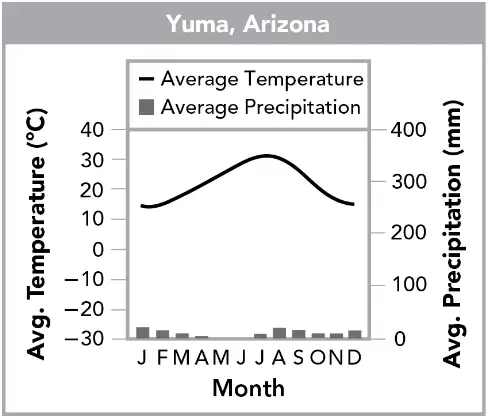
This climate diagram shows the average temperature (line graph) and precipitation (bar graph)
during each month of the year in Yuma, Arizona. Plants that thrive in this type of climate are MOST LIKELY adapted to which of these conditions?
seasonal variations in temperature
seasonal variations in precipitation
year-long cold temperatures
dense, competitive growth
rich, fertile soil
This climate diagram shows the average temperature (line graph) and precipitation (bar graph) during each month of the year in Yuma, Arizona. Which plant feature would MOST LIKELY be common in this type of climate?
leaves with waxy coverings
tall, woody trunks
broad, flat leaves
watery fruits
roots that dangle in the air
Which of the following BEST describes the flow of energy through a food chain?
Energy flows between primary producers (autotrophs) and consumers (heterotrophs), in either direction.
Energy flows from consumers (heterotrophs) to primary producers (autotrophs), in one direction only.
Energy flows from primary producers (autotrophs) to consumers (heterotrophs), in one direction only.
Energy flows between primary producers (autotrophs) and consumers (heterotrophs), in an endless cycle.
To represent all of the energy in a food chain, which modification to the arrows could be considered?
Add arrows from the environment to each organism, to show how the organisms gain energy from nonliving sources.
Add arrows that point from both ways, to show the two-way energy flow.
Add arrows from each organism to the environment, to show the energy that is lost as heat.
No modification is necessary, because the arrows in a food chain represent all of the energy in the ecosystem.
The carbon cycle is a biogeochemical cycle that moves and cycles carbon through the different spheres of Earth. Fill in the blanks in the sentences below to describe how each process moves carbon.
**A volcanic eruption moves carbon (a) .
**Photosynthesis moves carbon (b) .
**Cellular respiration moves carbon (c) .
**Dissolution (the dissolving of gaseous carbon into a solvent) move carbon (d) .
The human activity of burning fossil fuels moves carbon from the (a) to the (b) .

Francine is developing a model of the carbon cycle, which involves the movement of carbon among various Earth systems. She begins by drawing the diagram below. Match each numbered arrow in the model to the process that would cause the movement of carbon that the arrow shows.
Photosynthesis
Arrow 1
Cellular Respiration
Arrow 2
Volcanic Eruption
Arrow 4
Dissolution
Arrow 3
Francine is developing a model of the carbon cycle, which involves the movement of carbon among various Earth systems. She begins by drawing the diagram below. How does Francine’s model show the effect of photosynthesis and cellular respiration on Earth’s systems?
The model shows that their combined effects determine the amount of solid carbon compounds in the geosphere.
The model shows that their combined effects determine the level of carbon dioxide that dissolves in the hydrosphere.
The model shows that they have opposite effects on carbon dioxide levels in the atmosphere.
The model shows that they have opposite effects on carbon dioxide levels in the hydrosphere.
Since the industrial era, human activity has greatly impacted the carbon cycle due to our utilization and burning of fossil fuels at a much faster rate than natural processes can restore them. Keeping this in mind, complete the sentences below.
The human activity of burning fossil fuels affects carbon that moves from the (a) sphere to the (b) sphere.
Since the industrial era, human activity has greatly impacted the carbon cycle due to our utilization and burning of fossil fuels at a much faster rate than natural processes can restore them. Keeping this in mind, complete the sentences below
When humans burn fossil fuels...
The concentration of carbon in the geosphere (a) .
The concentration of carbon in the atmosphere (b) .

How many autotrophs are in the highlighted food chain?
1
2
3
4
How many heterotrophs are in the highlighted food chain?
1
2
3
4
Which of the following is an example of a predator and prey relationship from this food web?
gray wolf and deer mice
elk and snowshoe hare
aspen tree and mayfly
cutthroat trout and coyote
mayfly and grizzly bear
If the highlighted food chain begins with 10,000 units of energy, how much energy will the pond algae have?
10,000
1,000
100
10
1
If the highlighted food chain begins with 10,000 units of energy, how much energy will the mayfly have?
10,000
1,000
100
10
1
If the highlighted food chain begins with 10,000 units of energy, how much energy will the cutthroat trout have?
10,000
1,000
100
10
1
If the highlighted food chain begins with 10,000 units of energy, how much energy will the bald eagle trout have?
10,000
1,000
100
10
1
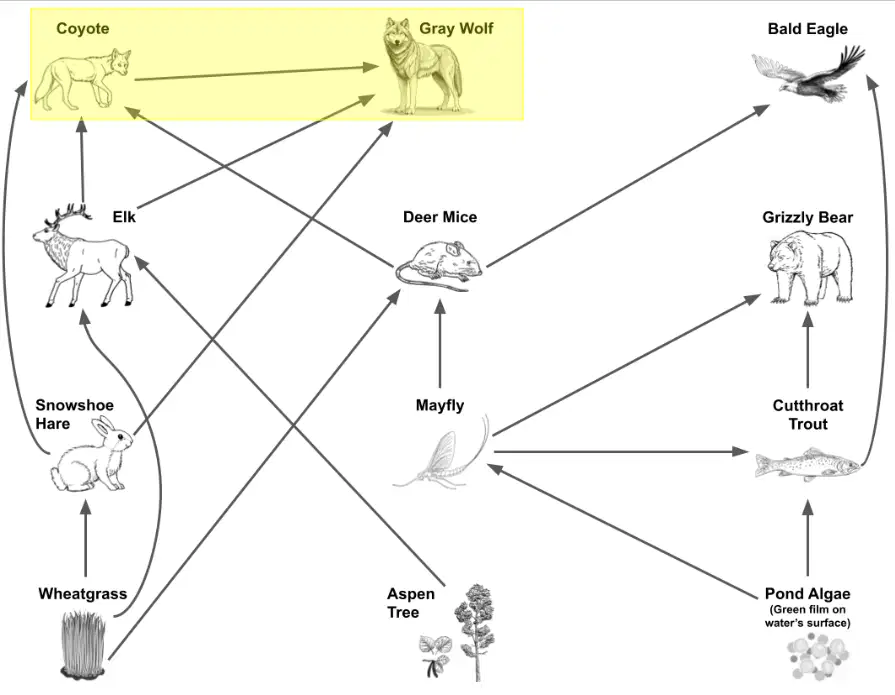
Which organism in the highlighted relationship is the prey?
coyote
gray wolf
Which organism in the highlighted relationship is the predator?
coyote
gray wolf
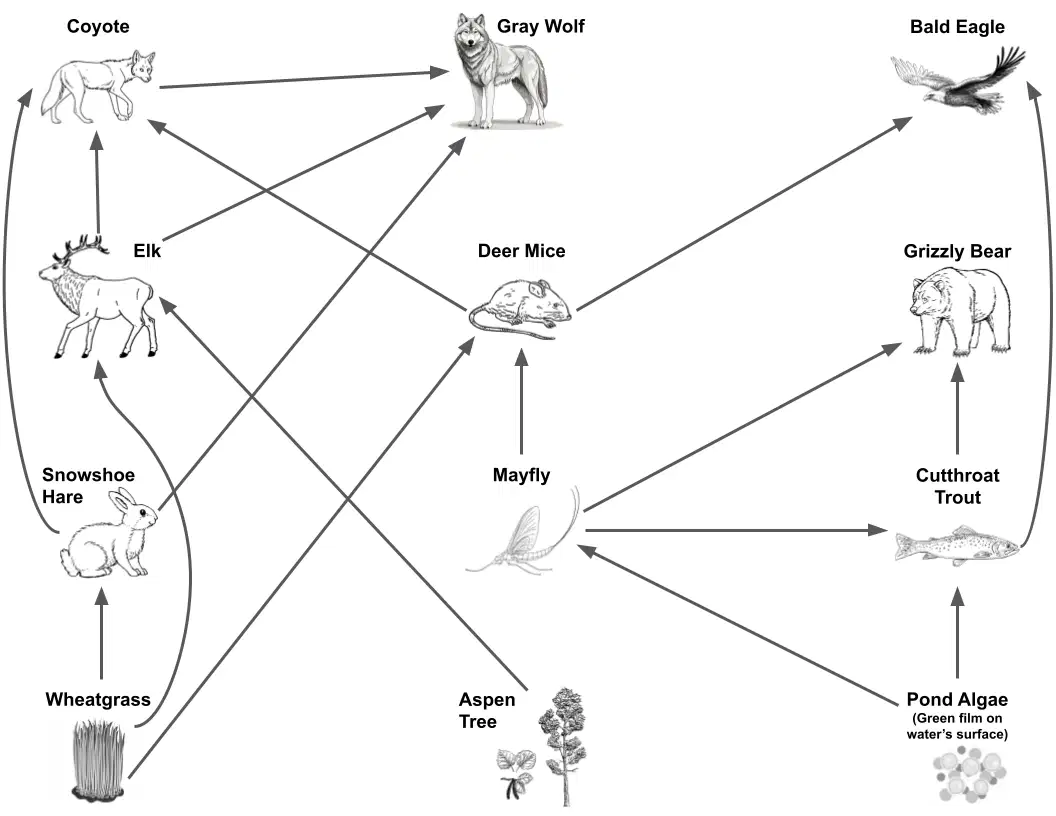
Which 3 organisms in the food web that would make up the greatest amount of biomass in this ecosystem?
Wheatgrass
Aspen Tree
Pond Algae
Elk
Coyote
Deer Mice
Gray Wolf
Bald Eagle
Grizzle Bear
Elk
Gray Wolf
Grizzly Bear
Pond Algae
Cutthroat trout
Mayfly
Why would the wheatgrass, aspen tree, and pond algae have the greatest amount of biomass?
Biomass depends on energy availability. They have the most energy available to them.
Biomass depends on the number of food sources. They have the most food sources.
Biomass increases as trophic level increases. They have the highest trophic level.
Biomass depends on organism size. They are the biggest organisms.
A rabbit population is affected by parasitism and disease, both of which are density-dependent limiting factors. Which statement describes the effects of parasitism and disease on the rabbits?
Parasites and disease weaken or kill a constant percentage of the rabbit population, regardless of its density.
As the density of the rabbit population increases, parasites and disease weaken or kill a greater percentage of rabbits.
As the density of the rabbit population increases, parasites and disease weaken or kill a lesser percentage of rabbits.
Parasites and disease weaken or kill mostly the youngest and oldest rabbits, and not the rabbits of average age.
Scientists have observed the exponential growth of lionfish in the Caribbean sea. Which of these predictions about the future of the lionfish population is most likely to occur?
A limiting factor will cause the lionfish population to decline rapidly and eventually decrease to near zero.
The lionfish population will enter a cycle of increasing and decreasing numbers, typical of many predators and prey.
The lionfish population will continue growing exponentially indefinitely.
A limiting factor will cause the growth of the lionfish population to slow down, forming a pattern of logistic growth.
A hurricane blows across a Caribbean island. The storm flattens trees and it drowns or washes away a large number of plants and animals. As a result of the storm, the carrying capacity of the island is temporarily reduced for many of the island species. How is the storm classified as a limiting factor?
The storm is a density-independent limiting factor, because its effect depends on the size and density of a population.
The storm is a density-independent limiting factor, because population size and density do not alter the storm’s effect.
The storm is a density-dependent limiting factor, because its effect depends on the size and density of a population.
The storm is a density-dependent limiting factor, because its effect depends on the strength of its wind and rainfall.
A prairie nature reserve is home to a population of pheasants. This year, the population of pheasants has increased sharply, and scientists think the population has exceeded the carrying capacity. The reserve is also home to a small, scattered population of bison. Scientists think that the bison population is significantly below carrying capacity, although it has been increasing gradually from year to year.
Both the pheasant and bison populations could be affected by a variety of limiting factors. Sort the examples of limiting factors to the populations they most likely would affect.
Competition within the species for food, water, and living space
Parasites that spread among species members
Predators that hunt and kill species members
The removal of protected status from the reserve, allowing human development to occur.
A wildfire that spreads across the prairie grasses
There are no limiting factors that would affect only this population.

Benny is studying the table shown below, which lists the birth rate and death rate for several different fictional countries. Benny analyzes the data in the table to calculate the rate of population increase or decrease in each country. Which assumption is necessary for Benny’s calculations to be accurate?
The immigration rates of the countries are much higher than the emigration rates
The population is evenly distributed between rural, suburban, and urban areas
The birth rate and death rate for each country will eventually be equal because the population will stop growing
The immigration and emigration rates of the countries are insignificantly small or approximately equal.
The immigration rates of the countries are much smaller than the emigration rates.
Based on the data in the table, Florin is in stage (a)
of the demographic transition because (b) .
Based on the data in the table, Panem is in stage (a)
of the demographic transition because (b) .
Based on the data in the table, Atlantis is in stage (a)
of the demographic transition because (b) .
The last known gray wolf native to the Adirondack Mountains in the state of New York was killed over a century ago. Several environmental groups have recently proposed reintroducing the wolf to the Adirondacks. These groups claim that there is sufficient prey to support a wolf population in this area. These prey include beaver, deer, and moose. Opponents of this proposal state that the Adirondacks already have a dominant predator, the Eastern coyote.
What type of limiting factor on the coyote population would increase due to the reintroduction of gray wolves ?
It would increase competition
It would increase predation
It would increase disease
It would increase parasitism
The last known gray wolf native to the Adirondack Mountains in the state of New York was killed over a century ago. Several environmental groups have recently proposed reintroducing the wolf to the Adirondacks. These groups claim that there is sufficient prey to support a wolf population in this area. These prey include beaver, deer, and moose. Opponents of this proposal state that the Adirondacks already have a dominant predator, the Eastern coyote.
What effect would the reintroduction of the gray wolf have on the carrying capacity of the coyote population within the Adirondack Mountains?
The coyote's carrying capacity would decrease
The coyote's carrying capacity would increase
The coyote's carrying capacity would stay the same
The last known gray wolf native to the Adirondack Mountains in the state of New York was killed over a century ago. Several environmental groups have recently proposed reintroducing the wolf to the Adirondacks. These groups claim that there is sufficient prey to support a wolf population in this area. These prey include beaver, deer, and moose. Opponents of this proposal state that the Adirondacks already have a dominant predator, the Eastern coyote.
What effect would the reintroduction of the gray wolf have on the carrying capacity of the coyote population within the Adirondack Mountains?
The coyote's population size would decrease
The coyote's population size would increase
The coyote's population size would stay the same
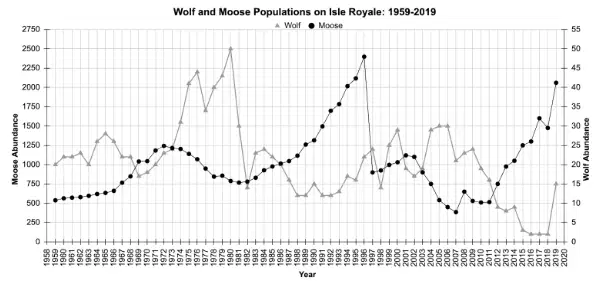
The graph shows the changing populations of wolves and moose on Isle Royale National Park from 1959 to 2019. Wolves are predators, and moose are their prey.
Which statement about the populations of wolves and moose is MOST strongly supported by the data in the graph?
Wolves are a limiting factor on the moose population, but moose do not affect the wolf population.
Moose are a limiting factor on the wolf population, but wolves do not affect the moose population.
Wolves and moose each act as a limiting factor on each other's populations.
Wolves and moose each act to increase each other's population, while other factors act to limit their populations.
The wolf and moose population sizes are determined by abiotic limiting factors, and not predator-prey relationships.
Carla claims that a strain of rose bushes is resilient to temperatures as low as 5°C. Which statement about rose bushes of this strain can be inferred from Carla’s claim?
They grow better at 5°C than at higher temperatures.
They grow better at higher temperatures, but can survive at 5°C.
They grow as well at 5°C as they grow at higher temperatures.
They can survive at 5°C without inputs such as water and sunlight.
Modern farming practices often act to reduce biodiversity, such as when genetically identical crops are raised in large fields. Which of the following proposed solutions would MOST likely improve the genetic diversity of a field of potato plants and increase the value of the potato crop?
Raise a variety of wild potatoes in the field
Reduce the use of pesticides and fertilizer
Increase the use of pesticides and fertilizer
Transfer useful genes from wild potato plants to the crop plants
Allow some potatoes to remain in the field over winter
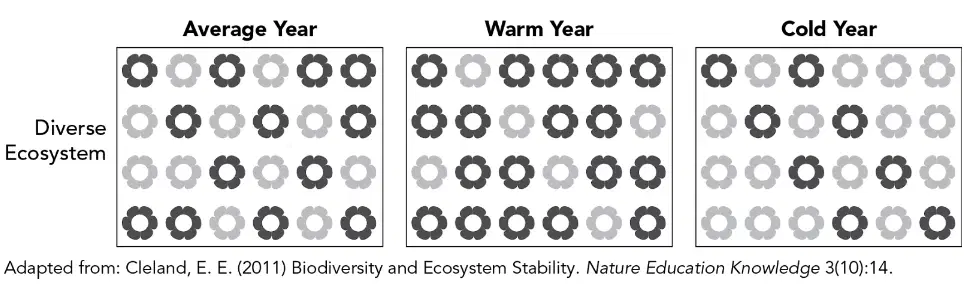
In this model, the dark and light shapes represent different members of an animal species in the environment. The members have different tolerances to an unusually warm climate and an unusually cooler climate. Which conclusion about biodiversity is most strongly supported by this model?
Biodiversity involves variations within a species, but not among several species.
Biodiversity has no or little effect on the survival of a species due to many environmental changes.
Biodiversity may help species to survive either warmer or cooler temperatures, but not both.
Biodiversity may help a species survive a variety of environmental changes.

A team of scientists is studying three related species of thrushes, which are a type of bird. In all three species, the thrushes feed on insects and build nests in trees. The team uses a computer simulation to predict the populations of each species in a tract of forest, both with or without the presences of other thrush species. The results are shown in the table below. Based on the data in the table, when all three species are present, which species dies off?
A
B
C

A team of scientists is studying three related species of thrushes, which are a type of bird. In all three species, the thrushes feed on insects and build nests in trees. The team uses a computer simulation to predict the populations of each species in a tract of forest, both with or without the presences of other thrush species. The results are shown in the table below. Based on the computer simulations, which statement MOST likely describes an ecological relationship among the three species?
All three species compete for the same niche, and species B is the strongest competitor.
All three species compete for the same niche, and species C is the strongest competitor.
Species A and species C compete for the same niche, and species C is the stronger competitor.
Species B fills a different niche than either species A or C.
Either species A or species C outcompetes species B for its niche.
Which type of succession occurs when there are NO remnants of the original community and begins with pioneer species growing on bare rock?
Primary Succession
Secondary Succession
Which type of succession occurs when parts of the original community remain and
starts with grasses and small plants growing in soil?
Primary Succession
Secondary Succession
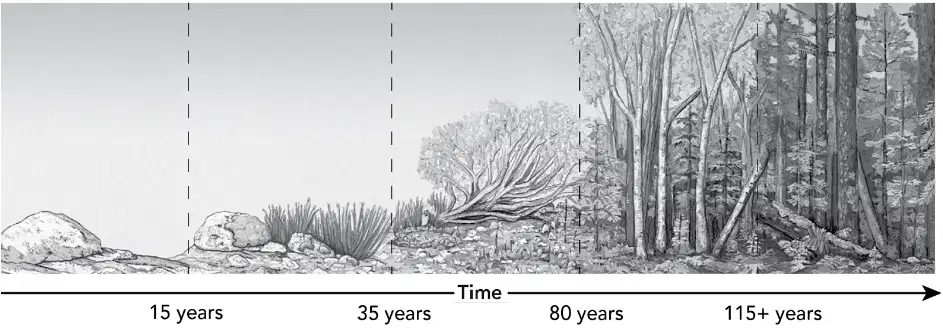
Zoe is studying a mountainous region where a glacier is melting and retreating. She constructs the timeline below to show her prediction of how the region will change over time. Why are the changes shown in the diagram classified as primary succession and not secondary succession?
The process results in the appearance of a climax community.
Many intermediate communities appear before the climax community.
The climax community appears after hundreds of years.
The process begins with pioneer species growing on bare rocks.
Zoe is studying a mountainous region where a glacier is melting and retreating. She constructs the timeline below to show her prediction of how the region will change over time. Which of the following events would be MOST LIKELY to permanently disturb the climax community that Zoe predicts will arrive?
a fire burns down half of the trees in the community
the introduction of grasses and other small plants
the spread of an invasive fungus that kills the oak trees
the arrival of deer that feed on the leaves of the trees
Primary succession ends in a climax community. Put the steps of primary succession leading up to this community in order from earliest to latest occurring step.
A retreating glacier or volcanic eruption leaves behind bare rock
Species such as lichens with a broad tolerance for environmental conditions arrive.
Pioneer species break down rock, synthesize organic material, and begin to form soil.
As the soil develops, over time, it supports larger plants, like bushes, shrubs, and small trees.
Larger trees move in. Their branches and leaves shade and protect the ground.
Which step occurs last in primary succession?
A climax community is reached. This community will likely remain stable until another disturbance occurs.
Species such as lichens with a broad tolerance for environmental conditions arrive.
Larger trees move in. Their branches and leaves shade and protect the ground.
A retreating glacier or volcanic eruption leaves behind bare rock

