wayground logo

Free Printable Worksheets

Font size

S
M
L
XL
Worksheets

Periodic trends

Total questions: 117

Worksheet time: 3hrs 59mins

Name
Class
Date
1.
A measure of the size of an atom, and is generally defined as the distance from the nucleus to the outermost electron orbit
a)
chemical reactivity
b)
atomic radius
c)
energy levels
d)
orbit
2.
Decreased attraction of electrons away from the nucleus
a)
attraction
b)
atomic radius
c)
electronegativity
d)
shielding effect
3.
The core of an atom where most of the mass of an atom exists; contains protons and neutrons
a)
nucleus
b)
electron shell
c)
proton
d)
electron
4.
The minimum energy required to remove an electron from the ground state of an atom
a)
electron configuration
b)
energy levels
c)
ionization energy
d)
ionic bond
5.
A negatively charged subatomic particle that exists in various energy levels outside the nucleus of an atom
a)
neutron
b)
electron
c)
proton
d)
subatomic particle
6.
The arrangement of electrons in the energy levels and orbitals within an atom
a)
electron configuration
b)
electron shells
c)
orbitals
d)
valence electron
7.
The chart scientists use to organize and classify all the known elements
a)
elements chart
b)
the chart
c)
Periodic Table of the Elements
d)
Period table
8.
A chemical bond in which one atom gives up electrons (cation) to another atom that gains the electrons (anion); results from a difference in electronegativity greater than 1.7
a)
chemical bond
b)
hydrogen bond
c)
ionic bond
d)
bond
9.
The tendency of an atom to attract electrons and acquire a negative charge
a)
electronegativity
b)
charge
c)
bonding ability
d)
electron configuration
10.
The energies of electrons as they orbit the nucleus of an atom
a)
energy levels
b)
orbits
c)
shells
d)
electron area
11.
An electron that resides in the outermost shell, or principal quantum level, of an atom
a)
periodic trend
b)
electron shell
c)
ionic radius
d)
valence electron
12.
Vertical columns of elements (families) on the periodic table with similar valence electron configurations and similar properties
a)
groups
b)
periods
c)
quadrants
d)
rows
13.
A set of chemical properties associated with elements that are metals
a)
metallic character
b)
properties
c)
tendencies
d)
non-metallic character
14.
Which of the following atoms has a largest atomic radii?
Ca - Ra - Be - Sr
a)
Ca
b)
Sr
c)
Be
d)
Ra
15.
Which of the following atoms has the smallest atomic radii? 
S - Cl - Na - Al
a)
S
b)
Cl
c)
Na
d)
Al
16.
Which of the following pairs of particles aren't isoelectronic?
a)
Na+1  and Ne
b)
S-2  and Cl-1
c)
F-1 and Ne
d)
Mg+2 and Na
17.
Arrange the following atoms in order from smallest to largest atomic radii.
Al-Mg-Cl-N
a)
Al-Mg-Cl-N
b)
N-Mg-Cl-Al
c)
N-Cl-Al-Mg
d)
Cl-N-Mg-Al
18.
Which of the following relationships is correct?
a)
Na > K
b)
S < P
c)
O > N
d)
Br < Cl
19.

How many valence electrons does chlorine have?

a)

3

b)

7

c)

17

d)

5

20.

The distance from the nucleus to the outermost electron is the....

a)

Atomic Radius

b)

Electronegativity

c)

Electron Affinity

d)

Ionization Energy

21.

The energy needed to REMOVE 1 electron is the....

a)

Atomic Radius

b)

Electronegativity

c)

Electron Affinity

d)

Ionization Energy

22.

The energy released when an electron is ADDED is the....

a)

Atomic Radius

b)

Electronegativity

c)

Electron Affinity

d)

Ionization Energy

23.

How much an atom attracts and bonds with electrons is the....

a)

Atomic Radius

b)

Electronegativity

c)

Electron Affinity

d)

Ionization Energy

24.

If you ADD an electron shell, the atomic radius

a)

Increases

b)

Decreases

c)

Stays the same

25.

Atomic radius increases...

a)

Left across a period

b)

Right across a period

c)

Up a group

d)

Down a group

26.

ionization energy increases...

a)

Left across a period

b)

Right across a period

c)

Up a group

d)

Down a group

27.

Elements in Group 16 have the same...

a)

Mass Number

b)

Atomic Number

c)

Valence Electrons

d)

Electron Shells

28.

Why is Mg smaller than Na

a)

Mg has more electrons

b)

Mg has more electron shells

c)

Mg has less electron shells

d)

Mg has less electrons

29.

Which of the following elements have the SMALLEST atomic radius?

a)

Be

b)

Sr

c)

Ra

d)

Mg

30.

Which of the following elements have the LARGEST atomic radius?

a)

K

b)

Fe

c)

Br

d)

As

31.

Which element has the lowest ionization energy in Group 2?

a)

Be

b)

Ra

c)

Ca

d)

Sr

32.

Who has the HIGHEST ionization energy

a)

Al

b)

S

c)

Na

d)

Cl

33.

Which noble gas has the HIGHEST electron affinity?

a)

He

b)

Ne

c)

Xe

d)

Rn

34.

Which of the following has the LOWEST electron affinity?

a)

Na

b)

B

c)

F

d)

Li

35.

Which element has the highest electronegativity?

a)

H

b)

Xe

c)

F

d)

Rb

36.
The periodic table has a hidden pattern that was recognized by:
a)
John Dalton
b)
Neil DeGrasse Tyson
c)
Mendeleev
d)
Gregor Mendel
37.
An anion is a negatively charged ion.
a)
True
b)
False
38.
Which of the following will have a larger radius than Zinc?
a)
Gallium
b)
Aluminum
c)
Magnesium
d)
Strontium
39.
Which of the following will have a higher electronegativity than arsenic (As)?
a)
Carbon (C)
b)
Neon (Ne)
c)
Antimony (Sb)
d)
Germanium (Ge)
40.
Which of the following will have a lower ionization energy than Scandium (Sc)?
a)
Helium (He)
b)
Titanium (Ti)
c)
Calcium (Ca)
d)
Magnesium (Mg)
41.
Which properties are characteristic of the group 1 metals?
a)
high reactivity and the formation of stable compounds
b)
high reactivity and the formation of unstable compounds
c)
low reactivity and the formation of stable compounds
d)
low reactivity and the formation of unstable compounds
42.
As atoms of elements in group 16 are considered in order from top to bottom, the electronegativity of each successive element....
a)
decreases
b)
increases
c)
remains the same
d)
none of the above
43.
As you move down the periodic table atoms get bigger.  This is because ____________.
a)
The atoms have more mass.
b)
The atoms have more protons.
c)
The atoms have more energy levels
d)
The atoms have more nuetrons
44.
As you move across the periodic table atoms tend to get smaller because, ______________.
a)
the atoms have more mass.
b)
the atoms have less mass
c)
the atoms have more protons.
d)
the atoms have less electrons.
45.
Atoms that have a high electronegativity, _______________.
a)
give up their electrons more easily.
b)
hold on to their electrons more tightly.
c)
have more electron shells.
46.
Electronegativity is...
a)
how good an atom is at attracting electrons
b)
the ability of an atom to lose electrons
c)
the energy required to remove an electron from a specific atom
d)
how easy it is to make friends. 
47.
Ionization energy is...
a)
the energy required to add an electron to a specific atom
b)
how much energy it takes to remove an electron from an atom
c)
the energy required to shield the outer electrons from the nucleus
d)
a measure of the ability of an atom to attract electrons
48.

which of the following families is the least electronegative?

a)

noble gases

b)

Halogens

c)

transition metals

d)

alkali metals

49.
What is the name of the group that never reacts--ever ever they are stable with a full outermost ring!!!
a)
noble gases
b)
transition
c)
halogens
d)
borons
50.
Elements on the far right side of the periodic table are classified as nonmetals.
a)
true
b)
false
51.
Elements arranged in vertical columns in the periodic table are called periods.
a)
true
b)
false
52.
Metals are good conductors of heat and electricity.
a)
true
b)
false
53.
Which compound contains an alkaline earth metal and a halogen? 
a)
CaS
b)
Rb2S
c)
RbCl
d)
CaCl2
54.
Which has the greater EN: 
Cl or Al?
a)
Cl
b)
Al
55.
Which has the greater EN: 
N or C?
a)
C
b)
N
56.
Which has the greater EN: 
H or F?
a)
H
b)
F
57.
Which atom has the largest atomic radius?
a)
potassium
b)
rubidium 
c)
francium
d)
cesium
58.
Ionization energy is...
a)
the energy required to add an electron to a specific atom
b)
how much energy it takes to remove an electron from an atom
c)
the energy required to shield the outer electrons from the nucleus
d)
a measure of the ability of an atom to attract electrons
59.
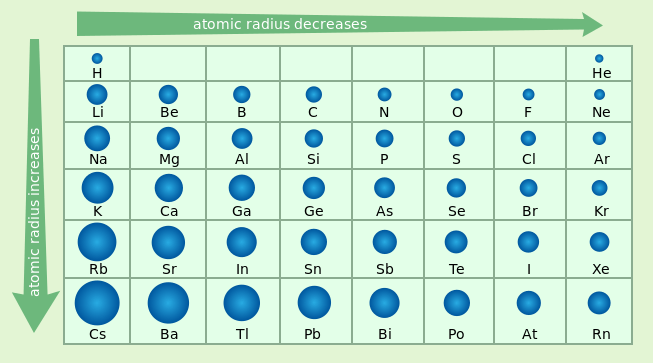
The picture shows what trend?
a)
Electronegativity
b)
Atomic Number
c)
Atomic Radius
d)
Ionization
60.
Which of the following sequences corresponds to a correct trend in ionization energy?
a)
Cl > S > P > Al
b)
Sr > Ca > Mg > Be
c)
Rb > K > Na > Li
d)
Rb > Sr > I > Xe
61.

What is the charge of the electron?

a)

neutral

b)

negative

c)

positive

62.

Where is the electron located in an atom?

a)

next to the proton in the nucleus

b)

next to the neutron in the nucleus

c)

in the energy levels in the cloud surrounding the nucleus

63.

The mass of an electron is

a)

1

b)

100

c)

1/1840

64.

How many electrons would Cl-1 charge have?

a)

16

b)

17

c)

18

d)

35

65.

How many electrons would Al+3 charge have?

a)

10

b)

13

c)

16

d)

27

66.

Which has the larger atomic radius? Cadmium (Cd) or Antimony (Sb)

a)

Cadmium

b)

Antimony

c)

they are the same size

67.

Atomic radius or size ___________ as you move from the top to the bottom of the periodic table.

a)

increases

b)

decreases

c)

stays the same

68.

It is more difficult to remove the _____ electron from an atom.

a)

1st

b)

2nd

c)

3rd

69.

Ionization energy is the energy required to remove an electron from an atom.

a)

True

b)

False

70.

Which has the largest ionization energy? Sodium (Na), Aluminum (Al), Phosphorus (P), or Argon (Ar)

a)

Sodium (Na)

b)

Aluminum (Al)

c)

Phosphorus (P)

d)

Argon (Ar)

71.

Ionization energy ________ as you move from bottom to top of the periodic table.

a)

increases

b)

decreases

72.

Which element has greater electronegativity? Oxygen (O) or Selenium (Se)

a)

Oxygen (O)

b)

Selenium (Se)

73.

Electronegativity ________ as you move from the left to the right on the periodic table.

a)

increases

b)

decreases

74.

Which of the period 3 elements has the largest electronegativity?

a)

Ar

b)

Cl

c)

Na

d)

F

75.
As you move down the periodic table atoms get bigger.  This is because ____________.
a)
The atoms have more mass.
b)
The atoms have more protons.
c)
The atoms have more energy levels
d)
The atoms have more nuetrons
76.
As you move across the periodic table atoms tend to get smaller because, ______________.
a)
the atoms have more mass.
b)
the atoms have less mass
c)
the atoms have more protons.
d)
the atoms have less electrons.
77.
Which atom has the largest atomic radius?
a)
potassium
b)
rubidium 
c)
francium
d)
cesium
78.
The atom with the largest atomic radius in Group 18 is - 
a)
Ar
b)
He
c)
Kr
d)
Rn
79.
Ionization energy is...
a)
the energy required to add an electron to a specific atom
b)
how much energy it takes to remove an electron from an atom
c)
the energy required to shield the outer electrons from the nucleus
d)
a measure of the ability of an atom to attract electrons
80.
Which of the following will have a lower ionization energy than Scandium (Sc)?
a)
Helium (He)
b)
Titanium (Ti)
c)
Calcium (Ca)
d)
Magnesium (Mg)
81.
Electronegativity is...
a)
how good an atom is at attracting electrons
b)
the ability of an atom to lose electrons
c)
the energy required to remove an electron from a specific atom
d)
how easy it is to make friends. 
82.
Which of the following will have a higher ionization energy than arsenic (As)?
a)
Gallium (Ga)
b)
Neon (Ne)
c)
Antimony (Sb)
d)
Germanium (Ge)
83.
Which element has the greatest electronegativity: Nitrogen (N) or Arsenic (As)?
a)
Nitrogen (N)
b)
Arsenic (As)
84.
Which element has the greatest ionization energy: Aluminum (Al)    or    Chlorine (Cl)?
a)
Aluminum (Al)
b)
Chlorine (Cl)
85.
The element with the largest electronegativity in the halogens is - 
a)
At
b)
F
c)
Cl
d)
Br
86.

The element with the lowest electronegativity in Period 3 is -

a)

Na

b)

Cl

c)

Ar

d)

Mg

87.
Which periodic group has the smallest atomic radius?
a)
Alkali metals
b)
Halogens
c)
Noble Gases
d)
Transition metals
88.
A negatively charged subatomic particle that exists in various energy levels outside the nucleus of an atom
a)
neutron
b)
electron
c)
proton
d)
subatomic particle
89.
The minimum energy required to remove an electron from the ground state of an atom
a)
electron configuration
b)
energy levels
c)
ionization energy
d)
ionic bond
90.
The tendency of an atom to attract electrons and acquire a negative charge
a)
electronegativity
b)
charge
c)
bonding ability
d)
electron configuration
91.
An electron that resides in the outermost shell, or principal quantum level, of an atom
a)
periodic trend
b)
electron shell
c)
ionic radius
d)
valence electron
92.
Vertical columns of elements (families) on the periodic table with similar  properties
a)
groups
b)
periods
c)
quadrants
d)
rows
93.
Which element has a full valence shell?
a)
F
b)
D
c)
C
d)
E
94.

What is the name of the family that is highlighted?

a)

Alkali Metal Family

b)

Halogen Family

c)

Noble Gas Family

d)

Transition Metal Family

95.

Which element has 3 valence electrons?

a)

A

b)

B

c)

E

d)

C

96.
Which element has a full valence shell?
a)
F
b)
D
c)
C
d)
E
97.
Which elements have the same number of valence electrons?
a)
A & C
b)
E & C
c)
F & A
d)
F & B
98.
Is silicon a metal, nonmetal or metalloid?
a)
Metal
b)
NonMetal
c)
Metalloid
99.
Which elements are in the same period?
a)
A & F
b)
F, B & D
c)
E & D
d)
F & B
100.
Is this a metal, nonmetal or metalloid?
a)
Metal
b)
Nonmetal
c)
Metalloid
101.
In which group does this atom belong?
a)
1
b)
3
c)
13
d)
11
102.
How many energy levels does an atom of Chlorine have?
a)
2
b)
3
c)
4
d)
7
103.

Which element in Period 2 has the greatest atomic radius?

a)

Be

b)

C

c)

Na

d)

Li

104.

Which of the alkaline-earth metals has the smallest electronegativity

a)

Be

b)

Sc

c)

Ra

d)

Sr

105.

Of the halogens, which has the smallest electronegativity?

a)

F

b)

Cl

c)

At

d)

Ne

106.

Which of the period 3 elements has the largest electronegativity?

a)

Ar

b)

Cl

c)

Na

d)

F

107.

Which of the transition metals in the 5th period is the largest?

a)

Y

b)

Mo

c)

Rb

d)

Xe

108.
An element needs 1 more electron to have a complete outer shell. What family is it in?
a)

Group 1 Alkaline metal

b)

Group 1 Alkali metal

c)

Group 17 Halogens

d)

Group 17 Halogans

109.
Which of the following will have a larger radius than Zinc?
a)
Gallium
b)
Aluminum
c)
Magnesium
d)
Strontium
110.
Put the following elements in order of increasing atomic radius:
Rb, Na, K, Fr.
a)
Rb, Na, K, Fr
b)
K, Rb, Fr, Na
c)
Fr, K, Na, Rb
d)
Na, K, Rb, Fr
111.
Which element has a larger atomic radius than Potassium?
a)
Sodium
b)
Cesium
c)
Lithium
d)
Chlorine
112.
How many protons does an atom of mercury have?
a)
200.6
b)
120
c)
80
d)
0
113.
Which quantity is determined by adding protons to neutrons?
a)
number of electrons
b)
atomic number
c)
atomic mass
d)
mass number
114.
An element with five valence electrons is
a)
phosphorus
b)
oxygen
c)
beryllium
d)
rubidium
115.
Which is smaller, a potassium ion or a chlorine ion?
a)
potassium ion
b)
chlorine ion
c)
they are equal in size
116.
An element needs three valence electrons to complete its outer shell. What family is this element likely in?
a)

Group 5

b)

Group 15

c)

Group 3

d)

Group 13

117.
An element has one valence electron. This element is likely in which group?
a)

Group 1

b)

Group 11

c)

Group 2

d)

Group 12