wayground logo

Free Printable Worksheets

NEW

Font size

S
M
L
XL
Worksheets

Forces and Motion

Total questions: 65

Worksheet time: 55mins

Name
Class
Date
1.
Which statement is true about a moving object?
When an object is ....
a)
...accelerating, the resultant force acting on it must be zero
b)
... moving at a steady speed, the air resistance acting on it must equal zero
c)
... moving at a steady speed, the resultant force acting on it must equal zero
d)
... moving, there must be a resultant force acting on it.
2.
A woman lifts 20 bricks, each of weight 6N.
What other information is needed to calculate the useful work done in lifting the bricks?
a)
the distance she lifts the bricks
b)
the mass of the bricks
c)
the time taken to lift the bricks
d)
the volume of the bricks
3.
How far does the car travel before it reaches a steady speed?
a)
10m
b)
20m
c)
100m
d)
200m
4.
Which statement is correct about a bottle of water?
a)
its mass at the North Pole is different from its mass at the Equator
b)
its mass is measured in newtons
c)
its weight and mass are the same thing
d)
its weight is one of the forces acting on it
5.
a)
  A
b)
  B
c)
  C
d)
  D
6.
Which statement about mass and weight is correct?
a)
Mass and weight are both forces
b)
Neither mass nor weight is a force
c)
Only mass is a force
d)
Only weight is a force
7.
In a race, a car travels 60 times around a 3.6km track. This takes 2.4 hours. What is the average speed of the car?
a)
1.5 km/h
b)
90 km/h
c)
144 km/h
d)
216 km/h
8.
Which quantity is measured in newtons?
a)
density
b)
energy
c)
pressure
d)
weight
9.
Two forces act on an object.
In which situation is it IMPOSSIBLE for the object to be in equilibrium?
a)
The two forces act in the same direction
b)
The two forces act through the same point
c)
The two forces are of the same type
d)
The two forces are the same size
10.

What are balanced forces?

a)

Forces of the same size, in opposite directions

b)

Forces of the same size, in the same direction

11.

What is the force that pulls us towards the Earth?

a)

Gravity

b)

Tension

c)

Friction

d)

Air Resistance

12.

Two forces on an object are in opposite directions. How do we calculate the resultant force?

a)

Divide one by the other

b)

Multiply them

c)

Take one away from the other

d)

Add them together

13.

Two forces on an object are in the same direction. How do we calculate the resultant force?

a)

Take away one from the other

b)

Multiply them

c)

Divide one by the other

d)

Add them together

14.

A ____________ is a push or a pull on an object.

a)

Chemical

b)

Force

c)

Magnet

d)

Gravity

15.
Two features of a vector?
a)
Size and direction
b)
Speed and distance
c)
Quantity and units
d)
Amount and magnitude
16.

The unit of force is...

a)

m/s

b)

m

c)

N

d)

kg

17.

How will this object move?

a)

It won't move.

b)

It will move to the right.

c)

It will move to the left.

d)

It will move up.

18.

How will this object move?

a)

It won't move.

b)

It will move to the right.

c)

It will move to the left.

19.

What is the resultant force?

a)

5000 N, Right

b)

4000 N, Right

c)

40 N, Left

d)

4000 N, Left

20.

Which of the following is not a store of energy?

a)

friction

b)

magnetic

c)

electrostatic

d)

nuclear

21.

What is the resultant force?

a)

10 N

b)

0 N

c)

25 N

d)

1 N

22.

What is the unit of work?

a)

Newton

b)

Joule

c)

Watt

d)

meter

23.

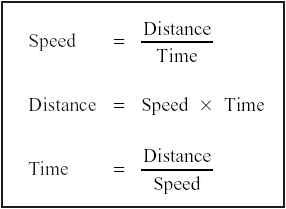
What equation links distance, speed and time?

a)

speed = time ÷ distance

b)

speed = distance ÷ time

c)

speed = distance x time

d)

speed = time x distance

24.
Which of the following is a unit for acceleration?
a)
km/s
b)
m/s2
c)
mi/hr
d)
ft
25.

Calculate the average speed (in m/s) if a cheetah runs 180 metres in 10 seconds.

a)

198 m/s

b)

170 m/s

c)

12 m/s

d)

18 m/s

26.

What are contact forces?

a)

Forces between similar objects

b)

Forces between touching objects

c)

Forces between objects that do not touch

27.

What is a non-contact force?

a)

Forces between touching objects

b)

Forces between objects that do not touch

c)

Forces between objects that are different to each other

28.

Which of these is a contact force?

a)

Tension

b)

Attraction

c)

Repulsion

29.

Which of these involves a contact force?

a)

A planet in orbit around a star

b)

A skydiver falling through the air

c)

Electrons attracted to the nucleus of an atom

30.

Which of these is a non-contact force?

a)

Friction

b)

Reaction force

c)

Weight

31.

Which of these words describes the force between two negatively charged particles?

a)

Gravitational

b)

Compression

c)

Repulsion

32.

What must an object have in order to be affected by electrostatic forces?

a)

Charge

b)

Mass

c)

Motion

33.

What must an object have in order to be affected by gravity?

a)

Charge

b)

Mass

c)

Magnetism

34.
Hooke's Law describes the behaviour of which kind of material under tension?
a)
plastic
b)
metals only
c)
elastic
d)
non-metals only
35.
If F is force, k is spring constant and x is extension, Hooke's Law tells us that:
a)
F=k/x
b)
x=Fk
c)
k=Fx
d)
F=kx
36.
Hooke's Law fails when a material reaches its:
a)
breakdown
b)
elastic limit
c)
end of tether
d)
fracture stress
37.
A stiff material has a:
a)
high spring constant
b)
low spring constant
c)
spring constant of any value
d)
spring constant which is difficult to predict
38.
A spring has a spring constant of 5N/cm.  What is its extension when loaded with 15N?
a)
4cm
b)
5cm
c)
3m
d)
3cm
39.
A spring extends 1.5m under load 10N. What is its spring constant?
a)
0.15N/m
b)
10N/m
c)
6.7N/m
d)
15N/m
40.

1N is equals to

a)

200g

b)

10g

c)

100g

d)

1g

41.

According to Hooke's law; Force is equal to -

a)

Spring Constant × Extension

b)

Spring Constant ÷ Extension

c)

Spring Constant + Extension

42.

_________ is the unit of Spring Constant

a)

N

b)

N/m

c)

m

43.
Which of the following is a true statement regarding springs?
a)
The higher the value of the spring constant, the stiffer the spring.  
b)
In Hooke's law, the force exerted by the spring acts in the same direction as displacement.  
c)
Springs are designed to provide unpredictable variations in force.  
d)
The force exerted by a spring has a quadratic relationship with the displacement form equilibrium.  
44.
The larger the mass you have the _____ force you need to change its motion.
a)
more
b)
less
45.
If F is force, k is spring constant and x is extension, Hooke's Law tells us that:
a)
F=k/x
b)
x=Fk
c)
k=Fx
d)
F=kx
46.
A stiff material has a:
a)
high spring constant
b)
low spring constant
c)
spring constant of any value
d)
spring constant which is difficult to predict
47.
Which runner had a head start?
a)
A
b)
B
c)
C
48.
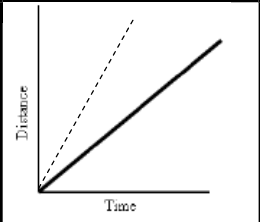
What does this graph represent?
a)
Constant Speed
b)
Acceleration
c)
Not moving
49.
How long did it take this object to travel 10 m?
a)
0 s
b)
10 s
c)
15 s
d)
20 s
50.
At 60 seconds, how far had this object traveled? 
a)
0 m
b)
10 m
c)
20 m
d)
40 m
51.
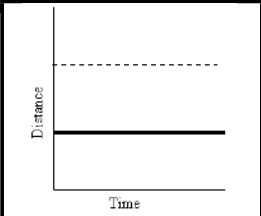
What does this graph represent?
a)
Constant speed
b)
Acceleration
c)
Not moving
52.
What is happening at D?
a)
Stationary
b)
Accelerating
c)
Fast steady speed; moving away from the starting position
d)
Slower steady speed; moving away from the starting position
53.
What does this graph represent?
a)
Constant speed
b)
Acceleration
c)
Not moving
54.
If you travel 10 miles in 5 minutes, what is your speed?
a)
10 mi/min
b)
15 mi/min
c)
50 mi/min
d)
2 mi/min
55.

Which of the following is the correct equation for calculating SPEED?

a)

s = d / t

b)

s = d x t

c)

s = t / d

d)

s = d - t

56.
What is this graph showing?
a)
Constant Speed
b)
Acceleration (speeding up)
c)
Deceleration (slowing down)
d)
No motion
57.
Which runner won the race?
a)
A
b)
B
c)
C
58.

A ball is thrown vertically upward as shown in

the figure below. At what point in the ball’s path does

it experience zero velocity and nonzero acceleration

at the same time?

a)

P

b)

Q

c)

R

d)

S

59.
The friction between the air and a moving object is called ___
a)
air resistance
b)
the atmosphere
c)
gravity
d)
upward draft
60.

As the cyclist accelerates, the _______________________ energy store in the cyclist’s body decreases and the _______________________ energy of the cyclist increases.

a)

chemical; kinetic

b)

gravitational potential; kinetic

c)

elastic potential; kinetic

d)

kinetic; gravitational potential

e)

kinetic; chemical

61.

As the drone accelerates upwards its __________________________ energy increases and its __________________________ energy increases.The __________________________ energy store of the battery decreases.

a)

kinetic ; gravitational potential ; chemical

b)

chemical ; gravitational potential ; kinetic

c)

kinetic ; gravitational potential ; nuclear

d)

kinetic ; elastic potential ; chemical

62.

A ball is thrown up in the air with 100 J of kinetic energy. How much gravitational potential energy does the ball have stored at the peak of its throw?

a)

100 J

b)

50 J

c)

25 J

d)

10 J

63.

Which of the following is an example of a mechanical transfer of energy?

a)

A battery powering a light bulb.

b)

A candle generating heat

c)

A candle generating light

d)

A ball falling towards the Earth

64.

If a falling ball has, at one point in its fall, 20 J of gravitational potential energy and 60 J of kinetic energy, how much kinetic energy will it have when it strikes the Earth?

a)

80 J

b)

60 J

c)

20 J

d)

40 J

65.

If a roller-coaster cart moving towards the top of a track has 40 J of kinetic energy and 30 J of gravitational potential energy, how much gravitational potential energy will it have at the top of the track?

a)

70 J

b)

40 J

c)

30 J

d)

10 J