
 Worksheets
Series Circuits
Total questions: 70
Worksheet time: 1hrs 13mins

Solve for the total resistance of the circuit shown
50 V
1970 ohms
705 K ohms
20 Amps

Solve for total Current in the circuit shown
25 Amps
35 amps
25 milliamps
35 milliamps

Solve for the current flowing through Resistor # 1
35 amps
25 amps
35 milliamps
25 milliamps

Solve for the voltage drop at resistor 1
38 volts
60 Kvolts
50 volts
25 volts
Voltage drop stands for what?
the voltage applied to a circuit
the voltage flowing through a resistor
the voltage used by a load
With three 10 resistors connected in series with a 30 volt power supply, the total circuit current will equal ____.
300 amps
1 amp
150 amps
1 millamp
The wattage value for any resistor is equal to ____.
I X R
E/R
I X E
I/R
Total series circuit wattage is equal to source voltage ____.
multiplied by the voltage value going through any resistor
multiplied by the current value going through any resistor
divided by the current value going through any resistor
divided by the voltage applied to the circuit and the total resistance of the circuit

Using the circuit shown solve for total power dissipated in this circuit.
20 watts
30 watts
1.8 Kilowatts
180 watts

The wattage being dissipated at R3 is ______________________________ W.
18
54
36

The voltage drop across R1 is ______________________________ V.
20
30
40
50

The wattage being dissipated at R2 is _______________ W.
27
12
15
36
When a resistor in a series circuit is replaced by another resistor with an increased resistance value, the total circuit current will __________.
stay the same
decrease
increase
double in value
This circuit has only one path for current to flow
series
parallel
combination
split
The formula I2 * R is used to find what?
Current
Voltage
Resistance
Power
The formula E2/R
Voltage
Current
Power
Resistance
__________ remains the same in a series circuit.
Resistance
Voltage
Current
Power
What is the total circuit resistance of the following five resistors connected in series?
R1 = 27 ohms
R2 = 33 ohms
R3 = 51 ohms
R4 = 1.2 kohms
R5 = 240 ohms
Rt = __________ Ohms
353.2
1551
1.9 K
What is the total circuit resistance of two 25 ohm resistors and three 75 ohm resistors connected in series?
100 ohms
200 ohms
275 ohm
175 ohms
What happens to total current in a series circuit when the total voltage stays the same, circuit resistance decreases, current will ____________.
increase
Stay the same
Decrease

This is an example of a series circuit
yes
no
In this circuit, the electrons have ____ path(s) to follow.
1
more than 1
In this circuit, the light bulbs share electrical pressure
yes
no
If more bulbs were added to this circuit, each bulb would get ___.
brighter
dimmer
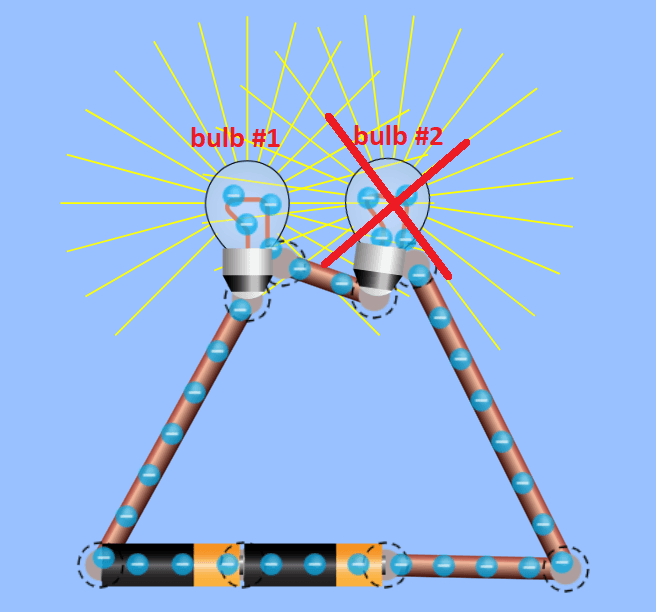
If bulb #2 in this series circuit broke, bulb #1 would
stay on
go off

If bulb #1 in this series circuit broke, bulb #2 would
stay on
go off

In a series circuit like this, devices ___.
are either ALL ON or ALL OFF
can be turned on or off individually
In a series circuit, each bulb
gets the full electrical pressure
shares the electrical pressure

Homes, school and factories ___ wired in series.
are
are not

In a series circuit, when you add more appliances, each appliance gets ___ power/electrical pressure.
more
less
As you continue to add lightbulbs in series, what happens?
The bulbs get brighter
The bulbs get dimmer
The bulbs remain the same brightness
The bulbs explode and shards of glass get everywhere
If one bulb goes out in a series circuit, the remaining bulbs...
also go out
get brighter
get dimmer
explode, leaving shards of glass everywhere

Ohm's Law?
Still works!
Out the window!
Not familiar!
Laws are meant to be broken!

What is the potential difference in this circuit?
30 V
60 V
2 V
9 V
What is the total resistance (equivalent resistance) in this circuit? Respond with number only (no units)
(a)
What is the total current in this circuit?
30 A
60 A
2 A
0.5 A
The current is the same through all 3 resistors
True
False

What is the total resistance (equivalent resistance) in this circuit? Respond with number only (no units)
(a)
What is the total current in this circuit? Respond with number only (no units)
(a)
The current through resistor one is greater than the current through resistor two.
True
False

What is the current throughout the circuit? Respond with number only (no units)
(a)
What is the total resistance (equivalent resistance) throughout the circuit? Respond with number only (no units)
(a)
What is the potential difference of the battery? Respond with number only (no units)
(a)

When the second bulb is added, they get
brighter
dimmer
broken
cold
What is the measuring device shown?
bulb
cell
ammeter
voltmeter
What can you say about the current in the series circuit?
it splits across the components
it changes constantly
it is different in different places
it is the same everywhere
Which component provides the energy for the charges?
cell
bulb
switch
ammeter
If the ammeter says the current is 5A, what is the current flowing through one bulb?
2.5A
10A
5A
0
If one bulb was broken, what would happen?
current would no longer flow, so everything would be off
the ammeter would measure a current from the other bulb
the switch would keep the current flowing
the cell would burn out and catch fire
What is the name of the device which measures current?
(a)
Current is measured in
Volts
Watts
Seconds
Amps
If the switch was opened, what would happen?
the ammeter would measure a current flowing
current would no longer flow, so everything would be off
the bulbs would stay on because they're connected to the cell
the bulbs would burn out and catch fire
Name the charged particle, which is part of an atom, that flows in a circuit
proton
electron
neutron
elepton
What causes a decrease in current? Select all that apply.
Adding another bulb
increasing resistance
decreasing voltage from the supply
decreasing the resistance
If the current flowing through the cell is 2A, what is the ammeter reading?
5A
1A
6A
2A
Solve for the total resistance of the circuit shown
50 V
1970 ohms
705 K ohms
20 Amps

As you continue to add lightbulbs in series, what happens?
The bulbs get brighter
The bulbs get dimmer
The bulbs remain the same brightness
The bulbs explode and shards of glass get everywhere
If one bulb goes out in a series circuit, the remaining bulbs...
also go out
get brighter
get dimmer
explode, leaving shards of glass everywhere
What is the total current in this circuit?
30 A
60 A
2 A
0.5 A
The current is the same through all 3 resistors
True
False
What is the total resistance (equivalent resistance) in this circuit? Respond with number only (no units)
(a)

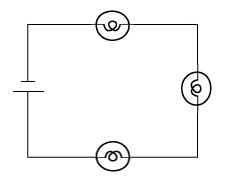
If bulb #1 in this series circuit broke, bulb #2 would
stay on
go off

If the total current in the circuit shown is 3 amperes, the current through each (identical) bulb is __________.
0 A
1 A
3 A
9 A

Look at this Christmas tree lights. Are they connected in series or parallel?
Series
Parallel
Both
I am not sure

