
 Worksheets
Physics equations and calculations practice
Total questions: 65
Worksheet time: 2hrs 4mins
What is the relationship between weight, mass and gravitational field strength?
Weight = mass / gravitational field strength
W = mg
Weight= mass x gravitational field strength
W =m/g
Which of the following equation is the average speed equation re-arranged so that 'time taken' is the subject.
time taken = average speed / distance travelled
time taken = average speed x distance travelled
time taken = distance travelled / average speed
time taken = distance travelled x average speed
What is the equation for the acceleration of an object?
change in velocity / time taken
change in time / velocity
change in time x velocity
change in velocity x time taken
State the relationship between work done, power, time taken?
Workdone= timetaken - power
Workdone = power - time taken
Power = workdone / time taken

What is the slope of a change in velocity graph vs time
distance
time
acceleration

momentum is .... to mass
directly proportional
inversely proportional
What is the relationship between speed, distance and time?
Speed = distance/time
Speed= distance x time
Distance= speed /time
Speed= time
What is the correct equation for acceleration
a = (v - u) / t
a = d / t
a = f x m
What is the correct equation linking force mass and acceleration
F = ma
m = Fa
a = Fm
What is the correct equation for gravitational potential energy
m x g x h
m x g / h
m x h / g
What is the correct equation for kinetic energy
1/2 x m x v2
m x v2
1 / 2 x v x m2
What is the equation that links distance (s), force (F) and work done (W)?
Work Done = Force x Distance, or W=Fs
Work Done = Force / Distance, or W=F/s
Work Done = Distance / Force, or W=s/F
What is the kinetic energy of a 4kg shotput thrown with a velocity of 13m/s
676 J
52 J
17J
338 J
what is the unit of work?
Newton
Joule
Watt
meter
if you push a cart with a force of 60 N for 2 m... how much work have you done
120 J
30 J
120 N
30 N
Two people shove on a wall with 100 N. The wall doesn’t move. How much work is done?
100J
100N
0J
0N
How much work is done by lifting an object with a weight of 250 N a total of 2 m off the ground?
125 J
125 W
500 W
500 J
An engine does 300 J of work in 10 seconds. How much power did it use?
3000 N
3000 W
30 W
30 J
If a car weighs 3000 N and drives a distance of 10 m in 2 seconds, how much power does it use?
1,500 J
60,000 W
15,000 W
6,000 J
What is the efficiency of a car that has enough fuel to drive 600 miles, but only actually drives 150 miles?
25%
4%
400
.25
A kettle uses 100J of electrical energy to produce 7J of sound energy and 93J of thermal energy. How efficient is the kettle?
100%
7%
93%
95%
A washing machine uses 250J of electrical energy to produce 125J of useful energy. How efficient is it?
5%
50%
55%
100%

Total energy = 200J
Useful energy = 20J
Workout the efficiency of this lightbulb.
efficiency = total energy inuseful enegy ×100
100%
80%
40%
10%
A 0.4 kg hockey puck is moving at 20 m/s. What is the puck's momentum?
8 kg m/s
50 kg m/s
20 kg m/s
0.02 kg m/s
A 2.5 kg ball moving at 5 m/s collides with a 2.5 kg stationary ball in a perfectly elastic collision (momentum is completely transferred - the first ball stops moving). What is the velocity of the second ball after the collision?
5 m/s
2.5 m/s
10 m/s
7.5 m/s
Two football players with mass 75 kg and 100 kg run directly toward each other with speeds of -6 m/s and 8 m/s respectively. If they grab each other as they collide, the combined speed of the two players just after the collision would be:
2 m/s
3.4 m/s
4.6 m/s
7.1 m/s
A cyclist in the Tour de France accelerates down a hill from 22 m/s to a speed of 37 m/s. This acceleration takes him 2 seconds. The acceleration is...?
7.5 m/s2
11 m/s2
18.5 m/s2
44 m/s2
A cyclist accelerates from 0 m/s to 8 m/s in 3 seconds. What is his acceleration?
24 m/s2
2.67 m/s2
0.375 m/s2
11 m/s2
A horse accelerates from 5 m/s to 10 m/s with acceleration of 2 m/s2. For how many seconds did it accelerate for?
20 sec
10 sec
5 sec
2.5 sec
Velocity has a negative /positive sign for _________, but speed does not.
magnitude
direction
meters
time
What is the speed of a car travelling 50m in 4s?
200 m/s
12.5 m/s
12.5 m
200m
How long does it take a car to travel 40m at 12m/s?
4.8 s
480 s
3.33 s
33.3 s

If a force of 50 Newton's was applied to an object with a mass of 500 grams, what will the object's acceleration be? (HINT - UNITS!)
10 m/s^2
.1 m/s^2
100 m/s^2
1 m/s^2
What is the gravitational potential energy (GPE) of a 1 kilogram book that is 1 meter above the ground?
g = 9.8 m/s2
9.8 Joules
1.0 Joule
0.10 Joule
11.8 m/s2
How much power is required to raise a 200-kg crate a vertical distance of 2 m in a time of 4 s?
400 W
1000 W
1600 W
4000 W

Ian and Steve ski down the 75 m slope in 80 seconds using 400 N of penguin force. Calculate their penguin power!
375 W
37.5 W
426.7 W
240 000W

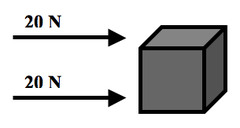
What is the resultant force?
40 N, Left
0 N, Balanced
400 N, Right
40 N, Right

What is the resultant force?
400 N, Up
400 N, Down
800 N, Up
800 N, Down

What is the resultant force?
17 N, Left
6N, Right
11N , Left
12N, Left

What is the resultant force?
40N, Left
40N, Right
0N, Balanced
75N, Right
A squirrel has a weight of 4.9 N. What is his Mass if he is running on the Ground? g is 9.81
4.9 kg
9.8 N/kg
0.5 kg
5.0 kg
A girl weighs 300 N what is her mass here on Earth?
40.8 kg
41 kg
30.6 kg
300 N
The specific heat of platinum is 133 J kg-1°C-1. How much heat(Q) is released when a 10 g piece of platinum cools from 100°C to 50°C?
66.5 J
665 J
0.0266 J
0.665 J
20 g of water. specific heat of water is 4200 J kg-1°C-1. temperature changes from 25° C to 20° C, how much heat energy (Q) moves from the water to the surroundings?
418 J
430 J
420 J
42000 J
The specific heat(c) of copper is 390 J kg−1°C−1 . What is the temperature change when 100 J of heat is applied on the 20 g of copper?
12 °C
24.12°C
1.95 °C
12.82 °C
The specific heat capacity of a substance is 1000 J/kgoC. How much energy is required to raise 1 kg of it by 1oC?
10 J
100 J
1000 J
10,000 J
The temperature of a 6.0 g sample of glass changed from 20.0°C to 45.0°C when it absorbed 550 J of heat. What is the specific heat of this glass?
0.27 J/g °C
3.7 J/g °C
130 J/g °C
12 J/g °C

Find the angle made by adjacent side 7 and hypotenuse is 14.
600
300
450
500

Find the missing side, where the hypotenuse is 14 and the adjacent side is 7.
15.6
12.1
8
5.25


104N
-60N
60N
95N

