
 Worksheets
Spring Exam Review
Total questions: 59
Worksheet time: 46mins
A student investigates heat transfer by placing an ice cube in warm water. The student takes the temperature of the water before the ice cube is placed in the water and again after the ice cube melts. Heat flows between the water and the ice cube during this process.
Type the word into the boxes that complete the sentence describing the flow of heat between the water and the ice cube. Heat moves from the (a) into the Ice Cubes until the ice cube melts in the water and both reach the same temperature.

The data table below shows the change in temperatures of a cup of tea, which sat in a cool science classroom over a 30-minute time period.
Using the data table, which of the following best explains the flow of thermal energy in relationship to the temperature of the tea and surrounding air?
The thermal energy of the tea moved from inside the cup to the surrounding air.
The thermal energy of the cool classroom moved from the room into the tea.
Condensed water vapor from the air formed around the rim of the cup, which then transferred thermal energy into the tea.
Evaporation of the tea resulted in less tea in the cup, which decreased the amount of thermal energy in the cup.
The closer a planet is to the Sun, the less time it needs to orbit the Sun. Which planet takes less time to orbit the Sun than Earth?
Jupiter
Earth
Mercury
Saturn
Why does a pan of warm water eventually become the same temperature as the room it is in?
Heat from the water flows into the air until they are the same temperature.
Coldness from the air flows into the water until they are the same temperature.
Heat from the air flows into the water until they are the same temperature.
Coldness from the water evaporates into the air until they are the same temperature.

A student designs an experiment to investigate convection. She fills a fish tank with water and puts a heater on one side of the tank, and a cup of ice on the other side of the tank. She drops blue food coloring in the water above the ice and red food coloring in the water above the heater. The picture shows her experiment.
After a few minutes, the food coloring begins to move. The picture shows the movement of the food coloring.
Which best explains the thermal energy transfer in the fish tank?
Thermal energy moves from the cooler water to the warmer water and will continue until one side of the tank is all cool water, and one side of the tank is all warm water.
Thermal energy moves from the cooler water to the warmer water and will continue until the entire tank becomes one temperature.
Thermal energy moves from the warmer water to the cooler water and will continue until the entire tank becomes one temperature.
Thermal energy moves from the warmer water to the cooler water and will continue until one side of the tank is all cool water, and one side of the tank is all warm water.

A student creates an experiment to observe thermal energy movement. He places a drop of food coloring at the bottom of a glass filled with cold water. He then places a mug of hot water under the glass. The picture shows his experiment.
Which best describes what will happen in the student's experiment?
Thermal energy from the warmer water at the bottom of the glass will transfer to the cooler water at the top of the glass, causing the food coloring to sink.
Thermal energy from the cooler water at the top of the glass will transfer to the warmer water at the bottom of the glass, causing the food coloring to sink.
Thermal energy from the cooler water at the top of the glass will transfer to the warmer water at the bottom of the glass, causing the food coloring to rise.
Thermal energy from the warmer water at the bottom of the glass will transfer to the cooler water at the top of the glass, causing the food coloring to rise.
A student is investigating how thermal energy moves. The student heated a nail to 100 °C and placed it into
250 mL of 20 °C water.
Based on your experience, what will happen to the thermal energy of the water and the nail?
The water will transfer energy to the nail until the water and nail have an equal temperature.
The nail will transfer energy to the water until the water and nail have an equal temperature
The nail will transfer energy to the water and the nail maintains its original temperature
The water will transfer energy to the nail and the water maintains its original temperature

A student is investigating thermal energy. She fills a glass with room temperature water. Then, she adds ice cubes to the water. The picture shows her investigation.
What will the student most likely observe in this investigation?
The warm water will transfer thermal energy to the cool ice cubes, causing them to melt.
The cool ice cubes will transfer thermal energy to the warm water, causing the ice cubes to melt.
he warm water will lose thermal energy to the surrounding air, causing the entire glass of ice water to cool.
The cool ice cubes will transfer thermal energy to the surrounding air, causing the entire glass of ice water to cool.

A limited number of the many known elements comprise the largest portion of solid Earth.
Which group of elements above comprises the largest portion of solid Earth?
Group A
Group B
Group C
Group D
Earth's atmosphere is made up mostly of which elements? (6.5B)
Carbon dioxide and oxygen
nitrogen and helium
helium and carbon dioxide
nitrogen and oxygen

Look at the circle graph of the different elements in Earth's crust.
Based on the graph, which conclusion can be drawn about the elements in Earth's Crust? (6.5B)
Iron is more abundant than sodium.
Silicon is more abundant than oxygen.
Aluminum is more abundant than silicon.
Calcium is more abundant than magnesium.
Label the blue and green portion of the pie chart
Carbon
Aluminium
Oxygen
Nitrogen
Trace elements
Silicon

The graph shows the element composition of an object.
What has this element composition?
Oceans
Living matter
Solid Earth
atmosphere
Which is the most common of the dissolved salts that compose Earth's oceans?
Magnesium chloride
Sodium chloride
Calcium sulfate
Potassium sulfate
What element makes up a large portion of both the atmosphere and solid earth?
Silicon
Carbon
Nitrogen
Oxygen
Which of the following models shows the correct representation of the two layers closest to the center of the Earth?


Which layer of Earth is shown as Layer X? Enter the layer into the box. Layer X represents Earth's (a) .

Which statement is true about Earth's core?
Earth's core is made of a liquid metal layer and a solid metal layer; the liquid metal layer is responsible for Earth's magnetic fie
Earth's core is made of a liquid metal layer and a solid metal layer; the liquid metal layer is responsible for tectonic plate movement.
Earth's core is made of a hard rock layer and a soft rock layer; the soft rock layer is responsible for tectonic plate movement.
Earth's core is made of a hard rock layer and a soft rock layer; the soft rock layer is responsible for Earth's magnetic field.

What layer do these two parts form?
Asthenosphere
Outer Core
Inner Core
Lithosphere

Earth's mantle is composed of a soft substance and a hard substance. These substances make layers as shown.
Earth's mantle is composed of a soft substance and a hard substance. These substances make layers as shown.
The lithosphere is the soft and hot outer layer of Earth; the asthenosphere is located below the lithosphere and is made of hard and brittle rock.
The lithosphere is the hard and brittle outer layer of Earth; the asthenosphere is located below the lithosphere and is made of soft and hot rock.
The asthenosphere is the soft and hot outer layer of Earth; the lithosphere is located below the asthenosphere and is made of hard and brittle rock.
The asthenosphere is the hard and brittle outer layer of Earth; the lithosphere is located below the asthenosphere and is made of soft and hot rock.

A boundary formed when two plates move away from each other.
convergent boundary
divergent boundary
transform boundary
The boundary between the Pacific Plate and the Australian Plate is a transform boundary. What event is likely to occur at this boundary?
mountain formation
earthquakes
volcanic eruptions

An image of the relative motion at a tectonic plate boundary is provided. What event will occur at the boundary shown?
mountain formation
an earthquake
volcanic island formation
A boundary formed when two plates collide.
convergent
divergent
transform
Rift valleys are formed by what type of plate boundary?
transform
divergent
convergent
What happens to a metamorphic rock if it melts and solidifies?
It changes into an igneous rock.
It changes into a sedimentary rock
It remains a metamorphic rock, but it is smaller.
It remains a metamorphic rock, but it is smoother.
Slate is a type of rock that forms when shale rock is exposed to heat and pressure deep under Earth's surface for thousands of years.
Using this information, what type of rock is slate?
Igneous
Sedimentary
Metamorphic
Intrusive

The diagram shows a simple model of an event that is part of the rock cycle.
Which type of event is most likely occurring in the diagram?
The compacting of layers by high pressure and heat that leads to metamorphic rock
The cementing of layers of sediment particles that leads to sedimentary rock
The melting of sediment particles that leads to igneous rock
The hardening of liquid magma that leads to igneous rock
Metamorphic rock is formed when —
sedimentary and igneous rocks change over time under heat and pressure.
earthquakes shake up the rocks so they are broken into small pieces.
sedimentary rocks are broken down over time by wind and rain.
lava that erupts from a volcano cools in the atmosphere

According to the diagram, metamorphic rock can eventually change into —
sedimentary rock, only.
sediments, only.
both igneous and sedimentary rock.
magma, only.
Igneous, sedimentary, and metamorphic rocks are all usually composed of —
fossils
minerals
sediments

Which of the rocks from the table would be classified as sedimentary rocks?
Gneiss, only
Slate and coal, only
Limestone and coal, only
Granite Only
What is the correct order of the planets from largest mass to smallest mass?
Mercury, Venus, Earth, Mars, Jupiter, Saturn, Uranus, Neptune
Saturn, Jupiter, Mars, Earth, Neptune, Venus, Mercury, Uranus
Jupiter, Saturn, Neptune, Uranus, Earth, Venus, Mars, Mercury
Saturn, Mars, Mercury, Jupiter, Uranus, Neptune, Earth, Venus
While gazing through a telescope, Elexi noticed a bright spot moving fast through the sky. On closer examination, she observed the spot was followed by a stream of hot dust. Elexi most likely observed —
Asteroid
Comet
Meteor
Moon
Which planet is closest to the asteroid belt?
Mars
Mercury
Saturn
Venus
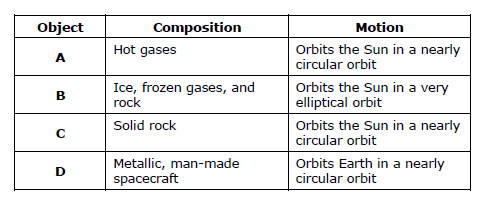
How is Earth's orbit around the Sun similar to the orbits of other planets around the Sun?
Each planet's orbit is determined by how fast it rotates.
Each planet's orbit takes about the same amount of time.
Each planet's travels the same distance in it's orbit as the other planets.
Each planet's orbit is controlled by the pull of the Sun's gravity.
How does gravities' interaction with the sun impact the sun and the rest of our solar system?
Gravity didn't actually cause the formation of our solar system, including the Sun, and its planets and moons
It is inertia that caused the formation of our solar system, including the Sun, and its planets and moons
gravity caused the formation the Sun only
It is gravity that caused the formation of our solar system, including the Sun, and its planets and moons
The sun's gravitational pull keeps our solar system in line. Why does gravity not bring the planets closer to the sun?
Because gravity doesnt really exist, its just a theory
Because of anti gravity forces
Because of inertia
Gravity is present but too weak to really impact the planets
Scientists observed a rocky, rotating object orbiting in space. It was 250 km wide. The rocky object was located several
times farther away from the Sun than the Earth.
The object is most likely —
Venus
The Moon
Mars
An Asteroid
The size and shape of the universe is primarily controlled by
friction
gravity
electricity
magnetism

Robert Hooke, Anton van Leeuwenhoek, Theodor Schwann, Rudolf Virchow, and Matthias Schliden were all responsible for what theory?
The Theory of Gravity
The Theory of Relativity
The Cell Theory
The Theory of Continental Drift
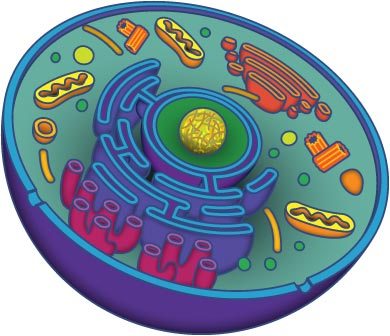
All living things are made up of...
cells
tissues
organ
organ systems
All cells -----
come from other dead cells
come from other living cells
crystallize out of the air
Cell theory states that...
cells are the basic building block of life
cells are cool
cells are microscopic
cells cannot be destroyed
In many desert ecosystems, days are hot and nights are cold. Water is scarce, so animals seek water wherever possible. The spines of a cactus are actually leaves adapted to conserve water. The cactus plants have also adapted to live in thin, sandy soil. Which of the following is a biotic component of a desert ecosystem?
the thin, sandy soil
the wide temperature range
the scarcity of water
the spiny cactus leaves
Which of these is a biotic factor in a river ecosystem?
the types of microorganisms that live in the river water
the amount of soil and other particles carried by the river
the speed at which the river water flows toward the ocean
the amount of rain that flows off the land and into the river
A hollow, sealed glass sphere contains sand, water, air, algae, and tiny brine shrimp. The sphere is a model ecosystem. Which of these is a biotic factor of this ecosystem?
air
algae
sand
water
Which is an example of a seasonal change to a biotic factor?
Temperatures get cooler in the fall.
Hours of sunlight increase the summer.
Birds fly south for the winter.
Rainfall increases in the spring.
Which of the following shows an abiotic factor interacting with a biotic factor in the environment?
Lamprey eels survive by attaching themselves to trout.
Water temperature affects its oxygen level.
Low light intensity affects the growth of forest pine trees.
Gypsy moth caterpillars eat the leaves of apple tree.
Which is an example of a biotic factor in the environment?
The climate in the region
Carnivores that consume other animals
Amount of helium gas in the air
Flow of water in a river
Which is an example of an abiotic factor in a pond environment?
The water
A frog
A grasshopper
A snake

