
 Worksheets
LT 1: Phases of Matter Diagram Retake Requirement
Total questions: 95
Worksheet time: 1hrs 7mins
Change from Liquid to Solid is called ...
fusion
Freezing
sublimation
evaporation
Change from liquid to gas is called....
expansion
evaporation
condensation
sublimation
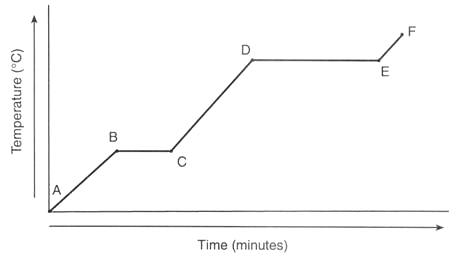
What state/phase is the object likely from points A to B?
Solid
Liquid
Gas
Plasma
What is happening to the particles in the substance between points D and E?
Melting
Freezing
Vaporizing
Sublimating

Where on the graph are phase changes taking place?
1
2
3
4
5
Which statement is NOT true about gases?
Gases flow.
Gases spread out.
Gases cannot be held.
None of these.


Does air have weight?
no
sometimes
yes
of course not
The phase change when a solid becomes a liquid.
freezing
sublimation
melting
condensation
During a PHASE CHANGE, like freezing, temperature...
increases.
decreases.
does NOT change.
varies.
The phase change when a liquid becomes a gas.
melting
boiling
sublimation
evaporation
The phase change when a gas becomes a liquid.
condensation
evaporation
deposition
sublimation

condensation

Which process could cause a material to change state from gas to liquid?
Adding heat
Adding energy
Removing particles
Removing energy


What must happen for molecules to move slower?
Kinetic energy is not changing. Temperature decreases.
Kinetic energy and temperature depend on the molecules.
Kinetic energy is decreasing and temperature is decreasing.
Kinetic energy is decreasing and temperature is increasing.

What phase is A?
Solid
Liquid
Gas
Plasma
What phase is C?
Solid
Liquid
Gas
Plasma
What phase is E?
Solid
Liquid
Gas
Plasma
What phase is D?
Melting
Freezing
Vaporization/Evaporating
Condensing
What phase is F?
Melting
Freezing
Vaporization/Evaporating
Condensing
What phase is B?
Melting
Freezing
Vaporization/Evaporating
Condensing
What phase is G?
Melting
Freezing
Vaporization/Evaporating
Condensing
What is true about point D?
The molecules are slowing down and getting closer together
The molecules are slowing down and getting further apart
The molecules are speeding up and getting closer together
The molecules are speeding up and getting further apart
What is true about point F?
The molecules are slowing down and getting closer together
The molecules are slowing down and getting further apart
The molecules are speeding up and getting closer together
The molecules are speeding up and getting further apart
What is true about point B?
The molecules are slowing down and getting closer together
The molecules are slowing down and getting further apart
The molecules are speeding up and getting closer together
The molecules are speeding up and getting further apart
What is true about point G?
The molecules are slowing down and getting closer together
The molecules are slowing down and getting further apart
The molecules are speeding up and getting closer together
The molecules are speeding up and getting further apart

Which of the following is true about the lines on the phase change diagram?
The diagonal line represents a phase change of matter
The flat line represents the phase of matter
The diagonal line shows a change in temperature
The flat line shows a change in temperature
Which of the following is true about the lines on the phase change diagram?
The diagonal line represents the phase of matter
The flat line represents the phase of matter
The diagonal line shows no change in temperature
The flat line shows a change in temperature
Which of the following is NOT true about the lines on the phase change diagram?
The diagonal line represents the phase of matter
The flat line represents a change in the phase of matter
The diagonal line shows a change in temperature
The flat line shows a change in temperature
Which of the following is NOT true about the lines on the phase change diagram?
The diagonal line represents the phase of matter
The flat line represents a change in the phase of matter
The diagonal line shows a change in temperature
The flat line shows no change in time
Which of the following is true about the lines on the phase change diagram?
The flat line on the graph demonstrates that the temperature does not change until the phase change is complete
The flat line represents a change in the phase of matter
The flat line shows a change in temperature
The flat line shows no change in time
What is needed for a solid to change to a liquid?
Thermal energy needs to increase the molecules need move further apart this is called melting
Thermal energy needs to decrease the molecules need to move closer together this is called freezing
Thermal energy needs to increase the molecules get closer together this is called melting
Thermal energy needs to decrease the molecules get further apart this is called freezing
Thermal energy needs to increase the molecules get further apart this is called vaporization
What is needed for a liquid to change to a solid?
Thermal energy needs to increase the molecules need move further apart this is called melting
Thermal energy needs to decrease the molecules need to move closer together this is called freezing
Thermal energy needs to increase the molecules get closer together this is called melting
Thermal energy needs to decrease the molecules get further apart this is called freezing
Thermal energy needs to decrease the molecules get closer together this is called condensation
What is needed for a liquid to change to a gas?
Thermal energy needs to increase the molecules need move further apart this is called vaporizing
Thermal energy needs to decrease the molecules need to move closer together this is called freezing
Thermal energy needs to increase the molecules get closer together this is called vaporizing
Thermal energy needs to decrease the molecules get further apart this is called freezing
Thermal energy needs to decrease the molecules get closer together this is called condensation
What is needed for a gas to change to a liquiid?
Thermal energy needs to increase the molecules need move further apart this is called vaporizing
Thermal energy needs to decrease the molecules need to move closer together this is called freezing
Thermal energy needs to increase the molecules get closer together this is called vaporizing
Thermal energy needs to decrease the molecules get further apart this is called freezing
Thermal energy needs to decrease the molecules get closer together this is called condensation

What term goes on the y-axis? (A)
Heat(Energy)
Temperature
Phase
Type of Matter
What phase of matter exists in part C of the graph?
Gas
Liquid
Solid
Plasma
What phase of matter exists in part D of the graph?
Gas
Liquid
Solid
Plasma
What phase of matter exists in part E of the graph?
Gas
Liquid
Solid
Plasma
What phase change occurs when you start at D and end at E?
Freezing
Melting
Condensing
Vaporization
What phase change occurs when you start at D and end at C?
Freezing
Melting
Condensing
Vaporization
What phase change occurs when you start at E and end at D?
Freezing
Melting
Condensing
Vaporization
What phase change occurs when you start at C and end at D?
Freezing
Melting
Condensing
Vaporization
On which parts of the graph does the temperature remain the same?
Between C and D
Between D and E
At C, D, or E
On both flat sections
On which parts of the graph does the temperature change?
Between C and D
Between D and E
At C, D, or E
On both flat sections
The temperature changes the most during a phase change.
True
False
What phase change occurs when you start at D and end at C?
Freezing
Melting
Condensing
Vaporization
What phase change occurs when you start at E and end at D?
Freezing
Melting
Condensing
Vaporization
What phase change occurs when you start at C and end at D?
Freezing
Melting
Condensing
Vaporization
On which parts of the graph does the temperature change?
Between C and D
Between D and E
At C, D, or E
On both flat sections
What phase of matter exists in part E of the graph?
Gas
Liquid
Solid
Plasma
What phase of matter exists in part D of the graph?
Gas
Liquid
Solid
Plasma
How would you describe the way molecules move when the molecules are gas?
the molecules are moving in place.
the molecules are moving around each other.
the molecules are moving away from each other.
the molecules are not moving
What happens to molecules when the temperature drops or lowers?
The molecules get closer together
The molecules start moving faster.
The molecules stop moving.
The molecules become smaller.


The state of matter that has particles close together and vibrating.
liquid
solid
gas
water
Temperature MEASURES...
the movement of particles.
how hot it is.
how cold it is.
weather.
Which of the following are characteristics of a gas? (Check all that apply)
Definite Shape
Indefinite Shape
Definite Volume
Indefinite Volume
Ionized
Which of the following are characteristics of a liquid? (Check all that apply)
Definite Shape
Indefinite Shape
Definite Volume
Indefinite Volume
Ionized

Identify the following phase of matter.
Solid
Liquid
Gas
Plasma
Which of the following statements are TRUE about states of matter and kinetic energy? (more than one answer)
Fewer particles means there is more kinetic energy
As temperature increases so does kinetic energy
As temperature decreases particles move closer together
As the number of particles increases so does kinetic energy

Which substance has the most energy?
Ice water
Ice
Tap water
Lightning
How does plasma, the fourth state of matter, differ from a gas?
Plasma has indefinite shape and volume; gas does not.
Plasma has definite shape and volume; gas does not.
Plasma cannot conduct electricity; gas can.
Plasma has electrically charged particles like the Northern Lights; gas does not.
Phase changes always involve changes in
matter.
space.
color.
energy.

Measures how fast or how slow molecules are moving
Density
Temperature
Heat
All of them
How are plasma and gas different?
Plasma has a definite shape, but gas does not.
Gas is hotter than plasma.
Electrons separate from atoms in plasma and plasma is hotter.
Gas has a definite volume, but plasma does not.
This is the most abundant state of matter in the Universe!
Gas
Plasma
Solid
Liquid
Which state of matter would be described as having highly energized, charged particles which move extremely fast?
solid
liquid
plasma
gas
SELECT ALL THAT APPLY
When you add energy to matter...
...the particles move faster.
...it might change state.
...the temperature will increase.
...you remove cold energy.
All of the above.
What term goes on the x-axis? (B)
Heat(Energy)
Temperature
Phase
Type of Matter
What term goes on the y-axis? (A)
Heat(Energy)
Temperature
Phase
Type of Matter
As an ice cube melts, its molecules
absorb heat energy and move farther apart
release heat energy and move farther apart
absorb heat energy and move closer together
release heat energy and move closer together
Which state of matter is described below?
1. Particles are packed closely together
2. Particles vibrate
3. Strong molecular attraction between particles
solid
liquid
gas
plasma
Which state of matter is described below?
1. Particles are less densely packed
2. Particles slide around past each other
3. Not a strong molecular attraction between particles
solid
liquid
gas
plasma
Which state of matter is described below?
1. Particles move freely
2. High energy
3. Very weak molecular attraction between particles
solid
liquid
gas
plasma
A hot air balloon rises because its ___.
particles are less attracted by gravity when heated
particles move slower and closer together when heated
particles move faster and farther apart when heated
particles become charged and repel each other when heated
The three states of matter are different. However, liquids and gases do have some things in common. One of these is ____.
the liquids and gases are both more dense than solids
the liquids and gases both take the shape of their container
that liquids and gases have the same densities as solids
that liquids and gases do not take the shape of their container
The change from a liquid to a solid state is called ___.
freezing
melting
condensing
vaporizing
What are the 3 parts of kinetic molecular theory?
Matter is made up of tiny particles called atoms
The phase is dependent on the kinetic energy of the particles
Atoms are in constant random motion.
All matter has mass and takes up space.
When an item is heated up it becomes a gas

