wayground logo

Free Printable Worksheets

NEW

Font size

S
M
L
XL
Worksheets

cell recap

Total questions: 61

Worksheet time: 1hrs 21mins

Name
Class
Date
1.
Which organelle is found in plant cells only?
a)
Cell Membrane
b)
Cell Wall
c)
Many Small Vacuoles
d)
Cytoplasm
2.
Which organelle is found in plant cells only?
a)
Cell Membrane
b)
Large Central Vacuole
c)
Many Small Vacuoles
d)
Cytoplasm
3.
Which organelle is found in animal cells only?
a)
Cell Membrane
b)
Large Central Vacuole
c)
Many Small Vacuoles
d)
Cytoplasm
4.
Which organelle is found in plant cells only?
a)
Cell Membrane
b)
Chloroplast
c)
Many Small Vacuoles
d)
Cytoplasm
5.
To provide a protective barrier between the interior of the cell and the outside environment is a function of _________.
a)
Cell Membrane
b)
Cell Wall
c)
Nucleus
d)
Mitochondria
6.
It is located outside the cell membrane of plants and some bacteria which serves as support.
a)
cell wall 
b)
choloroplast
c)
smooth ER 
d)
rough ER
7.
it uses sunlight to create food, photosynthesis (only found in plant cells),
a)
smooth ER
b)
golgi body
c)
cell wall
d)
chloroplasts
8.

Who looked at cork and named what he saw cells?

a)

Anton van Leeuwenhoek

b)

Robert Hooke

c)

Rudolph Virchow

d)

Matthias Schleiden

9.
This organelle takes food and turns it into ENERGY for plant and animal cells.
a)
Chloroplast
b)
Mitochondria
c)
Lysosome
d)
Ribosome
10.
This organelle acts like a gatekeeper, allowing some materials to pass through it, but not others. 
a)
Cytoplasm
b)
Cell Membrane
c)
Mitochondria
d)
Vacuole
11.
This organelle is a gel-like fluid that takes up most of the space inside the cell. 
a)
Cytoplasm
b)
Cell Membrane
c)
Vacuole
d)
Golgi Body
12.
What distinguishes a eukaryotic cell from a prokaryotic cell is the presence of 
a)
A cell wall
b)
A nucleus
c)
DNA
d)
Ribosomes
13.

An organism made of only one cell is called . . .

a)

Eukaryotic

b)

Monocellular

c)

Multicellular

d)

Unicellular

14.

Organisms with cells that have a nucleus are called . . .

a)

Archaea

b)

Bacteria

c)

Eukaryotes

d)

Prokaryotes

15.
This organelle is a gel-like fluid that takes up most of the space inside the cell. 
a)
Cytoplasm
b)
Cell Membrane
c)
Vacuole
d)
Golgi Body
16.
The _____________ stores food, water, wastes, and other materials in both plant and animal cells.
a)
Vacuole
b)
Mitochondria
c)
Ribosomes
d)
Chromatin
17.

“Power House” of the cell

a)

eukaryotic

b)

vacuole

c)

nucleus

d)

mitochondria

18.
Which organelle is found in plant cells only?
a)
Cell Membrane
b)
Large Central Vacuole
c)
Many Small Vacuoles
d)
Cytoplasm
19.
The basic unit of structure and function in living things is the ___________.
a)
Organ Systems
b)
Tissues
c)
Organs
d)
Cells
20.
Which cells contain a defined nucleus and membrane bound organelles
a)

Bacteria

b)
Eukaryotes
c)
Prokaryotes
d)

Archeabacteria

21.
The group of tissues working together to perform a specific function.  Example heart, brain, and stomach.
a)
Organ Systems
b)
Tissues
c)
Organs
d)
Cells
22.

Organism that has to get food from an outside source.

a)

photosythesis

b)

autotrophic

c)

organism

d)

heterotrophic

23.

Uses energy from the sun to make food (sugar and oxygen) for the plant (photosynthesis)

a)

cell wall

b)

chloroplast

c)

mitochondria

d)

plant cell

24.

Term describing an organism that makes it's own food.

a)

eukaryotic cell

b)

prokaryotic cell

c)

autotrophic

d)

heterotrophic

25.
What tool do you use to view the cells?
a)
metric ruler
b)
centrifuge
c)
microscope
d)
telescope
26.
Robert Hooke, Anton van Leeuwenhoek, Theodor Schwann, Rudolf Virchow, and Matthias Schliden were all responsible for what theory?
a)
The Theory of Gravity
b)
The Theory of Relativity
c)
The Cell Theory
d)
The Theory of Continental Drift
27.
All living things are made up of...
a)
cells
b)
cell tissues
c)
organ
d)
organ systems
28.

The 3 parts of the Cell Theory are...?

a)

All living things are composed of cells

Cells are the basic units of structure and function in living things

All cells are produced from other cells

b)

All living things are composed of cells

Cells are the basic units of dance and vibes in living things

All cells are destroyed from other aliens

c)

All living things are composed of Jell-O

Cells are the basic units of structure and function in living things

All cells are produced from factories in Canada

d)

All living things are composed of cells

Cells do karate and practice eating whole pies in their free time

All cells are produced from other cells
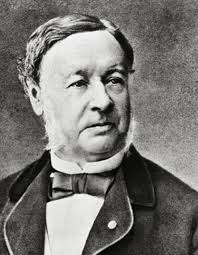
29.
Which of the following scientists concluded that all animals are made of cells?
a)
Rudolf Virchow
b)
Matthais Schleiden
c)
Robert Hooke
d)
Theodor Schwann
30.
Which of the following scientists was the first to observe bacteria?
a)
Anton van Leuwenhoek
b)
Matthais Schleiden
c)
Robert Hooke
d)
Theodor Schwann
31.
Which of the following statements is not part of the cell theory?
a)
Cells are the basic unit of structure and function in all living things.
b)
All cells are produced from other cells.
c)
Only animal cells are composed of cells.
d)
All living things are composed of cells.
32.

When cells are damaged, new cells are created by cell a process called cell division. How does the cell theory support this fact?

a)

It states that all cells have a nucleus which divides.

b)

It states that all living things are made up of one or more cells.

c)

It states that cells come from previously existing cells.

d)

It states that the basic units of structure and function are cells.

33.

Organism whose cells contain a nucleus

a)

Prokaryotic Cell

b)

Eukaryotic Cell

34.

Specialized structure that performs important cellular functions within a eukaryotic cells

a)

Nucleus

b)

Organelle

c)

Cells

35.

Contains DNA

a)

nucleus

b)

mitochondria

c)

chloroplast

d)

endoplasmic reticulum

36.

Converts solar energy to chemical energy stored in food

a)

nucleus

b)

mitochondria

c)

chloroplast

d)

endoplasmic reticulum

37.

Powerhouse of the cell

a)

nucleus

b)

mitochondria

c)

chloroplast

d)

endoplasmic reticulum

38.
The smallest unit that can perform the basic activities of life is
a)
a cell 
b)
a tissue
c)
an organ
d)
an organism
39.
Unlike eukaryotes, prokaryotes do not have:
a)
DNA
b)
cytoplasm
c)
cell walls
d)
a membrane bound nucleus
40.
 Which of the following is NOT one of the main components of the cell theory?
a)
cells must contain DNA
b)
all living things are made of cells
c)
cells can only come from other cells
d)
cells are the basic unit of life
41.
Rudolph Virchow's observations helped to disprove was commonly held belief of the time?
a)
evolution
b)
the existence of molecules
c)
spontaneous generation
d)
atomic models
42.
A plant and an animal are both living things. According to the Cell Theory, what can you conclude about these two very different organisms?
a)
Plants have cells but animals do not.
b)
They are both made of one or more cells. 
c)
They both come from the same kind of cell.
d)
They both come from a non-living organism.
43.

Which do BOTH prokaryotes and eukaryotes contain?

a)

nucleus

b)

mitochondria

c)

ribosomes

d)

cell wall

44.

Prokaryotic cells do not have…….

a)

membrane bound organelles

b)

cell membrane

c)

DNA or RNA

d)

life

45.

You can distinguish a prokaryote apart from a nucleus by--

a)

The presence of a ribosome

b)

The presence of a cell membrane

c)

The presence of DNA

d)

The presence of a nuclear membrane

46.
Which of the following is not a characteristic of a Prokaryotic cell?
a)
unicellular
b)
floating DNA
c)
very small
d)
complex
47.
A fossilized cell is discovered, and evidence suggests it reproduced on its own and had DNA, but a membrane did not enclose its DNA. Which type of organism would this most likely be?
a)
prokaryote
b)
eukaryote
c)
plant cell
d)
animal cell
48.

Which of the following structures is ALWAYS found in both eukaryotic and prokaryotic cells?

a)

nucleus

b)

mitochondria

c)

ribosomes

d)

cell wall

49.

The smallest unit of a living thing are

a)

atoms

b)

cells

c)

DNA

d)

organelles

50.

Which cell type tends to be smaller?

a)

Prokaryote

b)

Eukaryote

c)

there is not a size difference

51.

CHALLENGE QUESTION: Which of the following provides evidence for the hypothesis that prokaryotes evolved before eukaryotes.

a)

prokaryotes are more complex

b)

prokaryotes have no nucleus and fewer genes

c)

eukaryotes are multicellular which makes them simpler

d)

prokaryotes grow into eukaryotes

52.
Has membrane bound organelles
a)
Prokaryote
b)
Eukaryote
c)
both
53.
Has cytoplasm
a)
Prokaryote
b)
Eukaryote
c)
both
54.
more complex
a)
Prokaryote
b)
Eukaryote
c)
both
d)
both
55.
Which type of cell?
a)
Prokaryote
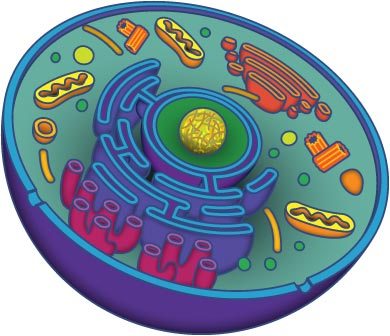
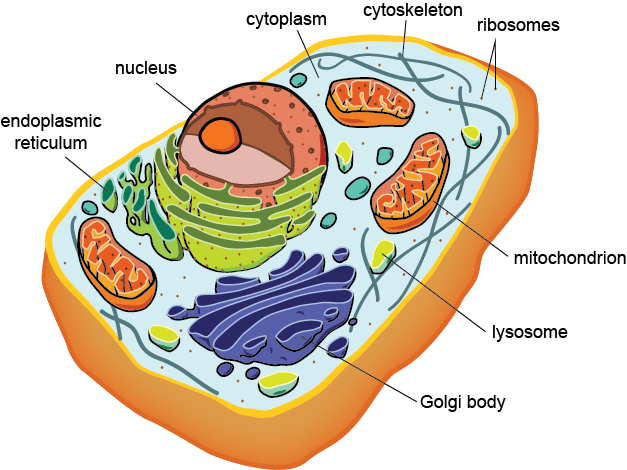
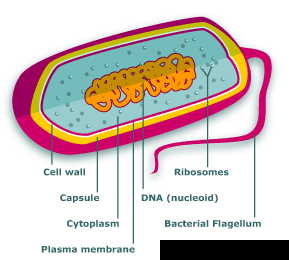
b)
Eukaryote
56.
Which type of cell?
a)
Prokaryote
b)
Eukaryote
57.
Where is the DNA found in a eukaryotic cell? 
a)
floating around in the cytoplasm 
b)
in the nucleus 
58.
What type of cell does not have a nucleus?
a)
eukaryotic 
b)
prokaryotic 
59.

These organisms can have specialized cells.

a)

eukaryotic

b)

prokaryotic

60.

The area between the cell membrane and the nucleus is filled with ...

a)

genetic information

b)

the nucleolus

c)

cytoplasm

d)

cell wall

61.

This organelle is covered in ribosomes.

a)

Smooth ER

b)

Rough ER

c)

Golgi body

d)

Ribosome