Worksheets
F23 Earth Science Course Quiz
Total questions: 134
Worksheet time: 3hrs 29mins
Two factors effecting the magnitude of the force of gravity between 2 objects are _?_.
mass and distance
mass and matter
distance and weight
weight and mass
A person would weigh more on Jupiter than on the Earth because _?_.
Jupiter has more mass, and therefore more gravity
Jupiter has less mass, and therefore more gravity
Jupiter has more mass, and therefore less gravity
Jupiter has less mass and therefore less gravity
Where is our solar system located in the Milky Way galaxy?
Right in the exact center
On the outside edge, near the rim
About 2/3rds of the way from the center
About half way out from the center
What is the shape of the Milky Way galaxy?
Linear
Elliptical
Spiral
Irregular
Which of the following objects is the biggest?
Solar system
Universe
Galaxy
Star
What is Hubble's Law?
The farther away a galaxy is from us, the faster it moves away from us.
The farther away a galaxy is from us, the slower it moves away from us.
The closer a galaxy is to us, the faster it moves away from us.
The more red light we observe from another galaxy, the closer we are to that galaxy
If an object is making noise and moving quickly towards us, we will observe:
the pitch of the noise will be higher than if the object wasn't moving
the pitch of the noise will be lower than if the object wasn't moving
the volume of the noise will be louder than if the object wasn't moving
the volume of the noise will be softer than if the object wasn't moving

When objects move towards you, the wavelength....
Increases (gets longer)
Decreases (gets shorter)

The top spectra is the laboratory spectra and is not moving. What type of shift is shown with the bottom spectra and is the object moving towards or away from the observer?
Red Shift
Towards
Red Shift
Away
Blue Shift
Towards
Blue Shift
Away

You are the observer looking at the jet. As the Jet takes off, what is happening to the wavelength of sound and the pitch of the sound?
Longer wavelength and getting less loud
Longer wavelength and getting louder
Shorter wavelength and getting less loud
Longer wavelength and getting louder

When objects move towards the observer, what color shift is happening?
Red Shift
Blue Shift
When hydrogen is "fused" together on the Sun, what new element is created?
Helium
Carbon Dioxide
Oxygen
Light


How old is the Solar system?
4.6 Billion years old
4.6 million years old
460 million years old
46 million years old
What happens if a planet is too hot?
The water will be nice and warm
The water will boil away
The water will be too cold
The water will freeze and make ice
What does most every living thing need to survive?
Steam
Ice
Plasma
Liquid water
What happens to the period of orbit as distance from the star increases?
Increases
Decreases
Stays the same
If planet A has an eccentricity of 0.001, planet B has an eccentricity of .04, and planet C has an eccentricity of .1, which planet has the most elliptical orbit?
A
B
C

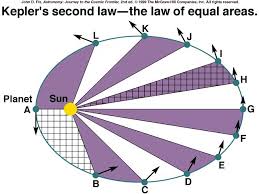
Where is the planet moving faster?
Which statement best describes Kepler’s 2nd Law of Planetary Motion?
Planets revolve around the sun over equal areas in equal time intervals.
Planetary orbits are in the shape of an ellipse.
A planet’s orbital period is proportionate to its distance from the sun.
Kepler’s first law states that
the sun is the center of the solar system.
planets orbit the sun in elliptical orbits, with the sun located at one focus.
planets orbit the sun in circular orbits, with the sun located at the center.
gravity provides the force that holds the planets in orbit about the sun.

What are fossils that are abundant, easily recognizable, short lived, and widespread called?
Preserved fossils
Index fossils
Imprints
Radioactive dating

Which fossil would make the best index fossil?
Beetle
Flower
Frog
Fish
Saying you are older than your sister is an example of _______.
absolute age
relative age

What era did trilobites, fishes, and other marine organisms dominate?
Precambrian
Paleozoic
Mesozoic
Cenozoic

Which Era occurred last (most recent)?
Cenozoic
Mesozoic
Paleozoic

Which of the following is tue?
A fault is younger than the rock layers that it goes through.
A fault is older than the rock layers that it goes through.
The rock layers are younger than the fault that cuts through it.

Which layer is OLDER? Intrusion M or Layer D?
Intrusion M
Layer D


The diagram shows fossils and rock features...
Which is younger than the clam fossil?
Layer Z
Broadleaf
Reptile bone
Intrusion X
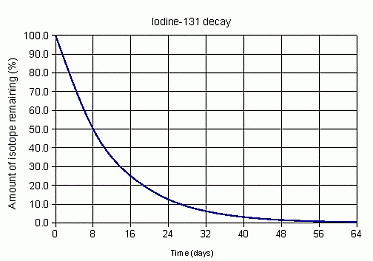


How do scientists classify different minerals?
scientist identify the elements that compose the mineral
scientists look at the number of molecules in the mineral sample
scientists classify minerals based on their age
scientists can identify the type of minerals based in its specific gravity

All minerals are ___, which means they have definite shape and volume. They cannot be liquids or gases.
definite chemical composition
color
luster
solid
Metamorphic rocks are formed from
heat and pressure
melted rock
sediment cementing together
minerals dissolving


Limestone is an example of...
Sedimentary
Igneous
Metamorphic

Marble is an example of...
Igneous
Sedimentary
Metamorphic

Obsidian is an example of...
Igneous
Sedimentary
Metamorphic

The best answer for section "A" in the diagram
metamorphic/melting
compaction/cementation
weathering/erosion
heat/pressure

The best answer for section "B"
metamorphic/melting
compaction/cementation
weathering/erosion
heat/pressure


Which layer exists as a collection of tectonic plates?
asthenosphere
mantle
lithosphere
outer core
Which describes the difference between continental and oceanic crust chemical composition?
continental crust has more SiO2 so it sinks
continental crust has more Fe so it floats
oceanic crust has more SiO2 so it floats
oceanic crust has more Fe so it sinks
Which of the following represents physical layers of Earth?
core, mantle, crust
core, mantle, oceanic crust, continental crust
inner core, outer core, mesosphere, asthenosphere, lithosphere
inner core, outer core, mantle, oceanic crust, continental crust
The Appalachian Mountains in the U.S. match up with a similar mountain ranges in northern Europe. How does this support Wegener's theory of Continental Drift?
The mountains were formed after tectonic plates had moved away from each other
The similarities provide evidence North America & Europe were connected when the mountains formed.
Similar rock samples were found on the ocean floor and at the two mountain ranges indicating that they both formed around the same time.
This evidence does not support the theory of continental drift.

According to the continental drift hypothesis, the presence of similar fossils in South America and Africa supports which scientific idea?
Animals easily and frequently travel from Africa to South America.
Species of animals probably traveled between continents on natural rafts (such as trees destroyed in tsunamis).
Land bridges once existed that connected the continents.
South America and Africa were once connected together.

The composition of Earth's interior affects
how long an earthquake will last
the speed and direction of seismic waves
the location of an earthquake's focus


When convergent plates collide, if both plates are pushed upward, this forms.
Fissures
Mountain Ranges
Volcanoes
Rock Cycle

What geologic feature/event would you most likely to find at a divergent boundary between two pieces of continental crust?
Mid-Ocean Ridge
Mountain
Rift Valley
Island Arc

What would you be most likely to find at a convergent boundary between two pieces of oceanic crust?
Mountains
Rift
Mid-Ocean Ridge
Island Arc

Molten mixture of rock-forming substances, gases and water from the mantle
magma
lava
Volcano
hot spot


What is label D
Trench
Mid ocean ridge
abyssal plain
sea mount
An area where a plume of magma melts through the crust in the middle of a tectonic plate is called:
Subduction
Hot Spot
Island Arc
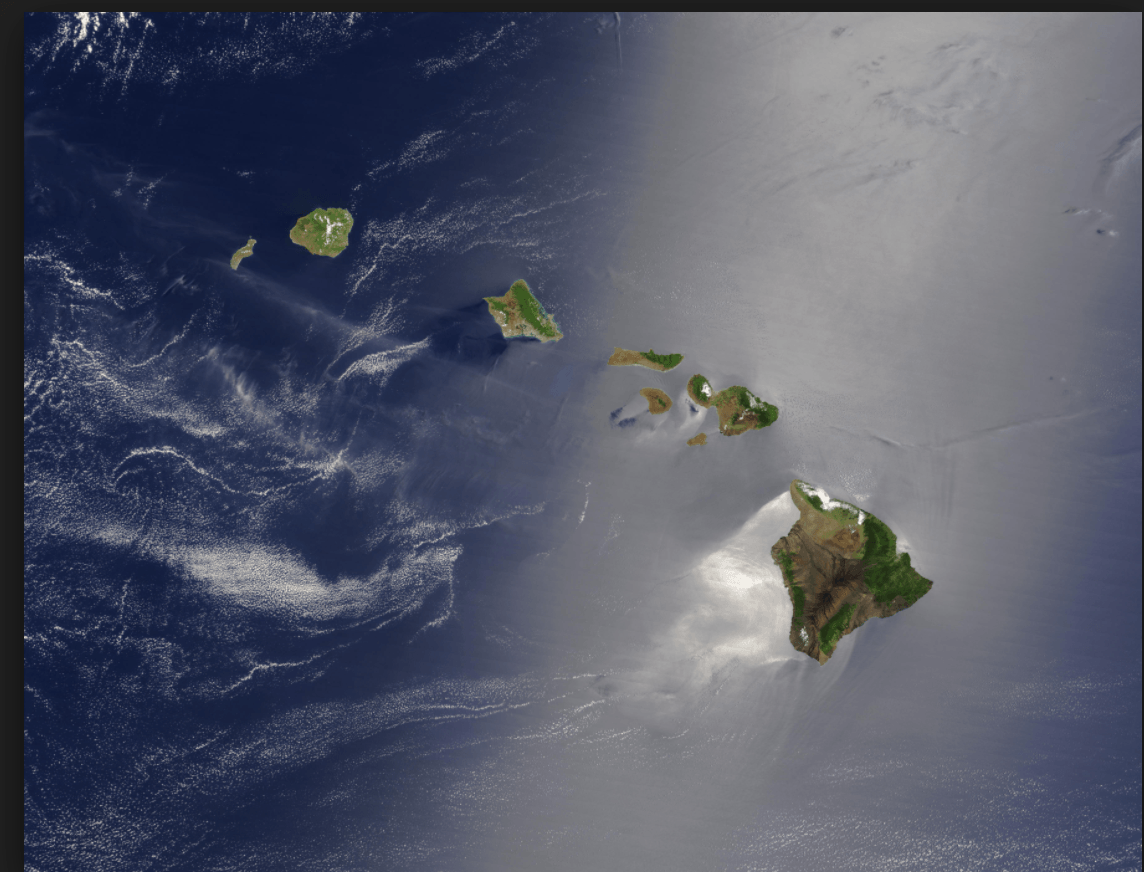
The oxidation of minerals that contain iron.
Physical Weathering
Chemical Weathering
The repeated freezing and thawing of water that cracks a rock.
Physical Weathering
Chemical Weathering
Rocks that have been carried by rivers and streams and have become more smaller and rounded.
Physical Weathering
Chemical Weathering


Limestone dissolves in the presence of acid rain
physical weathering
chemical weathering

Abrasion is physical weathering by:
ice
repeated contact
oxidation
reaction to acid
Which rock samples have undergone abrasion in water for the longest period of time?


oxygen + iron = rust
physical weathering: abrasion
chemical weathering: reaction with acid
chemical weathering: oxidation
physical weathering: frost wedging

The photograph shows a valley created by a glacier. The result of this glacial action will be a
U-shaped valley with well-sorted, rounded sediment
U-shaped valley with scratched and grooved bedrock
V-shaped valley with scratched and grooved bedrock
V-shaped valley with well-sorted, rounded sediment
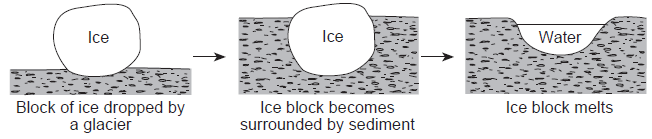
The diagram below shows a glacial landscape feature forming over time from a melting block of ice. This glacial landscape feature is best identified as
a kettle lake
an outwash plain
a finger lake
a moraine
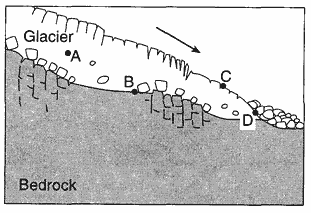
The cross section below represents the transport of sediments by a glacier. At which location is deposition most likely the dominant process?
A
B
C
D

What is this depositional feature called?
Tombolo
Spit
Sand Dune
Sand Bar

This is
Longshore Drift
Nearshore currents
Attrition
Undertow

What is the structure in the photo?
groin
seawall
breakwater
inlet

What is illustrated in this aerial photo?
seawall
breakwater
groin
jetty

Wave energy drops sand out in the ocean and forms a sand bar. Continued deposition causes the sandbar to rise out of the ocean and forms
spits
jetties
barrier islands
longshore currents
A barrier built out into a body of water to protect a coast or harbor from the force of wind, waves, tides and currents
spit
groin
seawall
breakwater


Which sample is MOST permeable?
round
flat
oval
Select the graph that shows the relationship between porosity and permeability.


Which of the statements gives an accurate description of the proportions of the soil a X?
Sand: 12% Silt: 9% Clay: 79%
Sand: 16% Silt: 30% Clay: 40%
Sand: 12% Silt: 9% Clay: 79%
Sand: 32% Silt: 48% Clay: 29%
Sand: 22% Silt: 18% Clay: 50%

Clay, silt, and sand are added to a jar of water. The jar is shaken and then allowed to stand quietly for a number of hours. The result of this demonstration could be best used as a model to show that
A) particles with the lowest density settle the fastest
B) particles with the largest size/diameter settle the fastest
C) water is denser than clay, silt, and sand
D) the bottom layer of a series of sediments is the youngest

Which graph best represents the relationship between the slope of a river and the particle size that can be transported by that river?
A
B
C
D
What is runoff?
The process of sediment moving or being weathered away by wind or water.
Water that moves over Earth's surface, because it doesn't infiltrate the ground.
Water moving from the liquid state to the gaseous state.
Observations described in words or letters.
Liquid to Gas
melting
vaporization
condensation
sublimation
What is the phase change from gas to liquid?
condensation
vaporization
melting
freezing

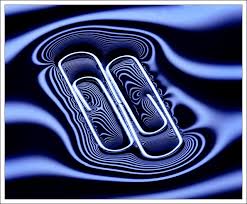


The fact that water can stick to other substances is called:
Ph
Adhesion
Cohesion
Insulation

Which will heat up faster?
copper
granite
iron
basalt
Which of the following best explains why the sand at the beach is hotter than the water?
Sand has a higher specific heat than water.
Sand has a lower specific heat than water.
There is more water than sand at the beach.
There is more sand than water at the beach.

What are the accepted units for specific heat capacity?
J/g * C
J/g
g/J * C
J
Which type of water is MOST dense?
fresh
salt
If the plant population decreased, the amount of carbon dioxide in the atmosphere would _________.
Stay the same
Increase
Decrease
Check all the ways that carbon dioxide is REMOVED from the atmosphere.
Respiration
Combustion
Photosynthesis
Diffusion
Decomposition

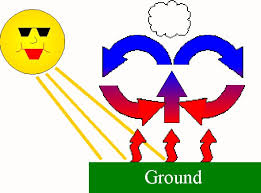
How is the greenhouse effect produced?
When solar energy trespasses the atmosphere.
When some energy is reflected back to earth.
When the green house is burned.
When the sun doesn't emit radiation.

Conduction
Convection
Radiation