
 Worksheets
Unit 1 Test Bank: Density, Heat, and Energy
Total questions: 130
Worksheet time: 3hrs 59mins
8.7: Combustion is when a __________ reacts with oxygen
petrol
fuel
fire triangle
carbon dioxide
What are the two PRODUCTS in a complete combustion reaction?
Carbon Dioxide and Water
Carbon Monoxide and Methane
Carbon and Water
Fuel and Oxygen
Which is the correct equation for calculating the calories from burning the cheeto?
qm=Δt⋅cal
m⋅c=gramcal
m=q⋅Δtc
What is NOT product of complete combustion?
carbon dioxide
water
carbon monoxide
water
This type of combustion occurs when there is a limited supply of oxygen
Complete Combustion
Incomplete Combustion
This burning of methane resulted in the formation of soot
methane + carbon monoxide --> oxygen + carbon + water
methane + oxygen --> carbon dioxide + carbon + water
methane + oxygen --> carbon monoxide + carbon + water
Hydrocarbon fuel + oxygen ----> ___+____
(Select 2)
CO2
O2
H2O
CxHy
C2H4 + 2 O2 -->
2 C6H14 + 19 O2 --> 12 CO2 + 14 H2O
What are the 3 reactants of photosynthesis? The reactants are the things needed for photosynthesis to occur.
oxygen, glucose, sunlight
sunlight, oxygen, water
water, oxygen, carbon dioxide
carbon dioxide, sunlight, water
Why do we burn a fuel?
To have fun
To release energy
To lose energy
To produce carbon dioxide

What does incomplete combustion produce that complete combustion doesn't?
Carbon Monoxide
Water
Heat
Carbon Dioxide

Which diagram shows the MOST dense object?
left
center
right

Which diagram shows the LEAST dense object?
left
center
right
A block of aluminum occupies a volume of 15.0 mL and weighs 45.0 g. What is its density?
3 g/mL
0.3333 g/mL
675 g/mL
I have no idea
Why do objects sink or float in H2O?
Because their densities are higher or lower than compared to water
Because their densities are using gravity to pull down
Because their densities are heavier or lighter
Because their mass and volumes are equal


What is the volume of 150 grams of lead if it has a density of 11.3 g/cm3?
13.3 g
13.3 cm3
.075 g
1695 cm3

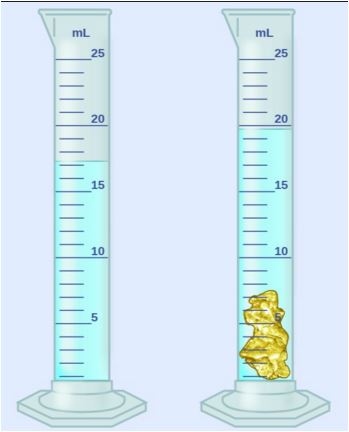

Which has the greatest volume?
One on left
One on right
Both the same
Volume cannot be determined
Which are measurable physical properties? (may be more than one)
volume
density
mass
temperature
Ethanol has a density of 0.789 g/cm 3 .
What is the mass of 225 cm 3 of ethanol?
178g
285g
0.004 g
225.789g


Pick the BEST Energy Conversion below for a Hydroelectric Dam.
The Law of Conservation of Energy states that energy is never _____________ or ____________, only transformed.
created, destroyed
created, subtracted
added, subtracted
destroyed, subtracted

If the specific heat of water is 4.18 J/g∙°C, how much heat is required to increase the temperature of 1.2 kg of water from 23 °C to 39 °C?
-80,256 J
80.256 J
80,256 J
-80.256 J
For a skillet, used for cooking, do you want a high or low specific heat
High, so that it will need more energy to heat up
Low, so that it will change temperature quickly
What is the specific heat of an unknown substance if 100.0 g of it at 200.0 °C reaches an equilibrium temperature of 27.1 °C when it comes in contact with a calorimeter of water. The water weighs 75. g and had an initial temperature of 20.00 °C? (Specific heat of water is 4.18 J/g°C)
0.111 J/g°C
1.29 J/g°C
0.129 J/g°C
22225.85 J
Calorimetry Question:
A piece of metal with a mass of 32.8 g is heated to 100.5°C and dropped into 138.2 g of water at 20.0°C. The final temperature of the system is 30.2°C. What is the specific heat capacity of the metal?
2.56 J/g°C
0.391 J/g°C
5.29 J/g°C
3.50 J/g°C

What is the temperature of the metal cube when thermal equilibrium is achieved between the cube and the liquid?

A metal cube at temperature of 70°C is immersed in water at temperature of 20°C. The metal _______ heat while the water __________ heat.
gains, loses
loses, gains
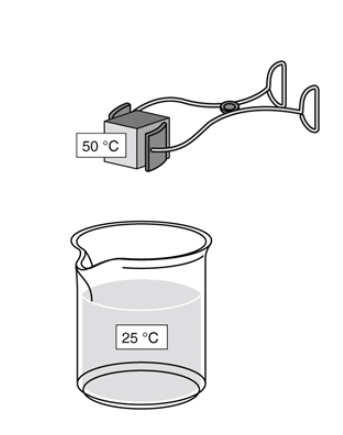
As part of a lab experiment, Tasha drops a metal cube into a beaker of water, as shown in the figure below.
After energy in the form of heat transfers between the substances, what is the final temperature of the water?
The final temperature is 25 °C because there is more water than metal.
The final temperature is 50 °C because the metal warms the water to the temperature of the metal.
The final temperature is between 25 °C and 50 °C because energy is transferred from the metal to the water.
The final temperature is between 25 °C and 50 °C because most of the thermal energy is lost to the air around the substances.
Which description defines heat?
total thermal energy of an object or substance
change in the temperature of a substance in degrees Celsius
energy transferred between objects at different temperatures
average kinetic energy of the particles that make up a substance
At room temperature water is a liquid. How could the water be changed to a solid?
add heat
remove heat
decrease density
increase density
On a hot day the lake water warms and the temperature increases. How does the movement of the particles change?
move slower and farther apart
move slower and closer together
move faster and farther apart
move faster and closer together
It is OK to goof off in the lab as long as you have finished your experiment.
true
false
Which of the following should you do in the lab?
wait for instructions
wash your hands when you are done with the experiment
keep your work area clean and organized
All of these
If you get a piece of glassware that is chipped or cracked, what should you do?
throw it in the trash can
let your teacher know
use it anyway
smash it on the floor
Which of these should you do in the lab?
listen to all instructions before starting the lab
let your teacher know if there is a problem
do only the experiment the teacher instructs you to do
all of these
When there is an accident in the lab...
Fix it before anyone sees!
Immediately report it to your teacher.
Run out of the room as fast as possible.
Try to make sure the teacher knows it wasn't your fault.
When it's time to dispose of a chemical, ____________________________
dump it down the drain.
pour it in the garbage.
pour it back into the stock bottle.
ask the teacher before disposing of any chemicals.
Which statement describes a chemical property of iron?
Iron can be flattened.
Iron conducts electricity.
Iron combines with oxygen to form rust.
Iron can be drawn into a wire.
1. A chemical change occurs when a piece of wood
splits.
decays.
is painted
is cut
1. Which of the following processes involves a change in physical properties?
rusting
fermenting
boiling
burning
1. The resistance of a fluid to flow is called
Viscosity
Energy
Density
Pressure
1. If an object is broken in half, it will have
Less density
More volume
More mass
The same density
What describes when a boat floats on water?
Viscosity
Density
Buoyancy
Pressure
1. As the viscosity of a liquid increases, the liquid —
a. evaporates more quickly
a. pours more slowly
a. conducts electricity
a. pours more quickly
What two things are needed to find the density of an object?
Mass and Velocity
Mass and volume
Speed and mass
Is digesting food a
Chemical change
Physical change
Neither
Which is a physical change?
dying your hair
dissolving sugar in water
What is the boiling point of water?
100 o C
O o C
32 o F
0 o F
If the exponent is a positive number...
If the exponent is a negative number...
8 x 10⁴

How many decades are equal to 1.7 x 1025 minutes? Round your final answer to 2 sig figs.
(60 min = 1 hour; 24 hours = 1 day; 7 days = 1 week; 52 weeks = 1 year; 10 years = 1 decade)
3.2 x 10¹⁸ decades
3.2 x 10¹⁹ decades
1.2 x 10²² decades
2.3 x 10²⁰ decades

On Dr. Davis' bookshelf, there are 23 science textbooks, each with an average of 31 chapters. If each chapter contains 5 pages, how many total pages are there? (Round your answer to 2 sig figs)
3.6 x 10⁴ pages
36 pages
3.6 x 10² pages
3600 pages

A backyard pool is 15.8 feet wide, 19.2 feet long and 5.5 feet deep. What is this pool's volume in cubic meters? [1 meter = 3.28 ft] Round your final answer to 3 sig figs.
1610 m3
47.3 m3
16,600 m3
55.9 m3
Q= m c ∆T
The units for specific heat are:
What does "q" mean?
A measure of heat energy
A change in heat energy
A measure of kinetic energy
A change in temperature
What does "ΔT" mean?
A change in health
A change in heat
A change in height
A change in temperature
Ice cream melting is an example of an __________ process.
endothermic
exothermic
Mass must always be in ________ for energy calculations.
kilograms
grams
joules
calories
When heat flows from system to the surroundings that is an example of an ________________ process.
exothermic
endothermic
What device is used to measure the amount of heat involved in a chemical reaction or physical process?
barometer
calorimeter
thermometer
1 food calorie = _______ chemistry calories
1000
1
500
4.184
The specific heat of a substance varies with the mass of a sample. True or False?
True
False
What is the SI unit of heat and energy?
calorie
celsius
joule
If 20g of sugar is stirred into a beaker containing 100g of water. What would the mass of the dissolved solution be after the sugar is dissolved fully?
20g
100g
80g
120g
Suppose you have 15g of baking soda and mix it with 15g of vinegar. When they are combined they bubble and fizz a lot. The final solution has a mass of 25g. What happened to the "lost" 5g?
it dissappears
it is still there just not weighted
it is in the gas that is formed
nothing happened
How many atoms of aluminum are on each side of the following equation?
4Al + 3O2 --> 2Al2 O3
2
6
4
1
Wildfires often start by
lightning
humans
lava
meteors
What are the three components of a wildfire?
carbon dioxide, fuel, water
oxygen, helium, sulfur dioxide
oxygen, fuel and a heat source
ozone, water, and a heat source

A wildfire is...
a controlled fire in a forest or woodland
an unplanned or uncontrolled fire in a forest, woodland or other area with vegetation that is easily burned
an uncontrolled fire in a city or other urban area
any fire that burns vegetation in a forest or woodland area

In a wildfire, the greenhouse gas (GHG) _________ is released into the atmosphere and adds to climate change.
carbon dioxide
nitrous oxide
water vapor
fluorinated gases

Which of the following would be the conditions for a LOW fire danger for a particular area?
high temperatures, medium humidity, and wind
cool temperatures, high humidity, and no wind
high temperatures, low humidity, and wind
cool temperatures, no wind, and low humidity

Which of the following would be the conditions for a HIGH fire danger for a particular area?
high temperatures, medium humidity, and wind
cool temperatures, normal humidity, and wind
high temperatures, low humidity, and wind
cool temperatures, no wind, and normal precipitation

Most wildfires are caused by...
human activities.
extreme heat.
lightning strikes.
animals chewing on electrical wires.
(Choose 2) What steps can be taken to reduce the chance of a wildfire when having a campfire?
choose a proper location for the campfire that is away from flammable materials
building a campfire under the canopy of trees
stir, drown and repeat until all coals are extinguished
leave the campfire while the coals are still hot
What would happen if we emit more and more greenhouse gases? (select 2)
less heat will be trapped in the earth
the Arctic ice grows, keeping earth cool
wildfires become more frequent and intense
drought worsens in already dry places

Wildfires can be caused by.....
Accidental human factors only
Deliberate human factors only
Climatic factors only
Both human and climatic factors

Which environmental problem do wildfires significantly contribute to?
the depletion of the ozone layer
eutrophication of water
overpopulation
the greenhouse effect
Why is fighting wildfires dangerous?
Wildfires require a lot of water
Wildfires can change directions quickly
Firefighters have to start fires sometimes
Firefighters do not have proper equipment

