
 Worksheets
REVIEW: Unit 7: The Atmosphere (GS)
Total questions: 130
Worksheet time: 1hrs 5mins
Which gases make up most of Earth’s atmosphere by volume?
Nitrogen and oxygen mainly
Carbon dioxide and oxygen
Argon and water vapor
Nitrogen and carbon dioxide
What is one vital function of Earth’s atmosphere for life?
Increasing ocean salinity
Blocking harmful solar radiation
Producing underground minerals
Creating mountain ranges
In which layer do most weather events like clouds and storms occur?
Stratosphere layer above
Troposphere near the surface
Mesosphere middle zone
Thermosphere high region
How does temperature change with altitude in the troposphere?
Becomes warmer higher up
Stays nearly constant
Becomes colder higher up
Warms then cools unpredictably
Which layer contains the ozone layer that absorbs UV radiation?
Troposphere lowest level
Stratosphere above troposphere
Mesosphere coldest region
Exosphere outer boundary
Which type of UV radiation is almost completely blocked by ozone?
UV-A lower energy
UV-B moderate energy
UV-C most dangerous
Visible light spectrum
During ozone absorption of UV, what happens to an ozone (O3) molecule?
It freezes into ice
It splits into O2 and O
It emits visible light
It becomes carbon dioxide
Why do temperatures increase with altitude in the stratosphere?
Air pressure rises strongly
Ozone absorbs solar energy
Clouds trap ground heat
Volcanic gases warm air
Which statement best describes UV-A at Earth’s surface?
Mostly passes through atmosphere
Almost completely blocked
Always causes severe burns
Converted to infrared heat
Which layer is the coldest and where meteors burn up?
Troposphere near ground
Stratosphere ozone zone
Mesosphere above stratosphere
Thermosphere upper region
The thermosphere is characterized by which feature?
Dense air and clouds
Thick ozone presence
Very high temperatures
Frequent rainfall
In which layer do auroras typically occur?
Troposphere
Stratosphere
Thermosphere
Exosphere
What is a key characteristic of the exosphere?
Dense, humid air
Strong convection currents
Extremely thin air
Continuous cloud cover
Why can satellites orbit within or above the exosphere?
Gravity is absent there
Air particles rarely collide
Ozone boosts lift forces
Temperatures are uniform
Which atmospheric layer extends roughly from 53 to 373 miles altitude?
Troposphere
Stratosphere
Thermosphere
Exosphere
Which layer directly above the troposphere contains the ozone layer?
Mesosphere
Stratosphere
Thermosphere
Exosphere
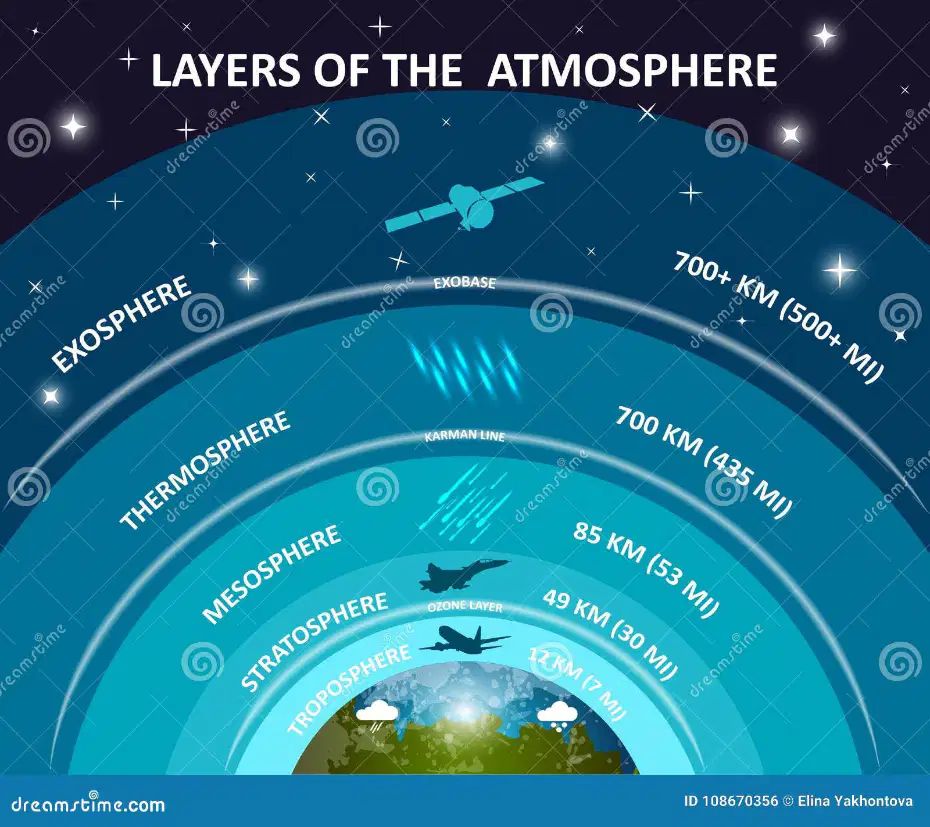
What approximate altitude marks the top of the mesosphere in the diagram?
49 km (30 mi)
85 km (53 mi)
700 km (435 mi)
12 km (7 mi)
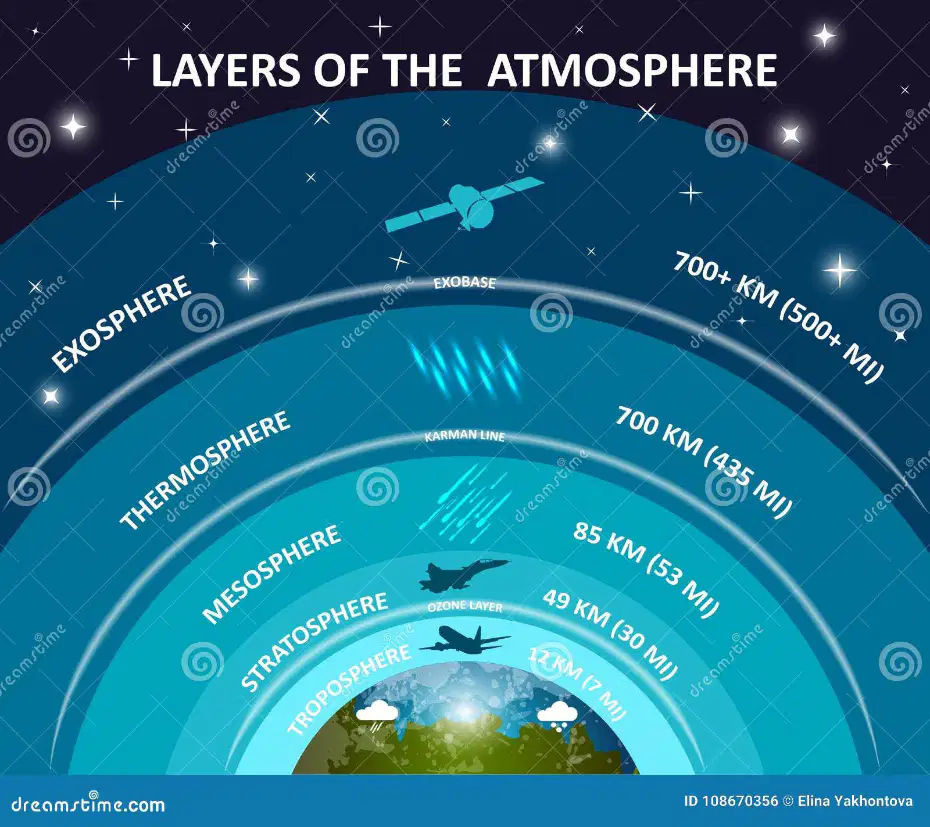
The Kármán line shown in the diagram is commonly used to define the boundary of space. Which altitude label aligns with it?
About 85 km (53 mi)
About 700 km (435 mi)
About 100 km (~62 mi)
About 12 km (7 mi)
Arrange the atmospheric layers from the ground upward.
Troposphere → Stratosphere → Mesosphere → Thermosphere → Exosphere
Stratosphere → Troposphere → Mesosphere → Exosphere → Thermosphere
Troposphere → Mesosphere → Stratosphere → Thermosphere → Exosphere
Troposphere → Stratosphere → Thermosphere → Mesosphere → Exosphere

At roughly 700+ km altitude in the diagram, which atmospheric layer is primarily indicated?
Troposphere
Stratosphere
Thermosphere
Exosphere
Which statement best defines an atmospheric pause?
A boundary where wind patterns reverse direction
A transitional boundary where temperature trends change
A zone of constant pressure between two air masses
A layer where humidity stays the same with altitude
What temperature trend occurs in the troposphere as altitude increases?
Temperature increases steadily with height
Temperature remains constant with height
Temperature decreases steadily with height
Temperature fluctuates randomly with height
What marks the tropopause’s role in temperature change?
Where warming stops and cooling begins
Where cooling stops and warming begins
Where pressure stops changing with height
Where humidity reaches its highest value
Which feature is associated with the tropopause and weather?
It creates most clouds above it
It traps most weather below it
It eliminates all storms near it
It produces ozone within it
Why do temperatures rise in the stratosphere?
Due to greenhouse gas reflection of heat
Because the ozone layer absorbs sunlight
From convection cells carrying warm air up
Because of volcanic aerosols releasing heat
What temperature pattern begins above the stratopause in the mesosphere?
Temperatures start increasing again
Temperatures start decreasing again
Temperatures stay constant and uniform
Temperatures fluctuate without a trend
Which pause is identified as the coldest point in Earth’s atmosphere?
Tropopause at the top of weather systems
Stratopause near the ozone-rich region
Mesopause between mesosphere and thermosphere
Thermopause above the exosphere boundary
What happens to temperatures after the mesopause in the thermosphere?
They drop due to reduced sunlight absorption
They rise sharply due to high-energy sunlight
They remain stable across large altitudes
They cycle daily with equal highs and lows
Which atmospheric layer shows temperatures increasing again above the mesopause?
Stratosphere above the stratopause
Mesosphere above the stratopause
Thermosphere above the mesopause
Troposphere above the tropopause
Where do most meteors burn up according to the diagram?
Lower troposphere near clouds
Stratosphere near ozone maximum
Mesosphere below the mesopause
Thermosphere above 100 km
Which pause marks the boundary where temperature stops decreasing and begins increasing within the middle atmosphere?
Tropopause at ~10–12 km
Stratopause at ~50–55 km
Mesopause at ~80–90 km
Thermopause at ~120–130 km
Which value is closest to surface pressure?
1000 mb near ground level
100 mb near 15–20 km
10 mb near 25–30 km
1 mb near 45–50 km
How does temperature change from the troposphere into the stratosphere?
Decreases in troposphere, then increases in stratosphere
Increases in troposphere, then decreases in stratosphere
Stays constant in troposphere, then spikes in stratosphere
Oscillates in both troposphere and stratosphere
A weather balloon ascends from 0 to 30 km. Which sequence of boundaries will it cross first according to the diagram?
Stratopause then tropopause
Tropopause then stratopause
Mesopause then thermopause
Ozone maximum then mesopause
Which factor is the primary cause of Earth's seasons?
Changes in Earth–Sun distance during orbit
Axial tilt combined with orbital position
Variations in solar output over decades
Monthly shifts in Earth's rotation speed
What is the approximate angle of Earth's axial tilt relative to perpendicular of its orbital plane?
15 degrees from vertical
23.5 degrees from vertical
30 degrees from vertical
45 degrees from vertical
Axial parallelism means which of the following during Earth's yearly orbit?
The axis wobbles slightly each season
The axis stays pointed in one direction
The axis points toward the Sun in summer
The axis flips between poles annually
At which orbital positions is Earth closest and farthest from the Sun, respectively?
Aphelion then perihelion
Perihelion then aphelion
Solstice then equinox
Equinox then solstice
A friend claims it is warmer in summer because Earth is much closer to the Sun then. Which response best corrects this misconception?
Distance controls seasons more than tilt effects
Axial tilt changes sunlight angle and day length
Solar energy output peaks during northern summer
Earth's orbit is extremely elliptical each year
During summer in a given hemisphere, which combination occurs?
Sunlight hits less directly and days are shorter
Sunlight hits more directly and days are longer
Sunlight is lower in the sky and energy decreases
Sunlight duration is unchanged but angle decreases
Why does the Northern Hemisphere experience winter near early January despite Earth being at perihelion?
Shorter orbital period reduces heating globally
Axial tilt directs sunlight less directly there
Aphelion reduces total solar output to Earth
Earth's rotation axis points away from Polaris
Which statement best explains why one hemisphere experiences summer while the other experiences winter at the same time?
Earth’s tilt causes differing sunlight angles
Earth’s distance from the Sun greatly changes
Cloud cover patterns reverse seasonally worldwide
Ocean currents swap directions every six months
During winter in a given hemisphere, what is the primary characteristic of incoming sunlight at the surface?
More direct and concentrated energy
Less direct, arriving at a slant
Uniform intensity across all latitudes
Blocked by the atmosphere entirely
Which observation indicates summer conditions in the Northern Hemisphere?
Shorter daylight and lower midday Sun
Longer daylight and higher midday Sun
Equal daylight and mid-height Sun
No sunrise or sunset at midlatitudes
What occurs during the equinoxes regarding hemispheric tilt?
Both hemispheres tilt toward the Sun
Both hemispheres tilt away from the Sun
Neither hemisphere is preferentially tilted
Only the Southern Hemisphere tilts toward
A city in the Southern Hemisphere reports shorter days and a lower Sun at noon. What season is most likely?
Summer in that city
Winter in that city
Equinox period there
Monsoon season there
If the Northern Hemisphere has summer, which condition is simultaneously true for the Southern Hemisphere?
It also has summer
It transitions to spring
It experiences winter
It has equal day and night
Which factor primarily controls the seasonal temperature differences between hemispheres?
Variation in Earth–Sun distance
Axial tilt altering solar angle
Changes in atmospheric composition
Reversal of planetary rotation
Why are days shorter in winter for a given hemisphere?
Sun stays below horizon longer
Sun follows a lower, shorter arc
Earth spins slower in winter
Sunlight is absorbed more strongly
During equinox, what is the expected pattern of daylight across latitudes?
Nearly equal day and night durations
Long days in the Northern Hemisphere only
Long nights in the Southern Hemisphere only
Extreme day length differences globally
A student claims summer happens because Earth is closer to the Sun in June. Which correction addresses this misconception?
Seasons are caused by axial tilt, not distance
Seasons are due to lunar phases, not tilt
Seasons occur randomly regardless of tilt
Seasons depend on Earth’s magnetic field
Which latitude line is at 0° and divides Earth into Northern and Southern Hemispheres?
Equator
Tropic of Cancer
Arctic Circle
Tropic of Capricorn
At approximately which latitude is the Tropic of Cancer located?
23.5° N
23.5° S
66.5° N
66.5° S
What best explains why mid-latitudes experience four distinct seasons?
Changing Sun angle through the year
Constant direct sunlight year-round
Permanent polar night in winter
Sun never sets for months in summer
Near the Equator, why are seasonal changes less noticeable?
Sunlight is strong and fairly direct
Sunlight is highly slanted all year
Days are extremely short in summer
Temperatures drop sharply each winter
Which statement describes high-latitude summers near the poles?
Midnight Sun occurs with cool temperatures
Sun is overhead with intense heating
Daylight is short with frequent snow
Temperatures are tropical and humid
Identify the correct pair of latitude lines that bound the low-latitude tropical zone.
Tropic of Cancer and Tropic of Capricorn
Arctic Circle and Antarctic Circle
Equator and 90°N
23.5° N and 66.5° N
What defines the summer solstice in a given hemisphere?
Longest daylight and shortest night
Equal day and night length
Shortest daylight and longest night
No sunrise for several weeks
A city at 50° N experiences warmer, longer days in June than in December mainly because sunlight is:
More direct with a higher Sun angle
Uniform year-round at all latitudes
Blocked by polar clouds in winter
Weaker due to Earth’s larger distance
On the Northern Hemisphere summer solstice, which latitude receives the Sun’s direct rays at a 90° solar angle?
Equator at 0° latitude
Tropic of Cancer at 23.5° N
Tropic of Capricorn at 23.5° S
Arctic Circle at 66.5° N
Which statement best describes Earth’s orientation on June 21 in the Northern Hemisphere?
South Pole tilted toward the Sun
North Pole tilted toward the Sun
Axis perpendicular to sunlight
Axis parallel to Earth’s orbit
At Lockport, Illinois (41.6° N), approximately how many hours of daylight occur on June 21?
About 12 hours of daylight
About 15 hours of daylight
About 18 hours of daylight
About 9 hours of daylight
Which location experiences continuous daylight on the Northern Hemisphere summer solstice?
Equator
North Pole
South Pole
Tropic of Capricorn
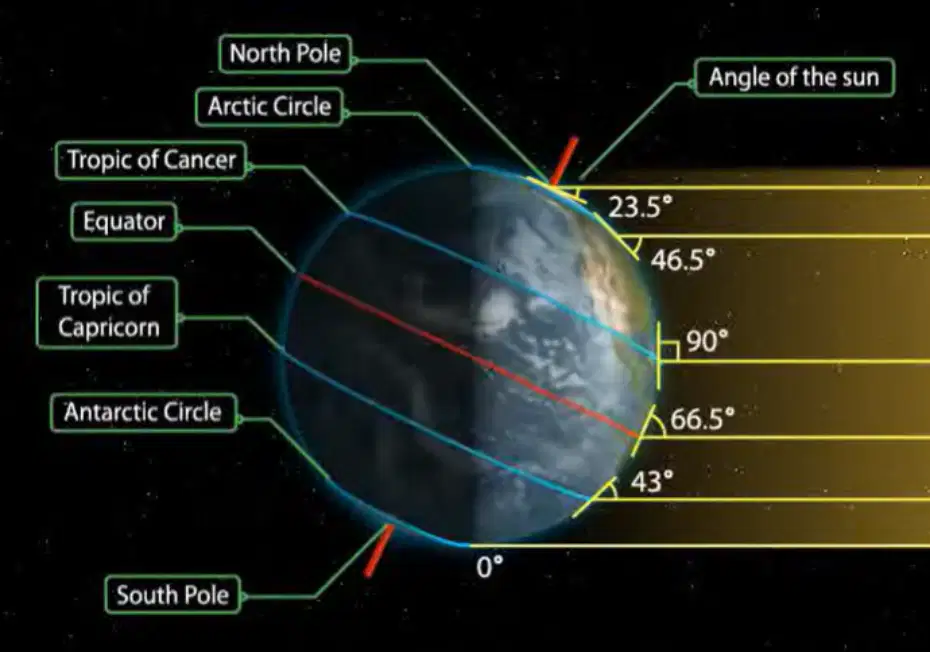
If Earth’s axial tilt were reduced from 23.5° to 0°, what would most directly change at the Tropic of Cancer on June 21?
Solar noon angle would stay at 90°
Direct rays would shift to the equator
Daylight hours at poles would increase
Southern Hemisphere would have longer days
A city at 60° N on June 21 will most likely experience which pattern compared to the equator?
Shorter day and lower Sun angle
Longer day and higher Sun angle
Same day length and Sun angle
Shorter day and higher Sun angle
After the summer solstice in the Northern Hemisphere, how do day lengths change as Earth continues its orbit?
Days get longer toward winter
Days get shorter toward fall
Days remain constant year-round
Days alternate randomly each week
On the autumnal equinox, what is the orientation of Earth’s axis relative to the Sun?
Tilted toward the Sun at 23.5°
Tilted away from the Sun at 23.5°
Not tilted toward or away from the Sun
Aligned perpendicular to the Sun’s rays
Which date most closely matches the autumnal equinox in the Northern Hemisphere?
Around June 21st
Around September 22nd
Around December 21st
Around March 21st
During the autumnal equinox, where do the Sun’s rays strike most directly at solar noon?
Tropic of Cancer (23.5° N)
Tropic of Capricorn (23.5° S)
Equator (0° latitude)
Arctic Circle (66.5° N)
At Lockport, Illinois (41.6° N), about how many hours of sunlight occur on the autumnal equinox?
About 9 hours of sunlight
About 12 hours of sunlight
About 15 hours of sunlight
About 24 hours of sunlight
Which location experiences approximately 12 hours of sunlight on the autumnal equinox?
North Pole
South Pole
Equator
All listed locations
After the autumnal equinox, how do daylight patterns change between hemispheres?
Northern Hemisphere gets more daylight
Southern Hemisphere gets less daylight
Northern Hemisphere gets less daylight
Both hemispheres gain equal daylight
In the Northern Hemisphere, when does the winter solstice typically occur?
Around September 22nd
Around December 21st
Around March 21st
Around June 21st
On the winter solstice in the Northern Hemisphere, how is the North Pole oriented relative to the Sun?
Tilted farthest toward the Sun
Tilted farthest away from the Sun
Not tilted toward or away
Tilted perpendicular to sunlight
Where do the Sun’s rays hit most directly on the winter solstice in the Northern Hemisphere?
Equator (0° latitude)
Tropic of Cancer (23.5° N)
Tropic of Capricorn (23.5° S)
Arctic Circle (66.5° N)
Approximately how many hours of sunlight does Lockport, Illinois receive on the winter solstice?
About 12 hours of sunlight
About 9 hours of sunlight
About 6 hours of sunlight
About 24 hours of sunlight
During the winter solstice in the Northern Hemisphere, what are the daylight conditions at the North Pole and South Pole?
North Pole 24 hours daylight, South Pole 0 hours
North Pole 0 hours daylight, South Pole 24 hours
Both Poles 12 hours daylight
Both Poles continuous darkness
How does day length change in the Northern Hemisphere after the winter solstice?
Days get shorter toward spring
Days remain the same until equinox
Days get longer toward spring
Days alternate randomly
Which statement best defines the vernal (spring) equinox?
Day and night are nearly equal worldwide
Northern Hemisphere has longest daylight period
Earth is closest to the Sun in its orbit
Sunlight is strongest at the Tropic of Cancer
On or around which date does the spring equinox typically occur each year?
Around March 20 each year
Around June 21 each year
Around September 22 each year
Around December 21 each year
During the spring equinox, how is Earth’s axis oriented relative to the Sun?
Not tilted toward or away from the Sun
Tilted 23.5° toward the Sun
Tilted 23.5° away from the Sun
Aligned parallel to the Sun’s equator
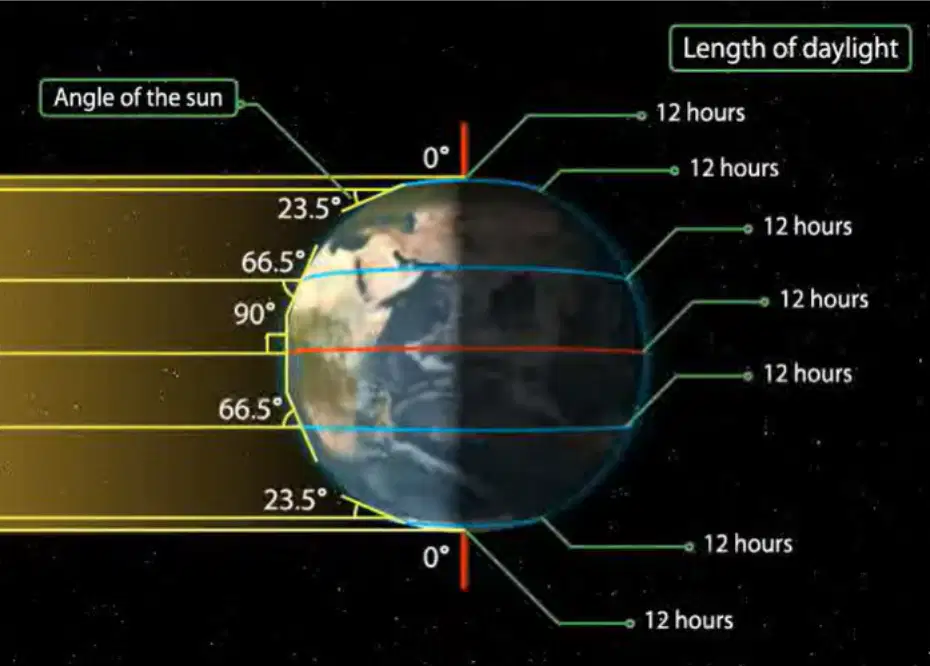
At solar noon on the equator during the spring equinox, what is the Sun’s angle above the horizon?
Directly overhead at 90°
Moderately high at 66.5°
Low angle around 48°
Near the horizon at 23.5°
How many hours of daylight are experienced at the North Pole on the spring equinox?
About 12 hours of sunlight
About 6 hours of sunlight
Continuous 24 hours of sunlight
No sunlight throughout the day
Immediately after the spring equinox, which hemisphere begins receiving more daylight?
Northern Hemisphere receives more daylight
Southern Hemisphere receives more daylight
Both hemispheres receive equal daylight
Equatorial regions receive reduced daylight
In Lockport, Illinois (41.6° N) at solar noon on the spring equinox, the Sun’s maximum angle is roughly which value?
About 48° above the horizon
About 66.5° above the horizon
About 23.5° above the horizon
About 90° above the horizon
Which explanation best connects Christmas on December 25 with a seasonal event in the Northern Hemisphere?
Date chosen near the winter solstice
Date fixed by a recorded biblical birth
Date aligns with spring equinox traditions
Date marks Earth at perihelion
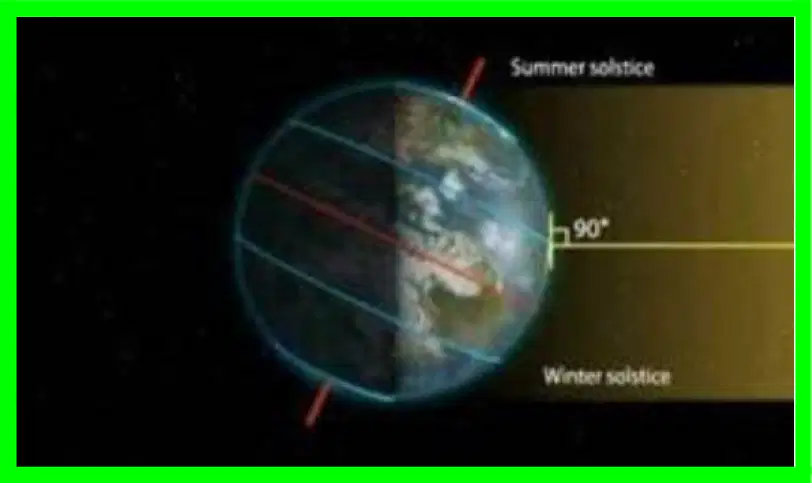
What is the primary reason the Northern and Southern Hemispheres experience opposite seasons at the same time?
Earth’s elliptical orbit changing distance from Sun
Earth’s 23.5° axial tilt relative to its orbital plane
Uneven heating due to ocean circulation patterns
Differences in landmass between hemispheres
If it is winter in the Northern Hemisphere during December, which season is occurring in the Southern Hemisphere, and why?
Winter, because both hemispheres are equally distant
Summer, because the Southern Hemisphere tilts toward the Sun
Spring, because Earth moves faster near perihelion
Fall, because the equator receives the most sunlight
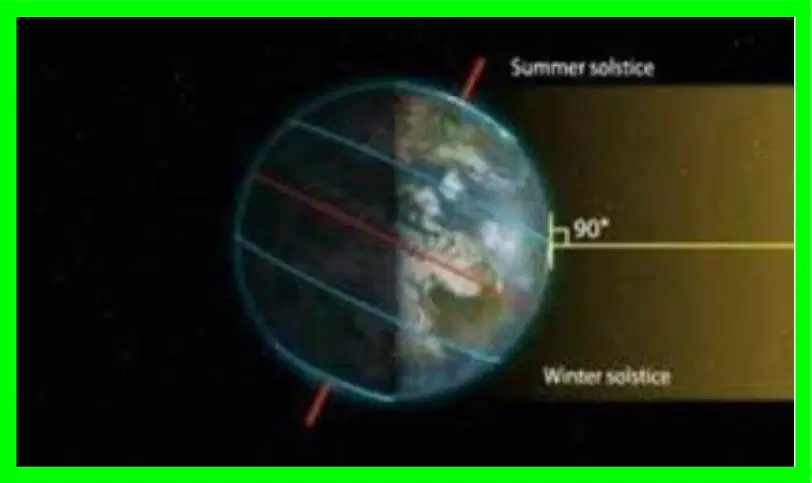
A student claims Australia has cold weather at the same time as Canada because Earth is farthest from the Sun in July. Which critique best addresses this misconception?
Distance changes dominate seasons for each hemisphere equally
Seasonal differences are set by Earth’s shape, not tilt
Axial tilt controls hemisphere sunlight; distance has minor effect
Cloud cover flips seasons between north and south regions
Which statement best describes the natural greenhouse effect on Earth?
It traps some outgoing infrared heat
It blocks all sunlight from entering
It cools Earth below freezing always
It releases heat directly into space
When sunlight reaches Earth’s surface, which form of energy is later emitted back toward the atmosphere?
Lower energy infrared radiation
Higher energy ultraviolet radiation
Higher energy gamma radiation
Lower energy microwave radiation
Which gases primarily absorb longer wavelengths and re‑radiate heat?
Carbon dioxide, methane, water vapor
Nitrogen, oxygen, argon
Helium, neon, krypton
Hydrogen, ozone, chlorine
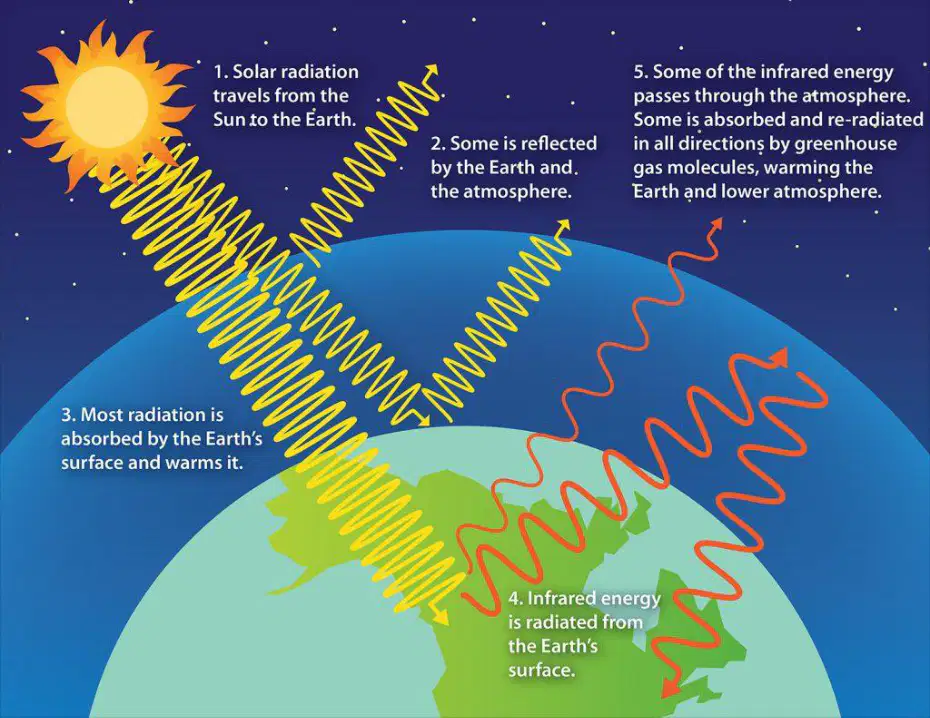
Why do greenhouse gases warm the lower atmosphere?
They re‑radiate absorbed heat downward
They reflect visible light strongly
They create ozone in the stratosphere
They convert heat into chemical energy
If Earth had no natural greenhouse effect, what would most likely happen to average surface temperature?
It would drop near 0°F (−18°C)
It would rise above boiling water
It would stay exactly 59°F (15°C)
It would fluctuate wildly each hour
A student claims greenhouse gases absorb shorter wavelengths better than longer wavelengths. What is the best evaluation of this claim?
Incorrect; they absorb longer wavelengths
Correct; shorter wavelengths dominate
Partly true; only methane does this
True only at night for water vapor

Which sequence correctly outlines the energy flow that keeps Earth warm?
Sunlight warms surface; surface emits infrared; gases trap heat
Gases create sunlight; surface reflects heat; Sun absorbs energy
Surface blocks sunlight; gases emit ultraviolet; oceans trap heat
Sunlight cools surface; gases absorb microwaves; space warms
Which statement best distinguishes the natural from the enhanced greenhouse effect?
Natural traps essential heat; enhanced adds extra gases
Natural cools Earth; enhanced removes atmospheric heat
Natural releases sunlight; enhanced blocks solar radiation
Natural is human-caused; enhanced occurs without humans
Which greenhouse gas contributes the largest share of total warming primarily due to its abundance?
Carbon dioxide contributes ~50–55% of warming
Methane contributes ~50–55% of warming
Nitrous oxide contributes ~50–55% of warming
Water vapor contributes ~50–55% of warming
Identify the source most directly linked to methane emissions.
Livestock digestion and landfill decomposition
Cement manufacture and deforestation
Fertilizer application in croplands
Evaporation from lakes and oceans
Which pairing of gas and typical source is accurate?
Nitrous oxide—fertilizers and industrial processes
Methane—cement production and deforestation
Water vapor—natural gas pipeline leaks
Carbon dioxide—rice paddies and wetlands
A policymaker wants rapid near-term warming reduction. Which gas’s control offers strong short-term benefits due to high per-molecule potency?
Methane, about 30 times stronger than CO2
Water vapor, the most abundant greenhouse gas
Carbon dioxide, the longest-lived greenhouse gas
Oxygen, a non–greenhouse atmospheric gas
Which statement about nitrous oxide’s climate impact is most accurate?
Very strong per molecule and long-lived, yet ~5–7% total warming
Weak per molecule but abundant, causing ~50% warming
Strong only short-lived, accounting for ~25–30% warming
Dominant driver that responds mainly to temperature changes
Warm air holds more water vapor. What is the climate implication of this property?
Warming amplifies as water vapor increases
Cooling accelerates as water vapor condenses
Water vapor directly initiates global warming
Evaporation declines with rising temperatures
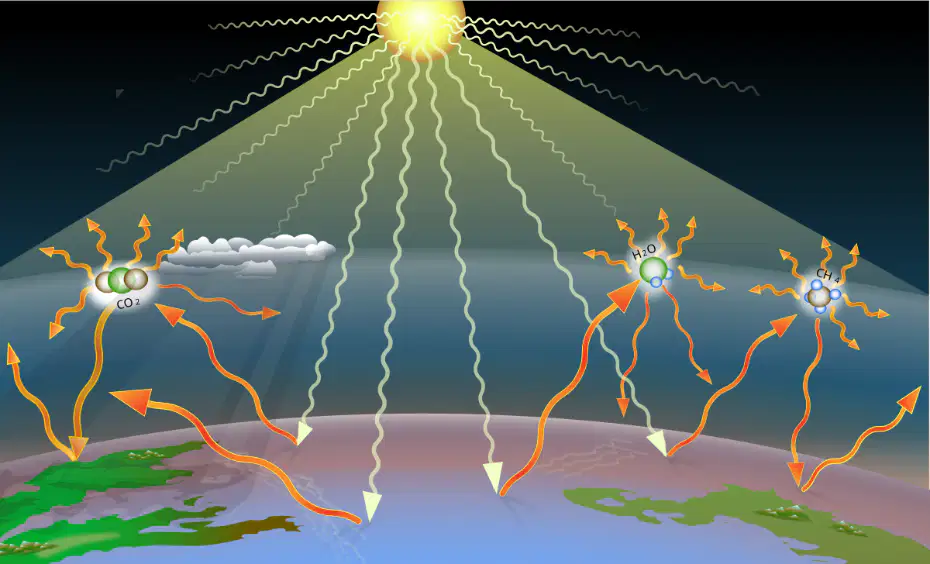
In the diagram showing solar radiation and re-emitted heat, which process is depicted by orange arrows leaving Earth’s surface?
Infrared heat trapped and re-radiated by greenhouse gases
Incoming visible sunlight from the Sun
Ultraviolet radiation absorbed by ozone
Conduction of heat within the Earth’s crust
Which statement best defines albedo in climate science?
Fraction of sunlight a surface reflects
Amount of heat a surface generates internally
Rate of infrared radiation emitted by air
Thickness of the atmosphere over a region
Which surface generally has the highest albedo under clear skies?
Fresh snow on ice sheets
Dark ocean water at noon
Wet forest canopy in summer
Bare soil after rainfall
Which pair correctly matches surface type with typical albedo category?
Clouds — high albedo
Oceans — high albedo
Forests — very high albedo
Soil — always high albedo
A city replaces dark roofs with bright reflective roofs. What is the most direct climate effect locally?
Lower surface temperatures by reflecting sunlight
Increase rainfall by trapping more moisture
Raise temperatures by absorbing more sunlight
Strengthen winds by reducing air pressure
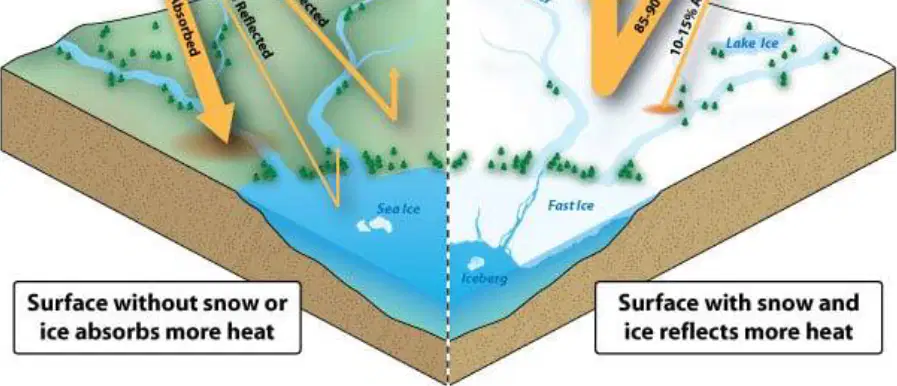
Consider the diagram showing snow-covered terrain reflecting more sunlight than bare ground. What primary energy balance change occurs on the snow-covered side?
Greater shortwave reflection, less absorption
Greater longwave emission, more absorption
Lower reflection, higher shortwave absorption
Higher geothermal input, unchanged absorption
Which sequence correctly describes the ice–albedo feedback?
Ice melts, darker surfaces exposed, more heat absorbed, further melting
Ice forms, lighter surfaces exposed, more heat absorbed, further melting
Ice melts, lighter surfaces exposed, less heat absorbed, cooling continues
Ice melts, darker surfaces exposed, less heat absorbed, cooling begins
If Arctic sea ice declines, which global effect is most consistent with the ice–albedo feedback mechanism?
Enhanced warming due to increased solar absorption
Immediate cooling due to higher atmospheric reflection
No change because oceans reflect sunlight equally
Enhanced cooling due to reduced greenhouse gases
Which statement best defines Snowball Earth during the Proterozoic Era?
A time when most continents briefly cooled
A period when nearly the whole planet iced over
A short episode of regional mountain glaciation
A phase when only polar seas partially froze
What approximate time frame did at least two Snowball Earth events occur?
About 65–70 million years ago
About 6.5–7.0 billion years ago
About 650–700 million years ago
About 150–200 million years ago
Which factor directly increases Earth’s planetary albedo during glaciation?
Expanding dark ocean surfaces worldwide
Expanding bright ice and snow surfaces
Increasing absorption by lush forests
Increasing volcanic ash on sea ice
During the ice–albedo feedback that cools the planet, what is the correct sequence?
Cooling → less ice → lower albedo → warming
Cooling → more ice → higher albedo → more cooling
Warming → more ice → lower albedo → cooling
Warming → less ice → higher albedo → more cooling
Which set lists hypothesized triggers for Snowball Earth?
Higher CO2, brighter Sun, fewer eruptions, stable currents
Lower CO2, cooler Sun, shifting continents, more eruptions
Higher methane, warmer Sun, fixed continents, fewer eruptions
Unchanged greenhouse gases, steady Sun, static plates, no eruptions
Why did the albedo feedback intensify global glaciation once ice spread?
More ice lowered albedo, so less sunlight reflected
More ice raised albedo, so less sunlight absorbed
More ice reduced reflection, so more heat retained
More ice boosted absorption, so oceans warmed
What immediate effect follows a higher global albedo during Snowball Earth?
Greater absorption and stronger warming
Less absorption and additional cooling
Equal absorption and thermal balance
More infrared emission from volcanoes
Which statement about termination of Snowball Earth is most accurate?
CO2 levels fell as oceans absorbed more gas
CO2 built up because oceans were sealed by ice
Methane dissolved quickly into open warm seas
Water vapor alone reversed the global freezing
Why couldn’t volcanic CO2 be removed efficiently during global ice cover?
It froze into glaciers instead of air
It reacted only with desert minerals
It could not dissolve into ice-covered seawater
It escaped to space faster than normal
Which outcome finally ended the Snowball Earth state?
Dust storms increased Earth’s reflectivity
Greenhouse gases became strong enough to melt ice
Plate motions stopped new mountain building
Solar output decreased and warmed climate
Identify the positive feedback loop central to Snowball Earth progression.
Cooling → less cloud → more sunlight absorbed
Warming → more snow → lower reflectivity → warming
Cooling → more ice → higher reflectivity → cooling
Warming → less sea ice → higher reflectivity → cooling
Which description best distinguishes global glaciation from a normal ice age?
Only high latitudes froze while tropics stayed warm
Continents iced while oceans remained largely ice-free
Planet-wide ice covered continents and oceans extensively
Glaciers advanced only on mountain ranges
What role did continental rearrangements likely play in initiating Snowball Earth?
They altered ocean currents, changing heat transport
They increased solar brightness by orbit shifts
They strengthened ozone, increasing surface heating
They thickened crust, reducing volcanic degassing
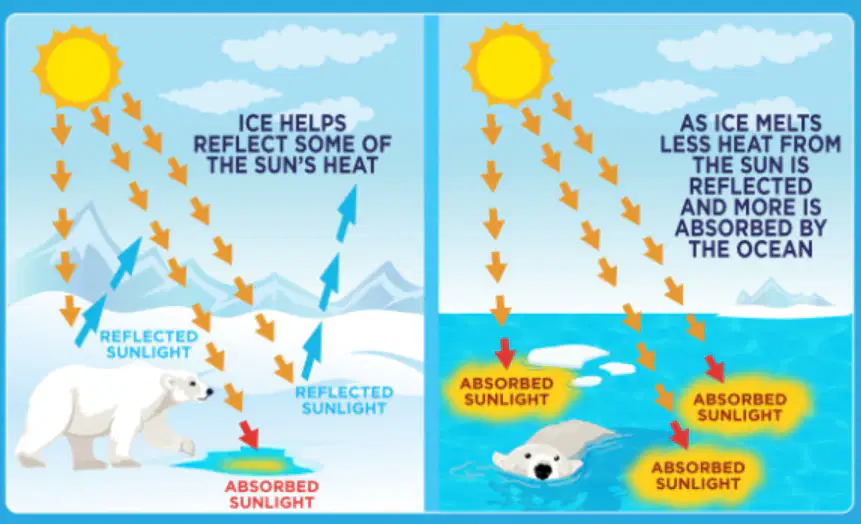
In the paired diagram of ice and open ocean, which surface reflects more incoming sunlight and why?
Open ocean, because dark water has high albedo
Sea ice, because bright surfaces reflect more energy
Open ocean, because it scatters light efficiently
Sea ice, because it absorbs more infrared radiation
Suppose volcanic emissions continued during a Snowball Earth episode. Which projection aligns with the described mechanism for deglaciation?
CO2 accumulates, greenhouse warming strengthens, ice melts
CO2 decreases, albedo increases, ice expands further
CO2 stays constant, ocean uptake balances emissions
CO2 dissolves quickly, carbonate burial cools climate

Which process initiates widespread freezing in the Snowball Earth cycle shown in the diagram?
Expanded polar ice caps during a long cold spell
Abrupt shutdown of mid-ocean ridge volcanism
Rapid continental drift toward high latitudes
Sudden collapse of the ozone layer
In the depicted cycle, why does cooling accelerate after initial ice growth?
Lowered reflectivity increases sunlight absorption
Lowered reflectivity reduces sunlight absorption
Higher albedo reflects more incoming sunlight
Higher albedo traps more outgoing infrared radiation

According to the diagram, what happens to atmospheric CO2 while oceans are ice-covered?
Biological uptake rapidly removes CO2 from air
Weathering pulls CO2 into carbonate rocks
Volcanic outgassing accumulates CO2 in atmosphere
Ocean circulation dissolves excess CO2 into deep water
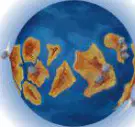
Which sequence best explains the transition out of Snowball Earth in the diagram?
CO2 builds up, greenhouse strengthens, global melt
Albedo decreases, volcanism stops, oceans refreeze
Weathering halts, greenhouse weakens, ice expands
Solar input drops, CO2 declines, ice persists

