
Font size
 Worksheets
Light , Human Eye and Colourful world
Total questions: 53
Worksheet time: 2hrs 36mins
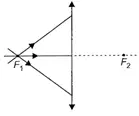
In the given diagram, three rays of light pass through focal point F1 to the converging lens, placed along the vertical line. Which of the following is correct regarding this?
A) The speed of light rays decreases when they enter the converging lens.
B) The speed of light rays decreases when they leave the converging lens.
C) The speed of light rays increases when they enter the converging lens.
D) The speed of light rays remains same while entering or leaving the converging lens.
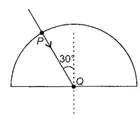
A ray of light passing through a semicircular block from air is shown below. Consider the given figure and select the correct option that correctly identifies the true (T) and false (F).
(i) There is no change in the direction of the ray at P because the light ray incident on the semicircular block at 90∘.
(ii) As light rays enter the semicircular block, their frequency remains the same.
(iii) The wavelength of light rays as it enters the block decreases.
(iv) The speed of light as it enters the block increases.

A

B

C

D
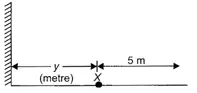
A man standing at a position X in front of a plane mirror, a distance of y metre from the mirror as shown in figure. When the man moves 5 m away from the mirror, the new distance between the man and his image becomes 20 metre. What is the value of y?
A) 5 m
B) 10 m
C) 20 m
D) 40 m
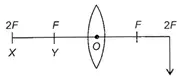
To produce an image by a convex lens, at the position shown (see figure) the object is needed to be placed
A) Between Y and O
B) At Y
C) Between X and Y
D) At X
When two plane mirrors are placed parallel and facing each other and an object is kept in between them, we get infinite images. But actually only a few images are visible because the intensity of the image is
A) Increased after each reflection
B) Decreased after each reflection
C) Always constant
D) None of these
Which of the following options is correct in case of a concave mirror?

A

B

C

D
Which of the following correctly depicts reflections in case of plane mirrors inclined at
40?


The image of an extended object placed in front of a concave mirror is formed at a distance of 40 cm from the object. If the image is 3 times bigger than the object, the magnitude of focal length of the mirror is
A) 15 cm
B) 10 cm
C) 20 cm
D) 5 cm
"HOTS"
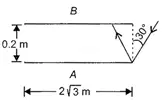
Two plane mirrors A and B are aligned parallel to each other as shown in the figure.
A light ray is incident at an angle 30∘ at a point just inside one end of A.
The plane of incidence coincides with the plane of the figure.
The maximum number of times the ray undergoes reflections (including the first one), before it emerges out, is
A) 28
B) 30
C) 32
D) 34
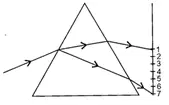
Direction: Read the passage carefully and answer the following question. A beam of white light falling on a glass prism gets split into seven colours marked 1 to 7 as shown in figure.
Which of the following statements is correct?
A) The colour at position marked 5 is similar to the colour of gold metal.
B) The colour at position marked 2 has longer wavelength than 1.
C) The colour at position marked 7 is violet.
D) The colour at position marked 5 has higher speed than 1.
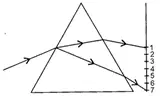
Direction: Read the passage carefully and answer the following question. A beam of white light falling on a glass prism gets split into seven colours marked 1 to 7 as shown in figure.
Which of the following statement is correct?
A) The colours in the order of increasing wavelength are 1 <2<3<4<5<6<7.
B) The colours in the order of increasing frequency are 1 <2<3<4<5<6<7.
C) The colours in the order of decreasing speed are 7>6>5>4>3>2>1.
D) The colours in the order of decreasing deviation are 1>2>3>4>5>6>7.
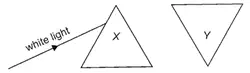
Two equilateral prisms are arranged as shown in diagram.
If white light incident on prism X then
Statement 1: The ray of light which emerges out of the prism Y will be white light.
Statement 2: The refraction produced by the prism Y is equal and opposite to that produced by prism X.
A) Both statements 1 and 2 are true and statement 2 is the correct explanation of statement 1.
B) Both statements 1 and 2 are true but statement 2 is not the correct explanation of statement 1.
C) Statement 1 is true but statement 2 is false.
D) Statement 1 is false but statement 2 is true.
An old person is unable to see clearly nearby objects as well as distant object. To correct the vision, what kind of lens will he require?
A) Concave lens
B) Bifocal lens whose upper portion is concave lens and lower portion is convex lens.
C) Convex lens
D) Bifocal lens whose upper portion is convex lens and lower portion is concave lens.
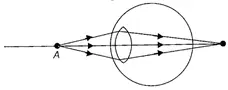
Observe the given diagram carefully. What could be the causes of this defect?
(i) The focal length of the eye lens is too long.
(ii) The eyeball becomes too small.
(iii) The focal length of the eye lens is too small.
(iv) The eyeball becomes too long.
A) Only (i) and (ii)
B) Only (i) and (iv)
C) Only (ii) and (iii)
D) Only (iii) and (iv)
In a room, artificial rain is produced at one end and a strong source of white light is switched on at the other end. To observe the rainbow an observer must
A) Look anywhere in the room
B) Look towards the source
C) Look towards the raindrops with the light source behind him
D) Look in a direction equally inclined to the source of raindrops.
A person needs a lens of power 2.5 D for correction of her vision. Then
(i) The focal length of the lens is 40 cm.
(ii) The focal length of the lens is - 40 cm.
(iii) The nature of the lens is concave.
(iv) The nature of the lens is convex.
(v) She is suffering from myopia.
A) Only (i) and (iv) are correct.
B) Only (ii) and (iii) are correct.
C) Only (i) (iii) and (v) are correct.
D) Only (ii) and (iii) are correct.
A person with a myopic eye cannot see objects beyond 1.4 m distinctly. The type of the corrective lens used to restore proper vision should be
A) A concave lens of focal length - 1.4 m and power + 0.71 D.
B) A convex lens of focal length 1.4 m and power + 0.71 D.
C) A concave lens of focal length - 1.4 m and power - 0.71 D.
D) A convex lens of focal length - 1.4 m and power - 0.71 D
Which of the following statements are correct regarding scattering of light?
(i) Scattering is responsible for the bluish appearance of the sky.
(ii) Clouds having droplets of water scatter all wavelengths are almost equal and so are generally white.
(iii) Advanced sunrise and delayed sunset.
A) Only (i) and (ii) are correct.
B) Only (ii) and (iii) are correct.
C) Only (iii) is correct.
D) All (i), (ii) and (iii) are correct.
Consider the given statements and select the correct option which correctly identifies true (T) and false (F).
(i) The focal length of the eye lens increases when eye muscles are relaxed and lens becomes thinner.
(ii) Stars appear to twinkle because of movement of air only.
(iii) In the dim light, the size of pupil increases.(iv) The blind spot on retina has high concentration of nerve ending.

A

B

C

D
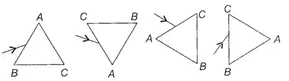
A prism ABC (with BC as base) is placed in different orientations. A narrow beam of white light is incident on the prism as shown in figure. In which of the following cases, after dispersion, the third colour from the top corresponds to the colour of the sky?
I
II
III
IV
Rays from sun converge at a point 15 cm in front of a concave mirror. Where should
an object be placed so that size of its image is equal to the size of the object?
(a) 15 cm in front of the mirror
(b) 30 cm in front of the mirror
(c) between 15 cm and 30 cm in front of the mirror
(d) more than 30 cm in front of the mirror
To determine the focal length of a concave mirror by forming image of a distant
object, the screen should be placed
(a) in any direction
(b) inclined at angle of 45°
(c) at right angle to the plane of mirror
(d) parallel to the plane of mirror
You are given water, mustard oil, glycerine and kerosene. In which of these media, a
ray of light incident obliquely at same angle would bend the most?
(a) Kerosene
(b) Water
(c) Mustard oil
(d) Glycerine
How will the image formed by a convex lens be affected if the upper half of the lens is
wrapped with a black paper?
(a) The size of the image is reduced to one-half.
(b) The upper half of the image will be absent.
(c) The brightness of the image is reduced.
(d) There will be no effect
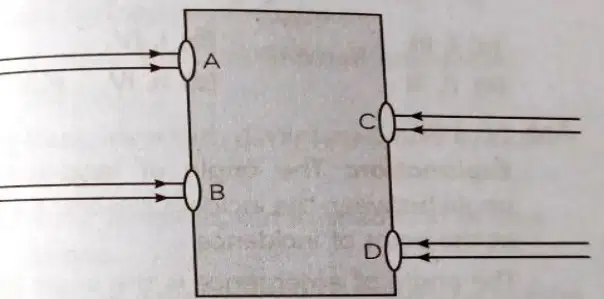
Beams of light are incident through the holes A and B and emerge out of box through
the holes C and D respectively, as shown in the figure. Which of the following could be
inside the box?
(a) A rectangular glass slab
(b) A convex lens
(c) A concave lens
(d) A prism
When an object is kept within the focus of a concave mirror, an enlarged image is
formed behind the mirror. This image is:
(a) real
(b) inverted
(c) virtual and inverted
(d) virtual and erect
A full length image of a distant tall building can definitely be seen by using:
(a) a concave mirror
(b) a convex mirror
(c) a plane mirror
(d) both concave as well as plane mirror
Magnification produced by a rear view mirror fitted in vehicles:
(a) is less than one
(b) is more than one
(c) is equal to one
(d) can be more than or less than one depending upon the position of the object in
front of it.
A student determines the focal length of a device 'X' by focusing the image of a
distant object on a screen placed 20 cm from the device on the same side as the
object. The device 'X' is
(a) Concave lens of focal length 10 cm
(b) Convex lens of focal length 20 cm
(c) Concave mirror of focal length 10 cm
(d) Concave mirror of focal length 20 cm
A small bulb is placed at the focal point of a converging lens. When the bulb is
switched on, the lens produces:
(a) a convergent beam of light
(b) a divergent beam of light
(c) a parallel beam of light
(d) a patch of coloured light
Assertion: A ray incident along normal to the mirror retraces its path.
Reason: In reflection, angle of incidence is always equal to angle of reflection.
(a) If both assertion and reason are true and reason is the correct explanation of
assertion
(b) If both assertion and reason are true but reason is not the correct
explanation of assertion
(c) If assertion is true but reason is false.
(d) If both assertion and reason are false.
Assertion: Higher is the refractive index of the medium, lesser is the velocity of light in
that medium.
Reason: Refractive index of a medium is inversely proportional to the velocity of
light.
(a) If both assertion and reason are true and reason is the correct explanation of
assertion
(b) If both assertion and reason are true but reason is not the correct
explanation of assertion
(c) If assertion is true but reason is false.
(d) If both assertion and reason are false.
Assertion: When a concave mirror is held in water, its focal length will decrease.
Reason: The focal length of a concave mirror depends on the density the medium in
which it is placed.
(a) If both assertion and reason are true and reason is the correct explanation of
assertion
(b) If both assertion and reason are true but reason is not the correct
explanation of assertion
(c) If assertion is true but reason is false.
(d) If both assertion and reason are false.
Assertion: A convex lens is made of two different materials. A point object is placed
on the principal axis. The number of images formed by the lens will be two.
Reason :The image formed by convex lens is always virtual.
(a) If both assertion and reason are true and reason is the correct explanation of
assertion
(b) If both assertion and reason are true but reason is not the correct
explanation of assertion
(c) If assertion is true but reason is false.
(d) If both assertion and reason are false.
Assertion: Full length image of a distant object, such as a tall building, can be seen in a
convex mirror.
Reason: A convex mirror has a greater focal length than a concave mirror of the same
aperture.
(a) If both assertion and reason are true and reason is the correct explanation of
assertion
(b) If both assertion and reason are true but reason is not the correct
explanation of assertion
(c) If assertion is true but reason is false.
(d) If both assertion and reason are false.
Light is a form of energy that induces a sensation of vision in our eyes. It becomes
visible when it bounces off surfaces and hits our eyes. The phenomenon of
bouncing back of light rays in the same medium on striking a smooth surface is
called reflection of light. If a parallel beam of incident rays remains parallel even
after reflection and goes only in one direction is known as regular reflection. It takes
place mostly in plane mirrors or highly polished metal surfaces. The mirror outside
the driver's side of a vehicle is usually spherical and printed on such a mirror is the
warning "Vehicles in this mirror are closer than they appear."
(i) Which type of mirror is used outside the driver's side of a vehicle?
a) Plane mirror
(b) Concave mirror
(c) Convex mirror
(d) Magic mirror
(ii) No matter how far you stand from a mirror, your image appears erect. The mirror
can be
(a) Plane
(b) Concave
(c) Convex
(d) Either plane or convex
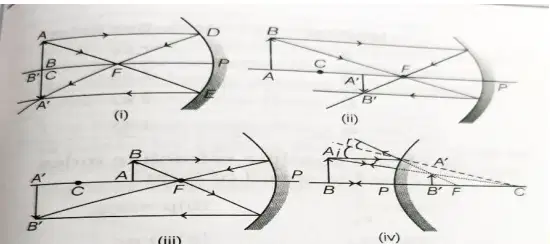
(iii) The diagram representing the image formation in the above case is:
(a) (i)
(b) (ii)
(c ) (iii)
(d) (iv)
If an object is placed at 10 cm from a convex mirror of radius of curvature 60 cm, then find the position of image.
(a) 4 cm
(b) 7.5 cm
(c) 10 cm
(d) 12.5 cm
(v) The focal length of mirror is 12 cm. The radius of curvature is (a) 12 cm (b) 24 cm (c) 20 cm (d) 36 cm
A
B
C
D

The refractive index of a medium with respect to vacuum is called absolute refractive index of the medium.
It is given by, μ = sin i/sinr
Absolute refractive indices of some of the materials A, B, C and D are given in the following table :

i) How is absolute refractive index related to speed of light?
(a)µ = C/vm
(b)μ=CVm
(c)μ=Vm
(d)Vμ=C
(ii) In which of the materials given in the above table, light travels fastest?
A
B
C
D
(iii) The speed of light in air is 3x10⁸ ms-1 and that in medium A is 2.5 x 10 ms-1 . The refractive index of A will be (a) 1.2 (b) 0.5 (c)4.5 (d)1.5
A
B
C
D
(iv) When light travels from air to glass,
(a) angle of incidence > angle of refraction
(b) angle of incidence < angle of refraction
(c) angle of incidence = angle of refraction
(d) Can't say
(v) The refractive index of P with respect to Q is 2. Find the refractive index of Q with respect to P
(a) 0.5
(b) 0.2
(c) 2
(d) 2.5
The refractive indices of glass and water with respect to air are 3/2 and 4/3 respectively. If speed of light in glass is 2 × 10⁸ m/s, find the speed of light in water.
(a)
If the focal length of this lens is 10 cm, the lens is held at a distance of 5 cm from the palm, use lens formula to find the position and size of the image
(a)
(a) A 5 cm tall object is placed perpendicular to the principal axis of a convex lens of focal length 20 cm. The distance of the object from the lens is 30 cm. Find the position, nature and size of the image formed.
"Specify the unit"
(a)
Size of image of an object by a mirror having a focal length of 20 cm is observed to be reduced to 1/3rd of its size. At what distance the object has been placed from the mirror? What is the nature of the image and the mirror?
"Specify the units at the end"
(a)
A concave mirror is used for image formation for different positions of an object. What inferences can be drawn about the following when an object is placed at a distance of 10 cm from the pole of a concave mirror of focal length 15 cm?
(a) Position of the image
(b) Size of the image
(a)
The image of a candle flame placed at a distance of 30 cm from a mirror is formed on a screen placed in front of the mirror at a distance of 60 cm from its pole. What is the nature of the mirror? Find its focal length. If the height of the flame is 2.4 cm, find the height of its image.
– 20 cm , – 4.8 cm
– 45 cm , – 4.8 cm
– 32 cm , – 4.8 cm
-24 cm , -4.8cm
An object 4 cm in height, is placed at 15 cm in front of a concave mirror of focal length 10 cm. At what distance from the mirror should a screen be placed to obtain a sharp image of the object. Calculate the height of the image
v = -40 , h’ = -7 cm
v = -45 , h’ = -9 cm
v = -30 , h’ = -8 cm
v = -50 , h’ = -10 cm
Assertion - A beam of white light gives a spectrum on passing through a prism. Reason - Speed of light outside the prism is different from the speed of light inside the prism.
(A) Both A and R are true and R is a correct explanation of A.
(B) Both A and R are true but R is not correct explanation of A.
(C) A true but R is false
(D) A false but R is true
Assertion - Myopia is called far-sightedness. Reason - Myopia is corrected by using a concave lens in front of the eye lens.
(A) Both A and R are true and R is correct explanation of A.
(B) Both A and R are true but R is not correct explanation of A
(C) A true but R is false.
(D) A false but R is true
Assertion - By using the Tyndall effect, we can identify colloidal solutions.
Reason - In true solutions, the path of light is not visible.
(A) Both A and R are true and R is a correct explanation of A.
(B) Both A and R are true but R is not correct explanation of A.
(C) A true but R is false
(D) A false but R is true
Assertion - Cataract can be corrected by using a bifocal lens.
Reason - The crystalline lens of old people becomes milky and cloudy; this is due to the age of the person.
(A) Both A and R are true and R is correct explanation of A.
(B) Both A and R are true but R is not correct explanation of A.
(C) A true but R is false
(D) A false but R is true

When a ray of light incident on a prism it will split in seven colours that is called dispersion of light.
A prism is a transparent refracting body bounded by plane faces which are inclined to each other at a particular angle called angle of prism denoted by A .
When a ray of light passes through a prism, it suffers refraction twice and hence the ray deviates through a certain angle from its original path. The angle between the incident ray and emergent ray is called angle of deviation.
For which colour the angle of deviation is minimum?
A. Red
B. Blue
C. Violet
D. Yellow
When a white light falls on a prism, the ray at its surface suffers:
(A) Refraction only
(B) dispersion only
(C) deviation only
(D) all of above
In nature, dispersion of light is happening in
(A) Blue colour of sky
(B) Formation of rainbow
(C) Twinkling of stars
(D) advance sunrise
The cause of dispersion of light is –
(A) All colours of light travel with the speed more than the speed of light
(B) All colours have different angle of deviation
(C) All the colours of light do not travel with the same speed
(D) All the colours have same wavelength
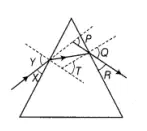
The following diagram, the path of a ray of light passing through a glass prism is shown below.
In this diagram, the angle of incidence, the angle of emergence and the angle of deviation respectively, are
(a) X, R and T
(b) Y, Q and T
(c) X, Q and P
(d) Y, Q and P
The far point of a myopic person is 80 cm in front of the eye. What is the
nature and power of the lens required to correct the problem?
(a)
An object 5.0 cm in length is placed at a distance of 20 cm in front of a convex
mirror of radius of curvature 30 cm. Find the position of the image and
size.
8.57 cm , -2.14 cm
7.57cm , -2.14 cm
4.57cm , -2.14cm
9.57cm , -2.14cm
An object of size 7.0 cm is placed at 27 cm in front of a concave mirror of focal
length 18 cm.
At what distance from the mirror should a screen be placed, so that
a sharp focussed image can be obtained? Find the size of the image.
-54cm,-14cm
-64cm,-24cm
-57cm,-17cm
-48cm,-12cm
1 D is the power of the lens of focal length of ______ cm.
1. 100
2. 10
3. 1/100
4. 1/10

