
 Worksheets
Unit 7 Pre-Quiz
Total questions: 61
Worksheet time: 53mins
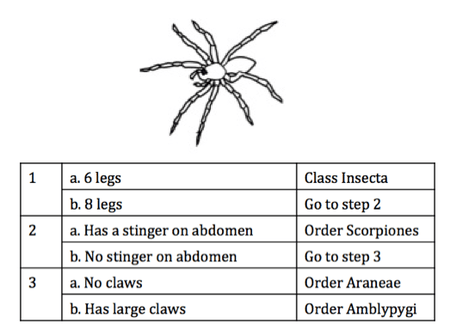

arachnids and insects?
following observations of the plant’s characteristics would be useful in determining its identity with a dichotomous key?

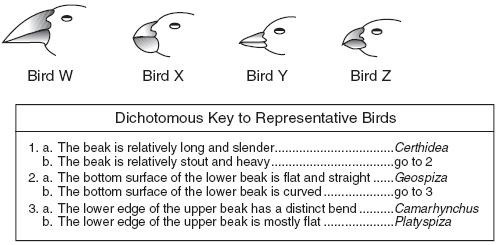
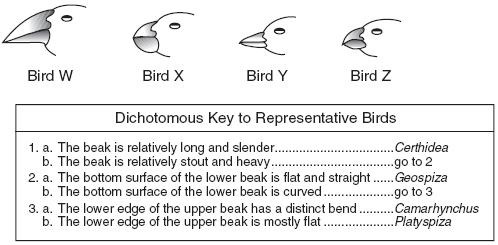


Two scientists want to compare their research of fireflies. Which information must the two scientists provide to each other to determine if they studied the same type if fireflies?
Size of the firefly populations
Type of habitat in which the fire flies live
Color of light produced by te fireflies
Species name of the fire flies studied

Students examine images of a certain species of bat commonly found in Texas. Using the bat dichotomous Key, they conclude that the bat species is a Mexican free-tailed bat due to its large, round ears.
Based on the dichotomous key, in addition to the shape of the bat's ears, which other set of features should the students look for to confirm the identity of the bat?
Solitary with a wingspan greater than 35cm
Solitary with a wingspan less than 35cm
Colonial with a wingspan greated than 35cm
Colonial with a wingspan less than 35cm

The taxonomic classifications of four species of amphibians are shown.
Based on the information provided, which two species are most closely related?
northern cricket frog and bull frog
northern leopard frog and green treefrog
northern cricket frog and green treefrog
northern leopard frog and bullfrog
A researcher determines an organism to be eukaryotic, unicellular and autotrophic. In which taxonomic group should this organism be classified?
bacteria
protista
archaea
animalia
The gray squirrel, Eastern fox squirrel, and red squirrel are all different species of squirrels. Why is having a scientific name for each species of an organism important?
To prevent existing named organisms from having their names changed as they become extinct
To keep the classification system from being altered as new organisms are discovered
To allow organisms to be placed in many classification levels at the same time
To standardize the naming and organization of organisms to avoid confusion

Organisms are classified today using the Linnaean system, and the following table shows the taxonomic classification of two marine organisms living along the Pacific Coast.
Taxonomic classification is important to marine biologists because it provides a way to -
prove that marine evolution occurs
discover and name every marine organism on Earth
designate Latin as the universal language of marine biology
identify marine organisms and find evolutionary relationships between them

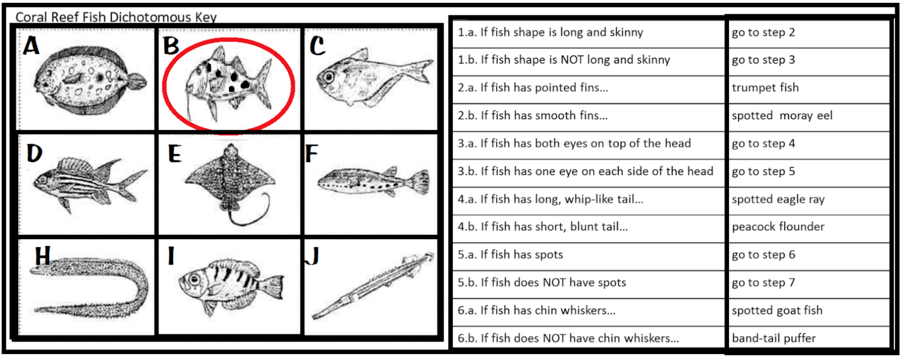
A dichotomous key for identifying fish is shown.
Based on this key, which two fish have eyes located on either side of their head and are not spotted?
Glassy sweeper and squirrelfish
Glasseye snapper and spotted eagle ray
Spotted goatfish and bandtail puffer
Peacock flounder and glassy sweeper
Many tree frog populations are threatened due to habitat loss. In an effort to promote conservation, tree frogs may be bred in captivity. A zoo acquired male and female tree frogs from two different populations. In the zoo, the tree frogs were able to successfully mate within their own population, but breeding attempts between the two populations were unsuccessful.
Based on this information, which statement correctly describes the relationship between the two populations of tree frogs.
They are in the same species but different kingdoms.
They are in the same class but different phyla.
They are in the same family but different orders.
They are in the same genus but different species.
A team of students encounters an unknown organism in a field while conducting a biodiversity study. Some students think the organism is a plant, while others think it is a fungus.
Which question should the students investigate to classify the organism correctly?
Is there a cell wall around the cells of the organism?
Does the organism perform photosynthesis?
Is there nervous tissue present in the organism?
Does the organism reproduce sexually?
Which list correctly identifies characteristics that protists share with animals?


Five general characteristics of organisms in kingdoms Plantae or Fungi are listed in the box.
Which table correctly lists the characteristics of the organisms in the two kingdoms?


The formal name for seaweed; multicellular algae
seagrass
thallaus
macroalgae
microalgae

the stem-like portion of then of seaweeds
thallus
blade
stipe
pneumatocyst
holdfast
the root-like portion of the seaweed
thallus
pneumatocyst
stipe
holdfast
blades
pneomatocysts
root-like structure of seaweeds
leaf-like structure of seaweeds
stem-like structure of seaweeds
gas-filled bladders that sometimes keep their blades close to the sea surface

stipe
blade
holdfast
pneumatocyst

body of seaweed
stipe
macroalgae
thallus
blade
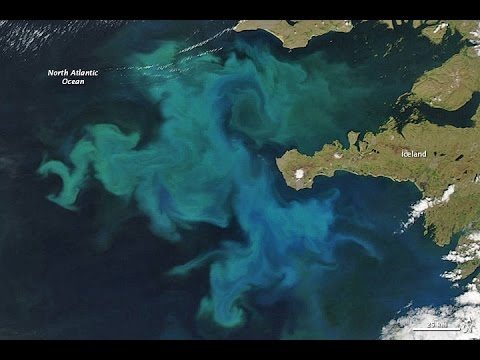

What is one reason that phytoplankton are important?
they clean the water
they make oxygen
they are drifting animals
they make the water warmer
Which of the following phytoplankton are able to move using flagella?
Dinoflagellate
Diatoms
Coccolithophores
Cyanobacteria
How are seaweed classified or sorted in to groups?
By their pigment
By their length
By the water they are found in
By their toxins
Which seaweed can withstand the least amount of light and can grow the deepest?
red
brown
green
blue

Why are floats/bladders important for seaweed?
float closer to the sun to create shade
float closer to the sun to capture prey
float closer to the surface to collect oxygen
float closer to the sun for photosynthesis
Which type of algae has red pigment?
Chlorophyta
Phaeophyta
Rhodophyta
Merophyta
Which type of Algae has green pigments?
Chlorophyta
Phaeophyta
Rhodophyta
Merophyta
Whyich type of algae has brown/yellow pigments?
Chlorophyta
Phaeophyta
Rhodophyta
Merophyta
Why is phytoplankton/seaweed/kelp important to humans?
food
byproducts are used in food
skeltons are fossil fuel - oil and gas
process CO2 and create O2
All of the above
Which products contains seaweed?
cosmetics
dairy products - icecream, processed cheeses, yogurts
fertilizers
toothpaste, shampoos, etc.
All of these

A is the __.
thallus
holdfast
bladder/pneumatocyst
blade
stipe
B is the __.
thallus
holdfast
bladder/pneumatocyst
blade
stipe
C is the __.
thallus
holdfast
bladder/pneumatocyst
blade
stipe
E is the __.
thallus
holdfast
bladder/pneumatocyst
blade
stipe
green pigment
fucoxanthin
chlorophyll
carotenoids
phycoblins
brown pigment
fucoxanthin
chlorophyll
carotenoids
phycoblins
red pigment
fucoxanthin
chlorophyll
carotenoids
phycoblins
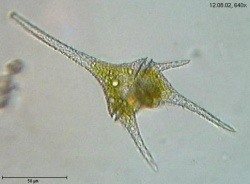

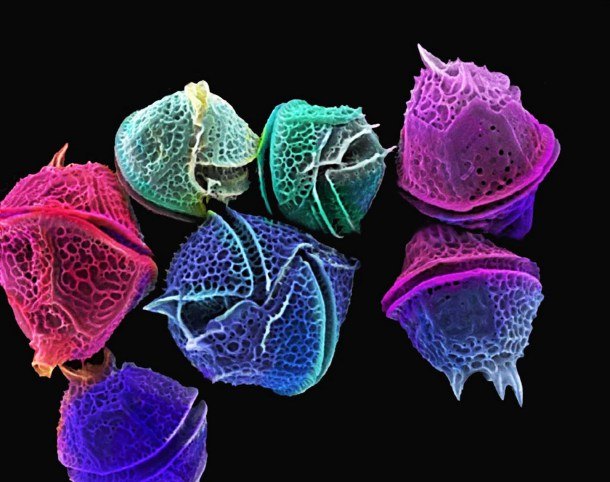
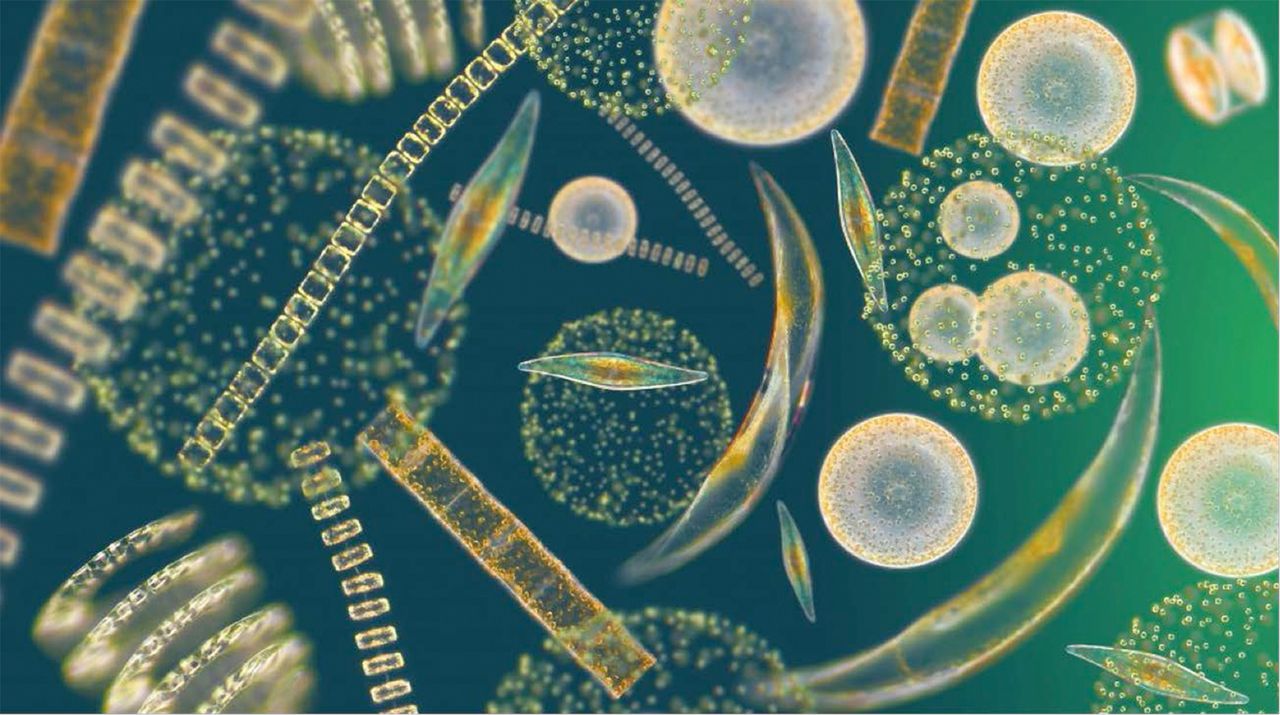
What organism(s) are pictured here?
Diatom
Dinoflagellate
Zooplankton
Nekton

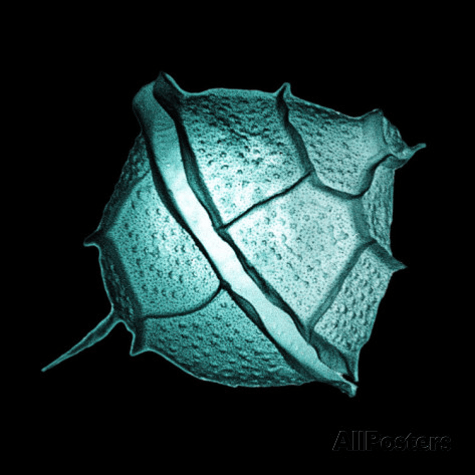
What organism(s) are pictured here?
Diatoms
Dinoflagellates
Zooplankton
Nekton


Oxygen is produced through the exhalations of marine animals.
Oxygen is produced through precipitation falling on the ocean.

