
 Worksheets
EXCEL IRISH PART
Total questions: 200
Worksheet time: 2hrs 40mins
Name
Class
Date
1.
State which of the following is false. The capacitance of a capacitor
a)
is proportional to the cross-sectional area of the plates
b)
is proportional to the distance between the plates
c)
depends on the number of plates
d)
is proportional to the relative permittivity of the dielectric
2.
Magnetic flux can always be
attributed to:
a)
A. Ferromagnetic materials
b)
B. Aligned atoms
c)
C. Motion of charged particles
d)
D. The geomagnetic field
3.
A straight conductor 500 mm long is
moved with constant velocity at right
angles both to its length and to a
uniform magnetic field. Given that
the e.m.f. induced in the conductor is
2.5 V and the velocity is 5 m/s,
calculate the flux density of the
magnetic field. If the conductor forms
part of a closed circuit of total
resistance 5 ohms, calculate the force
on the conductor.
a)
A. 0.25 N
b)
B. 0.025 N
c)
C. 2.5 N
d)
D. 250 N
4.
Which of the following statements is
true?
a)
A. Unlike charges repel each other.
b)
B. Like charges repel each other.
c)
C. Unlike charges attract each other
d)
D. Both B and C.
5.
A changing magnetic field:
a)
A. Produces an electric current in an insulator.
b)
B. Magnetizes the earth.
c)
C. Produces a fluctuating electric field.
d)
Results from a steady electric current.
6.
A conductor of length 15 cm is moved
at 750 mm/s at right-angles to a
uniform flux density of 1.2 T.
Determine the e.m.f. induced in the
conductor.
a)
A. 0.135 V
b)
B. 1.350 V
c)
C. 0.0135 V
d)
D. 13.50 V
7.
For the current carrying conductor
lying in the magnetic field shown in
the figure below, the direction of the
force on the conductor is:
a)
A. downwards
b)
B. to the right
c)
C. upwards
d)
D. to the left
8.
Which is the wrong statement? The
magnetizing force at the center of a
circular coil varies
a)
A. directly as the number of its turns
b)
B. directly as the current
c)
C. directly as its radius
d)
D. inversely as its radius
9.
A 25 cm long conductor moves at a
uniform speed of 8 m/s through a
uniform magnetic field of flux
density 1.2 T. Determine the current
flowing in the conductor when its
ends are connected to a load of 15
ohms resistance.
a)
A. 1.6 A
b)
B. 0.16 A
c)
C. 16 A
d)
D. 0.016 A
10.
Two bar magnets are placed parallel
to each other and about 2 cm apart,
such that the south pole of one
magnet is adjacent to the north pole
of the other. With this arrangement,
the magnets will:
a)
A. attract each other
b)
B. have no effect on each other
c)
C. repel each other
d)
D. lose their magnetism
11.
A car is travelling at 80 km/h.
Assuming the back axle of the car is
1.76 m in length and the vertical
component of the earth’s magnetic
field is 40 T, find the e.m.f.
generated in the axle due to motion.
a)
A. 1.56 mV
b)
B. 15.6 mV
c)
C. 0.156 mV
d)
D. 156 mV
12.
Calculate the current required in a 240
mm length of conductor of a d.c.
motor when the conductor is situated
at right-angles to the magnetic field of
flux density 1.25 T, if a force of 1.20
N is to be exerted on the conductor.
a)
A. 4 A
b)
B. 6 A
c)
C. 2 A
d)
D. 5 A
13.
If a neutral atom loses one of its
valence electrons, it becomes a (n)
a)
A. negative ion.
b)
B. electrically charged atom.
c)
C. positive ion.
d)
D. Both B and C.
14.
For the current-carrying conductor
lying in the magnetic field shown in
the figure below, the direction of the
current in the conductor is:
a)
A. towards the viewer
b)
B. away from the viewer
c)
C. upwards
d)
D. downwards
15.
A conductor 300 mm long carries a
current of 13 A and is at right-angles
to a magnetic field between two
circular pole faces, each of diameter
80 mm. If the total flux between the
pole faces is 0.75 mWb, calculate the
force exerted on the conductor.
a)
A. 0.0582 N
b)
B. 5.82 N
c)
C. 0.582 N
d)
D. 58.2 N
16.
Calculate the force exerted on a
charge of 2x10^-18 C travelling at
2x10^6 m/s perpendicular to a field of
density 2x10^-7 T.
a)
A. 8.0 x 10⁻¹⁹ N
b)
B. 0.8 x 10⁻¹⁹ N
c)
C. 0.008 x 10⁻¹⁹ N
d)
D. 80.0 x 10⁻¹⁹ N
17.
The most basic particle of negative
charge is the ____.
a)
A. coulomb
b)
B. proton
c)
C. electron
d)
D. neutron
18.
Which of the following statements is
true?
a)
A. Unlike charges repel each other.
b)
B. Like charges repel each other.
c)
C. Unlike charges attract each other.
d)
D. Both B and C.
19.
Aluminum, with an atomic number
of 13, has
a)
A. 13 valence electrons.
b)
B. 3 valence electrons.
c)
C. 13 protons in its nucleus.
d)
D. Both B and C.
20.
The nucleus of an atom is made up
of
a)
A. electrons and neutrons.
b)
B. ions.
c)
C. neutrons and protons.
d)
D. electrons only.
21.
One ampere of current corresponds to
a)
A. 1 C/1 s
b)
B. 1 J/1 C
c)
C. 6.25 X 10¹⁸ electrons
d)
D. 0.16 x 10^-18 C/s
22.
Conventional current is considered
a)
A. the motion of negative charges in the opposition direction of electron flow.
b)
B. the motion of positive charges in the same direction as electron flow.
c)
C. the motion of positive charges in the opposition direction of electron flow.
d)
D. None of the above.
23.
The coulomb is a unit of
a)
A. electric charge.
b)
B. potential difference.
c)
C. current.
d)
D. voltage.
24.
A conductor 30 cm long is situated at
right-angles to a magnetic field.
Calculate the flux density of the
magnetic field if a current of 15 A in
the conductor produces a force on it
of 3.6 N
a)
A. 0.08 T
b)
B. 0.008 T
c)
C. 8.0 T
d)
D. 0.80 T
25.
The coulomb is a unit of:
a)
A. Power
b)
B. Voltage
c)
C. Energy
d)
D. Quantity of electricity *
26.
How long must a current of 100 mA
flow so as to transfer a charge of 80
C?
a)
A. 800 ms
b)
B. 800 s
c)
C. 800 μs
d)
D. 80 s
27.
If a neutral atom loses one of its
valence electrons, it becomes a (n)
a)
A. negative ion.
b)
B. electrically charged atom.
c)
C. positive ion.
d)
D. Both B and C.
28.
A current of 6 A flows for 10
minutes. What charge is transferred?
a)
A. 360 C
b)
B. 3600 mC
c)
C. 36 C
d)
D. 3600 C
29.
Voltage drop is the:
a)
A. maximum potential
b)
B. difference in potential between 2 points
c)
C. voltage produced by a source
d)
D. voltage at the end of the circuit
30.
Determine the speed of a 10^-19 charge
travelling perpendicular to a field of
flux density 10^-7 T, if the force on the
charge is 10^-20 N.
a)
A. 107 m/s
b)
B. 105 m/s
c)
C. 106 m/s
d)
D. 103 m/s
31.
Which of the following statements is
false?
a)
A. For non-magnetic materials reluctance is high
b)
B. Energy loss due to hysteresis is greater for harder magnetic materials
c)
C. The remanence of a ferrous material is measured in ampere/meter
d)
D. Absolute permeability is measured in henrys per meter
32.
A conductor carries a current of 70 A
at right-angles to a magnetic field
having a flux density of 1.5 T. If the
length of the conductor in the field is
200 mm, calculate the force acting on
the conductor.
a)
A. 21.0 N
b)
B. 0.21 N
c)
C. 2.10 N
d)
D. 210 N
33.
The effect on an air gap in a
magnetic circuit is to:
a)
A. increase the reluctance
b)
B. reduce the flux density
c)
C. divide the flux
d)
D. reduce the magnetomotive force
34.
If a conductor is horizontal, the
current flowing from left to right and
the direction of the surrounding
magnetic field is from above to
below, the force exerted on the
conductor is:
a)
A. from left to right
b)
B. from below to above
c)
C. away from the viewer
d)
D. towards the viewer
35.
Electromotive force is provided by:
a)
A. resistance’s
b)
B. a conducting path
c)
C. an electric current
d)
D. an electrical supply source
36.
Find the speed that a conductor of
length 120 mm must be moved at
right angles to a magnetic field of
flux density 0.6 T to induce in it an
e.m.f. of 1.8 V.
a)
A. 2.5 m/s
b)
B. 0.25 m/s
c)
C. 250 m/s
d)
D. 25 m/s
37.
The most basic particle of positive
charge is the _____.
a)
A. coulomb
b)
B. proton
c)
C. electron
d)
D. neutron
38.
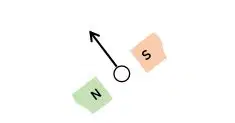
For the current-carrying conductor
lying in the magnetic field shown in
the figure below, the direction of the
current in the conductor is:
a)
A. towards the viewer
b)
B. away from the viewer
c)
C. upwards
d)
D. downwards
39.
An electric bell depends for its action
on:
a)
A. a permanent magnet
b)
B. reversal of current
c)
C. a hammer and a gong
d)
D. an electromagnet
40.
A relay can be used to:
a)
A. decrease a current in a circuit
b)
B. control a circuit more readily
c)
C. increase a current in a circuit
d)
D. control a circuit in a distance
41.
The magnetic field due to a current-
carrying conductor takes form of:
a)
A. rectangles
b)
B. concentric circles
c)
C. wavy lines
d)
D. straight lines radiating outwards
42.
A strong permanent magnet is
plunged into a coil and left in the
coil. What is the effect produced on
the coil after a short time?
a)
A. There is no effect
b)
B. The insulation of the coil burns out
c)
C. A high voltage is induced
d)
D. The coil winding becomes hot
43.
In what time would a current of 10 A
transfer a charge of 50 C?
a)
A. 5 s
b)
B. 5 ms
c)
C. 0.5 s
d)
D. 0.5 ms
44.
The atomic number of an element is
determined by:
a)
A. The number of neutrons.
b)
B. The number of protons.
c)
C. The number of neutrons plus the number of protons.
d)
D. The number of electrons.
45.
An ion:
a)
A. Is electrically neutral.
b)
B. Has positive electric charge.
c)
C. Has negative electric charge.
d)
D. Might have either a positive or negative charge.
46.
There is a force of attraction between
two current-carrying conductors
when the current in them is:
a)
A. in opposite direction
b)
B. in the same direction
c)
C. of different magnitude
d)
D. of the same magnitude
47.
A coulomb:
a)
A. Represents a current of one ampere.
b)
B. Flows through a 100-watt light bulb.
c)
C. Is one ampere per second.
d)
D. Is an extremely large number of charge carriers.
48.
A potentially lethal electric current is
on the order of ____.
a)
A. 0.01 mA
b)
B. 1 mA
c)
C. 0.1 mA
d)
D. 0.1 A
49.
Which of the following units can
represent magnetic flux density?
a)
A. The volt-turn.
b)
B. The ampere-turn.
c)
C. The gauss.
d)
D. The gauss-turn.
50.
A ferromagnetic material:
a)
A. Concentrates magnetic flux lines within itself.
b)
B. Increases the total magnetomotive force around a current-carrying wire.
c)
C. Causes an increase in the current in a wire.
d)
D. Increases the number of ampere-turns in a wire.
51.
The force between two electrically
charged objects is called:
a)
A. Electromagnetic deflection.
b)
B. Electrostatic force.
c)
C. Magnetic force.
d)
D. Electroscopic force.
52.
If a resistance to which a constant
voltage is applied is halved, what
power dissipation will result?
a)
A. Doubled
b)
B. Halved
c)
C. Stays the same
d)
D. Quadrupled
53.
If the reference point is changed to
the earth point then any voltage taken
w.r.t. the earth is known as
a)
A. Absolute potential
b)
B. Earth ground
c)
C. Relative voltage
d)
D. Absolute point
54.
What is the significance of
connecting loads in parallel?
a)
A. It makes power consumption less
b)
B. It provides greater efficiency
c)
C. It increases the safety factor
d)
D. It allows independent operations of loads
55.
Which of the following safety rules
should be observed while working on
live electric circuit?
a)
A. Keep yourself well insulated from earth ground.
b)
B. When making measurements in a live circuit place one hand behind your back or in your pocket.
c)
C. Make resistance measurements only in a live circuit.
d)
D. Both A and B.
56.
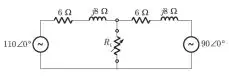
Two ac sources feed a common
variable resistive load as shown in
figure. Under the maximum power
transfer condition, what is the power
absorbed by the load resistance RL?
a)
A. 526 W
b)
B. 562 W
c)
C. 625 W
d)
D. 652 W
57.
The hot resistance of an incandescent
lamp is about _____ times its cold
resistance.
a)
A. 10
b)
B. 50
c)
C. 5
d)
D. 100
58.
If a resistor in a series circuit is
shorted, the series current, I,
a)
A. decreases
b)
B. stays the same.
c)
C. increases.
d)
D. drops to zero.
59.
The equivalent wye element of 3
equal resistors each equal to R and
connected in delta is
a)
A. R
b)
B. R/3
c)
C. 3/2 R
d)
D. 3R
60.
A coil of aluminum wire has a
resistance of 50 when its
temperature is 0°C. Determine its
resistance at 100°C if the temperature
coefficient of resistance of aluminum
at 0°C is 0.0038/°C.
a)
A. 69 Ω
b)
B. 65 Ω
c)
C. 96 Ω
d)
D. 90 Ω
61.
A certain factory takes 250 A at 220
V. It is supplied through a pair of
feeders 73.2 meters long and 1.29
cm2
in cross section. What voltage
must be maintained at the supply end
of the feeders? (Use = 1.78 -cm)
a)
A. 111.5 V
b)
B. 222.5 V
c)
C. 333.5 V
d)
D. 444.5 V
62.
A wire with a smaller cross-sectional
area will produce:
a)
A. less heat
b)
B. more conductance
c)
C. less resistance
d)
D. more heat
63.
Halving the cross-sectional area of a
conductor will:
a)
A. Not affect the resistance.
b)
B. Quarter the resistance.
c)
C. Half the resistance.
d)
D. Double the resistance.
64.
An aluminum wire has a resistance of
50 at 20°C. The wire is heated to a
temperature of 100°C. Determine the
resistance of the wire at 100°C,
assuming that the temperature
coefficient of resistance at 0°C is
0.004/°C
a)
A. 64.81 Ω
b)
B. 61.84 Ω
c)
C. 68.14 Ω
d)
D. 63.16 Ω
65.
In Norton’s Theorem, the short
circuit current is obtained by
a)
A. opening the load terminals
b)
B. shorting the load terminals
c)
C. opening the voltage source
d)
D. shorting the voltage source
66.
Delta to wye or wye to delta
transformation technique is applied
to a ______ network.
a)
A. one-terminal
b)
B. two-terminal
c)
C. three-terminal
d)
D. complex
67.
If the diameter of a wire is doubled,
its current carrying capacity becomes
a)
A. one-fourth
b)
B. half
c)
C. twice
d)
D. four times
68.
17.If a resistance element is part of two
loops, how many voltage drops must
be calculated for that component?
a)
A. Two
b)
B. None
c)
C. One
d)
D. Three
69.
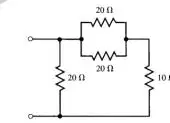
Find the equivalent resistance of the
figure shown below:
a)
A. 10 ohms
b)
B. 20 ohms
c)
C. 15 ohms
d)
D. 5 ohms
70.
Suppose you double the voltage in a
simple dc circuit and cut the
resistance in half. The current will
become:
a)
A. Four times as great
b)
B. Twice as great
c)
C. The same as it was before
d)
D. Half as great
71.
In a series circuit, the current, I, is
a)
A. different in each resistor.
b)
B. the same everywhere.
c)
C. the highest near the positive and negative terminals of the voltage source.
d)
D. different at all, the largest resistance has
72.
When a material becomes a
superconductor, its resistivity
becomes
a)
A. very small
b)
B. zero
c)
C. about 10% of normal value
d)
D. about 20% of normal value
73.
“The sum of the emf’s and potential
differences around a closed loop
equals zero” is a consequence of:
a)
A. Newton’s third law
b)
B. Newton’s second law
c)
C. Conservation of energy
d)
D. Conservation of charge
74.
Two (2) 115-V incandescent lamps A
and B are connected in series across a
230-V source. If lamp A is rated 75
watts and lamp B is rated 50 watts,
determine the current drawn by the
series connection.
a)
A. 0.52 A
b)
B. 0.48 A
c)
C. 0.64 A
d)
D. 0.57 A
75.
A network contains linear resistors
and ideal voltage sources. If values of
all the resistors are doubled, then the
voltage across each resistor is
a)
A. increase by 4 times
b)
B. half
c)
C doubled
d)
D. no change
76.
Which of the following is neither a
basic physical law nor derivable from
one?
a)
A. Ohm’s law
b)
B. Coulomb’s law
c)
C. Kirchhoff’s first law
d)
D. Kirchhoff’s second law
77.
Which of the following is the poorest
conductor of electricity?
a)
A. Aluminum
b)
B. Nichrome
c)
C. Copper
d)
D. All of the above
78.
If a resistor in a series circuit
becomes open, how much is the
voltage across each of the remaining
resistors that are still good?
a)
A. Each good resistor has the full value of applied voltage.
b)
B. The applied voltage is split evenly among the good resistors.
c)
C. 0 V.
d)
D. It cannot be determined.
79.
A series circuit in which desired
portions of the source voltage may be
tapped off for use in equipment.
a)
A. Voltage selector
b)
B. Dividing network
c)
C. Voltage trap
d)
D. Voltage divider
80.
If a complex circuit is reduced to an
equivalent circuit consisting of a
single voltage source in series with a
single resistor, this is an example of:
a)
A. Norton's theorem
b)
B. Thevenin's theorem
c)
C. Ohm's law
d)
D. Kirchhoff's law
81.
If one branch of a parallel circuit is
short-circuited.
a)
A. the fuse in the main line will blow.
b)
B. the voltage across the short- circuited branch will measure the full value of applied voltage.
c)
C. all the remaining branches are effectively short-circuited as well.
d)
D. Both A and C.
82.
Twelve 1 Ω resistance are used as
edges to form a cube. What is the
resistance between two diagonally
opposite corners of the cube?
a)
A. 5/6 Ω
b)
B. 6/5 Ω
c)
C. 1 Ω
d)
D. 3/2 Ω
83.
The polarity of a resistor’s voltage
drop is determined by
a)
A. the direction of current through the resistor.
b)
B. how large the resistance is.
c)
C. how close the resistor is to the voltage source.
d)
D. how far away the resistor is from the voltage source
84.
The electric energy required to raise
the temperature of a given amount of
water is 1000 kWh. If heat losses are
25%, the total heating energy
required is _____ kWh.
a)
A. 1500
b)
B. 1333
c)
C. 1250
d)
D. 1000
85.
The resistance of a 5 m length of
wire is 600 ohms. Determine the
resistance of an 8 m length of the
same wire.
a)
A. 960 Ω
b)
B. 906 Ω
c)
C. 690 Ω
d)
D. 609 Ω
86.
What is expected when two 20 kohms, 1
watt resistor in parallel are used
instead of one 10 kohms, 1 watt?
a)
A. Provides higher current
b)
B. Provides less power
c)
C. Provides more power
d)
D. Provides wider toleranceTwelve identical wires of resistance 6
87.
Twelve identical wires of resistance 6
ohms each are arranged to form the
edge of a cube. A current of 40 mA is
led into the cube at one corner and
out at the other diagonally opposite
corner. Calculate the potential
difference developed between these
corners.
a)
A. 0.20 V
b)
B. 0.22 V
c)
C. 0.28 V
d)
D. 0.24 V
88.
The superposition theorem is used
when the circuit contains
a)
A. reactive elements
b)
B. active elements
c)
C. number of voltage sources *
d)
D. single voltage source
89.
In a normally operating parallel
circuit, the individual branch currents
are
a)
A. independent of each other.
b)
B. not affected by the value of the applied voltage.
c)
C. larger than the total current, IT.
d)
D. None of the above.
90.
What is a closed path made of several
branches of the network called?
a)
A. Junction
b)
B. Terminal
c)
C. Node
d)
D. Loop
91.
What is expected when two 20 kohms, 1
watt resistor in parallel are used
instead of one 10kohms, 1 watt?
a)
A. Provides higher current
b)
B. Provides less power
c)
C. Provides more power
d)
D. Provides wider tolerance
92.
If one branch of a parallel circuit
becomes open,
a)
A. all remaining branch currents increase.
b)
B. the voltage across the open branch will be 0 V.
c)
C. the remaining branch currents do not change in value.
d)
D. the equivalent resistance of the circuit decreases.
93.
In a parallel circuit, the individual
branch currents are
a)
A. not related to the branch resistance values
b)
B. directly proportional to the branch resistance values
c)
C. inversely proportional to the branch resistance values.
d)
D. None of the above
94.
In any network made up of linear
resistances and containing more than
one source of e.m.f., the resultant
current flowing in any branch is the
algebraic sum of the currents that
would flow in that branch if each
source was considered separately.
What is this theorem?
a)
A. Thevenin's theorem
b)
B. Norton's theorem
c)
C. Superposition theorem
d)
D. Millman's theorem
95.
Two resistors of 4 ohms and 6 ohms
are connected in parallel. If the total
current is 30 amperes, find the
current through each.
a)
A. 17 A and 13 A
b)
B. 18 A and 12A
c)
C. 20 A and 30 A
d)
D. 16 A and 14 A
96.
If an emf in circuit A produces a
current in circuit B, then the same
emf in circuit B produces the same
current in circuit A. This theorem is
known as
a)
A. Maximum power transfer theorem
b)
B. Millman’s theorem
c)
C. Reciprocity theorem
d)
D. Norton’s theorem
97.
A 100-ohms resistor, R1, and a 300-ohms
resistor, R2, are in parallel across a
dc voltage source. Which resistor
dissipates more power?
a)
A. The 300-ohms resistor.
b)
B. Both resistors dissipate the same amount of power.
c)
C. The 100-ohms resistor.
d)
D. It cannot be determined.
98.
The power transferred from a supply
source to a load is at its maximum
when the resistance of the load is
_______ the internal resistance of the
source.
a)
A. lower than
b)
B. greater than
c)
C. equal to
d)
D. one-half of the
99.
What If you have a 12-strand
conductor and each strand has a
radius (one-half the diameter) of 2/10
inch, what is the square mil area of
the conductor?
a)
A. 1507965 sq. mil *
b)
B. 1705965 sq. mil
c)
C. 1607955 sq. mil
d)
D. 1907565 sq. mil
100.
A 5-ohms and 10-ohms resistor are
connected in series across a dc
voltage source. Which resistor will
dissipate more power?
a)
A. the 5-ohms resistor.
b)
B. the 10-ohms resistor.
c)
C. It depends on how much the current is.
d)
D. They will both dissipate the same amount or power.
101.
The first step in Thevenin's theorem
is to:
a)
A. determine the short-circuit current
b)
B. open the load under test
c)
C. short the load under test
d)
D. determine the open-circuit current
102.
A resistor with a power rating of 25W is most likely a
a)
carbon-composition resistor.
b)
metal-film resistor.
c)
surface-mount resistor.
d)
wire-wound resistor.
103.
A significant advantage, in some situations, of a toroidal coil over a solenoid is:
a)
The toroid is easier to wind
b)
The solenoid cannot carry as much current
c)
The toroid is easier to tune
d)
The magnetic flux in a toroid is practically all within the core
104.
Find the e.m.f. induced in a coil of 200 turns when there is a change of flux of 30 mWb linking with it in 40ms.
a)
-150 V
b)
150 V
c)
-100 V
d)
100 V
105.
The charge on the plates of a capacitor is 6 mC when the potential between them is 2.4 kV. Determine the capacitance of the capacitor.
a)
2.5 μF
b)
1.0 μF
c)
2.0 μF
d)
1.5 μF
106.
What formula would calculate the total inductance of inductors in series?
a)
A. LT = L1 / L2
b)
B. LT = L1 + L2
c)
C. LT = 1 / L1 + L2
d)
D. LT = 1 / L1 x L2
107.
Some wire of length 5 m and cross-sectional area 2 mm2 has a resistance of 0.08 ohms. If the wire is drawn out until its cross-sectional area is 1
mm2, determine the resistance of the wire.
a)
0.32 ohms
b)
0.032 ohms
c)
0.21 ohms
d)
0.021 ohms
108.
What is the ability to store energy in a magnetic field called?
a)
Admittance
b)
Capacitance
c)
Resistance
d)
Inductance
109.
How would you calculate the total capacitance of three capacitors in parallel?
a)
A. CT = C1 + C2 / C1 - C2 + C3.
b)
B. CT = C1 + C2 + C3.
c)
C. CT = C1 + C2 / C1 x C2 + C3.
d)
D. CT = 1 / C1+1 / C2 + 1 / C3.
110.
What is the ability to store energy in an electric field called?
a)
A. Inductance
b)
B. Resistance
c)
C. Tolerance
d)
D. Capacitance
111.
With permeability tuning, moving the core further into a solenoidal coil:
a)
A. Increases the inductance
b)
B. Reduces the inductance
c)
C. has no effect on the inductance, but increases the current-carrying capacity of the coil
d)
D. Raises the frequency
112.
Which of the following statement is false?
a)
A. An air capacitor is normally a variable type
b)
B. A paper capacitor generally has a shorter service life than most other types of capacitor
c)
C. An electrolytic capacitor must be used only on a.c. supplies
d)
D. Plastic capacitors generally operate satisfactorily under conditions of high temperature
113.
A capacitor is constructed with parallel plates and has a value of 50 pF. What would be the capacitance of the capacitor if the plate area is doubled and the plate spacing is halved?
a)
200 pF
b)
50 pF
c)
100 pF
d)
75 pF
114.
What electrical parameter is controlled by a potentiometer?
a)
A. Inductance
b)
B. Resistance
c)
C. Capacitance
d)
D. Field strength
115.
What electrical component usually is constructed as a coil of wire?
a)
Switch
b)
Diode
c)
Cpacitor
d)
Inductor
116.
One precaution to observe when checking resistors with an ohmmeter is to
a)
A. check high resistance on the lowest ohms range
b)
B. check low resistance on the highest ohms range.
c)
C. disconnect all parallel paths.
d)
D. make sure your fingers are touching each test lead.
117.
What is a relay?
a)
A. An electrically-controlled switch
b)
B. A current controlled amplifier
c)
C. An optical sensor
d)
D. A pass transistor
118.
18. For how long must a charging current of 2 A be fed to a 5 uF capacitor to raise the p.d. between its plates by 500 V.
a)
0.5 mS
b)
1.0 mS
c)
1.15 mS
d)
1.25 mS
119.
Carbon-composition resistors:
a)
A. Can handle lots of power
b)
B. Have capacitance or inductance along with resistance
c)
C. Are comparatively nonreactive
d)
D. Work better for ac than for dc
120.
A capacitor is to be constructed so that its capacitance is 0.2 μF and to take a p.d. of 1.25 kV across its terminals. The dielectric is to be mica which, after allowing a safety factor of 2, has a dielectric strength of 50 MV/m. Find the thickness of the mica needed and the area of a plate assuming a two-plate construction. (Assume r for mica to be 6).
a)
A. 0.025 mm; 941.6 cm2
b)
B. 0.015 mm; 671.7 cm2
c)
C. 0.019 mm; 893.9 cm2
d)
D. 0.035 mm; 561.4 cm2
121.
The total resistance in a parallel circuit:
a)
A. is always less than the smallest resistance
b)
B. depends upon the voltage drop across each branch
c)
C. could be equal to the resistance of one branch
d)
D. depends upon the applied voltage
122.
A potentiometer is a
a)
A. three-terminal device used to vary the voltage in a circuit.
b)
B. two-terminal device used to vary the current in a circuit.
c)
C. fixed resistor.
d)
D. tow-terminal device used to vary
123.
The material separating the plates of a capacitor is the:
a)
A. dielectric
b)
B. semiconductor
c)
C. resistor
d)
D. lamination
124.
An e.m.f. of 25 V is induced in a coil of 300 turns when the flux linking with it changes by 12 mWb. Find the time, in milliseconds, in which the
flux makes the change.
a)
144mS
b)
120mS
c)
114mS
d)
155mS
125.
Which of the following is combined with an inductor to make a tuned circuit?
a)
Zener diode
b)
Potentiometer
c)
Resistor
d)
Capacitor
126.
The total capacitance of two or more capacitors in series is:
a)
A. always less than that of the smallest capacitor
b)
B. always greater than that of the largest capacitor
c)
C. found by adding each of the capacitances together
d)
D. found by adding the capacitances together and dividing by their total number
127.
A potentiometer is used to:
a)
A. Compare voltages
b)
B. Measure power factor
c)
C. Compare currents
d)
D. Measure phase sequence
128.
Determine the voltage across a 1000 pF capacitor to charge it with 2 C.
a)
1kV
b)
2.5kV
c)
2 kV
d)
0.5kV
129.
The total resistance of two resistors R1 and R2 when connected in parallel is given by:
a)
A. R1 + R2
b)
B. 1/R1 + 1/R2
c)
C. (R1 + R2)/R1R2
d)
D. R1R2/(R1 + R2)
130.
Which of the following statements is false? The inductance of an inductor increases:
a)
A. with a short, thick coil
b)
B. when wound on an iron core
c)
C. as the number of turns increases
d)
D. as the cross-sectional area of the coil decreases
131.
The energy stored in the magnetic field of an inductor is 80 J when the current flowing in the inductor is 2 A. Calculate the inductance of the coil.
a)
40H
b)
20H
c)
30H
d)
50H
132.
Two coils have self inductances of 250 mH and 400 mH respectively. Determine the magnetic coupling coefficient of the pair of coils if their mutual inductance is 80 mH.
a)
0.115
b)
0.253
c)
0.124
d)
0.162
133.
A chip resistor is marked 394. Its resistance value is
a)
A. 39.4 ohms
b)
B. 390,000 ohms
c)
C. 39,000 ohms
d)
D. 394 ohms
134.
The best place to use a wirewound resistor is _____.
a)
A. in a radio-frequency amplifier
b)
B. when the resistor doesn’t dissipate much power
c)
C. in a high-power, radio frequency circuit
d)
D. in a high-power, direct-current circuit
135.
Self-inductance occurs when the:
a)
A. current is changing
b)
B. circuit is changing
c)
C. flux is changing
d)
D. resistance is changing
136.
A capacitor uses a dielectric 0.04 mm thick and operates at 30 V. What is the electric field strength across the dielectric at this voltage?
a)
A. 750 kV/m
b)
B. 650 kV/m
c)
C. 850 kV/m
d)
D. 700 kV/m
137.
Calculate the equivalent capacitance of two capacitors of 6 μF and 4 μF connected in parallel and in series.
a)
A. 10 uF; 2.4 uF
b)
B. 10 mF; 2.4 mF
c)
C. 6 uF; 1.5 uF
d)
D. 6 mF; 1.5 mF
138.
Which of the following resistors has the smallest physical size?
a)
A. wire-wound resistors.
b)
B. carbon-composition resistors.
c)
C. surface-mount resistors.
d)
D. potentiometers.
139.
Which of the following statement is false?
a)
A. An air capacitor is normally a variable type
b)
B. A paper capacitor generally has a shorter service life than most other types of capacitor
c)
C. An electrolytic capacitor must be used only on a.c. supplies
d)
D. Plastic capacitors generally operate satisfactorily under conditions of high temperature
140.
If a thermistor has a negative temperature coefficient (NTC), its resistance
a)
A. increases with an increase in operating temperature.
b)
B. decreases with a decrease in operating temperature.
c)
C. decreases with an increase in operating temperature.
d)
D. is unaffected by its operating temperature.
141.
Two coils connected in series have self inductance of 40 mH and 10 mH respectively. The total inductance of the circuit is found to be 60 mH. Determine the mutual inductance between the two coils and the coefficient of coupling.
a)
A. 5 H, 0.23
b)
B. 5 uH, 0.21
c)
C. 5 mH, 0.25
d)
D. 5 nH, 0.24
142.
The capacitance of a capacitor is the ratio
a)
A. charge to p.d. between plates
b)
B. p.d. between plates to plate spacing
c)
C. p.d. between plates to thickness of dielectric
d)
D. p.d. between plates to charge
143.
The effect of inductance occurs in an electrical circuit when:
a)
A. the resistance is changing
b)
B. the flux is changing
c)
C. the current is changing
d)
D. all of the above
144.
A current changing at a rate of 5 A/s in a coil of inductance 5 H induces an e.m.f. of:
a)
A. 25 V in the same direction as the applied voltage
b)
B. 1 V in the same direction as the applied voltage
c)
C. 25 V in the opposite direction to the applied voltage
d)
D. 1 V in the opposite direction to applied voltage
145.
Which of the following axial-lead resistor types usually has a blue, light green or red body?
a)
A. wire-wound resistors.
b)
B. carbon-composition resistors.
c)
C. carbon-film resistors.
d)
D. metal-film resistors.
146.
The resistance of 500 m of wire of cross-sectional area 2.6 mm2 is 5 ohms. Determine the resistivity of the wire in
μohms-m.
a)
A. 0.26 μΩ-m
b)
B. 0.026 μΩ-m
c)
C. 2.60 μΩ-m
d)
D. 0.0026 μΩ-m
e)
Option 5
147.
If a 75-ohm sample of copper wire at 0C is heated to 30C, what is the approximate total resistance? (The temperature coefficient of resistance of copper at 0oC is 0.00427).
a)
A. 0.32 ohms
b)
B. 9.61 ohms
c)
C. 65.39 ohms
d)
D. 84.61 ohms
148.
Which of the following statements is
true?
a)
A. Resistors always have axial leads.
b)
B. Resistors are always made from carbon.
c)
C. There is no correlation between the physical size of a resistor and its resistance value.
d)
D. The shell life of a resistor is about 1 year.
149.
Two metal plates separated by air form a 0.001 uF capacitor. Its value may be changed to 0.002 uF by:
a)
A. bringing the metal plates closer together
b)
B. using the plates smaller in size
c)
C. moving the plates apart
d)
D. touching the two plates together
150.
Find the charge on a 10 μF capacitor when the applied voltage is 250 V.
a)
A. 2.5 mC
b)
B. 1.5 mC
c)
C. 3.0 mC
d)
D. 5.0 mC
151.
In a parallel ac circuit with XL and XC,
a)
A. IL and Ic are 90 out of phase.
b)
B. IL and IC are in phase.
c)
C. IL and IC are 180 out of phase.
d)
D. XL and XC are 90 out of phase.
152.
What is the term for the out-of-phase
power associated with inductors and
capacitors?
a)
A. Effective power.
b)
B. True power.
c)
C. Peak envelope power.
d)
D. Reactive power.
153.
In an AC circuit, if the voltage andcurrent are in phase, the circuit is
a)
resistive
b)
capacitivie
c)
reactive
d)
inductive
154.
For a capacitor in a sine-wave ac
circuit,
a)
A. Vc lags ic by 90
b)
B. ic leads Vc by 90
c)
C. ic and Vc have the same frequency.
d)
D. All of the above.
155.
Calculate the r.m.s. value of a
sinusoidal current of maximum value
20A.
a)
7.07 A
b)
14.14 A
c)
28.28 A
d)
26.25 A
156.
An alternating voltage is given by
v=75 sin (200πt −0.25) volts. Find
the phase angle (in degrees and
minutes)
a)
A. 14.32 (lagging)
b)
B. 14.32 (leading)
c)
C. 31.83 (lagging)
d)
D. 31.83 (leading)
157.
In a parallel RL circuit,
a)
A. IL lags IR by 90.
b)
B. IL leads IR by 90.
c)
C. IL and IR are in phase.
d)
D. IR lags IL by 90.
158.
Calculate the current taken by a 10
uF capacitor when connected to a
200 V, 100 Hz supply.
a)
0.1257A
b)
125.7 A
c)
12.57 A
d)
1.257 A
159.
What is the power factor (PF) of a purely resistive ac circuit?
a)
A. 0.
b)
B. 1.
c)
C. 0.707.
d)
D. Without values, it cannot be determined.
160.
A resistive and a capacitive load of
equal magnitude is connected in
series, determine the phase difference
between the voltage and the current.
a)
A. current leads the voltage by 45°
b)
B. current lags the voltage by 45°
c)
C. current leads the voltage by 90°
d)
D. current lags the voltage by 90°
161.
For an inductor in a sine-wave ac
circuit,
a)
A. VL leads iL by 90.
b)
B. VL lags iL by 90.
c)
C. VL and iL are in phase.
d)
D. None of the above.
162.
What will happen when the power
factor of a circuit is increased?
a)
A. Reactive power increases
b)
B. Active power increases
c)
C. Both active and reactive powers increases
d)
D. Both active and reactive powers decreases
163.
Calculate the capacitive reactance of a
capacitor of 20 μF when connected to
an a.c. circuit of frequency 20 Hz
a)
A. 397.9 ohms
b)
B. 379.8 ohms
c)
C. 399.7 ohms
d)
D. 378.9 ohms
164.
The impedance in the study of
electronics is represented by resistance and ________.
a)
A. inductance and capacitance
b)
B. inductance
c)
C. reactance
d)
D. capacitance
165.
In a series RLC circuit,
a)
A. XL and XC are 180 out of phase.
b)
B. IL and IC are 180 out of phase.
c)
C. IL and XC are 180 out of phase.
d)
D. IL and XC are in phase.
166.
A resistive and a capacitive load of
equal magnitude is connected in
series, determine the phase difference
between the voltage and the current.
a)
A. current leads the voltage by 45°
b)
B. current lags the voltage by 45°
c)
C. current leads the voltage by 90°
d)
D. current lags the voltage by 90°
167.
In a series RC circuit,
a)
A. Vc leads VR by 90
b)
B. Vc and I are in phase.
c)
C. Vc lags Vr by 90
d)
D. Both B and C.
168.
An e.m.f. of 200 V at a frequency of
2 kHz is applied to a coil of pure
inductance 50 mH. Determine the
reactance of the coil and the current
flowing in the coil.
a)
A. 628 Ω; 0.318 A
b)
B. 628 Ω; 0.328 A
c)
C. 630 Ω; 0.318 A
d)
D. 618 Ω; 0.318 A
169.
If a circuit has an admittance of Y =
0.2 + j0.6, the circuit is
a)
A. purely inductive
b)
B. inductive
c)
C. capacitive
d)
D. reactive
170.
What is the significance of
connecting loads in parallel?
a)
A. It makes power consumption less
b)
B. It provides greater efficiency
c)
C. It increases the safety factor
d)
D. It allows independent operations of loads
171.
What is the term used to identify an
AC voltage that would cause the
same heating in a resistor as a
corresponding value of DC voltage?
a)
A. Cosine voltage.
b)
B. Power factor.
c)
C. Root mean square (RMS).
d)
D. Average voltage.
172.
When the frequency of the applied
voltage increases in a series RC
circuit,
a)
A. the phase angle, , becomes more negative.
b)
B. ZT increases.
c)
C. ZT decreases.
d)
D. Both A and C.
173.
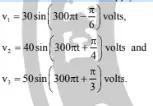
The voltages across three
components in a series circuit when
connected across an a.c. supply are:
Calculate the supply voltage in
sinusoidal form.
a)
A.
b)
B.
c)
C.
d)
D.
174.
The product of the readings of an AC
voltmeter and AC ammeter is called:
a)
A. Apparent power.
b)
B. True power.
c)
C. Power factor.
d)
D. Current power.
175.
A resistor of 150 Ω, a coil with
reactance 100 Ω and a capacitor with
reactance - 200 Ω are connected in
series. What is the complex
impedance R + jX?
a)
A. 150 + j100
b)
B. 150 – j200
c)
C. 100 – j200
d)
D. 150 – j100
176.
In an ac circuit with only series
capacitors,
a)
A. VT leads IT by 90.
b)
B. VT lags IT by 90.
c)
C. each capacitor voltage drop leads IT by 90.
d)
D. Both A and C.
177.
A value of –j500 represents
a)
A. 500 of inductive reactance.
b)
B. 500 of capacitive reactance.
c)
C. 500 of resistance.
d)
D. 500 of conductance.
178.
Inductive reactance, XL,
a)
A. applies only to non-sinusoidal waveforms or dc.
b)
B. applies only to sine waves.
c)
C. applies to either sinusoidal or non-sinusoidal waveforms.
d)
D. is inversely proportional to frequency.
179.
Susceptance, B, is the
a)
A. reciprocal of impedance.
b)
B. reciprocal of reactance.
c)
C. reciprocal of resistance.
d)
D. same as conductance.
180.
What is the total impedance of a
series AC circuit having a resistance
of 6 ohms, an inductive reactance of
17 ohms, and zero capacitive
reactance?
a)
6.6
b)
18
c)
11
d)
23
181.
When the frequency of the applied
voltage decreases in a parallel RL
circuit,
a)
A. the phase angle, 1, becomes less negative.
b)
B. ZEQ increases.
c)
C. ZEQ decreases.
d)
D. Both A and B.
182.
An impedance draws a current i = 10cos (ωt – 30) from a voltage, v =220 sin (ωt + 30). What is the impedance?
a)
A. 15.6 – j15.6
b)
B. 15.6 + j15.6
c)
C. 19.1 – j11.1
d)
D. 11.1 + j19.1
183.
In a parallel RC circuit,
a)
A. Ic lags IR by 90
b)
B. IR and IC are in phase.
c)
C. IC leads IR by 90.
d)
D. IR leads IC by 90.
184.
If a circuit has an admittance of Y = 0.5- j0.9, the circuit is
a)
resistive
b)
capacitive
c)
inductive
d)
reactive
185.
A coil, resistor and capacitor are in
parallel. The resistance is 1 Ω; the
capacitive susceptance is 1.0
siemens; the inductive susceptance is
- 1.0 siemens. Then the frequency is
cut to half its former value. What will
be the admittance vector, G + jB, at
the new frequency?
a)
1 +j0
b)
1-j1.5
c)
1+j1.5
d)
1-j2
186.
A branch current of +j250 mA
represents
a)
A. 250 mA of inductive current.
b)
B. 250 mA of resistive current.
c)
C. 250 mA of capacitive current.
d)
D. 250 mA of in-phase current.
187.
A capacitor has a capacitive
reactance of 400 when connected
to a 100 V, 25 Hz supply. Determine
its capacitance and the current taken
from the supply.
a)
A. 15.92 μF; 0.25 A
b)
B. 15.92 μF; 0.15 A
c)
C. 15.29 μF; 0.25 A
d)
D. 15.92 μF; 0.025 A
188.
What happens to reactive power in a
circuit that has both inductors and
capacitors?
a)
A. It is dissipated as heat in the circuit.
b)
B. It alternates between magnetic and electric fields and is not dissipated.
c)
C. It is dissipated as inductive and capacitive fields.
d)
D. It is dissipated as kinetic energy within the circuit.
189.
How do you compute true power
(power dissipated in the circuit) in a
circuit where AC voltage and current
are out of phase?
a)
A. Multiply RMS voltage times RMS current.
b)
B. Subtract apparent power from the power factor.
c)
C. Divide apparent power by the power factor.
d)
D. Multiply apparent power times the power factor.
190.
In a parallel RC circuit,
a)
A. VA and IR are in phase.
b)
B. VA and IC are in phase.
c)
C. IC and IR are in phase.
d)
D. VA and IR are 90 out of phase.
191.
An alternating voltage given by v =
100 sin 240t volts is applied across a
coil of resistance 32 and
inductance 100 mH. Determine the
circuit impedance.
a)
40 ohms
b)
20 ohms
c)
30 omh
d)
50 ohms
192.
What is a sine wave?
a)
A. A constant-voltage, varying-current wave.
b)
B. A wave whose amplitude at any given instant can be represented by the projection of a point on a wheel rotating at a uniform speed.
c)
C. A wave following the laws of the trigonometric tangent function.
d)
D. A wave whose polarity changes in a random manner.
193.
A 120 mH inductor has a 50 mA, 1
kHz alternating current flowing through it. Find the p.d. across the
inductor
a)
36.7 V
b)
33.7 V
c)
35.7 V
d)
37.7 V
194.
What type of wave is characterized
by a rise time significantly faster than
the fall time (or vice versa)?
a)
A. Cosine wave.
b)
B. Square wave.
c)
C. Sawtooth wave.
d)
D. Sine wave.
195.
What type of wave is made up of sine
waves of the fundamental frequency
and all the odd harmonics?
a)
Square
b)
cosine
c)
sine
d)
tangent
196.
When the frequency of the applied
voltage increases in a parallel RC
circuit,
a)
A. the phase angel, , increases.
b)
B. ZEQ increases.
c)
C. ZEQ decreases.
d)
D. Both A and C.
197.
How many degrees are there in one
complete sine wave cycle?
a)
A. 90 degrees.
b)
B. 270 degrees.
c)
C. 180 degrees.
d)
D. 360 degrees.
198.
In a series RC circuit,
a)
A. Vc and VR are in phase.
b)
B. VT and I are always in phase.
c)
C. VR and I are in phase.
d)
D. VR leads I by 90.
199.
What is the description of a square
wave?
a)
A. A wave with only 300 degrees in one cycle.
b)
B. A wave whose periodic function is always negative.
c)
C. A wave whose periodic function is always positive.
d)
D. A wave that abruptly changes back and forth that abruptly changes back and forth between two voltage levels and stays at these levels for equal amounts of time.
200.
What type of wave is made up of sine
waves at the fundamental frequency
and all the harmonics?
a)
A. Sawtooth wave.
b)
B. Square wave.
c)
C. Sine wave.
d)
D. Cosine wave.
100 %

