
 Worksheets
Neuro Exam 1 Prep: Part 2
Total questions: 55
Worksheet time: 5hrs 35mins
Which of the following are the spinal cord's two main functions?
To convey information between neurons innervating peripheral structures and the brain
To process information
Coordinates movement
Controls equilibrium
(T/F): Information is integrated in white matter.
True
False
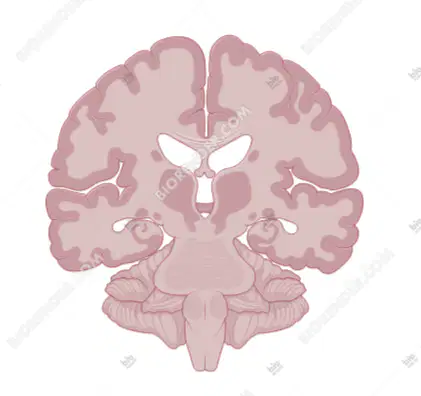
(T/F): You are able to see the occipital lobe through this coronal cut of the brain.
True
False
The (a) contains important groups of neurons that control equilibrium, cardiovascular activity, respiration, eye movements, and other functions.
(a) receive information, process it, and generate output. They typically have four main components.
Some axons are specialized for faster action potential propagation. Which of the following are structural adaptations that improve their passive properties? Select all that apply.
Increased diameter of the axon
Myelination
Decreased diameter of the axon
Decreased length of the axon
(T/F): Myelin promotes the dissipation of the action potential so that it does not need to be regenerated as frequently.
True
False
(T/F): In myelinated axons, nodes of Ranvier are the only sites where ion exchange across the membrane occurs.
True
False
Which of the following are the three core functions of glial cells?
Myelinating
Signaling, cleaning, nourishing
Defending
Demyelinating
(a) are found in the CNS and myelinates parts of several axons from different neurons.
(T/F): A Schwann cell can only myelinate one axon at a time.
True
False
_____ provide metabolic support to the unmyelinated axons.
Oligodendrocytes
Schwann cells
Microglia
Astrocytes
The internal carotid artery branches into two of the major cerebral arteries: the _____ and _____.
ACA and MCA
ACA and PCA
MCA and PCA
ACA and Basilar artery
(T/F): The anterior communicating artery links the internal carotid arteries with a posterior cerebral artery.
True
False
All of the following lobes are able to be seen in a midsagittal view of the brain EXCEPT FOR:
Frontal lobe
Parietal lobe
Occipital lobe
Temporal lobe
With repetition of a task, the number of active regions in the brain is reduced. Eventually, when a motor task has been learned, only a small, distinct regions of the brain show increased activity during performance of the task. This describes _____.
Experience-dependent plasticity
Habituation
Maladaptation after injury
(T/F): LTP is the conversion of silent synapses to active synapses, while LTD occurs when an active synapse is converted to a silent synapse.
True
False
(T/F): Plasticity is not considered to be maladaptive or have harmful consequences because it is essential for neural recovery following an injury or insult.
True
False
(T/F): Transcranial magnetic stimulation (TMS) applied to the motor cortex and other brain areas involved in motor learning can enhance or inhibit motor learning and memory formation.
True
False
When the distal segment of an axon degenerates, the myelin sheath pulls away from that segment. The axon swells and breaks into shorter segments. The terminals rapidly degenerates, and their loss is followed by the death of the entire distal segment.
The above describes (a) .
Glial scars, formed by astrocytes and microglia, physically block axonal regeneration in the _____.
PNS
CNS
Functional regeneration of axons occurs more frequently in the peripheral system than in the CNS owing to the production of nerve growth factor (NGF) by _____.
Oligodendrocytes
Microglia
Satellite cells
Schwann cells
Select all of the following structures that are visible in a horizontal cut of the brain.
Corpus callosum
Frontal lobe
Parietal lobe
Cerebellum
Thalamus
(T/F): For Guillian-Barre syndrome, occupational therapy is directed at activities of daily living, including self-care.
True
False
People with _____ are encouraged to avoid high temperatures and excessive exertion because increases in body temperature may interfere with the activity of membrane proteins in axons, further disabling action potential conduction.
Guillian-Barre Syndrome
MS
Epilepsy
Diabetic Polyneuropathy
For mild cases of _____, often occupational therapy treatment of full-time splinting and a formal education program constitute sufficient intervention.
Carpal tunnel syndrome
MS
Apraxia
Diabetic Polyneuropahty
In _____, the knowledge of how to perform a skilled movement is lost.
Apraxia
Agnosia
Dysarthria
Ataxia
(T/F): Arnold-Chiari type I is almost always associated with another disorder - incomplete closure of the neural tube, called myelomeningocele.
True
False
_____ may result in problems with tongue and facial weakness, decreased hearing, dizziness, weakness of lateral eye movements, and problems with coordination of movement.
Arnold-Chiari Type I
Arnold-Chiari Type II
Spina Bifida
Tethered Cord
Clinical signs of _____ include progressive lower limb weakness, deterioration of walking, back pain, leg pain, excessive muscle resistance to stretch, increasing scoliosis, increasing foot deformity, and deterioration in bladder and bowel function.
Tethered spinal cord
Spina Bifida
MS
Epilepsy
(T/F): Growing into deficit is common in CP.
True
False
In _____ hydrocephalus, the ventricular system is intact and a blockage exists beyond the fourth ventricle.
Communicating
Noncommunicating
Formation of the nervous system occurs during the _____ stage of development.
Pre-embryonic
Embryonic
Fetal
All of the following are responses of the parasympathetic nervous system EXCEPT for:
Pupil constriction
Saliva stimulation
Bladder constriction
Slow heartbeat
Pupil dilation
(T/F): Bladder relaxation and fast heartbeat are responses of the sympathetic nervous system.
True
False
A(n) _____ is a blood clot that formed elsewhere and were transmitted by the blood to a new location.
Embolus
Thrombus
If there is damage to the PCA, what cognition, language, or memory deficit might an individual experience?
Difficulty w/ divergent thinking
Difficulty understanding spatial relationships, neglect, or impairment of nonverbal communication
Mild deficit in recall after distraction
Difficulty reading; memory loss
Reduced consciousness
If there is damage to the basilar artery, what cognition, language, or memory deficit might an individual experience?
Difficulty w/ divergent thinking
Aphasia
Difficulty reading; memory loss
Reduced consciousness
The _____ is located within the central sulcus and on the adjacent post-central gyrus.
Primary somatosensory cortex
Primary auditory cortex
Primary motor cortex
Premotor cortex
What area of the cerebrum learns goal-oriented actions and prepares, selects, and initiates movements?
Premotor cortex
Primary motor cortex
Primary somatosensory cortex
Secondary sensory areas
What area of the cerebrum integrate tactile and proprioceptive information obtained from manipulating an object?
Secondary sensory areas
Primary motor cortex
Premotor cortex
Primary somatosensory cortex
_____ involves the injection of radioactive isotopes and is able to measure blood flow, glucose metabolism, and oxygen consumption.
Positron Emission Tomography (PET)
Functional Magnetic Resonance Imaging (fMRI)
Angiography
Computed Tomography (CT)
(T/F): fMRI measures gray matter activity and is considered safer when compared to a PET scan.
True
False
The anterior inferior cerebellar artery stems off of which of the following arteries?
Basilar artery
Vertebral artery
Superior cerebellar artery
Middle cerebral artery
The posterior inferior cerebellar artery stems off of which of the following arteries?
Basilar artery
Vertebral arteries
Spinal arteries
Anterior cerebral arteries
(T/F): MRI provides better resolution of nervous system anatomy compared with a CT scan.
True
False
(T/F): Pathology is generally more evident on T2 scans compared to T1 scans.
True
False
THIS technology is being used to determine the effects of brain injury and degree of neuroplasticity following rehabilitation.
Functional Imaging Techniques
Neuroangiography
CT Scan
MRI
If you are examining an MRI image of the brain showing plaques in the white matter and a considerable reduction in gray matter volume, the individual is most likely diagnosed with ______.
MS
Guillian-Barre Syndrome
Epilepsy
Spina Bifida
_____, the principal fast excitatory transmitter of the central nervous system, has powerful excitatory effects on virtually every region of the brain, eliciting neural changes that occur with learning and development.
Glutamate
GABA
Glycine
Dopinamine
All of the following are amines EXCEPT for:
Acetylcholine (ACh)
Dopamine
Norepinephrine
Serotonin
Histamine
_____ affects motor activity, cognition, and behavior. It is associated with seeking a reward and this motivates certain behaviors.
Dopamine
Serotonin
Norepinephrine
Histamine
(T/F): Serotonin is essential in producing the freeze, fight, or flight reaction to stress.
True
False
Where is histamine concentrated within the diencephalon?
Thalamus
Hypothalamus
Epithalamus
The (a) plexus emerges between the anterior and middle scalene muscles, passes deep into the clavicle, and enters the axilla.

