Wayground logo

Free Printable Worksheets

Font size

S
M
L
XL
Worksheets

chapter1-3

Total questions: 60

Worksheet time: 30mins

Name
Class
Date
1.
In order to make an inference, you must have:
a)
Make observations with all senses
b)
Made 3 other observations
c)
Background knowledge
d)
A hypothesis in mind first
2.

Which of the following is NOT a characteristics of a hypothesis?

a)

Must be made with background knowledge

b)

Must be testable

c)

Must organizes the IV and DV

d)

Must always be correct

3.
In a hypothesis written in the "If, then" format, which variable comes first?
a)
Independent
b)
Dependent
4.
In a hypothesis written in the "If, then" format, which variable comes second?
a)
Independent
b)
Dependent
5.
The step of the scientific method that would come after testing is:
a)
Inferencing
b)
Hypothesizing
c)
Peer Review
d)
Analyzing Data
6.
The easy way to pick out an experiments responding (DV) variable is to look for:
a)
What was purposefully changed
b)
Number of trials
c)
What's being measured
d)
The test group
7.
The test group gets its name because this scientific variable is applied to this group:
a)
Manipulated
b)
Responding
c)
Dependent
8.

The control group , or the normal group, is needed for:

a)

Keeping aspects of experiment constant

b)

Comparison

c)

Hypothesis formation

d)

Application of the manipulated variable

9.

Experiments include many trials, since:

a)

It's fun

b)

Scientists like to stay busy

c)

More trials ensure the hypothesis is ALWAYS correct

d)

More trials increase accuracy of results

10.
A good experiment will yield accurate results if it has:
a)
A really strong hypothesis
b)
Only one manipulated variable
c)
1 or 2 trials maximum
d)
Two separate responding variables.
11.

If I add sliced garlic to my aquarium water, then my fish will eat a lot. The IV in this hypothesis is:

a)

Adding garlic to the aquarium

b)

The fish eating a lot

12.

If I feed Puff Puff McGuff mole crabs, then his teeth will wear down. The responding variable in this hypothesis is:

a)

Mole crabs as food

b)

Wearing down puffs teeth

13.

On our water density lab, the IV was:

a)

Applying heat to the water

b)

Measuring salinity

c)

Applying freshwater

d)

The use of the graduated cylinder

14.

On our density doughnuts lab, the DV was:

a)

Mass measurements

b)

Volume measurements

c)

How well the doughnuts stayed together

d)

Having 3 trials

15.
Which of the following elements has the smallest radius?
a)
Mg
b)
Al
c)
Si
d)
K
16.

Which element in Period 2 has the greatest atomic radius?

a)

Be

b)

C

c)

Na

d)

Li

17.

Of the halogens (group 7A), which has the smallest radius?

a)

F

b)

Br

c)

He

d)

At

18.
As you move across the periodic table from left to right, the atomic radius decreases.  This is because - 
a)
the number of protons increases, so attraction to electrons increases
b)
the number of energy levels increases
c)
the number of electrons increases
d)
the atomic mass increases
19.
Ionization energy is...
a)
the energy required to add an electron to a specific atom
b)
how much energy it takes to remove an electron from an atom
c)
the energy required to shield the outer electrons from the nucleus
d)
a measure of the ability of an atom to attract electrons
20.

Electronegativity __________ from left to right within a period and __________ from top to bottom within a group.

a)

decreases, increases

b)

increases, increases

c)

increases, decreases

d)

stays the same, increases

21.

The vertical (up and down) columns in the Periodic Table are called

a)

groups

b)

towers

c)

periods

d)

atomic numbers

22.

The atom with the largest atomic radius in Group 8A is -

a)

Ar

b)

He

c)

Kr

d)

Rn

23.
Francium (Fr) has the lowest ionization energy in Group 1 because - 
a)
it has the smallest number of valence electrons
b)
it has the greatest atomic mass
c)
it has the greatest number of protons, so it attracts its electrons the strongest
d)
its 1 valence electron is very far from the nucleus, so little energy is needed to remove it
24.
Which has the greater EN: 
H or F?
a)
H
b)
F
25.
Which has the greater EN: 
N or C?
a)
C
b)
N
26.

How many valence electrons does Carbon have?

a)

4

b)

5

c)

6

d)

8

27.
Atoms that have a high electronegativity, _______________.
a)
give up their electrons more easily.
b)
hold on to their electrons more tightly.
c)
have more electron shells.
28.
Which of the following sequences corresponds to a correct trend in ionization energy?
a)
Cl > S > P > Al
b)
Sr > Ca > Mg > Be
c)
Rb > K > Na > Li
d)
Rb > Sr > I > Xe
29.

The ability of an atom to attract electrons in a bond is called

a)

Ionization energy

b)

electronegativity

c)

atomic radius

d)

proton affinity

30.
As you move down a group, atomic radius increases because - 
a)
you add more and more neutrons
b)
you add more and more protons
c)
you add more and more shells (energy levels)
d)
you add more atomic mass
31.
The element with the smallest ionization energy in Period 6 is - 
a)
Rn
b)
Cs
c)
Os
d)
Tm
32.

Which of the following will have a lower ionization energy than Scandium (Sc)?

a)

Helium (He)

b)

Titanium (Ti)

c)

Calcium (Ca)

d)

Magnesium (Mg)

33.

Which of the following will have a higher electronegativity than arsenic (As)?

a)

Carbon (C)

b)

Neon (Ne)

c)

Antimony (Sb)

d)

Germanium (Ge)

34.

As you move left to right across a period, ionization energy

a)

increases

b)

decreases

c)

says the same

35.

What group is highlighted here on the periodic table (Group 1A)?

a)

Noble Gases

b)

Halogens

c)

Alkali Metals

d)

Alkaline Earth Metals

36.

What group is highlighted here on the periodic table (Group 8A)?

a)

Noble Gases

b)

Halogens

c)

Alkali Metals

d)

Alkaline Earth Metals

37.

What group is highlighted here on the periodic table (Group 2A)?

a)

Noble Gases

b)

Halogens

c)

Alkali Metals

d)

Alkaline Earth Metals

38.

What group is highlighted here on the periodic table (Group 7A)?

a)

Noble Gases

b)

Halogens

c)

Alkali Metals

d)

Alkaline Earth Metals

39.

What group is highlighted here on the periodic table (D-block elements)?

a)

Non-metals

b)

Metalloids

c)

Rare Earth Metals

d)

Transition Metals

40.

Which of the following is not one of the four major classes of macromolecules?

a)

Lipids

b)

Carbon

c)

Protein

d)

Carbohydrates

e)

Nucleic Acid

41.

Which macromolecule is used as our main source of energy?

a)

Lipids/Fats

b)

Nucleic Acids

c)

Proteins

d)

Carbohydrates

42.

Which of the following elements are found in all macromolecules? (Select all that apply).

a)
b)
c)
d)
43.
Waxes, oils and fats are examples of
a)
Carbohydrates
b)
Lipids
c)
Proteins
d)
Nucleic Acids
44.

Nucleic acids make up which of the two molecules listed below?

a)

FDA

b)

RNA

c)

DNA

d)

FDR

45.

This macromolecule breaks down into sugars such as glucose.

a)

Lipids/Fats

b)

Nucleic Acids

c)

Protein

d)

Carbohydrates

46.

Storing energy is the primary function of two macromolecules. What macromolecule is represented by the structure below?

a)

Carbohydrates

b)

Proteins

c)

Lipids

d)

Nucleic Acids

47.

Which of the following are examples of carbohydrates? (Select all that apply).

a)

Bread

b)

Pasta

c)

Olive Oil

d)

Cheese

48.
Proteins are made of monomers called ___________
a)
Nucleotides
b)
Monosaccharides
c)
Amino Acids
d)
Glycerol and fatty acids
49.
What is the primary function of carbohydrates in your body?
a)
Speed up chemical reactions.
b)
Give immediate energy.
c)
Help to store energy.
d)
Build cell walls in plants.
50.
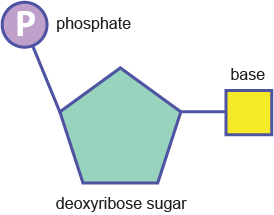
What type of macromolecule is being represented in this image? 
a)
carbohydrate
b)
lipid
c)
protein
d)
nucleic acid
51.
Nucleotides are monomers of
a)
Carbohydrates
b)
Lipids
c)
Proteins
d)
Nucleic Acids
52.
What is the function of nucleic acids?
a)
store genetic information
b)
store energy (long-term)
c)
store energy (short-term)
d)
build skin, hair, nails, muscles
53.
Which macromolecule stores energy, insulates us, and makes up the cell membrane?
a)
lipids
b)
proteins
c)
carbohydrates
d)
nucleic acids
54.
All polymers are made up of...
a)
monosaccharides
b)
monomers
c)
proteins
d)
None of these
55.

The most important element that is the backbone of all biological molecules

a)
carbon
b)
nitrogen
c)
phosphorus
d)
sulfur
56.
Enzymes are..
a)
nucleic acids 
b)
carbohydrates 
c)
lipids 
d)
proteins 
57.

Chitin is found in the exoskeleton of arthropod. What group does this monomer belong to?

a)

Carbohydrates

b)

Lipids

c)

Proteins

d)

Nucleic Acids

58.

Identify the monomer shown

a)

monosaccharide

b)

amino acid

c)

neucleotide

d)

glucose molecule

59.

What elements are in proteins

a)

CHO

b)

CHON

c)

CHONP

d)

CHOP

60.

What elements are in carbohydrates

a)

CHO

b)

CHON

c)

CHONP

d)

CHOP