
Font size
 Worksheets
Immunology: antigen presentation FINISHED
Total questions: 93
Worksheet time: 48mins
Which of the following is/are non-specific defences?
first line defense
second line defense
third line of defense
Skin, mucous membranes, secretions of skin and mucous membranes
first line defense
second line of defense
third line defense
phagocytic leukocytes, antimicrobial proteins, inflammatory response, fever
first line of defense
second line of defense
third line of defense
lymphocytes, anitbodies, memory cells
first line of defense
second line of defense
third line of defense
which of the following is/are specific defences?
first line defense
second line defense
third line defense
An acquired response to an antigen
innate immunity
adaptive immunity
Any substance recognized by antigen receptors on T and B lymphocytes.
antigen
antibody
Proteins, glycoproteins, and polysaccharides are all components of
a pathogen
an antibody
nickel, penicillin, and urushiol are all chemicals that can cause and immune response.
True
False
Portion of the antigen that is recognized by the antigen receptor
epitope or antigenic determinant
not this
What cells recognize antigens presented to them?
T cells
macrophages
DCs
B cells
Which one CANNOT respond to intracellular antigen?
B cells
T cells
Which lymphocyte has a cellular receptor and can also be free antibodies?
B cell
T cell
B cell receptors or antibodies can bind to epitopes on free antigen
True
False
What is needed in order to show antigen to T cells?
MHC complex
nothing is needed
In humans, MHCs are referred to as human leukocyte antigen (HLA) complex
True
False
MHC molecules are encoded by a cluster of closely associated group of genes called the MHC locus.
True
False
MHC genes have multiple alternative forms called alleles.
True
False
Which one can recognize a broad range of antigen types?
naive B cells
naive T cells
Antigen recognition is limited to short peptides that are produced by antigen processing.
B cells
T cells
Foreign peptide is bound to a protein in the ER or endosome and then loaded into the MHC that brings it to the cell surface for T cell recognition.
antigen processing
antigen presentation
Intracellular degradation of a pathogen's proteins.
antigen processing
antigen presentation
Which receptors are ALWAYS bound to the membrane of a cell?
B cell receptors (BCR)
T cell receptors (TCR)
Which serve as antigen receptors ONLY.
B cell
T cell
Where do T cells develop?
bone marrow
thymus
T cell diversity is generated during T cell development PRIOR to antigen binding.
True
False
Which part of the TCR binds antigen?
transmembrane region
constant region
variable region
Each V domain on a T cell has how many complementary determining regions?
1
2
3
What from the T cell comes in contact with the peptide antigen presented by MHC?
Variable region
CDR
Constant region
transmembrane region
T cell receptors must associate with 4 invariant membrane proteins to be transported to the cell surface.
True
False
The 4 invariant membrane proteins that must associate with TCR for it to be transported to the cell surface are called ____
CD3 complex
MHCs
Transmits signals through the TCR to the cell's interior after the TCR recognizes antigen.
CD3 complex
not this
What are the 2 specialized types of effector T cells that recognize specific MHCs?
Cytotoxic T cells
Helper T cells
Which specialized type of effector T cells express CD8?
cytotoxic T cells
Helper T cells
Which specialized effector T cell expresses CD4?
cytotoxic T cell
Helper T cell
T cell co-receptors
CD4
CD8
Which recognizes MHC class II?
CD8
CD4
Which recognizes MHC class I?
CD8
CD4
What kind of peptide antigens can T cell receptors recognize?
long peptide antigens
short peptide antigens
When extracellular pathogen is engulfed and degraded within macrophages and DCs into small peptide fragments that can be read by a TCR.
antigen presentation
antigen processing
Peptides from intracellular pathogens are produced by antigen processing in all infected human cells.
True
False
glycoprotein that binds peptide fragments from the pathogen and escort the peptide antigen to the cell surface.
MHC
lysosome
MHC can bind multiple peptides at a time.
True
False
For TCR to recognize a peptide antigen, it must be bound to an MHC and displayed on the cell surface
True
False
Present antigens from INTRACELLULAR pathogens.
MHC class I
MHC class II
Peptides are degraded in the CYTOSOL and then join with this MHC in the ER to move to the cell surface.
MHC class I
MHC class II
This MHC is recognized by CD8 + cytotoxic T cells
MHC class I
MHC class II
Induce apoptosis of target cells by releasing cytotoxic enzymes form their granules.
helper T cells
cytotoxic T cells
Present antigens from EXTRACELLULAR pathogens.
MHC class I
MHC class II
Peptides are degraded in the LYSOSOME and then join with this MHC in endosome and move to cell surface.
MHC class I
MHC class II
Recognized by CD4 + helper T cells
MHC class I
MHC class II
Help macrophages and B cells respond to the infection.
MHC class I
MHC class II
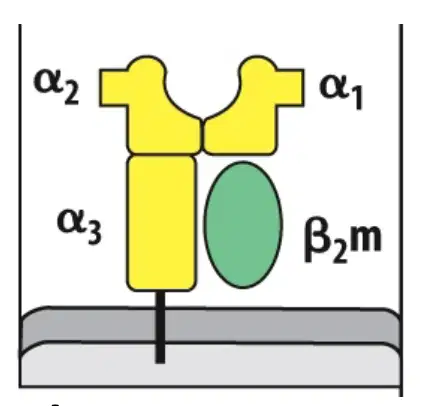
Which one?
MHC class I
MHC class II
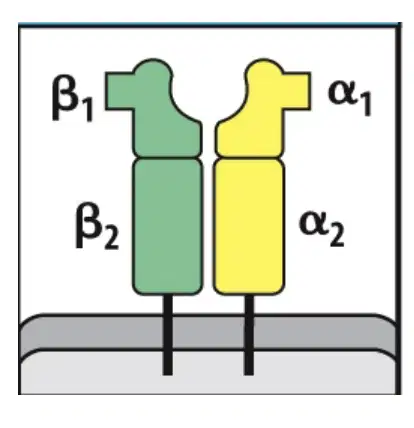
Which one?
MHC class I
MHC class II
has 3 extracellular alpha chain domains and 1 alpha chain transmembrane domain.
MHC class I
MHC class II
Contains a beta 2 microglobulin not part of the MHC.
MHC class I
MHC class II
Peptide binding site is made up of alpha 1 and alpha 2
MHC class I
MHC class II
Which domain interacts with CD8 and CTL on the MHC class I molecule?
alpha 1
alpha 2
alpha 3
Only contain genes that encode for alpha domains.
MHC class I
MHC class II
consists of 2 polypeptide chains, one alpha and one beta
MHC class I
MHC class II
Has TWO transmembrane domains made up of alpha 2 and beta 2
MHC class I
MHC class II
What makes up the peptide binding site for MHC class II molecule?
alpha 1 and alpha 2
alpha 1 and beta 1
Which MHC class has only one transmembrane domain?
MHC class I
MHC class II
Each class of MHC molecule has a peptide size constraints within its groove.
True
False
MHC class I and II molecules can bind a lot of different peptides of varying amino acid sequences
True
False
Bind peptides that are 8-10 amino acids in length
MHC class I
MHC class II
Bind peptides 12-25 amino acids in length.
MHC class I
MHC class II
Processes and presents ENDOGENOUS antigen
MHC class I
MHC class II
Processes and presents EXOGENOUS antigens
MHC class I
MHC class II
Antigen specific and MHC restricted
T cell
B cell
recognition of antigen requires cell to cell contact
B cell
T cell
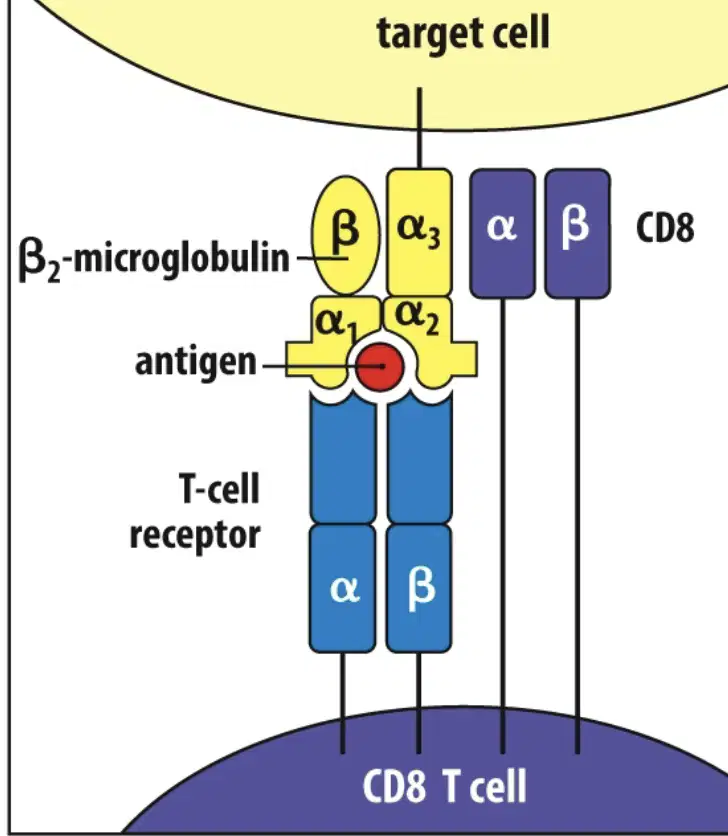
Which MHC class is represented here?
MHC class I
MHC class II
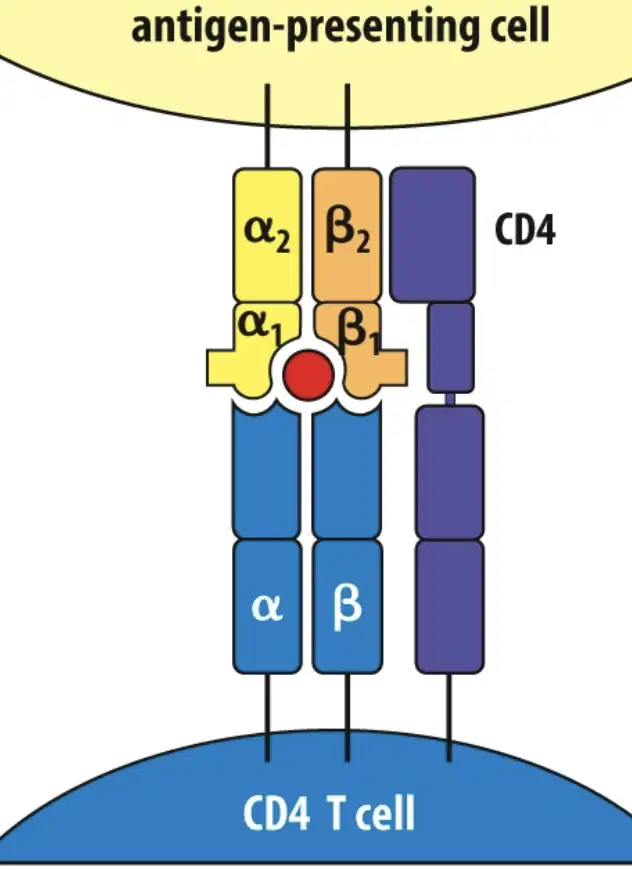
Which MHC class is represented here?
MHC class I
MHC class II
Expressed on ALL nucleated cells
MHC class I
MHC class II
Expressed only on antigen presenting cells
MHC class I
MHC class II
B cells are phagocytic.
True
False
The diversity of MHC molecules in the human population is due to
multigene families
genetic polymorphism
allotypes
Human MHC is called the human leukocyte antigen complex (HLA)
True
False
Genes that encode for MHCs
do not rearrange
rearrange
Genes that encode for BCR/antibodies and TCR
do not rearrange
rearrange
Set of genes encoding proteins of similar structure
gene families
genetic polymorphism
allotypes
alternative form of a given gene
gene families
genetic polymorphism
allotypes
Different protein products from different alleles
gene families
genetic polymorphism
allotypes
Human MHC class I & II isotypes have the same function and extent of polymorphism.
True
False
Which HLA class I's are highly polymorphic?
HLA-A
HLA-B
HLA-C
HLA-E
Which HLA's are oligomorphic?
HLA-A
HLA-B
HLA-C
HLA-E
HLA-G
May be the most polymorphic genetic complex known.
MHC
TCR
BCR
Due to high MHC polymorphism, if a novel disease should arise, at least part of the population should be able to present antigen and defend themselves against the pathogen.
advantage of MHC polymorphism
disadvantage of MHC polymorphism
MHC polymorphism greatly complicates transplantation
advantage
disadvantage
TCRs form a complex with ___ to move from endoplasmic reticulum to cell surface .
CD4
CD8
CD3
Only recognizes peptide antigen presented by an MHC molecule requiring cell to cell contact.
BCR
TCR
Present endogenous peptides to CTL.
MHC class I
MHC class II
Present exogenous peptides to helper T cells.
MHC class I
MHC class II

