wayground logo

Free Printable Worksheets

NEW

Font size

S
M
L
XL
Worksheets

Unit 3 Test Review (Chapters 5 & 6)

Total questions: 66

Worksheet time: 3615secs

Name
Class
Date
1.
Put the following stages of the cell cycle in order: G2, S, G1, M. 
a)
G1, S, G2, M
b)
S, G1, G2, M
c)
G1, M, G2, S
d)
M, G1, S, G2
2.

Which phase of the cell cycle is represented in the diagram?

a)

Prophase

b)

Interphase

c)

Anaphase

d)

Telophase

3.

Which phase of the cell cycle is represented in the diagram?

a)

Anaphase

b)

Cytokinesis

c)

Telophase

d)

Metaphase

4.
a)
Cytokinesis
b)
Interphase
c)
Anaphase
d)
Metaphase
5.

Which phase of the cell cycle is represented in the diagram?

a)

Cytokinesis

b)

Anaphase

c)

Telophase

d)

Prophase

6.
The phase in mitosis where chromosomes move away and are pulled apart by spindles to opposite sides of the cell.
a)
prophase
b)
anaphase
c)
metaphase
d)
telephase
7.
The dark "spider" looking things on opposite sides of the cell are called "Spindle Fibers".  What is their job?
a)
Eating the chromosomes
b)
Pulling the chromosomes apart
c)
Putting the chromosomes together
8.
Where does a cell contain it's genetic material?
a)
nucleus
b)
nucleolus
c)
cytoskeleton
d)
golgi
9.

Which of the following is/are results of the cell cycle ?

a)

growth

b)

repair of damaged cells

c)

replacement of dying cells.

d)

All of the above

10.
Put the following stages of mitosis in order: anaphase, prophase, metaphase, and telophase. 
a)
prophase, metaphase, telophase, anaphase
b)
prophase, anaphase, metaphase, telophase
c)
prophase, metaphase, anaphase, telophase
d)
prophase, telophase, metaphase, anaphase
11.
Uncontrollable cell growth is known as _____
a)
obesity
b)
cancer
c)
diabetes
d)
hepatitis
12.
During what phase of the cell cycle does cell division occur?
a)
Interphase
b)
M phase
c)
S phase
d)
G2 phase
13.

What is the result of the cell cycle?

a)

Three cells

b)

Four daughter cells

c)

Two identical cells

d)

One clone cell

14.
Which type of cell is unspecialized?
a)
skin cell
b)
stem cell
c)
liver cell
d)
muscle cell
15.

Chromosomes line along the center of the cell

a)

anaphase

b)

prophase

c)

metaphase

d)

telophase

16.
The structure labeled A is a(n)
a)
chromatid
b)
centriole
c)
centromere
d)
chromophere
17.
The cell spends most of it's life in ________________.
a)
mitosis
b)
cytokinesis
c)
Interphase
d)
None of the above
18.
The structures labeled B are
a)
centrioles
b)
chromatids
c)
centromeres
d)
chromopheres
19.
All of the offspring of an organism have the same genetic material, which is identical to the parent organism. From this, we can conclude that this organism -
a)
makes its own food
b)
is unicellular
c)
live in a marine habitat
d)
reproduces asexually
20.
Which is a type of Asexual Reproduction
a)
Sexual 
b)
Binary fission
c)
Cells 
d)
organism 
21.
What are some of the facts about asexual reproduction?
a)
Takes only one mate to reproduce and takes a longer time to reproduce
b)
Takes a shorter amount of time to reproduce and it takes two mates to reproduce
c)
Reproduces diverse offspring and takes a longer time to reproduce
d)
Takes only one mate to reproduce and takes a shorter time to reproduce
22.
What are some of the facts about sexual reproduction?
a)
Takes two mates to reproduce and takes a longer time to reproduce
b)
Takes one mate to reproduce and takes a shorter amount of time to reproduce
c)
Takes two mates to reproduce and takes a shorter amount of time to reproduce
d)
Takes one mate to reproduce and takes a shorter amount of time to reproduce
23.
What is an advantage of sexual reproduction?
a)
Allows genetic variation
b)
Only needs one parent
c)
Happens very quickly
d)
Offspring are exact copies of parent
24.
What is one disadvantage of sexual reproduction?
a)
Only one parent needed
b)
Off spring are exact copies of parents
c)
Happens very quickly
d)
Needs two parents
25.
If an environment suddenly changes, which type of reproduction would be most beneficial? Why?
a)
Asexual, because asexual organisms always have variation within species.
b)
Sexual, because sexual organisms have variation within species.
c)
Both Asexual and Sexual reproduction would be beneficial, because they both have variation within species.
d)
Asexual, because asexual organisms have no variation, so they can adapt to a changing environment.
26.
If two organisms reproduce sexually, then their offspring will exhibit a genetic makeup that is -
a)
identical to only one parent
b)
identical to all of its siblings
c)
a unique combination of traits
d)
the recessive traits of each parent
27.
Which statement correctly describes meiosis?
a)
cells divide only once
b)
meiosis does not occur in reproductive cells
c)
the cells produced at the end of meiosis are genetically identical to the parent cell
d)
The cells produced at the end of meiosis contain half the number of chromosomes as the parent cell
28.
Meiosis is the key process in the production of_________.
a)
body cells
b)
RNA
c)
white blood cells
d)
gametes
29.
The correct order of the phases of mitosis and meiosis could be abbreviated as:
a)
MAPT
b)
PAMT
c)
TPAM
d)
PMAT
30.
Which process and type of resulting cells are represented?
a)
mitosis, gametes
b)
mitosis, body cells
c)
meiosis, gametes
d)
meiosis, body cells
31.
What is one advantage of sexual reproduction?
a)
offspring are identical to parents
b)
offspring are resistant to viruses
c)
offspring are born live, rather than from eggs
d)
offspring inherit a wider variety of genetic information
32.
Each human skin cell has ____ pairs of chromosomes.
a)
13
b)
18
c)
23
d)
46
33.
How many times does a reproductive cell divide during meiosis?
a)
1
b)
2
c)
3
d)
4
34.
A cell that has 2 of every kind of chromosome is _____.
a)
haploid
b)
diploid
c)
an egg
d)
a sperm
35.
Haploid numbers of chromosomes are usually found in the ____ of an organism.
a)
tissues
b)
body cells
c)
sex cells
d)
zygotes
36.
After meiosis, how many chromosomes does each cell have compared to the original cell?
a)
same number
b)
half as many
c)
twice as many
d)
three times as mny
37.

What organism did Mendel study?

a)

pea plants

b)

onions

c)

mice

d)

cats

38.

Which of the following is heterozygous?

a)

MM

b)

Mm

c)

mm

39.

Which of the following is homozygous dominant?

a)

RR

b)

Rr

c)

rr

40.

Which of the following is homozygous recessive?

a)

PP

b)

Pp

c)

pp

41.

What term denotes the physical expression of a gene?

a)

genotype

b)

phenotype

c)

appearance

d)

homologous

42.

Which term denotes the combination of genes an organism has?

a)

genotpye

b)

phenotype

c)

heterozygous

d)

homozygous

43.

Which of these genotypes would most likely be used to represent the dominant for pea plant height?

a)

TT

b)

tt

c)

PP

d)

pp

44.

Which of the following would produce a recessive phenotype?

a)

hh

b)

Rr

c)

Ww

d)

BB

45.

Which of the these is homozygous?

a)

gg

b)

Yy

c)

Nn

d)

Ee

46.

Which of the following laws claims that alleles will separate during meiosis, one going to half the sex cells, the other allele going to the other half.

a)

Law of Domination

b)

Law of Segregation

c)

Law of Speciation

d)

Law of Genetics

47.

Which of the following laws claims that alleles will come together independently of each other in the offspring?

a)

Law of Independent Assortment

b)

Law of Probable Expression

c)

Law of Typical Collection

d)

Law of Assorted Assignment

48.

If Y (yellow) is the dominant allele for pea plant seed color, which of the following would produce green seeds?

a)

yy

b)

Yy

c)

YY

d)

gg

49.

What are the chances that two white flower (pp) pea plants could produce a purple flower pea plant?

a)

0%

b)

25%

c)

50%

d)

75%

50.
What you see, or the physical appearance.
a)
Genotype
b)
Phenotype
c)
Homozygous
d)
Heterozygous
51.
Which of the following is homozygous recessive?
a)
Tt
b)
tt
c)
TT
d)
T
52.

Which of the following genotypes is considered to be purebred dominant?

a)

A

b)

Aa

c)

AA

d)

aa

53.

Which of the following genotypes is hybrid?

a)

Bb

b)

BB

c)

bb

d)

B

54.
What genotype would go in box 2?
a)
BB
b)
Bb
c)
bb
55.
What genotype would go in box 3?
a)
BB
b)
Bb
c)
bb
56.

Which choice best represents the genotypic ratio of this cross?

a)
1 Yy: 2 yy: 0 YY
b)
2 Yy: 2 yy: 0 YY
c)
3 Yy: 1 yy: 0 YY
d)
1 Yy: 3 yy: 0 YY
57.
What allele combination should go in the missing box?
a)
AA
b)
Aa
c)
aa
d)
none of these
58.
What allele combination should go in the missing box?
a)
AA
b)
Aa
c)
aa
d)
none of these
59.
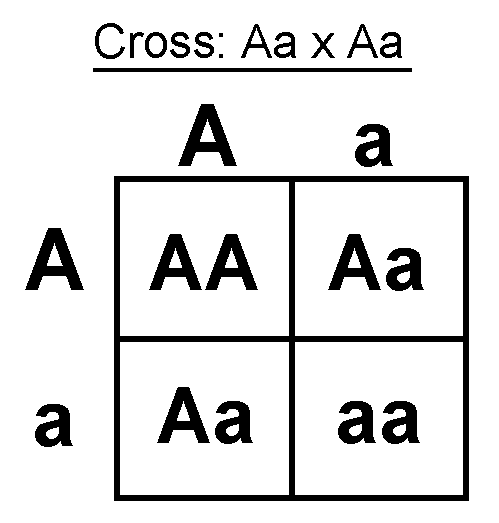
What is the probability of heterozygous offspring?
a)
25%
b)
50%
c)
0%
d)
100%
60.
What is the phenotype of the offspring? (A-Brown hair; a-blond hair) 
a)
50 % Brown Hair and 50% Blond Hair 
b)
25 % Brown Hair and 75% Blond Hair 
c)
75 % Brown Hair and 25% Blond Hair 
d)
0% Brown Hair and 100% Blond Hair 
61.
If T=Tall & t=short, what is the genotypic ratio?
a)
1:3
b)
3:1
c)
1:2:1
d)
2:2
62.
What are the possible genotypes for this cross?
(Click the picture to see it without the text)
a)
TT = 25% Tt= 50% tt=25%
b)
all tall
c)
TT= 75% tt = 25%
d)
Tt = 100%
63.

Law of Segregation

a)

Genes for different traits are inherited independently of each other

b)

Every organism has two alleles which seperate when gametes are produced.

c)

The way an organism looks and behaves.

64.

Somatic cells undergo

a)

mitosis

b)

meiosis

65.

Independent Assortment and Crossing Over are part of

a)

all cell division

b)

meiosis

c)

mitosis

66.

Two identical daughter cells are produced in

a)

meiosis

b)

mitosis

c)

all cell division