
Font size
 Worksheets
BIO-108 First Test Study Guide
Total questions: 69
Worksheet time: 17hrs 5mins
Which of these makes up the greatest portion of whole blood by volume?
erythrocytes
platelets
leukocytes
plasma
What is the Percentage Components of whole blood?
55% Plasma
45% Erythrocytes
45% Plasma
55% Erythrocytes
50% Plasma
50% Erythrocytes
60% Plasma
40% Erythrocytes
What is a hematocrit?
A hematocrit is the percentage of plasma in a whole blood sample.
A hematocrit is the percentage of all formed elements in a whole blood sample.
A hematocrit is the percentage of erythrocytes in a whole blood sample.
A hematocrit is the percentage of leukocytes and platelets in a whole blood sample.
Which of the following is NOT a formed element in whole blood?
albumin
leukocytes
platelets
erythrocytes
What triggers erythropoietin (EPO) release that leads to the production of new red blood cells?
reduced availability of oxygen
a high hematocrit
too many platelets
excess oxygen in the bloodstream
How many oxygen molecules can be transported by one hemoglobin molecule?
two
four
eight
The cells responsible for producing platelets are called ________.
monoblasts
megakaryocytes
myeloblasts
lymphoid stem cells
What enzyme removes unneeded clots after healing has occurred?
plasmin
thrombin
plasminogen
fibrin
What protein involved in coagulation provides the activation for the final step in clotting?
fibrin
prothrombin activator
thrombin
fibrinogen
Which step of hemostasis involves activation of formed elements in the blood?
vascular spasm
platelet plug formation
fibrin mesh formation
fibrinolysis
Loss of fibrinogen within the plasma would most likely cause which of the following?
loss of blood clotting
fever with pain
pallor (pale skin)
edema (swelling)
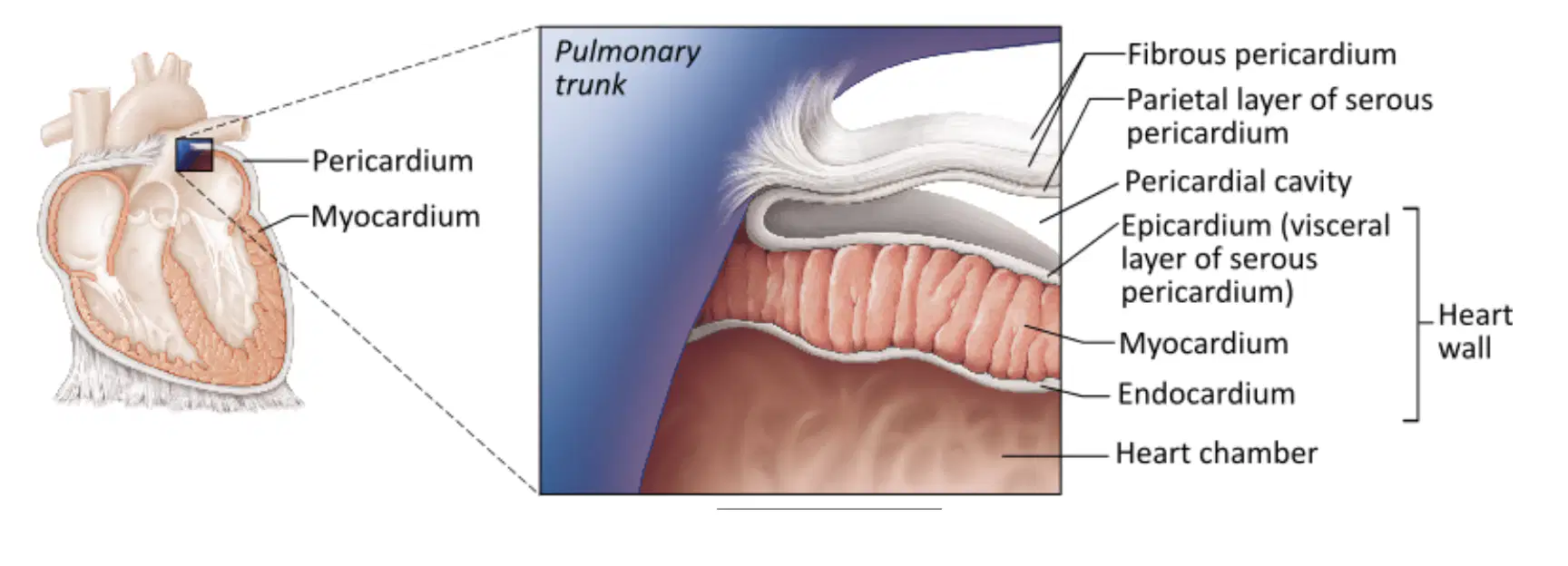
What separates the parietal and visceral pericardium?
myocardium
pericardial cavity
fibrous pericardium
epicardium

Which of the following is the innermost layer of the heart?
endocardium
epicardium
parietal layer
visceral layer
Which layer of the heart wall contracts and is composed primarily of cardiac muscle tissue?
endocardium
epicardium
visceral layer of the serous pericardium
myocardium
Which of these vessels returns blood to the left atrium of the heart?
coronary sinus
pulmonary veins
pulmonary trunk
superior vena cava
The right tricuspid valve prevents backflow of blood from the right ventricle into the __________
left ventricle
left atrium
right atrium
pulmonary trunk
Which statement is correct regarding the ventricles?
The right ventricle empties into the pulmonary trunk.
The left ventricle has a thinner wall than the right ventricle.
The left ventricle empties into the pulmonary circuit.
The right ventricle forms a complete circle in cross section.
The receiving chambers of the heart include the ________.
right atrium and ventricle
left atrium and ventricle
right and left ventricles
right and left atria
Which valve is located between the right atrium and ventricle?
tricuspid valve
bicuspid valve
mitral valve
pulmonary semilunar valve
The __________ valve is located between the right atrium and the right ventricle.
aortic semilunar
pulmonary semilunar
mitral
tricuspid
If the mitral valve is unable to close properly, ________.
blood could flow back into the right atrium
blood could flow back into the left ventricle
blood could flow back into the right ventricle
blood could flow back into the left atrium
Into which chamber of the heart do the superior vena cava, inferior vena cava, and coronary sinus return deoxygenated blood?
right ventricle
left atrium
right atrium
left ventricle
Which chamber of the heart sends oxygenated blood directly to the systemic circuit via the aorta?
right ventricle
left ventricle
right atrium
left atrium
Which heart chamber receives oxygenated blood from the lungs?
left ventricle
right atrium
right ventricle
left atrium
The left ventricular wall of the heart is thicker than the right wall in order to ________.
accommodate a greater volume of blood
pump blood through a smaller valve
pump blood with greater pressure
expand the thoracic cage during diastole
The "pacemaker potential" of pacemaker cells is produced by the opening of ________ at the end of an action potential.
K+ channels
fast Ca2+ channels
slow Na+ channels
slow Ca2+ channels
What structure in the intrinsic cardiac conduction system determines heart rate?
the cardiac nerve
the vagus nerve
the sinoatrial (SA) node
the atrioventricular (AV) node
What causes heart sounds?
pressure of blood in the ventricles
blood flowing from the atria into the ventricles
opening of heart valves
heart valve closure
The first heart sound (the "lub" of the "lub-dup") is caused by __________.
closure of the atrioventricular valves
ventricular contraction
closure of the semilunar valves
atrial contraction
As soon as ventricular pressure falls below atrial pressure, the atrioventricular valve will open and ventricular filling will begin.
True
False
During the isovolumetric relaxation phase of the cardiac cycle, _______.
atrioventricular, aortic, and pulmonary valves are closed
atrioventricular valves are open; aortic and pulmonary valves are closed
atrioventricular valves are closed; aortic and pulmonary valves are open
atrioventricular, aortic, and pulmonary valves are open
Which of the following receive(s) blood during ventricular systole?
pulmonary arteries only
pulmonary veins only
aorta only
both the aorta and pulmonary trunk
The atrioventricular (AV) valves are closed ________.
when the ventricles are in diastole
by the movement of blood from atria to ventricles
when the ventricles are in systole
while the atria are contracting
Calculate the stroke volume if the end diastolic volume (EDV) is 135 mL/beat and the end systolic volume (ESV) is 60 mL/beat.
60 mL/beat
75 mL/beat
205 mL/beat
8100 mL/beat
Which of the following would decrease stroke volume?
increasing sympathetic stimulation
increasing contractility
increasing preload
increasing afterload
What best describes afterload?
back pressure exerted by arterial blood
contractility of cardiac muscle
degree of stretch of the heart muscle
cardiac reserve
The Frank-Starling Law states that, if other factors are constant, a ________.
higher stroke volume will produce a higher end diastolic volume
higher end diastolic volume will produce a lower stroke volume
higher end diastolic volume will produce a higher stroke volume
higher stroke volume will produce a lower end diastolic volume
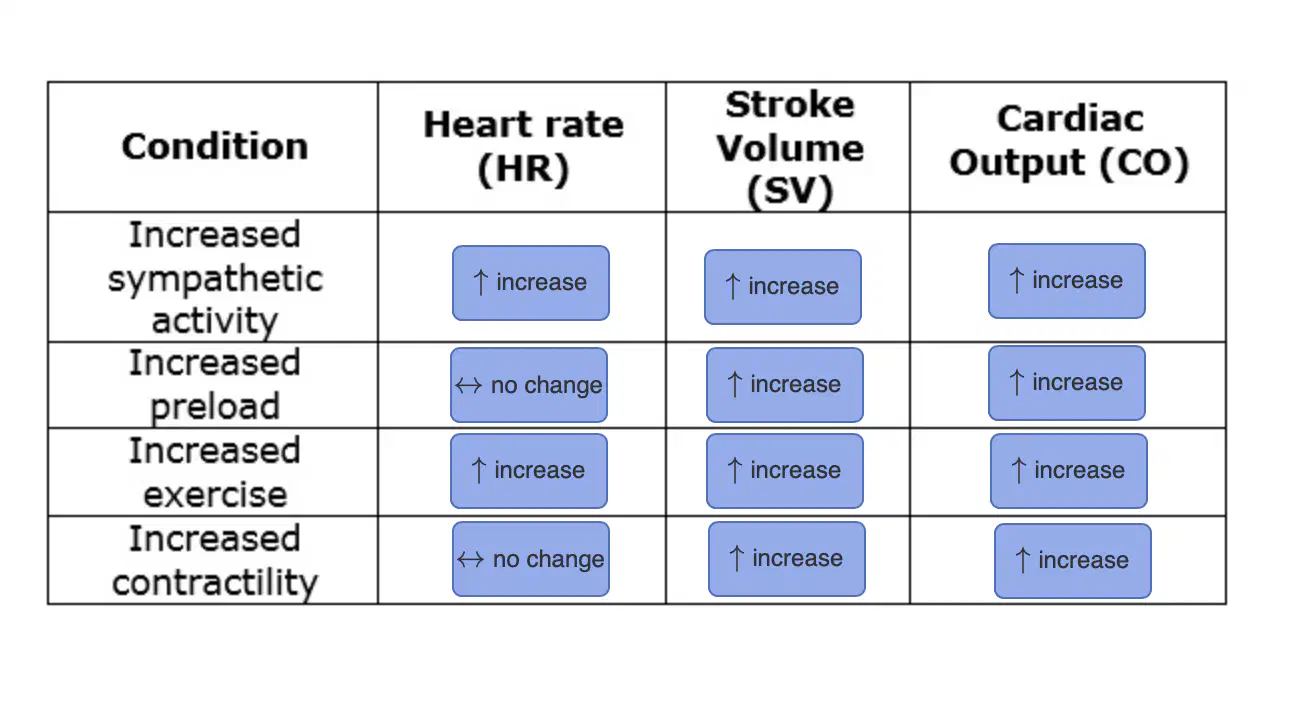
Answers to calculate Cardiac Output when given the Heart Rate and Stroke Volume. Type "Yes" when done
(a)
Which layer of the typical blood vessel is constructed from simple squamous epithelium?
tunica externa
tunica media
tunica intima
Which layer of the typical vessel can be regulated to constrict or dilate the lumen?
vasa vasorum
tunica intima
tunica externa
tunica media
Which type of vessel is most suited to expanding and recoiling in response to the ejection of blood from the heart?
large veins
muscular artery
arteriole
elastic artery
What type of vessel has a relatively large amount of smooth muscle compared to its elastic tissue?
muscular artery
arteriole
capillary
elastic artery
What type of vessel is capable of allowing the passage of gases and nutrients though its walls to nourish surrounding tissue?
arterioles
small veins
capillaries
venules
Which of the following form successively larger vessels that carry blood toward the heart?
capillaries
veins
arteries
venules
Large diameter, thick-walled arteries that are close to the heart and act as pressure reservoirs are called __________.
elastic arteries
muscular arteries
veins
arterioles
The most permeable capillaries, which contain fenestrations and large intercellular clefts, are called __________.
continuous capillaries
arterioles
sinusoid capillaries
fenestrated capillaries
Continuous capillaries are the most common capillaries in the body.
True
False
Permitting the exchange of nutrients and gases between the blood and tissue cells is the primary function of ________.
arteries
arterioles
veins
capillaries
Which of the following is true regarding veins?
Veins have smaller-diameter lumens compared to arteries.
Veins are more muscular than arteries.
Veins carry blood away from the heart, while arteries carry blood to the heart.
Veins have valves; arteries do not.
The velocity of blood flow is ________.
slowest in the capillaries because the total cross-sectional area is the greatest
slower in the arteries than in capillaries because arteries possess a relatively large diameter
in direct proportion to the total cross-sectional area of the blood vessels
slower in the veins than in the capillaries because veins have a large diameter
The adjustment of blood flow to each tissue in proportion to its requirements at any point in time is termed autoregulation.
True
False
Which of the following would reflect the typical net hydrostatic pressure (HP) at the arterial end of the capillary?
34 mm Hg
1 mm Hg
12 mm Hg
Reabsorption of fluid into the capillary takes place at the arterial end or venous end of the capillary?
arterial
venous
Which of the following is NOT a vasoconstrictor?
Angiotensin II
Antidiuretic hormone
Norepinephrine
Atrial natriuretic peptide
Which of the following CANNOT diffuse across a capillary wall to or from the surrounding interstitial fluid?
proteins
oxygen and carbon dioxide
lipid-soluble substances
monosaccharides and amino acids
Whereas diffusion is more important for solute exchange between plasma and interstitial fluid, bulk flow is more important for regulation of the relative volumes of blood and interstitial fluid.
True
False
An increase in blood viscosity will cause an increase in total peripheral resistance.
True
False
Which of the following is NOT an important source of resistance to blood flow?
blood viscosity
total blood volume
vessel length
vessel diameter
Which of the following would decrease total peripheral resistance to blood flow?
atherosclerosis
increasing blood vessel length
decreasing the hematocrit
vasoconstriction
Blood flow is ________ proportional to the difference in blood pressure. Blood flow is ________ proportional to the total peripheral resistance.
directly; inversely
directly; directly
inversely; inversely
inversely; directly
The influence of blood vessel diameter on total peripheral resistance is ________.
significant because resistance is inversely proportional to the fourth power of the vessel radius
insignificant because vessel diameter does not vary
the only factor that influences resistance
significant because resistance is directly proportional to the blood vessel diameter
Calculate the mean arterial pressure (MAP) for a patient whose systolic blood pressure is 120 mm Hg and diastolic blood pressure is 70 mm Hg.
50 mm Hg
87 mm Hg
95 mm Hg
120 mm Hg
What blood vessel experiences the steepest drop in blood pressure?
arteries
venules
capillaries
arterioles
What vessels sustain a drop in pressure from approximately 35 mm Hg to around 17 mm Hg?
veins
arterioles
elastic arteries
capillaries
Which of the following does NOT contribute to venous blood pressure?
constriction of smooth muscle around veins by the sympathetic nervous system
venous anastomoses
increased abdominal pressure during breathing
skeletal muscle activity
The pulse pressure is ________.
diastolic pressure plus 1/3 (systolic pressure plus diastolic pressure)
systolic pressure minus diastolic pressure
systolic pressure plus diastolic pressure
systolic pressure divided by diastolic pressure
Arteriolar blood pressure increases in response to all but which of the following?
rising blood volume
increasing heart rate
increasing stroke volume
falling blood volume
all of these
Where are arterial baroreceptors located: 2 spots
carotid sinus, aortic arch
I had to look this one up wasn't in the Pearson
Are you Ready for the test?
Yes
No
Maybe
A lil bit

